
An in-lab sleep study, or attended polysomnogram, records several body signals at the same time while you sleep. Those synchronized signals let a sleep specialist see when you were asleep, how you were breathing, whether oxygen levels changed, how your heart rhythm and muscles behaved, and which events occurred together.
A sleep technologist applies the sensors, checks that they work, and monitors the recording from a nearby control room. After the study, a technologist scores the data and a sleep physician interprets the findings alongside your symptoms, health history, medicines, and the reason the test was ordered 1 2.
First, the clinician chooses the right test
"Sleep study" is an umbrella term, not another name for every polysomnogram. The test should match the clinical question:
- Attended polysomnography (PSG) is the overnight laboratory test explained in this guide. It directly measures sleep and can evaluate breathing, movement, and some unusual behaviors during sleep.
- Home sleep apnea testing (HSAT) uses fewer signals and is designed for suspected obstructive sleep apnea in selected adults. It is not a general home version of PSG. Read our separate guide to an at-home sleep study.
- A split-night study begins as a diagnostic PSG. If the early recording meets the laboratory's clinical criteria and enough time remains, the second part is used to adjust positive airway pressure (PAP).
- A PAP titration study begins with PAP treatment and adjusts pressure while sleep and breathing are monitored. It may be a separate night. Our CPAP titration guide explains that process.
- A multiple sleep latency test (MSLT) consists of scheduled daytime nap trials, usually after an overnight PSG. It measures the tendency to fall asleep under standardized conditions and contributes to the evaluation of disorders such as narcolepsy and idiopathic hypersomnia.
- A maintenance of wakefulness test (MWT) measures the ability to remain awake during repeated daytime trials. It may inform treatment or safety decisions, but it is one piece of a clinical assessment rather than a stand-alone declaration that someone is safe to drive or perform a particular job 3.
For a broader comparison, see our guide to sleep-study types and uses.
The American Academy of Sleep Medicine recommends choosing PSG or HSAT for suspected obstructive sleep apnea as part of a comprehensive sleep evaluation. HSAT can be appropriate for certain uncomplicated adults, while PSG is preferred when the history raises concern about other sleep disorders or complicating conditions. A negative, inconclusive, or technically inadequate HSAT should generally lead to PSG rather than repeated guesswork from symptoms alone 2.
Before the night
The sleep center should send instructions for the specific study. Follow those instructions over generic online advice because preparation differs by test and clinical question.
Before the appointment, make sure the center knows about:
- prescription and over-the-counter medicines, supplements, alcohol, nicotine, cannabis, and other substances
- your usual caffeine intake and any medicine you take for sleep
- PAP, oxygen, an oral appliance, or another nighttime treatment you already use
- adhesive allergies, sensitive skin, scalp conditions, hairpieces, or a hairstyle that may affect electrode placement
- mobility, transfer, toileting, positioning, hearing, vision, communication, or sensory needs
- a child's need for a parent to stay, or an adult's need for an approved caregiver
Do not stop a prescription, change PAP use, or abruptly eliminate caffeine simply because a general article says to do so. Ask the ordering clinician or laboratory what to continue and what to change. Medication and caffeine planning is especially important before an MSLT because sedating, alerting, and REM-modifying substances can alter the result, and withdrawal can also distort it 3.
Many laboratories ask patients to avoid naps and alcohol on the day of an overnight study and to arrive with clean, dry hair without gels, oils, or heavy skin products. The center may also ask you to bring comfortable sleepwear, your medication list, and your PAP mask or equipment. Confirm the arrival time, morning release time, food policy, bathroom arrangements, and what you should bring 4.
If standard setup may be difficult, call before the study rather than waiting until bedtime. Ask what the facility can provide, such as an accessible room, help with transfers, extra setup time, a caregiver or parent accommodation, a quieter introduction to the sensors, or an alternative adhesive. Policies and equipment vary by center.
Arrival, setup, and signal checks
After check-in, the technologist reviews the order and usually asks about that day's naps, caffeine, alcohol, medicines, symptoms, and anything different from your usual routine. You change into sleepwear in a private room. The exact equipment depends on the order, so not every person receives every possible sensor.
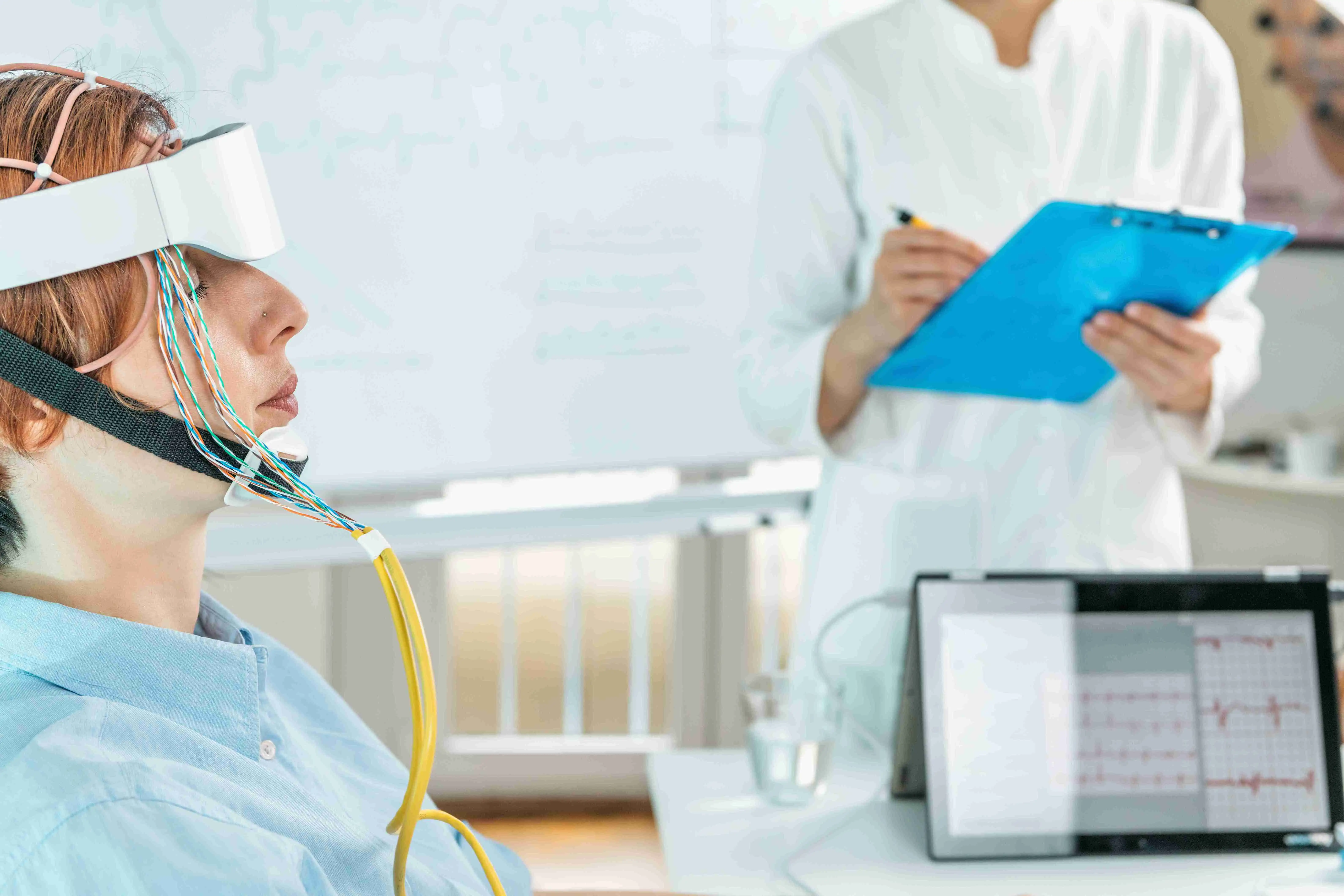
The standard setup uses small metal electrodes, soft belts, a finger sensor, and breathing sensors. The electrodes are attached with conductive paste, tape, or another adhesive. They do not send electricity into the brain or read thoughts. The setup is noninvasive, although pressure from a sensor or irritation from an adhesive can occur 5.
Once everything is connected, the technologist performs signal checks, sometimes called biocalibrations. You may be asked to open and close your eyes, look left and right, blink, clench your jaw, move your legs, take breaths, or briefly hold your breath. These actions create recognizable patterns so the technologist can confirm that the channels are recording the intended signals before lights out 1 6.
What the sensors measure
A polysomnogram is useful because the channels provide context for one another. An oxygen change means something different when airflow and breathing effort are visible. A leg movement means more when the record also shows whether it caused an arousal.
Brain waves, eye movements, and chin muscle tone
Electroencephalogram (EEG) electrodes on the scalp record electrical activity used to distinguish wake from sleep and identify sleep stages. Electrooculogram (EOG) electrodes near the eyes record eye movements. Chin electromyogram (EMG) electrodes record muscle tone.
Together, these channels help the scorer identify sleep onset, non-REM and REM sleep, and brief arousals. They do not, by themselves, diagnose ordinary insomnia or explain every reason someone feels that their sleep is poor.
Heart rhythm
Electrocardiogram (ECG or EKG) electrodes record heart rate and rhythm during the study. The channel helps show how the heart behaves around breathing events, arousals, and other sleep events. A sleep-study ECG is not a substitute for a full cardiac evaluation when a heart condition is suspected.
Airflow and breathing effort
Sensors at the nose and mouth detect airflow. Separate elastic belts around the chest and abdomen record breathing effort. Looking at flow and effort together helps the scorer distinguish a narrowed or blocked airway from an event in which breathing effort itself is reduced or absent.
Some studies add carbon dioxide monitoring when the question involves ventilation or hypoventilation. This is not part of every routine setup.
Oxygen and pulse
A pulse oximeter, usually placed on a finger, estimates blood oxygen saturation and pulse. It shows whether oxygen falls during a suspected breathing event, but oximetry alone cannot show sleep stage, airflow, or why an oxygen change occurred.
Leg movement
EMG sensors over the lower-leg muscles record movements during sleep. These signals can identify periodic limb movements and show whether they coincide with arousals.
Restless legs syndrome is different. It is defined by an awake experience, including an urge to move the legs that is worse at rest and typically worse in the evening or at night. There is no objective test that establishes RLS, so a normal or abnormal leg channel does not diagnose it on its own. Periodic limb movement disorder also requires clinical symptoms and exclusion of other explanations, not merely a movement count 7.
Position, sound, and video
A position sensor records how much of the study occurred on the back, side, or another position. A microphone may record snoring and other sounds. Low-light video helps the physician place movements, vocalizations, or unusual behavior in context. The laboratory should explain its audio and video practices and how recordings are handled.
What happens after lights out
When you are ready, the technologist completes final checks and turns off the lights. The wires are gathered with enough slack for normal position changes. You are not expected to remain motionless or sleep flat on your back for the entire night unless the laboratory gives a specific instruction.
The technologist watches signal quality and the audio-video feed from the control room. If an electrode loosens or a signal becomes unreliable, the technologist may enter the room to repair it. The purpose is to protect the recording, not to judge how neatly you sleep.
If you need the bathroom, call or speak to the technologist. Some leads can be disconnected from a central connection so you can get up safely, and the technologist reconnects them when you return. Do not try to walk away while attached 4.
A diagnostic PSG usually remains observational. PAP is not automatically started in every study. During a planned split-night protocol, PAP may begin only if the early diagnostic portion provides the information required by the laboratory's protocol and enough time remains for useful titration. If those conditions are not met, a separate titration night may be considered 2.
What happens in the morning
At the scheduled end time, the technologist wakes you and removes the belts, cannula, oximeter, tape, and electrodes. Paste or adhesive may remain in the hair or on the skin until it is washed away. Mild temporary skin irritation is possible. Tell the technologist if removal hurts or the skin looks unusually irritated 5.
You may complete a questionnaire about how the night compared with sleep at home. The technologist can explain the checkout process but usually cannot give a diagnosis at the bedside. The full recording still has to be scored and interpreted.
How the recording becomes a report
Scoring is a structured review of the synchronized data. A trained technologist identifies sleep stages, arousals, breathing events, oxygen changes, limb movements, and other ordered measurements according to the laboratory's scoring rules. The interpreting physician then reviews the scored study, raw signals, technical notes, and relevant history 1 6.
If obstructive sleep apnea is part of the question, the report may include the apnea-hypopnea index (AHI). For PSG, this is the number of scored apneas and hypopneas divided by the hours actually scored as sleep. The EEG, EOG, and chin EMG channels allow PSG to measure that sleep time.
Many home sleep apnea tests cannot directly determine sleep versus wake. They may calculate a respiratory event index using monitoring or recording time instead. That denominator can differ from total sleep time, so a laboratory AHI and a home-test index should not be treated as perfectly interchangeable numbers 2 6.
A responsible interpretation looks beyond one index. Depending on the question, the physician may consider:
- whether events clustered in REM sleep or a particular body position
- the type and duration of breathing events
- arousals, oxygen patterns, carbon dioxide, and heart rhythm
- periodic limb movements and whether they disrupted sleep
- sleep timing, stages, and how much usable sleep was recorded
- audio-video findings and technologist observations
- medicines, treatment use, symptoms, and technical limitations
What if you sleep less than usual?
Sleeping poorly in the laboratory is common and does not automatically make the study useless. A complete eight hours is not a universal requirement. Whether the study is adequate depends on the question and the data obtained.
For example, a study may capture clear repetitive breathing events despite a shorter night. In another case, too little sleep, extensive signal loss, or no sleep in a clinically important stage or position may leave uncertainty. The physician should account for those limits rather than assume that every awakening is harmless or that any amount of recording is sufficient.
A repeat or different test may be appropriate when:
- an important sensor failed for a substantial part of the night
- too little interpretable sleep was captured to answer the question
- a negative result does not fit a strong, continuing clinical suspicion
- a treatment needs separate titration or objective follow-up
- the original test answered one question but symptoms suggest another condition
For suspected obstructive sleep apnea, AASM guidance says a second PSG can be considered when the first PSG is negative but clinical suspicion remains. It also recommends PSG after a negative, inconclusive, or technically inadequate HSAT 2.
Our separate guide explains the practical options if you are worried that you cannot sleep during a sleep study.
What an attended PSG can and cannot tell you
PSG can provide strong objective evidence about sleep-related breathing, oxygenation, sleep stages, arousals, periodic limb movements, and selected nighttime behaviors. With the appropriate montage and clinical context, it can contribute to evaluating sleep apnea, hypoventilation, periodic limb movement disorder, parasomnias, or events suspected to be seizures 6.
It is not a universal explanation for fatigue, unrefreshing sleep, or every nighttime awakening. One laboratory night cannot show every night-to-night pattern. It also does not directly diagnose RLS, and PSG is not routinely required to diagnose chronic insomnia. Those conditions depend heavily on the person's history, timing, symptoms, and other clinical information 7 6.
A technically normal PSG therefore does not mean that symptoms are imaginary or that the evaluation is over. It means the measured signals did not establish the suspected abnormality under the conditions recorded. The next step may be a review of sleep opportunity and schedule, medicines, medical or mental health conditions, circadian timing, another sleep disorder, or whether a different test is needed.
Getting and discussing the result
Turnaround time varies by center. At follow-up, ask the interpreting clinician:
- Did the study collect enough usable sleep and technically sound data?
- Was there enough REM sleep and sleep in relevant positions for the question being asked?
- What did the study establish, and what did it rule out less confidently?
- Were any findings likely incidental rather than an explanation for symptoms?
- Does the result fit the clinical history?
- Is treatment, another test, or observation the next step?
The value of a sleep study comes from that connection between the recording and the clinical question. The sensors produce measurements. Careful interpretation determines what those measurements do, and do not, mean for the person who slept under them.