
Most adults should not treat mouth taping as a routine sleep habit or a do-it-yourself treatment for snoring, dry mouth, or sleep apnea. The research is small, short, and limited to selected groups. It has not established a taping product or method that is safe and effective for the general public 1.
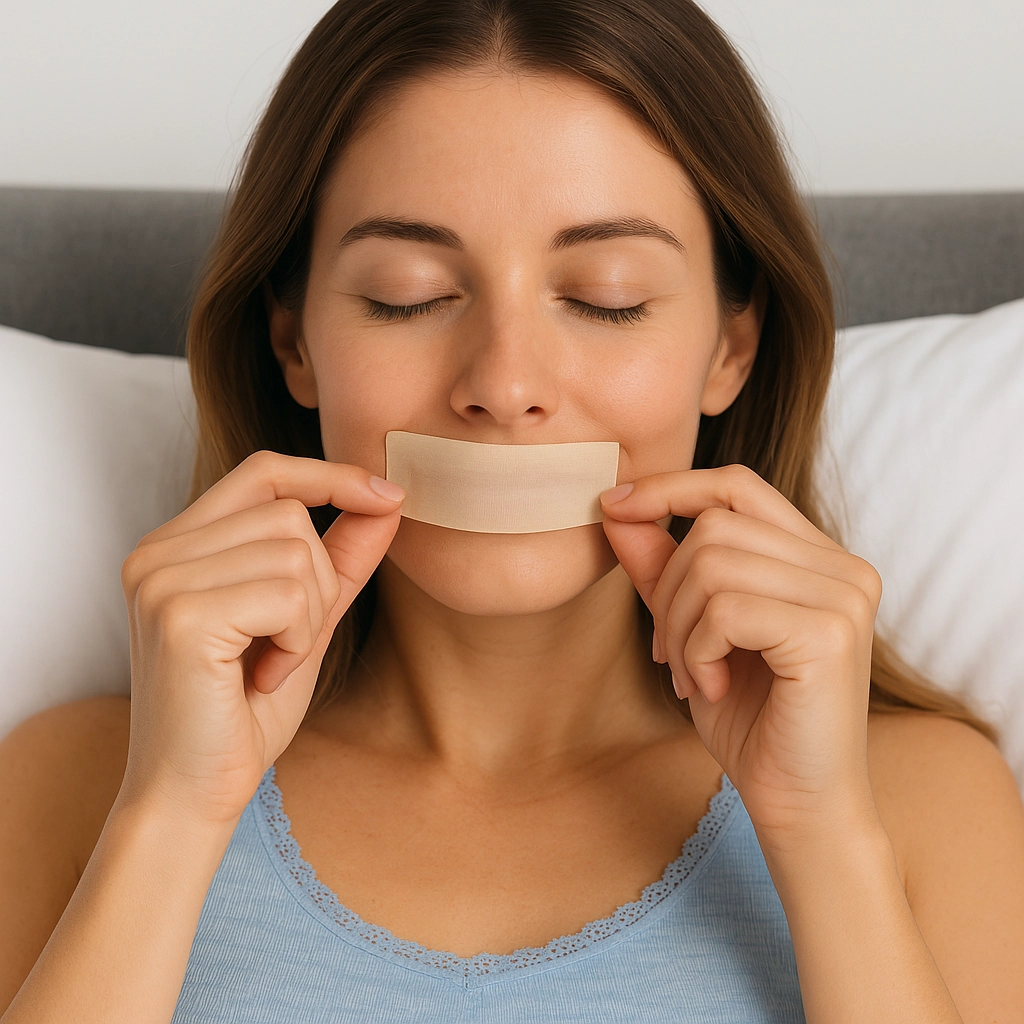
Mouth taping means using an adhesive strip or patch to restrict opening of the lips during sleep. It is intended to reduce oral airflow, but it does not show why a person is breathing through the mouth. Nasal blockage, rhinitis, airway anatomy, dry mouth, air leaking from PAP therapy, and obstructive sleep apnea can each require a different response 1.
What the research actually found
A 2025 systematic review found 10 studies of oral tape, sealing devices, patches, or chinstraps in people with mouth breathing or sleep-disordered breathing. Across all studies there were 233 participants, individual studies included 9 to 71 people, and the reviewers rated every study as poor quality. The products, populations, comparison conditions, and outcomes differed too much for a pooled analysis 1.
Some studies reported changes in snoring, the apnea-hypopnea index (AHI), oxygen desaturation, mouth leak, or arousals. Others found no significant change. These measures are not interchangeable: less snoring does not prove that breathing events stopped, less mouth leak during PAP does not show that tape treats sleep apnea, and a lower AHI does not by itself establish better daytime function or long-term health 1.
The mild sleep apnea studies were narrow
Two often-cited studies involved selected adults with mild obstructive sleep apnea and observed mouth breathing. One followed 20 people using a particular silicone tape for one week. The other tested a specific porous oral patch in 30 people. Both reported lower median AHI and snoring measures, but neither was a large randomized trial. They excluded or managed several factors that are common outside a study, including nasal obstruction and particular anatomical or health conditions 23.
Those findings may justify more research. They do not show that any tape will help an untested adult who snores, breathes through the mouth, or has undiagnosed sleep apnea.
Closing the mouth can affect different airways differently
A 2024 nonrandomized study examined 54 adults with OSA during drug-induced sleep endoscopy. Investigators closed the mouth for alternating breaths while measuring airflow. Airflow improved in people with moderate oral airflow, did not clearly change in people with almost none, and worsened in the group with the most oral airflow. Velopharyngeal obstruction, meaning blockage behind the soft palate, was linked to the negative response 4.
This was a short physiological maneuver, not a trial of sleeping at home with tape. It still matters because it shows why mouth breathing can be a route around an obstruction for some people. Forcing the lips closed is not automatically beneficial, even when nasal breathing is usually desirable.
PAP mouth leak is a separate clinical situation
A 2025 randomized crossover study involved 62 adults who already had diagnosed OSA, used CPAP, and breathed through the mouth during treatment. Thirty days with silicone tape improved CPAP use and several reported symptoms compared with CPAP without tape. The intervention was an addition to CPAP, not a replacement for it 5.
An older study of nine people receiving long-term nasal bilevel ventilation also found that taping reduced leak and arousals. Most participants had elevated carbon dioxide, and the authors specifically did not recommend indiscriminate long-term home use because of risks involving nasal obstruction, equipment failure, or regurgitation 6.
Results from people using prescribed PAP or bilevel ventilation cannot be transferred to someone taping their mouth without respiratory treatment. They also do not establish that a person using PAP should add tape without reviewing the leak and airway with the treating team.
What mouth tape has not been shown to do
The nose warms, filters, and humidifies incoming air, and the route of breathing can affect upper-airway mechanics. Those physiological facts do not prove that forcing the lips closed improves sleep or health 1.
Current mouth-taping research has not established improvements in:
- sleep stages or sleep quality in the general population * memory, concentration, or other cognitive performance * blood pressure or cardiovascular outcomes * dental health, cavities, gum disease, or bad breath * facial shape, jawline, or facial development * ADHD symptoms in adults or children
The small bilevel study reported a change in REM sleep while treating a very specific group with assisted ventilation. That result cannot establish a sleep-stage benefit for a healthy adult or for mouth tape used alone 6. The systematic review did not find evidence supporting the broader claims commonly made for routine mouth taping 1.
Mouth breathing is a symptom, not a diagnosis
A mouth that opens during sleep can reflect temporary congestion, allergic or chronic rhinitis, a deviated septum, enlarged tissue, another anatomical narrowing, or an airflow route around blockage behind the palate. Mouth opening during nasal PAP can instead be a treatment leak. Dry mouth can come from mouth breathing, but it can also result from medicines, salivary-gland problems, autoimmune disease, diabetes, cancer treatment, or other causes 17.
Snoring, witnessed breathing pauses, gasping, and persistent daytime sleepiness can point to sleep apnea. Tape cannot diagnose the condition, and quieter snoring after closing the mouth would not prove that the obstruction or oxygen changes have resolved 8.
Mouth tape is not an established treatment for OSA. It should not replace prescribed PAP or an oral appliance. Both treatments require diagnosis, selection, fitting or setup, and follow-up appropriate to the individual 910.
Why a universal "safe method" cannot be given
Research has not established one safe adhesive, porous patch, vent, partial strip, placement, daytime trial, wear time, or removal method for everyone. The studies used different products and excluded different risks. Passing an awake nose-breathing test would not show how the airway will behave in every sleep stage or position 14.
Safety is particularly uncertain when a person has:
- blocked or unreliable nasal airflow from congestion, rhinitis, or anatomy * vomiting, reflux with regurgitation, or another aspiration concern * reduced arousal from alcohol, sedating medicines, or another substance * a condition affecting alertness, hand control, cognition, or the ability to remove tape * irritated, injured, infected, or allergic skin or lips * panic, trauma-related distress, anxiety, or claustrophobia around restricted breathing
The studies commonly excluded nasal obstruction, and some excluded adhesive allergy, tape intolerance, sedative use, or other conditions. Several study authors raised concern about nasal obstruction or regurgitation, but the available research cannot estimate how often serious harm occurs 1.
No included study established that mouth taping is safe or effective for children. A child may also be less able to remove tape or communicate breathing distress. Nighttime mouth breathing in a child should be assessed for its cause rather than managed with tape 1.
An OSA diagnosis does not mean every person will be harmed by mouth closure. The PAP study found a possible supervised use in one selected context, while the airflow study found both positive and negative responses. That variability is the reason tape should not be used to self-treat or screen for OSA 54.
Better next steps for the problem you are trying to solve
If your nose feels blocked
Ask a primary care clinician or ear, nose, and throat specialist to identify the cause when blockage is persistent, recurrent, or affecting sleep. Rhinitis and structural narrowing do not have the same treatment. Avoid using tape to force nasal breathing through an airway that does not feel reliably open 1.
If air leaks through your mouth during PAP
Keep using prescribed PAP unless your clinician tells you otherwise. Ask the sleep team to distinguish mouth leak from leak around the mask, review fit and pressure, address nasal symptoms, and consider heated humidification or a different interface. An American Thoracic Society workshop report recommends individualized troubleshooting and notes that a full-face interface may be considered when oral leak remains significant 11.
The 2025 tape study suggests that a clinician may sometimes consider mouth tape as an addition for a selected CPAP user. It does not provide a general instruction for choosing or applying tape 5.
If dry mouth is the main problem
Persistent dry mouth deserves medical and dental review because mouth breathing is only one possible cause. Reduced saliva can increase tooth decay and oral infection risk. A dentist or clinician can review medicines, health conditions, saliva, oral tissues, and appropriate symptom relief 7.
If snoring or poor sleep is the concern
Seek a sleep evaluation for loud habitual snoring, witnessed pauses, gasping or choking, morning headaches, or daytime sleepiness. A sleep study, when indicated, can determine whether breathing events are present and guide treatment 8.
If OSA is diagnosed, PAP is a standard treatment. A custom oral appliance may be appropriate for some adults who prefer it or cannot tolerate CPAP, with qualified dental fitting and sleep follow-up. Mouth tape should not replace either treatment 910.
When breathing trouble is an emergency
Remove anything covering the mouth if breathing becomes difficult. Call emergency services for severe or sudden trouble breathing, confusion, loss of consciousness, or blue or gray lips or skin. If a person is unresponsive and not breathing normally, call emergency services and follow dispatcher instructions for immediate care 12.
Mouth breathing, snoring, dry mouth, and PAP leak are problems worth addressing. The safest route is to identify which problem is present and treat its cause rather than covering the symptom with tape.