
There is no universally best way to sleep with lower back pain. Back, side, stomach, and a supported reclined position are all reasonable starting points if they let you settle and do not worsen your symptoms. A pillow under the knees, between the legs, or under the pelvis is a comfort experiment, not a way to put every spine into one medically correct shape.
That distinction matters because the position evidence is much thinner than common advice suggests. A 2025 systematic review found only six observational studies of sleep posture and lower back pain 1. Those studies reported associations favoring supine or supported side-lying positions over prone sleeping, but they did not randomly assign people to positions. They cannot establish that a posture caused, prevented, or relieved pain, and they do not justify forcing yourself out of the only position in which you can sleep 1.
For tonight, choose the least aggravating position, change one support at a time, and reassess how you sleep, how you feel on waking, and what you can do the next day.
First, notice what kind of pain you have
Most uncomplicated lower back pain is described as nonspecific, meaning an examination cannot identify one precise structure as the cause. That is different from saying the pain is not real. It means that a mattress, a sleeping posture, or a scan cannot usually explain the whole experience 2.
A localized ache, stiffness, or pain that changes with movement can often be managed with a comfortable night setup while you remain active during the day. Pain that travels into a buttock or leg, especially with tingling or numbness, may reflect an irritated nerve root, often called radicular pain or sciatica. A position that is comfortable for local back pain can aggravate leg symptoms, so use the leg symptoms as part of your decision rather than following a generic pillow diagram 2.
New or progressive weakness, numbness around the genitals or anus, or a change in bladder or bowel control is not a positioning problem. Those symptoms need emergency assessment 2.
Pain that lasts longer than three months needs a wider plan than changing sleep posture. World Health Organization guidance for chronic primary lower back pain emphasizes individualized, person-centered care and a combination of suitable physical, psychological, educational, and sometimes medicine-based approaches rather than a single device or routine 3.
Choose a starting position for tonight
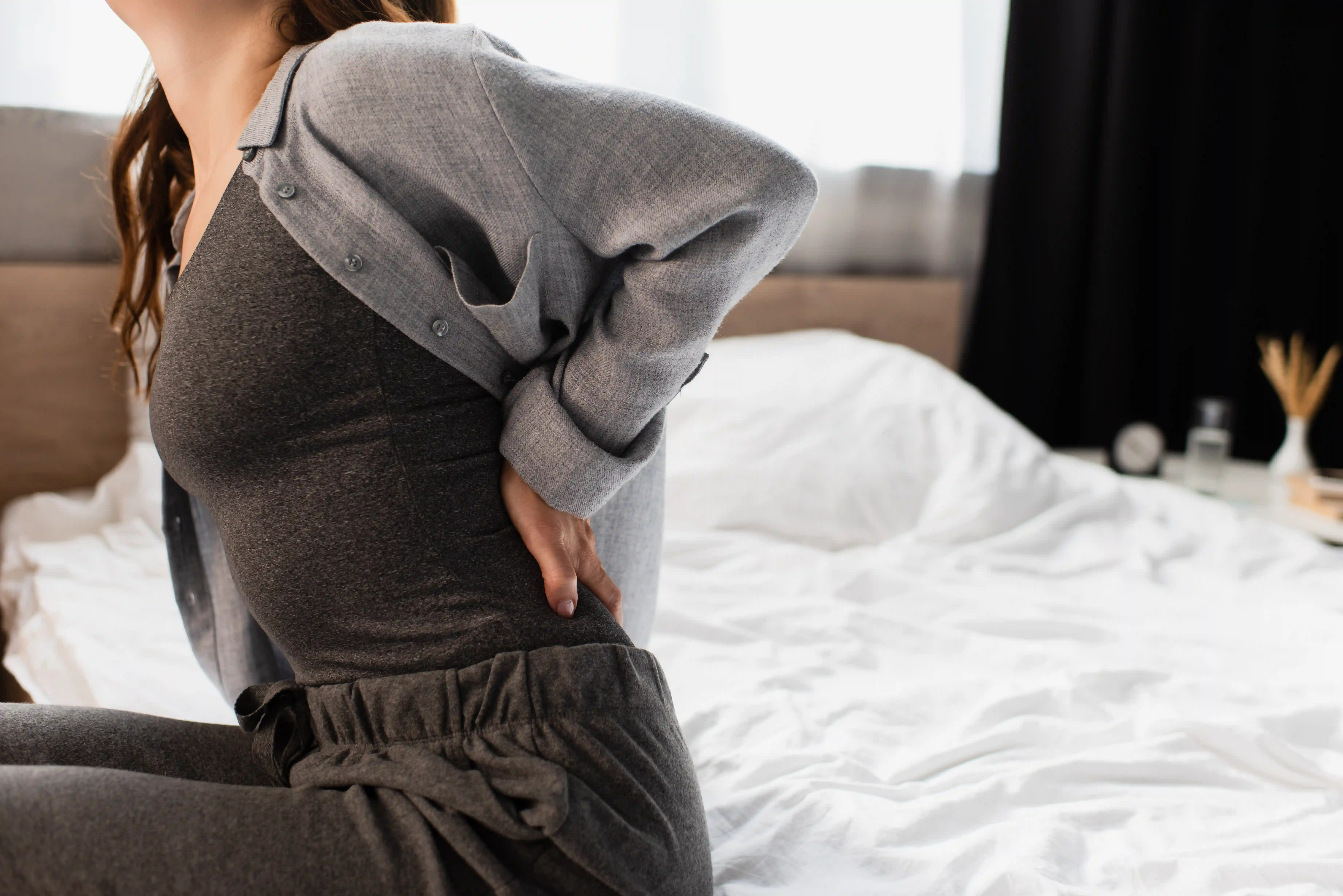
These are options, not rankings. Stay with a familiar position if it is the only one in which you can settle. If none is tolerable, a clinician or physical therapist can help work out whether leg symptoms, hip or pelvic pain, pregnancy, surgery, or another condition changes the plan.
On your back
Lie on your back with your legs straight first. If the lower back feels tense or unsupported, try one pillow or a folded blanket under both knees. Keep it only if it reduces symptoms and helps you relax.
Do not treat a visible curve beneath your waist as a defect that must be flattened. The goal is comfort, not a prescribed amount of spinal curvature. If raising the knees worsens pain down a leg, remove the support and try a different position.
On your side
Use whichever side feels better, with the knees slightly bent or more extended. If the upper leg pulls the pelvis forward or the knees press uncomfortably together, place a pillow between the thighs or knees. A pillow can reduce strain for some people, but no good evidence establishes an exact thickness, knee angle, or side for lower back pain.
If symptoms travel down one leg, compare sides instead of assuming you must lie on the painful or painless side. Stop an adjustment that increases tingling, numbness, or leg pain.
On your stomach
Stomach sleeping is not automatically damaging, and a person who sleeps well this way does not need to abandon it because of an alignment rule. If it aggravates your lower back, try a thin support beneath the lower abdomen or pelvis, or test another position. Remove the support if it creates more pressure or discomfort.
Your head pillow also has to work for your neck and breathing. Do not make the neck uncomfortable to create a theoretical benefit for the lower back.
In a supported reclined position
A bed with an adjustable base or a stable recliner can be a temporary option if lying flat is intolerable. Raise the torso and support the knees only as much as feels comfortable. Make sure you can stand up safely, keep the controls within reach, and do not sleep in an unstable chair or improvise elevation with loose stacks that can shift.
A reclined position can help someone rest through a flare, but it does not diagnose the cause or repair an injured structure.
Test one change instead of rebuilding the whole bed
When several variables change at once, you cannot tell what helped. Use this simple experiment:
- Start in the position you normally fall asleep in.
- Add or remove one pillow, folded blanket, or degree of elevation.
- Keep the change only if it feels at least as comfortable while you settle.
- The next morning, note pain on waking, leg symptoms, stiffness, sleep disruption, and your ability to walk, dress, and start the day.
- Repeat or reverse the change the following night.
This is a practical way to reduce guesswork, not a validated medical test. Symptoms naturally vary from day to day, so one unusually good or bad morning does not prove that a pillow fixed or caused the problem.
Turn over and get out of bed with less strain
Quick twisting or sitting straight up can be the most painful part of the night. A side-roll sequence can make the movement easier:
- Bend the knees only as far as comfortable.
- Roll the shoulders and hips toward the side together rather than twisting sharply at the waist.
- Move the lower legs over the edge of the bed.
- Push through the forearm and hands as the legs lower, then pause while seated before standing.
Reverse the sequence to get into bed: sit near the edge, lower onto one side using the arms, bring the legs onto the bed, then roll into the chosen position. NHS musculoskeletal guidance describes the same side-roll and arm-assisted approach for getting in and out of bed 4.
This is a comfort strategy, not a requirement to keep a healthy spine rigid. After spinal surgery, a fracture, or childbirth, follow the movement restrictions and technique given by your own clinical team. General spine-surgery discharge advice also puts the surgeon's instructions first 5.
If you cannot stand safely, a leg gives way, or movement brings on new weakness or numbness, get help rather than repeatedly forcing the maneuver.
Short-term comfort before bed
Heat or cold
A wrapped heat pack or hot-water bottle may ease stiffness or muscle spasm, while a wrapped cold pack may feel better after a fresh flare. NHS guidance includes both as symptom-relief options rather than cures 6.
Use whichever feels better, protect the skin, and stop if pain, redness, discoloration, or blistering increases. People with impaired sensation or circulation should ask a clinician before using either heat or cold 4. Follow the product instructions and do not fall asleep on an electric heating pad. The U.S. Consumer Product Safety Commission warns that a heating pad can cause serious burns even at relatively low settings and should be turned off before sleep 7.
The American College of Physicians guideline includes superficial heat among the initial non-drug options for acute or subacute nonradicular lower back pain 8. That supports a short comfort trial. It does not mean heat heals a disc, resolves sciatica, or should be left on all night.
Pain medicine
A medicine that reduces pain enough to let you move and sleep may be useful, but the right choice depends on the kind of pain, your health conditions, and the other medicines you take. Follow the label or your prescriber's instructions instead of using a universal bedtime dose.
NICE advises clinicians to consider an oral nonsteroidal anti-inflammatory drug, or NSAID, for lower back pain at the lowest effective dose for the shortest possible period, while weighing stomach, liver, kidney, heart, age-related, and interaction risks. It does not recommend paracetamol, called acetaminophen in the United States, on its own for lower back pain, and it does not recommend opioids for chronic lower back pain 9. Guidance and available medicines differ by country, so ask a pharmacist or clinician what is suitable if you are pregnant, older, take blood thinners, or have ulcers, kidney, liver, or cardiovascular disease.
Do not add a nighttime antihistamine, sleep aid, alcohol, or someone else's prescription just to make yourself unconscious. Muscle relaxants, opioids, sleep medicines, and some antihistamines can impair coordination and driving, sometimes into the next morning 10. If a medicine makes you drowsy, dizzy, confused, or unsteady, do not drive or operate equipment and contact a pharmacist or prescriber for advice.
What to do during the day
Resting for a short period when pain spikes is different from staying in bed for days. NICE recommends encouragement to continue normal activities as part of self-management 9. A Cochrane review of ten randomized trials found small benefits from advice to stay active rather than rest in bed for acute lower back pain; for sciatica, the two approaches made little or no difference, but bed rest did not provide a clear advantage 11.
Use manageable movement through the day, such as short walks and ordinary tasks broken into smaller pieces. Reduce or modify an activity that sharply escalates symptoms, but do not wait to be completely pain-free before moving at all. A clinician-directed exercise plan is more appropriate than a generic stretch list when pain is persistent, follows surgery or trauma, or travels into the leg.
There is no required bedtime stretch for lower back pain. A gentle movement you already know is safe is reasonable if it settles symptoms. Stop if it increases leg pain, tingling, numbness, or weakness.
Does the mattress need to change?
Do not assume a new mattress is the first treatment for a new flare. First check whether the surface has a visible, unloaded sag, whether the foundation or frame is damaged, and whether the mattress is being used on the support system its manufacturer requires. There is no evidence-based replacement age that applies to every mattress or every person with back pain.
The best-known firmness trial included 313 adults with chronic nonspecific lower back pain, pain while lying in bed or on rising, and no referred leg pain. After 90 days, the group given medium-firm mattresses improved more than the group given firm mattresses 12. That is a useful correction to the old rule that the firmest bed is always best, but it is not a prescription for everyone. It does not cover acute pain, sciatica, pregnancy, postoperative recovery, or every product sold as "medium-firm."
A later literature review found no common agreement on the optimal mattress design, noted that therapeutic marketing claims were not supported by enough evidence, and called for more research despite generally favorable findings for medium-firm surfaces 13. Material labels such as memory foam, latex, hybrid, and innerspring do not guarantee pain relief.
If the bed is clearly damaged or remains uncomfortable after the flare settles, compare surfaces by comfort, ease of turning and standing, sleep disruption, morning symptoms, and daytime function. A meaningful return or exchange period is more useful than a medical-sounding material claim.
Pain and sleep can reinforce each other
Lower back pain can delay sleep and wake you when you move. Poor sleep can also make pain feel harder to manage the next day. A systematic review and meta-analysis of prospective cohort studies found that sleep-related problems and chronic musculoskeletal pain predicted each other over time 14. The studies were observational, sleep was self-reported, and the results were highly variable, so the findings show a bidirectional association rather than proof that one bad night damages the back 14.
Deep sleep is not a treatment that repairs a painful back on a set schedule. The more useful goal is to reduce pain-related disruption while addressing persistent pain and persistent insomnia as related but separate problems. If poor sleep continues after the flare eases, or worry about sleep keeps you awake even when you can find a comfortable position, mention that at your appointment rather than continuing to add pillows or sedating products.
When lower back pain needs medical care
Most lower back pain is not an emergency, but a few symptom patterns should not wait for a mattress change or another night.
Call emergency services now for:
- new difficulty starting or controlling urination, urinary retention, or loss of bladder or bowel control
- new numbness around the genitals, anus, or inner thighs
- severe or progressive weakness or numbness in one or both legs, especially with bladder, bowel, or saddle sensory changes
- back pain after a serious accident, fall, or other major trauma
- sudden severe back or abdominal pain with fainting, collapse, clammy skin, dizziness, or a known aortic aneurysm
- back pain with chest pain
The bladder, bowel, saddle-sensation, and progressive neurological signs can indicate cauda equina or another serious nerve problem 2. Sudden severe back or abdominal pain with collapse can be a vascular emergency such as a rupturing abdominal aortic aneurysm 15.
Seek urgent same-day advice if pain starts severely and suddenly, is worsening quickly, or comes with fever, chills, or feeling generally unwell. Infection deserves particular attention if you are immunosuppressed, use injected drugs, recently had a significant infection, or have an indwelling catheter 26. New pain after a lesser injury also needs prompt assessment if you have osteoporosis, use corticosteroids long term, or are at higher fracture risk 2. Seek same-day advice as well for severe unrelenting pain that does not change with rest or position 16.
Arrange a routine clinical assessment if the pain is not starting to improve after a few weeks, repeatedly wakes you, limits ordinary function, travels down a leg, or comes with persistent numbness. Also arrange assessment for unexplained weight loss, a history of cancer with new back pain 26. Night pain alone does not diagnose cancer or infection, but it belongs in the full clinical picture.
During pregnancy, the sleep-position decision has an additional safety boundary. NICE advises going to sleep on either side rather than on the back after 28 weeks and says pillows may help maintain that position 17. If back or pelvic pain is new, severe, or concerning, contact the maternity team rather than treating it as ordinary lower back pain. After childbirth or an operation, use the position, lifting, and bed-mobility instructions from your own team because they take precedence over general advice here.