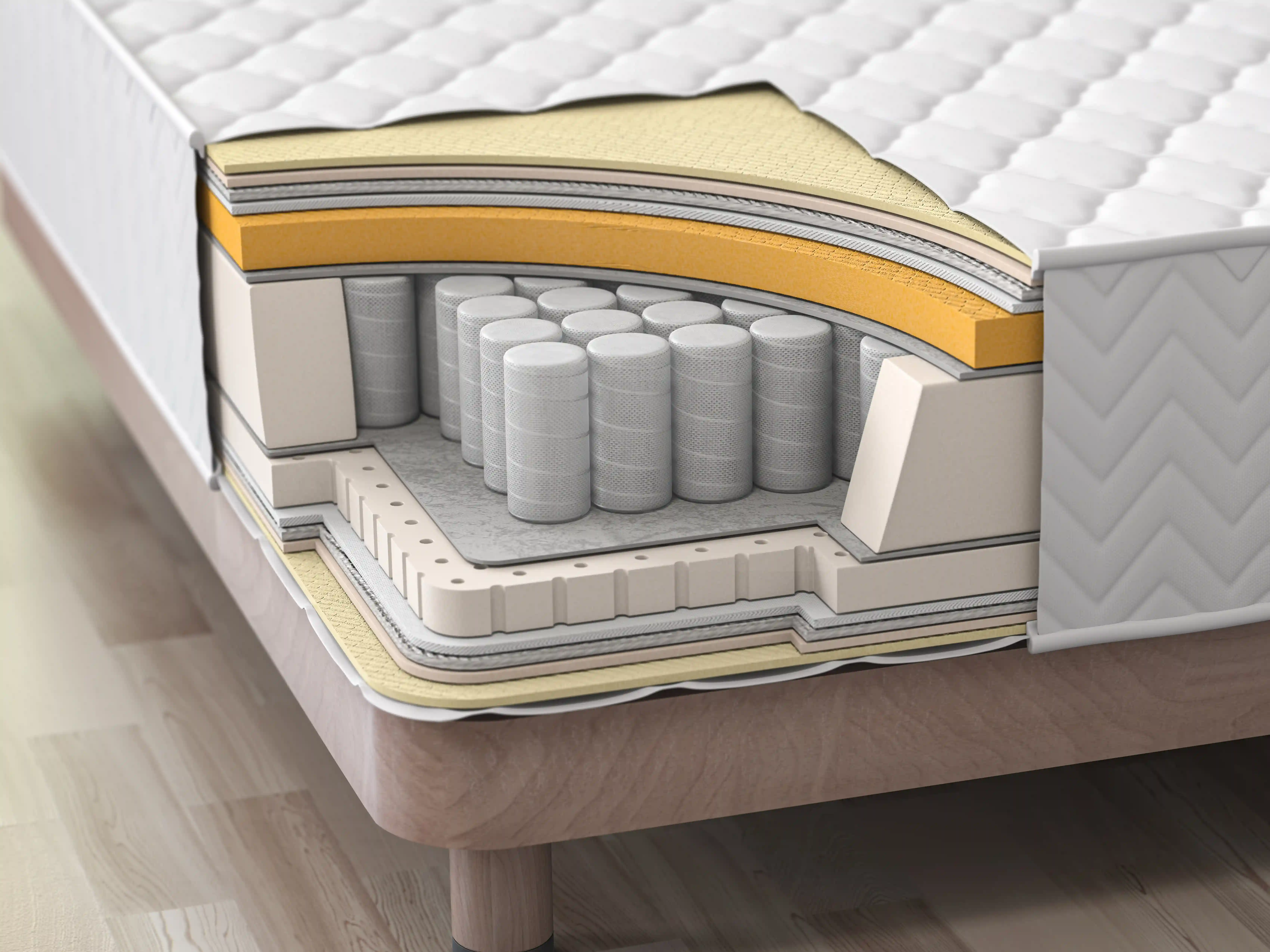
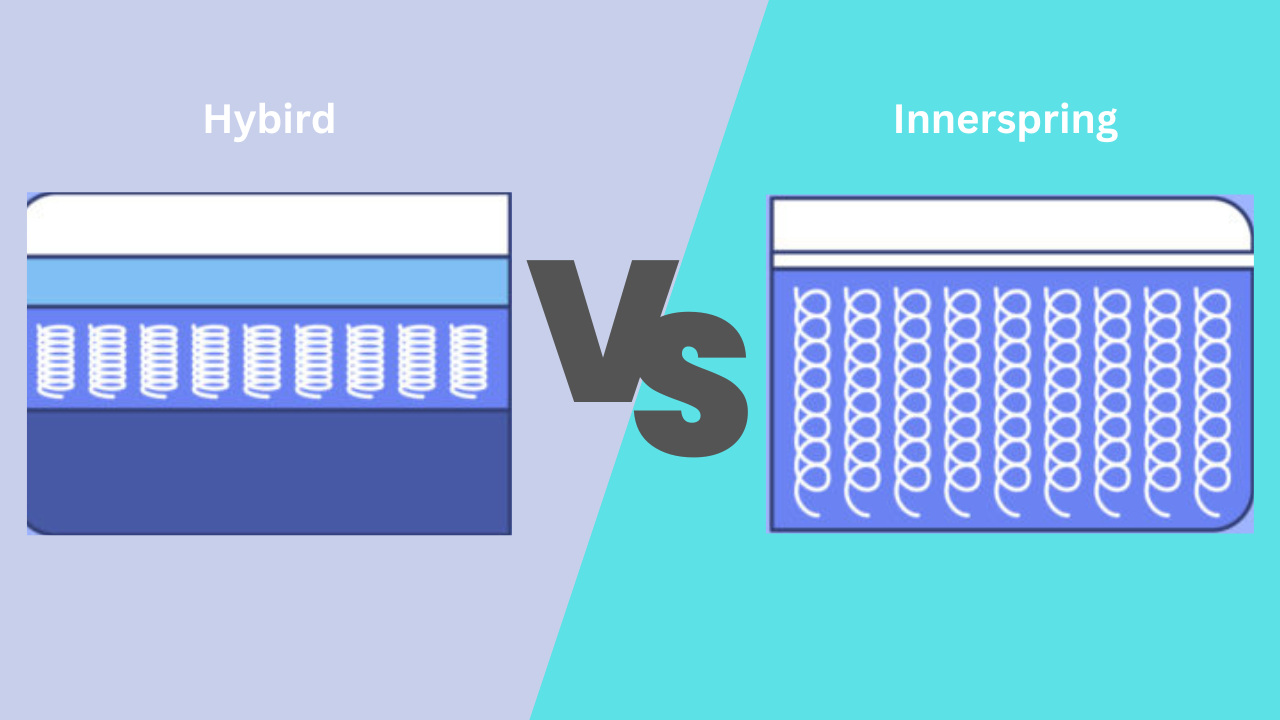
A hybrid usually has a coil support core beneath a more substantial comfort system made from foam, latex, fibers, microcoils, or a combination of materials. A traditional innerspring usually puts thinner upholstery over its coil unit.
That is a useful starting point, not a firm technical boundary. There is no industry-wide standard for what a manufacturer may call a hybrid, and products sold under the two labels can have very similar constructions 1. U.S. flammability rules define and label mattresses broadly, but they do not give shoppers a construction test that separates a hybrid from an innerspring 2.
The practical answer is to compare the two exact mattresses in front of you. The coil design, layers above it, finished feel, support requirements, and purchase terms matter more than the category printed on the product page.
Why hybrid and innerspring overlap
Both categories can use the same basic component: an innerspring unit. A U.S. International Trade Commission report identifies innerspring units as components used in both innerspring and hybrid mattresses 3.
In retail language:
- Hybrid commonly means a coil core paired with enough cushioning material for that upper system to be a prominent part of the feel.
- Innerspring commonly means a coil-led mattress with a thinner upholstered surface.
There is no universal foam thickness, coil height, material, or ratio that changes one into the other. Some hybrids feel deeply cushioned, while others feel spring-forward. Some products called innersprings have pillow tops or substantial foam layers. Treat the label as a clue, then read the layer-by-layer specification.
What to compare inside the mattress
| Part of the mattress | Variations you may find | Why it matters |
|---|---|---|
| Coil unit | Pocketed coils; connected Bonnell, offset, or continuous coils; full-size or smaller microcoils | Changes how movement spreads, how locally the surface responds, and how the support system is built |
| Coil design | Wire gauge, coil shape, turns, height, tempering, arrangement, and zoning | These details work together; no single number establishes firmness, support, or durability |
| Comfort system | Polyurethane foam, memory foam, latex, fibers, microcoils, or mixed layers | Influences surface cushioning, contouring, ease of movement, odor, and how much of the coil response you feel |
| Perimeter | Firmer coils, a border rod, foam rails, or no separate reinforcement | Can change sitting and lying support near the edge, but the result still needs to be tested |
| Cover and fire-protection system | Quilting, stretch or woven fabric, padding, and different barrier constructions | Affects the immediate surface feel and care instructions; ask for materials rather than inferring them from the category |
Pocketed versus connected coils
Pocketed coils are individually enclosed in fabric and joined through that fabric. Connected units link coils with wire or form rows from continuous wire. The USITC report notes that pocketed coils can move more independently and reduce overall mattress movement compared with interconnected springs 3.
That does not guarantee strong motion isolation. Thick, slow-responding comfort layers may absorb movement, while responsive layers may transmit more of it. Edge construction, mattress size, the bed frame, and the force of a partner's movement also affect what reaches the other side. If partner disturbance matters, test the complete mattress rather than buying on the phrase "pocketed coils" alone.
Gauge and coil count
Gauge describes wire diameter. In the common numbering system, a lower gauge denotes thicker wire, but gauge is only one part of the design 3. Coil shape, height, turns, tempering, zoning, and how the coils are joined also affect the unit.
A higher coil count is not a universal quality score. Counts change with mattress size, coil diameter, use of microcoils, and counting methods. Compare counts only when the mattresses are the same size and the manufacturer explains what is included. Even then, use the figure as one specification, not a prediction of comfort or service life.
Comfort layers
The materials above the coils often create the clearest difference between two models. More material does not automatically mean better material, and a thicker comfort system does not guarantee better pressure relief.
Look for:
- The type and thickness of each layer
- Foam density when the manufacturer publishes it
- Whether latex is solid, perforated, or zoned
- Whether a listed microcoil layer is part of the comfort system or the main support unit
- Quilting and fiber fill that may change the initial feel
- Whether the cover is removable and, if so, how it may be cleaned
If a specification lists only a proprietary layer name, ask what the material is and how thick it is. A trademark does not tell you how the mattress will feel or wear.
Which category feels better?
Neither category has one standard feel.
A mattress with thick conforming layers may allow more sink and reduce how much coil response reaches the surface. A model with thinner or more resilient upholstery may feel more buoyant. Either category can be soft, medium, or firm, and the same firmness label can feel different across brands.
Compare the experiences that matter to you:
- Cushioning: Does the surface relieve uncomfortable pressure without making it hard to turn?
- Movement: Can you change position and get out of bed comfortably?
- Partner disturbance: Do ordinary turns or getting into bed wake the other sleeper?
- Edge use: Does the perimeter feel secure enough for sitting, transfers, and your usable sleeping area?
- Temperature: Do the complete cover, comfort layers, protector, sheets, room, and bedding keep you comfortable?
- Noise: Does the assembled mattress and frame remain acceptably quiet when you move?
Coils create open spaces within a mattress, but that fact alone does not establish that a model will keep you cool or prevent sweating. The layers closest to the body, bedding, room conditions, humidity, medications, and health factors can all influence thermal comfort. Treat "cooling" as a model-specific claim to test, not a benefit guaranteed by either label.
Height, weight, odor, and price also vary by model. A hybrid is not necessarily heavier or more expensive than every innerspring. Check the finished dimensions, packaged and unpackaged weight, delivery method, setup requirements, and return logistics for the exact size you plan to buy.
Which lasts longer?
The category does not provide a dependable lifespan. Wear can begin in the comfort layers, coil unit, perimeter, cover, stitching, or support beneath the mattress. Load, use, rotation instructions, moisture, moving, and the bed base can also affect the result.
Avoid universal promises such as "hybrids last 8 to 10 years" or "more coils make an innerspring last longer." A warranty term is not an expected service life, either. Read what the warranty defines as a defect, how an indentation is measured, which bases qualify, and which costs or exclusions remain the owner's responsibility.
Judge replacement by condition and function. Persistent sagging, broken components, loss of support, or discomfort that continues after checking the frame and foundation are more useful signals than a fixed age.
Is one better for back pain?
Research does not show that hybrid mattresses as a category are better for back pain than innersprings.
In a randomized trial of 313 adults with chronic nonspecific low back pain, a medium-firm mattress produced better 90-day pain and disability outcomes than a firm mattress 4. The study compared two firmness levels, not hybrid and innerspring construction.
A systematic review found some support for subjectively rated medium-firm or self-adjusted mattresses, but it also described disagreement in the evidence and grouped together varied designs and outcomes 5. These findings cannot establish that coils plus a thicker foam layer treat back pain, correct spinal alignment, or suit every body.
If pain is part of the decision, focus on whether the complete mattress lets you rest and change position comfortably. Seek medical advice for new, worsening, or persistent back pain rather than relying on a mattress category as treatment.
A fast way to choose between two mattresses
1. Map the actual construction
Write down the type of coil unit, comfort-layer materials and thicknesses, perimeter design, finished height, and mattress weight. Mark any specification the seller will not disclose. This side-by-side map is more useful than comparing "hybrid" with "innerspring."
2. Test the complete feel
When possible, lie in your usual positions, turn over, sit near the edge, and get in and out of bed. For a shared mattress, have both sleepers test it together and create the kinds of movement that usually cause disturbance. A brief press with a hand cannot reproduce body weight or a full night of sleep, so pair an in-store trial with fair return terms.
Body size and sleep position can change how deeply a person compresses a mattress, but they do not create a universal category rule. Check the stated load rating and choose the model that gives each sleeper workable cushioning, stable support, and comfortable movement.
3. Verify the base and adjustable-bed rules
Do not assume that every innerspring needs a box spring or that every hybrid prohibits one. Support rules are manufacturer-specific. Sealy's current warranty, for example, calls for a firm, non-spring surface and sets its own slat and frame requirements 6. Saatva's warranty permits qualifying platforms but limits adjustable-base compatibility to listed mattress models and, for one model, a specific profile 7.
Read the exact mattress warranty and installation instructions for:
- Permitted foundation or box-spring types
- Maximum slat spacing and any minimum slat width
- Center-rail, leg, and weight-capacity requirements
- Adjustable-base compatibility for the exact model and height
- Whether a mattress and foundation are labeled or sold as a set
Our box spring guide explains the support types in more detail.
4. Read the trial, return, and warranty terms
Confirm when the trial begins, whether a minimum use period applies, who arranges pickup, and whether original delivery, return, exchange, or restocking charges are refundable. For the warranty, check indentation thresholds, required documentation, base exclusions, stain or damage exclusions, transport costs, and whether coverage is prorated.
A long trial is useful only if you can return the mattress under terms you accept. A long warranty is useful only for defects it actually covers.
5. Check labels and certification scope
U.S. mattress flammability rules require specific compliance and product-identification information, but the required label is not a complete ingredient list 2. Ask the manufacturer what is in the cover, comfort layers, adhesives, fire-protection system, and coil encasement if those details affect your decision.
Read certification claims narrowly. CertiPUR-US instructs sellers to make clear that its certification applies to eligible foam, not the entire mattress 8. For any other mark, look up the certificate or issuer's directory and check the exact product, component, test scope, and validity rather than treating the logo as proof of comfort, durability, or overall safety.
6. Plan for delivery and handling
Measure doorways, stairs, turns, bed height, and the support surface. Confirm whether the mattress arrives flat or compressed, whether it needs time before use, and who handles setup or removal. If lifting is difficult, delivery service and mattress weight may matter more than its category.
Bottom line
Choose between the two specific mattresses, not between two loosely defined labels. A hybrid commonly has a more substantial comfort system over coils, while a traditional innerspring commonly keeps that upholstery thinner. The dividing line is not standardized.
Compare the coil unit, every layer above it, the finished feel, dimensions, load rating, base rules, trial, return costs, and warranty. Those details can reveal meaningful differences. The words "hybrid" and "innerspring" alone cannot tell you which mattress will be more comfortable, cooler, quieter, more durable, or better for pain.