

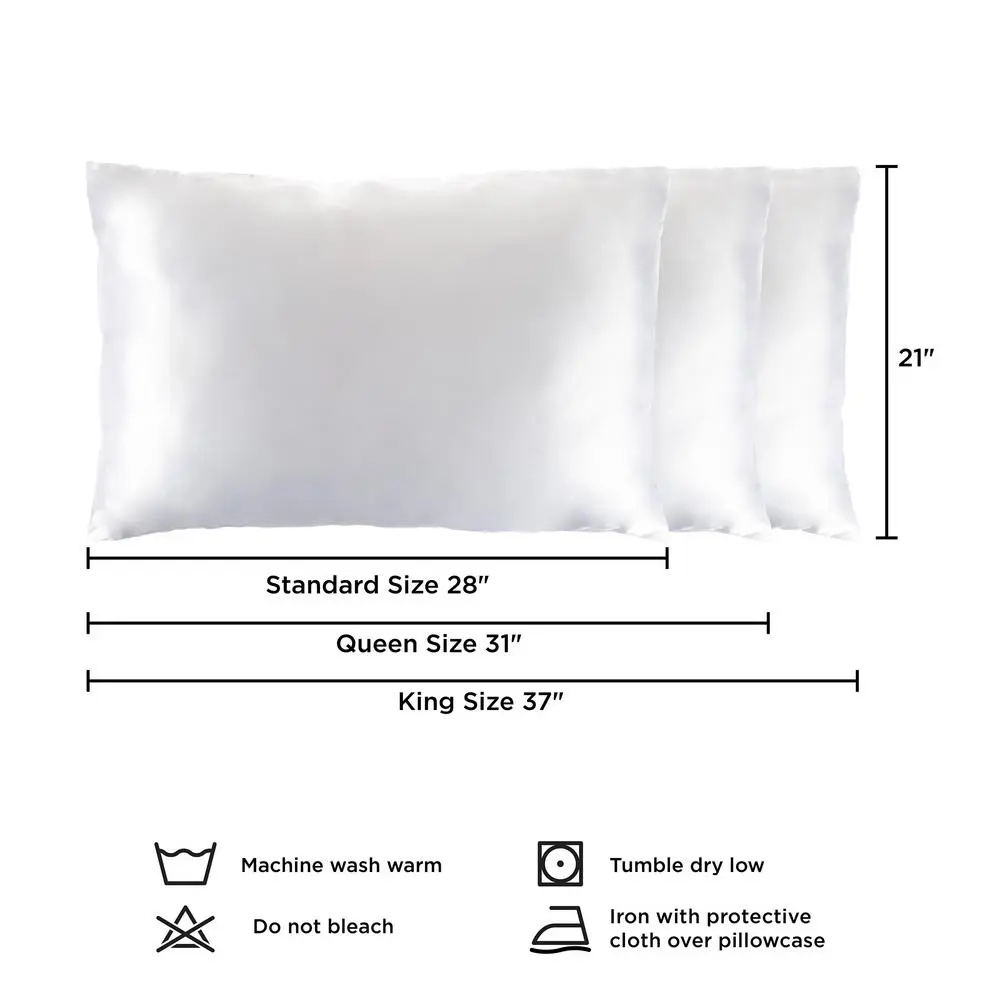
A pillowcase size label is a useful category, not a guarantee of exact dimensions. For a reliable fit, compare three pieces of information: the pillow's measured length and width, the case's finished dimensions, and the pillow dimensions the case is designed to fit. Then account for the closure, the pillow's fullness, and any protector beneath the case.
A familiar example shows why these measurements should stay separate. NIST Handbook 130 gives a model labeling example for a standard pillowcase designed for a 20-by-26-inch pillow with a finished case size of 20 by 30 inches. The pillow and case do not have the same length, even though both belong to the standard size category 1.
What pillowcase measurements mean
- Designed-to-fit dimensions describe the pillow insert the case is intended to cover.
- Finished dimensions describe the completed case laid flat, usually from seam to seam.
- Usable interior space is the space the pillow can actually occupy after seams, hems, closure overlaps, zippers, and decorative borders are considered.
- Pillow footprint is the insert's length and width. Its loft, gusset, contour, and fill volume are separate measurements.
NIST Handbook 130 is a collection of model laws and regulations that different authorities adopt in different forms. Its labeling language is useful because it distinguishes designed fit from finished size, but it does not establish one mandatory nationwide dimension for every standard, queen, or king pillowcase 1.
Standard, queen, king, Euro, and body labels
Common U.S. pillow insert reference sizes are 20 by 26 inches for standard, 20 by 30 inches for queen, and 20 by 36 inches for king. One current DOWNLITE pillow uses those three measurements, but other pillows and cases can differ 2.
| Case label | Common insert reference | What the label does not tell you |
|---|---|---|
| Standard | 20 by 26 inches | The finished case length, closure, or whether it also fits a queen insert |
| Queen | 20 by 30 inches | Whether queen is sold separately or grouped with standard |
| King | 20 by 36 inches | How much extra length is part of an open hem or closure |
| Euro | 26 by 26 inches | Whether the measurement is the insert cavity or includes a sham border |
| Body | No single universal size | The exact length, width, shape, closure, or model compatibility |
Current finished case dimensions show how much labels can vary:
| Manufacturer example | Standard case | King case | Construction detail |
|---|---|---|---|
| Parachute percale | 20.5 by 26.5 inches | 20.5 by 36.5 inches | Back envelope, side envelope, or side open options |
| Casper percale | 21 by 29 inches | 21 by 37 inches | Finished dimensions listed by the manufacturer |
| The Company Store brushed cotton | 20 by 30 inches | 20 by 40 inches | Traditional open end |
| L.L.Bean flannel | 20 by 32 inches | 20 by 40 inches | Product-specific shrink-resistance claim |
These examples are current product specifications, not a ranking or a universal chart 3456.
A queen pillowcase is not always a separate retail option. The cited Parachute and Casper products are sold in standard and king sizes, while The Company Store calls its 20-by-30-inch case standard. Since 20 by 30 inches is also a common queen insert footprint, read the designed-to-fit statement or ask the manufacturer which insert dimensions the case is intended to cover 345.
Euro and body cases
Euro cases are square and are often sold as shams or protectors rather than everyday open-end pillowcases. A current DOWN inc. zippered protector includes a 26-by-26-inch Euro Square option 7.
Body is a category, not one standard length. Saybrook Sleep lists a 20-by-54-inch body pillow protector, while The Company Store sells a zippered 20-by-72-inch cover designed for its body pillow. Other body pillows may be wider, curved, or U-shaped, so match the cover to the exact product dimensions and shape 89.
How closure type changes fit
Open-end pillowcases
An open-end case has an opening at one short side. Some of its listed length may be intended to extend beyond the pillow, so a finished case can be several inches longer than the insert it covers. The Company Store example lists a traditional open end with 20-by-30-inch standard and 20-by-40-inch king finished dimensions 5.
An open end is not automatically looser than every envelope case. Width, hem depth, fabric, and pillow fullness still matter.
Envelope closures
An envelope closure uses an overlapping fabric panel to hide or retain the pillow. The overlap occupies part of the case construction, so the outside dimensions alone may not reveal how much usable interior length remains. Parachute sells the same percale line with back-envelope, side-envelope, and side-open options, which shows why closure style should be checked alongside the size label 3.
Zippered cases and protectors
A zipper closes the opening rather than leaving a fabric tail. The zipper tape and end stops reduce usable space near the opening, and forcing a full pillow against them can strain the seam or prevent closure. DOWN inc. lists its zippered protectors at 20 by 26, 20 by 30, 20 by 36, and 26 by 26 inches for standard, queen, king, and Euro Square 7.
A zippered protector usually sits beneath the pillowcase. Its label and dimensions should be checked independently from the decorative case.
Shams and flanges
A sham is a cover that may have a back opening, decorative stitching, or a flange around the central insert cavity. The flange is the fabric border outside the pillow area. It should not be counted as extra room for the insert.
The Company Store's Beekman sham, for example, lists insert-area sizes of 20 by 26 inches for standard, 20 by 36 for king, and 26 by 26 for Euro, each with an additional 2-inch flange. This is a product-specific construction, but it illustrates why the cavity and outside dimensions must not be confused 10.
A measurement and fit workflow
1. Measure the pillow without its covers
Remove the case and protector. Let a compressed or adjustable pillow reach the configuration you actually use. Place it on a flat surface without pressing it down, then measure seam to seam across the short side and long side. Record the loft, gusset, or highest contour separately.
A soft, generously filled pillow and a flatter pillow can share the same nominal footprint but occupy a case differently. The length and width measurement cannot capture all of that volume.
2. Add the protector if you use one
Put the protector on and close it without forcing the zipper. Then check the assembled pillow's footprint and fullness again. The protector adds fabric, seams, and a closure beneath the case, so a fit that was comfortable on the bare insert may feel tighter once layered.
3. Measure the empty case
Lay the case flat and measure its finished width and length from seam to seam. Identify:
- the depth and position of an envelope overlap
- the zipper, end stops, or button line
- any open-end hem or inner flap
- the central cavity of a sham
- any flange, ruffle, piping, or other border outside that cavity
If a manufacturer lists both the finished size and designed-to-fit pillow size, use both. If it lists only one measurement, confirm whether that number describes the outside case, the usable cavity, or the intended insert.
4. Test the assembled fit
Insert the protected pillow and settle the corners without pulling hard on the fabric. The closure should work as designed. A case is probably too tight for this configuration if the zipper cannot close normally, the envelope pulls open, or the case strongly compresses a pillow that is not meant to be compressed. A very loose case may leave excess fabric or allow the insert to shift.
There is no universal rule that a case must be 1 inch, 2 inches, or any other fixed amount larger than the pillow. A workable allowance depends on the closure, seam construction, fabric, protector, insert fullness, and the fit you prefer.
Pillowcase fit is not the same as pillow support
A case can change how freely a soft pillow expands, but its size does not establish the pillow's loft, firmness, pressure response, or ergonomic suitability. A larger case does not make a pillow more supportive, and a fitted case does not prove that a pillow will improve alignment, pain, snoring, or sleep quality.
Choose the pillow for the feel and shape you need. Choose the case for compatible dimensions, construction, care, and surface preference. Treat those as related but separate decisions.
Contoured and model-specific covers
A rectangular standard, queen, or king case may fit poorly over a molded or contoured pillow even when one side measurement looks similar. The Tempur-Pedic Neck Pillow, for example, has an approximate 20-by-12.5-inch footprint in three sizes, with profile heights of 3.5, 4, and 4.75 inches. Its supplied removable cover follows that contour 11.
For a contour, crescent, cervical roll, U-shaped body pillow, or adjustable pillow with an unusual gusset, look for a cover made for the exact model. If using a generic case, compare the full shape and closure rather than matching one dimension.
Care, shrinkage, and returns
Follow the care instructions for the specific case. Current manufacturers do not give one universal wash setting: Casper instructs owners of its percale cases to use a warm normal cycle and low tumble dry, while The Company Store gives cold gentle washing and low drying instructions for its body cover 49.
Fabric can change with laundering, but the amount is product-specific. L.L.Bean describes its cited flannel cases as made to resist shrinkage. That claim should not be transferred to another cotton, linen, silk, synthetic, or blended case 6.
If you are replacing a case that has already been washed, measure its current dimensions. For a new case with a close fit:
- Read whether the listed dimensions are finished, prewash, or designed-to-fit measurements.
- Check the product's care directions and any shrinkage statement.
- Confirm the return policy before washing or sleeping on it.
Return rules can affect whether a fit trial is reversible. Parachute currently accepts eligible returns within 60 days, while Casper states that its pillowcases may be returned within 30 days if unused and in original condition. Terms can change, so verify the current policy for the exact item before altering or laundering it 34.
Frequently asked questions
Will a standard pillowcase fit a queen pillow?
It can, but not every standard case will. A common queen insert is 20 by 30 inches. Current standard cases range from 20.5 by 26.5 inches to 20 by 32 inches in the examples above. The closure and usable interior length determine whether the queen pillow remains covered and whether the case closes normally 36.
Can a king pillowcase cover a standard pillow?
A king case is generally long enough to contain a standard pillow, but it will leave extra fabric because the insert is shorter. Whether that is acceptable is a fit and appearance preference. Folding or tucking the unused length can also change where seams and fabric sit.
Is a pillow protector the same as a pillowcase?
No. A protector is an inner cover, often zippered, used beneath the pillowcase. The outer case is the removable surface layer. If you use both, size them separately and test the case over the protected pillow 7.
Does mattress size determine pillowcase size?
No. A mattress or sheet-set label may influence which cases are packaged together, but the case must fit the pillow, not the mattress. Check the set contents and case dimensions rather than assuming a queen sheet set includes a distinct queen pillowcase.
What case should I use for a body or contoured pillow?
Use the exact length, width, profile, shape, and closure specified for the model. Body, travel, pregnancy, roll, and contoured labels cover many different designs, so a category name alone is not enough 8911.