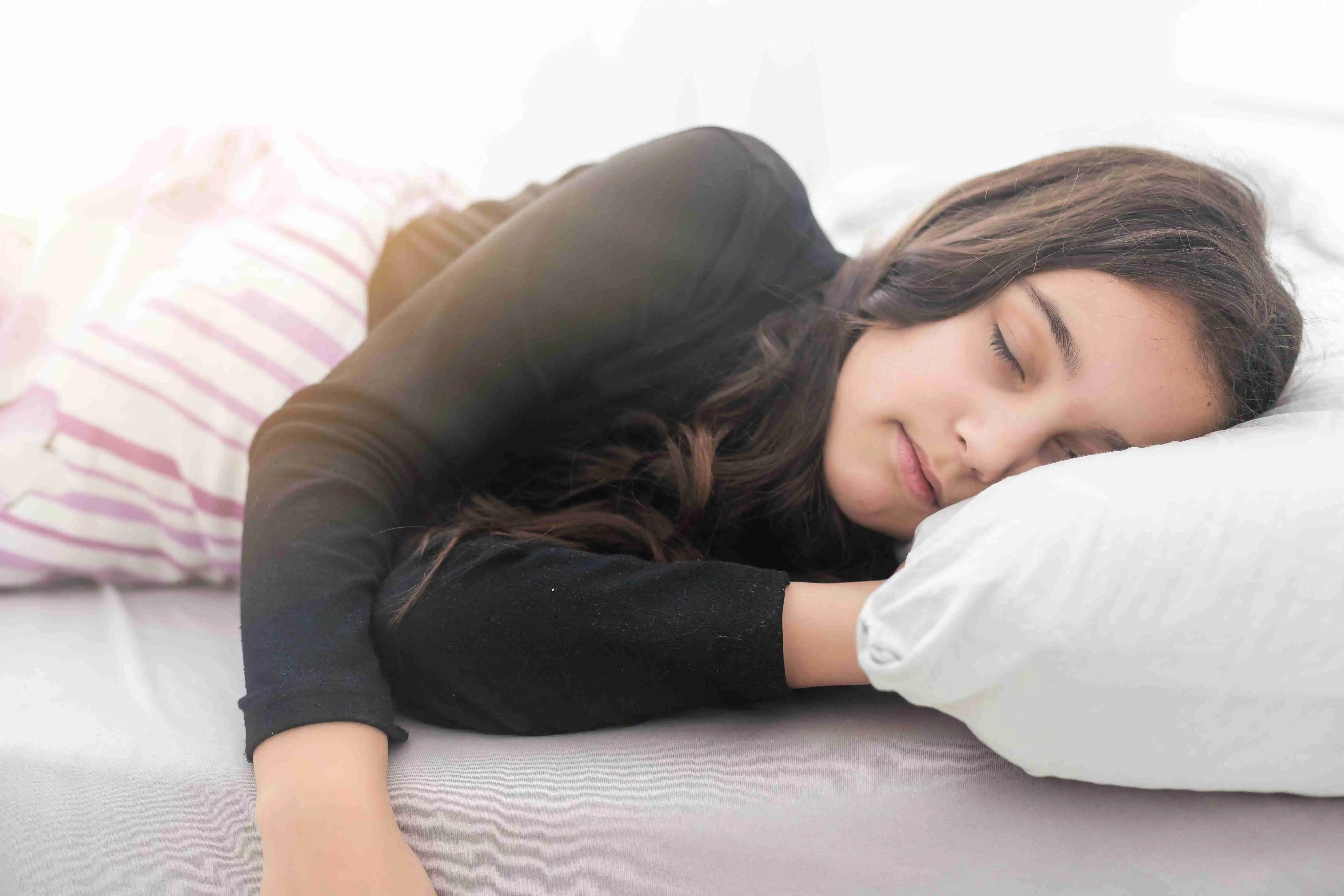

School-night sleep works best when a student has enough time to sleep, a schedule their body can follow, and no untreated problem repeatedly interrupting rest. The American Academy of Sleep Medicine recommends 9 to 12 hours per 24 hours for children ages 6 to 12 and 8 to 10 hours for teenagers ages 13 to 18 1.
These ranges describe healthy sleep opportunity, not a grade formula or a pass-fail target. Individual need varies, and duration is only one part of sleep health. Timing, regularity, sleep quality, and daytime alertness matter too. If a student regularly cannot stay awake in class, that should not be dismissed as laziness.
How much sleep opportunity does a student need?
Use the age range as a starting point:
- Ages 6 to 12: 9 to 12 hours per 24 hours
- Ages 13 to 18: 8 to 10 hours per 24 hours
Count backward from the required wake time to see whether the daily schedule leaves a realistic sleep window. Time in bed and time asleep are not identical, so the schedule needs some room for winding down and falling asleep. Children can need different amounts within the recommended range 1.
A single short night is different from a pattern. Look across ordinary school nights and ask whether the student usually wakes reasonably alert, stays awake through the day, and can function without repeatedly catching up through long naps or large weekend sleep-ins.
Why school sleep can become difficult
Adolescent sleep timing shifts later
During puberty, changes in the circadian system and the buildup of sleep pressure tend to favor later sleep and wake times. The timing and size of that shift vary, but it can make an early bedtime and an early school wake time harder to combine 2.
Biology is only part of the picture. Homework, commuting, sports, arts, clubs, religious activities, part-time work, caregiving, household responsibilities, meals, social time, and stress can all occupy the same evening hours. Early school or bus times then fix the morning end of the sleep window. Research on adolescent sleep describes this as an interaction between development and social demands, not simply a matter of teens refusing to go to bed 3.
If the first bell is the main constraint, see our separate guide to later school start times. That page covers the policy evidence and implementation questions in depth.
Devices can interfere, but they are not the only cause
A phone or laptop can displace sleep when homework, games, videos, or conversations continue into the sleep window. Notifications, emotionally activating content, cyberbullying, and pressure to reply can also keep a student engaged. Evening light may affect circadian timing, but blaming blue light alone misses much of the problem.
The research is more nuanced than a simple screen-time rule. A systematic review of prospective adolescent studies found inconsistent results for general device or social-media use, while problematic use, pressure to respond, and cybervictimization showed more consistent links with poorer sleep. The authors rated much of the evidence as methodologically weak 4. In a smaller study that measured both screens and sleep objectively, screen use during the two hours before bed was not associated with most sleep measures, but interactive use after getting into bed was associated with less sleep 5.
Focus on what the device is doing, when it is used, and whether it remains active in bed. Screens may be one movable constraint, but they do not explain every student's sleep problem.
Stress and mood can affect sleep in both directions
Worry about school, friendships, family, safety, or health can make sleep difficult. Poor sleep can also make emotions and daily demands harder to manage. A meta-analysis of longitudinal adolescent studies found bidirectional associations between sleep measures and later internalizing or externalizing symptoms, but the authors cautioned that the evidence does not establish a simple one-way cause 6.
Improving sleep is worthwhile, but it is not a substitute for assessment and treatment of depression, anxiety, trauma, bullying, or another mental health concern.
Does more sleep guarantee better grades?
No. Sleep supports alertness and learning, but grades reflect teaching, prior learning, disability support, attendance, health, home conditions, language, assessment methods, and many other influences.
A systematic review included 14 observational studies of U.S. adolescents, 11 of which contributed to a meta-analysis. Sleep duration had a negligible, non-significant correlation with academic performance. Sleep quality had a small correlation, and the studies used inconsistent definitions and measures 7.
A student may still notice better attention or less sleepiness after getting adequate rest. The evidence does not support promising a particular grade increase, test score, or amount of learning from adding a set number of sleep minutes.
Is it insufficient sleep, insomnia, or another problem?
These patterns can look similar during the school day, but they call for different responses.
Insufficient sleep opportunity
The schedule does not leave enough time for the student's age-based sleep need. The student may fall asleep readily, struggle to wake for school, and sleep longer when the morning schedule is removed. This pattern points first to time demands and scheduling, although another disorder can coexist.
A delayed body clock
The student sleeps reasonably well on a later schedule but persistently cannot fall asleep or wake at the times school requires. Some delay is common in adolescence. A severe, lasting mismatch that causes major impairment may be a circadian rhythm sleep-wake disorder and needs clinical assessment rather than repeated punishment or an ever-earlier forced bedtime 2.
Insomnia
Insomnia involves repeated trouble falling asleep, staying asleep, or obtaining satisfactory sleep despite adequate opportunity and conditions, together with daytime consequences. Simply having too little time available is not insomnia. For adolescents with diagnosed insomnia, a meta-analysis of eight randomized trials found that cognitive behavioral therapy for insomnia improved insomnia symptoms and some sleep measures, although findings for total sleep time and longer follow-up were less consistent 8.
Another sleep or health condition
Sleep can be disrupted by breathing problems, restless legs syndrome, pain, eczema, reflux, medicines, substance use, anxiety, depression, and other conditions. A sleep diary can show the pattern, but it cannot diagnose the cause.
A practical school-night plan
1. Observe the pattern before changing everything
For a typical week or two, record:
- when the student gets into bed and when they think sleep begins
- night waking and final wake time
- school-day and weekend differences
- naps and caffeine timing
- homework, work, practice, and commute times
- device use in bed and overnight notifications
- snoring, breathing pauses, leg discomfort, mood symptoms, and daytime sleepiness
This is a practical observation period, not a diagnostic test. It can reveal whether the main problem is too little opportunity, difficulty sleeping within an adequate window, or signs that need medical review.
2. Protect the sleep window from the largest movable constraint
Start with the required wake time and the age-based range. Then identify what most often consumes the intended sleep window. The useful change may be starting homework earlier, reducing an overscheduled evening, changing a work shift, moving a recurring household task, preparing school items earlier, or discussing a long commute or early practice with the school.
Not every family controls these demands. Aim for the largest feasible improvement instead of treating a perfect routine as a test of discipline.
3. Keep timing reasonably predictable
A fairly consistent wake time and regular daytime light exposure are useful timing cues. Physical activity and a calmer transition before bed can also make a repeatable schedule easier to maintain. The routine does not need to be elaborate or identical every night. It needs to leave enough time and use cues the student can realistically maintain 23.
Large shifts between school days and free days may reflect accumulated sleep loss and can also make the next early school night harder. Do not solve that by withholding needed recovery sleep. Address the weekday shortfall and work toward a smaller, sustainable timing difference.
4. Set device boundaries around sleep, not punishment
Agree on a point when interactive use ends and overnight notifications are silenced. If possible, charge the phone outside the bed or use a do-not-disturb setting that still permits urgent family contacts. A student who needs a computer for homework may benefit more from an earlier homework cutoff and a separate wind-down period than from a blanket ban they cannot follow.
If a student uses a device because they are already unable to sleep, removing it may reduce stimulation without resolving the underlying insomnia, anxiety, pain, or circadian mismatch. Reassess if the problem persists.
5. Bring the school into the solution when school demands are central
The Centers for Disease Control and Prevention identifies sleep education and review of school start times as options schools can consider 9. Education alone is unlikely to solve a structural shortage. A 2024 systematic review of 21 randomized school-based studies found that brief sleep-education programs were usually ineffective at changing sleep behavior, with some concern or high risk of bias across outcomes 10.
Useful school-level questions include:
- Are early practices, zero-period classes, transport, or recurring deadlines removing sleep opportunity?
- Can major assignments and exams be coordinated across classes?
- Can a student with a health condition or disability access an appropriate accommodation?
- Does repeated classroom sleepiness trigger a health referral rather than discipline alone?
Naps and caffeine
Naps
A nap may temporarily reduce sleepiness after a short night, but it does not replace a sufficient nighttime schedule. There is no single evidence-based nap length that is ideal for every adolescent. In an observational study of adolescents who often took long naps, later and longer naps were associated with later sleep that night, especially on weekdays 11.
If a nap is helpful, keep it early and short enough that it does not make the intended bedtime harder. A daily need for long naps, uncontrollable napping, or sleeping through activities deserves assessment rather than repeated attempts to compensate.
Caffeine
Caffeine can temporarily mask sleepiness without correcting sleep loss. A systematic review found that most included adolescent studies linked caffeine-product use with shorter total sleep, while findings for bedtime and time to fall asleep were inconsistent 12.
Avoid using energy drinks to stay awake for class, studying, work, sports, or driving. The U.S. Food and Drug Administration notes that medical experts advise against energy drinks for children and teens, and that caffeine sensitivity and product content vary widely 13. If caffeine is already used, record the amount and timing and move it earlier or reduce it with family or clinical guidance. Do not apply the FDA's adult caffeine limit to a child.
When a student should get medical help
Arrange a healthcare evaluation for:
- persistent difficulty falling or staying asleep despite adequate opportunity
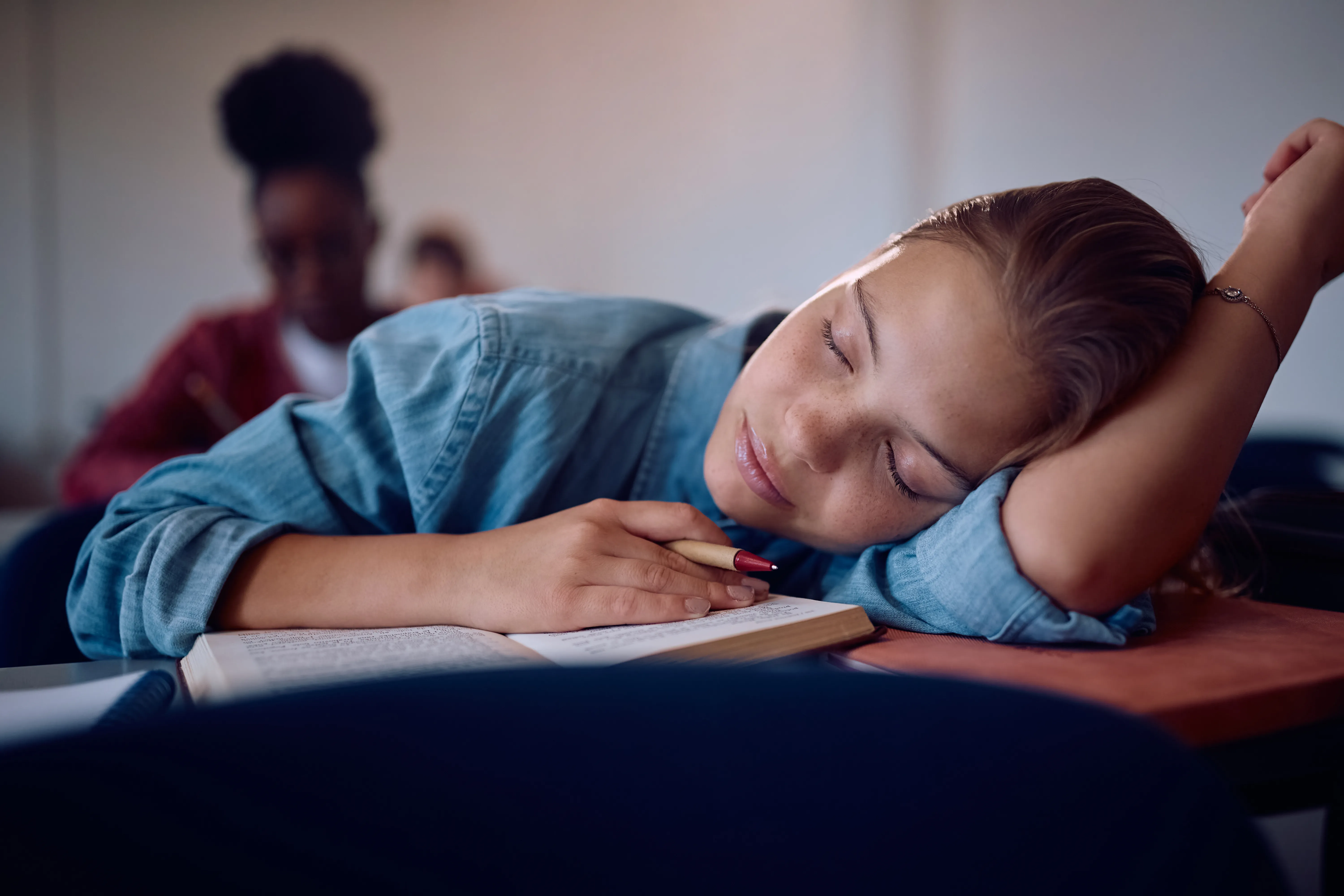
- repeated inability to wake, falling asleep in class, or uncontrollable sleep episodes
- loud habitual snoring, mouth breathing, gasping, or breathing that stops and starts
- morning headaches together with snoring or disturbed breathing
- an uncomfortable urge to move the legs that is worse at rest or in the evening and improves temporarily with movement
- ongoing low mood, anxiety, irritability, school refusal, or a marked change in behavior or functioning
- a major sleep change after starting or changing a medicine or substance
Snoring and daytime behavior changes can be signs of sleep apnea in children. The National Heart, Lung, and Blood Institute advises that diagnosis requires medical assessment and an appropriate sleep study 14. For the classic restless-legs pattern, the AASM guideline recommends clinical evaluation, including appropriate iron studies. Do not start an iron supplement for a child based on symptoms alone 15.
Thoughts of self-harm or suicide require immediate mental health help 16. Severe breathing difficulty, collapse, confusion, or an inability to stay awake can signal a medical emergency 17. Sleep and mental health problems can reinforce one another, so urgent mood symptoms should never be treated as a sleep-hygiene problem 6.
A sleepy student should not drive. The National Highway Traffic Safety Administration advises teens to delay driving until they are well rested because sleepiness impairs attention, reaction time, judgment, and decision-making 18.
Common questions
Will an earlier bedtime solve teen sleep loss?
Sometimes an earlier sleep opportunity helps, but it is not the whole answer. A later adolescent body clock, stress, homework, work, activities, devices, or insomnia may make that bedtime unrealistic. Assess both ends of the schedule and the reason sleep is delayed.
Should parents ban all screens at night?
Protecting the sleep window and keeping interactive use out of bed are reasonable goals. A blanket ban may not address schoolwork, anxiety, social pressure, or an underlying sleep disorder. Use a boundary that targets the student's actual pattern and can be followed consistently 45.
Is sleeping late on weekends harmful?
Sleeping later can be a sign that the student is repaying a school-week sleep debt. Large timing shifts may also make an early Sunday bedtime and Monday wake time harder. The priority is to create more weekday sleep opportunity, then reduce the difference gradually rather than treating recovery sleep as misbehavior 3.
What if a student gets the recommended hours but is still tired?
Hours alone do not rule out fragmented sleep, sleep apnea, restless legs syndrome, insomnia, a circadian disorder, depression, a medicine effect, or another medical condition. Persistent sleepiness despite adequate opportunity needs evaluation.