
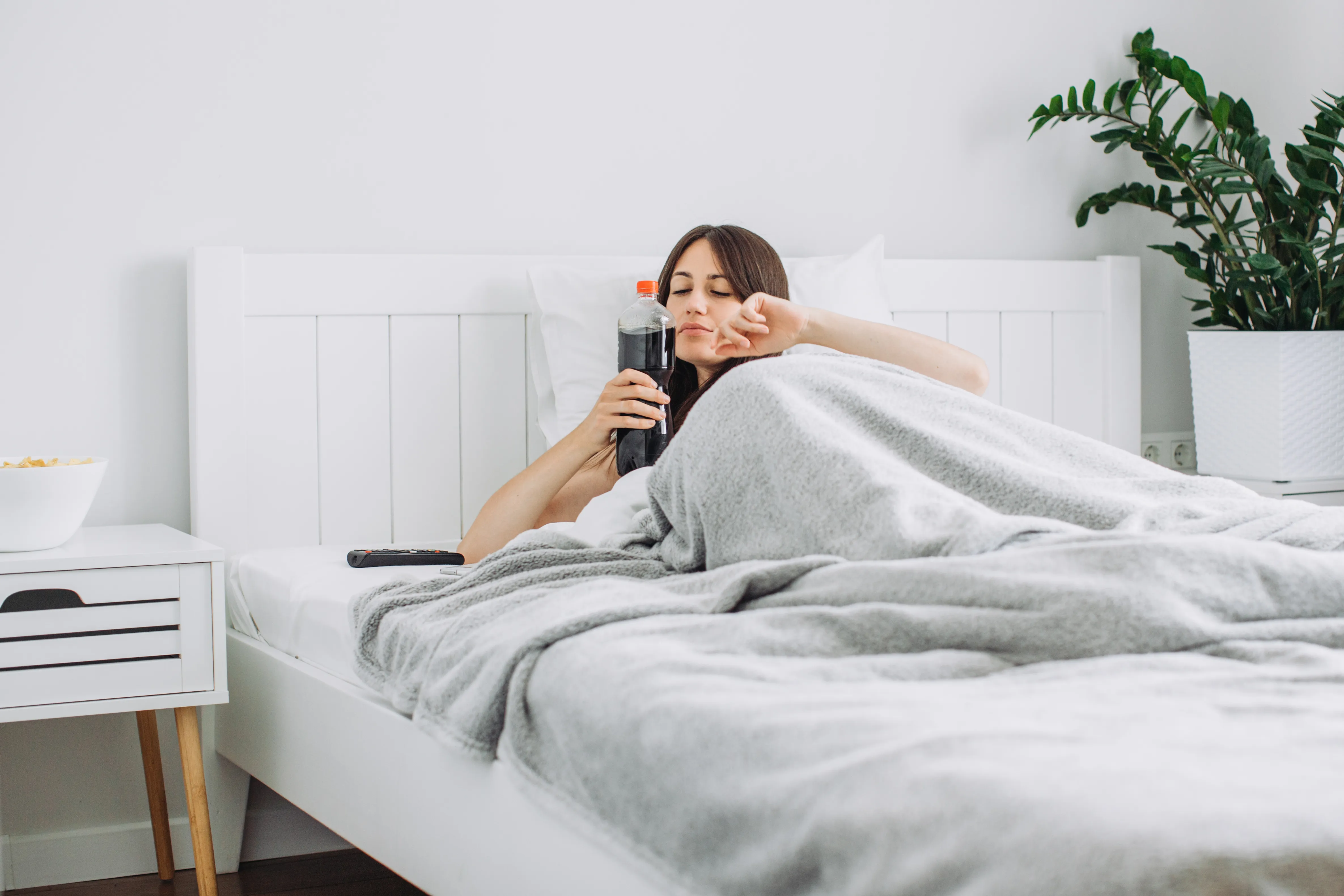
Soda can interfere with sleep, but the answer depends on what is in the drink, how much you have, when you have it, and how your body responds. Caffeine has the clearest direct effect. A large drink may also prompt a bathroom trip, while carbonation or acidity may worsen reflux symptoms in some people. Regular, diet, caffeine-free, and caffeinated sodas should not be treated as one exposure.
If you are trying to work out whether soda is affecting your sleep, start with the exact product and serving rather than the word “soda.”
Which part of soda may affect sleep?
A soda can involve several separate questions:
- Caffeine: A stimulant that can delay sleep or make it lighter, depending on the dose, timing, and your sensitivity.
- Serving size: A bottle may contain more than one labeled serving. More drink can mean more caffeine, added sugar, and fluid than the front of the package suggests.
- Fluid volume: Any large drink close to bed may contribute to nighttime urination in someone who is susceptible.
- Carbonation and acidity: These may cause belching, bloating, or reflux symptoms for some people, but they do not directly stimulate the brain like caffeine.
- Added sugar: Regular soda can be a substantial source of added sugar. Research links short sleep and higher sugar-sweetened beverage intake, but it does not show that a single soda causes an immediate “sugar crash” or nighttime awakening.
A diet soda usually has little or no added sugar, but it may still contain caffeine. A caffeine-free soda removes caffeine, not necessarily sugar, carbonation, or acidity. Check both claims separately.
Caffeine is the strongest direct sleep concern
Caffeine blocks adenosine signaling, which normally contributes to the pressure to sleep. In a meta-analysis of 24 controlled studies, caffeine shortened total sleep time, reduced sleep efficiency, and increased the time it took participants to fall asleep on average. The studies used different doses, products, and schedules, so their pooled results do not establish one cutoff that works for everyone 1.
Dose matters. The U.S. Food and Drug Administration reports a wide range of about 23 to 83 milligrams of caffeine in a 12-fluid-ounce caffeinated soft drink. It cites 400 milligrams per day as an amount not generally associated with negative effects for most adults, but this is not a sleep target or a guarantee for every person. Sensitivity and the speed at which people clear caffeine vary with factors that include medicines, medical conditions, pregnancy, and individual biology 2.
A randomized crossover trial helps show why a fixed “stop six hours before bed” rule is too simple. Twenty-three healthy men received caffeine capsules containing either 100 or 400 milligrams at 12, 8, or 4 hours before bed. The 100-milligram dose did not produce a statistically significant sleep change in this small sample. The 400-milligram dose affected sleep even when taken much earlier, with larger disruptions closer to bedtime. The study used pills, included only healthy men ages 18 to 40, and tested single doses much larger than many sodas, so it cannot tell you that 100 milligrams is harmless or that everyone needs a 12-hour cutoff 32.
Caffeine’s half-life is the time it takes the body to clear half of a dose, not all of it. It is often described as roughly three to six hours, but there is meaningful variation between people 32. A person who sleeps well after an afternoon cola and a person who lies awake after the same drink can both be responding plausibly.
Sugar and sleep are linked, but the direction is unclear
Sugar-sweetened beverage studies do not support the common story that soda creates a quick energy spike, followed by a crash that wakes everyone at night. A systematic review found an association between shorter sleep and higher intake of sugar and sugar-sweetened drinks, but the included studies were observational. They cannot establish that soda caused short sleep. Short sleepers may also choose more caffeinated or sugary drinks to cope with tiredness, and diet, work schedules, stress, and other habits may influence both 4.
This does not make the added sugar irrelevant. It means the honest sleep conclusion is narrower: check how much added sugar the drink contributes to your overall diet, but do not assume sugar is the reason for a particular bad night without testing the more direct possibilities, especially caffeine, timing, symptoms, and serving size.
The same restraint applies to diet soda. “Diet” tells you that the product has little or no sugar. It does not tell you whether the soda contains caffeine, and the evidence above does not establish that a particular non-sugar sweetener is the cause of insomnia. For sleep troubleshooting, the caffeine line, amount consumed, timing, and symptoms are more useful starting points.
Carbonation, reflux, and late fluid volume
Carbonation does not affect alertness in the way caffeine does. Its relevance is usually indirect. A fizzy or acidic drink may produce belching, fullness, or reflux symptoms in a susceptible person, and discomfort can make sleep harder.
The American College of Gastroenterology lists carbonated beverages among possible reflux triggers, but it also notes that evidence for broad food restrictions is limited and variable. Its recommendation to avoid personal trigger foods is conditional and based on low-quality evidence. For someone with nighttime reflux, leaving two to three hours between a meal and lying down is also suggested 5. In practical terms, remove or move soda only if it reliably tracks with your symptoms rather than assuming carbonation causes reflux in everyone.
Fluid volume is a separate issue. A large caffeine-free soda can still add enough late fluid to matter if you already wake to urinate. The National Institute of Diabetes and Digestive and Kidney Diseases advises against restricting fluids to the point of dehydration and recommends changing the amount or timing with a clinician’s guidance when bladder symptoms are a concern 6.
How to read a soda label for sleep
Use the package to answer four questions:
- How much will you actually drink? Compare the container size with the serving size and servings per container. Nutrition information is usually listed per serving, and one package may contain more than one 7.
- Does it contain caffeine? Added caffeine must appear in the ingredient list, but the number of milligrams is not always required. Many manufacturers list it voluntarily. If the amount is missing and it matters to you, check the manufacturer’s product information 2.
- How much added sugar is in your actual amount? Multiply the per-serving number if you drink more than one serving.
- Are you mixing up “diet” and “caffeine-free”? These are different claims. Verify each one on the specific product.
Also count caffeine from coffee, tea, chocolate, energy products, supplements, and some over-the-counter medicines. The sleep effect comes from the total dose and timing, not the soda category alone 2.
Try one change at a time
A short personal trial can be more informative than adopting a rigid universal rule. It is not a medical test, but it can show whether one part of your routine consistently tracks with symptoms.
- For several ordinary days, note the exact soda, amount, time, other caffeine, bedtime, estimated time to fall asleep, awakenings, bathroom trips, and reflux symptoms.
- For about a week, change one variable. If caffeine is the main question, move the same soda earlier or compare labels and choose the closest caffeine-free formulation. Keep the serving, other caffeine, and your usual sleep schedule as steady as practical.
- If reflux or fluid volume is the main question, keep the product the same but have it earlier or reduce only the late serving. Do not deliberately dehydrate yourself.
- Compare the pattern, then repeat once if the result is unclear.
Start with the change most likely to answer your question. If an evening caffeinated soda coincides with delayed sleep, test caffeine or timing first. If a caffeine-free soda coincides with heartburn, test timing and symptoms. If the only problem is a bathroom trip after a large drink, test late fluid volume.
People who use caffeine every day may feel headache, fatigue, or irritability after stopping abruptly. The FDA recommends reducing it gradually because withdrawal can be unpleasant, although it is not considered dangerous 2. You do not need a detox product or a replacement supplement.
Children, pregnancy, medicines, and caffeine sensitivity
The FDA’s adult 400-milligram reference should not be applied to children. It advises avoiding caffeinated drinks for children younger than 2, choosing beverages without added sugar as the main options for children and teens, and discussing a young person’s caffeine intake with a health professional 2. A review of adolescent studies found that higher caffeine intake was associated with more sleep problems, but most studies were cross-sectional and relied on self-report, so they do not prove cause and effect 8.
During pregnancy, the American College of Obstetricians and Gynecologists describes less than 200 milligrams per day as moderate intake. That total includes soda along with every other caffeine source 9. Someone who is pregnant, trying to become pregnant, or breastfeeding should discuss their own limit with their clinician, especially if sleep or other symptoms are a concern.
Some medicines and health conditions can increase caffeine sensitivity or change how quickly the body clears it. Ask a clinician or pharmacist about caffeine if you take prescription or over-the-counter medicines, or if caffeine brings on palpitations, marked anxiety, tremor, nausea, or repeated sleep disruption 2.
When soda is probably not the whole explanation
Seek medical advice if insomnia persists after you have changed caffeine and timing, or if reflux or nighttime urination is frequent, worsening, or disrupting sleep. These symptoms can have causes that a soda experiment will not identify.
Get urgent help for chest pain, fainting, severe or sustained palpitations, confusion, or other severe symptoms. If you are dangerously sleepy, do not drive and do not treat soda as a safety measure. The National Highway Traffic Safety Administration warns that caffeine alone may briefly increase alertness without preventing microsleeps in someone who is seriously sleep deprived 10.
The bottom line
Soda does not have one uniform effect on sleep. Caffeine dose and timing have the strongest direct evidence, while serving size, late fluid volume, and reflux symptoms may matter for an individual. Sugar-sweetened soda is associated with short sleep in population research, but that relationship does not prove that sugar caused the sleep loss. Read the specific label, identify the most plausible exposure, and test one change at a time.