
A weighted blanket is heavier than ordinary bedding and spreads added pressure across the part of the body it covers. Some people find that sensation calming or comfortable, but research does not show that weighted blankets reliably treat insomnia, anxiety, autism-related sleep problems or another health condition. Benefits vary by the population, product and outcome studied. A person must be able to breathe, move, regulate temperature and remove the blanket independently before comfort or possible sleep benefits are considered.
The physical action is simple: the blanket rests on the body with more force than an ordinary blanket. “Deep pressure” is a useful description of that input, not proof that the product regulates the nervous system or changes brain chemistry. Current evidence does not justify claims that a weighted blanket raises serotonin, dopamine or melatonin, lowers cortisol, increases deep sleep or produces pain relief in a way that can be predicted for an individual 12.
What weighted blankets are made from
Most retail designs use one of two approaches:
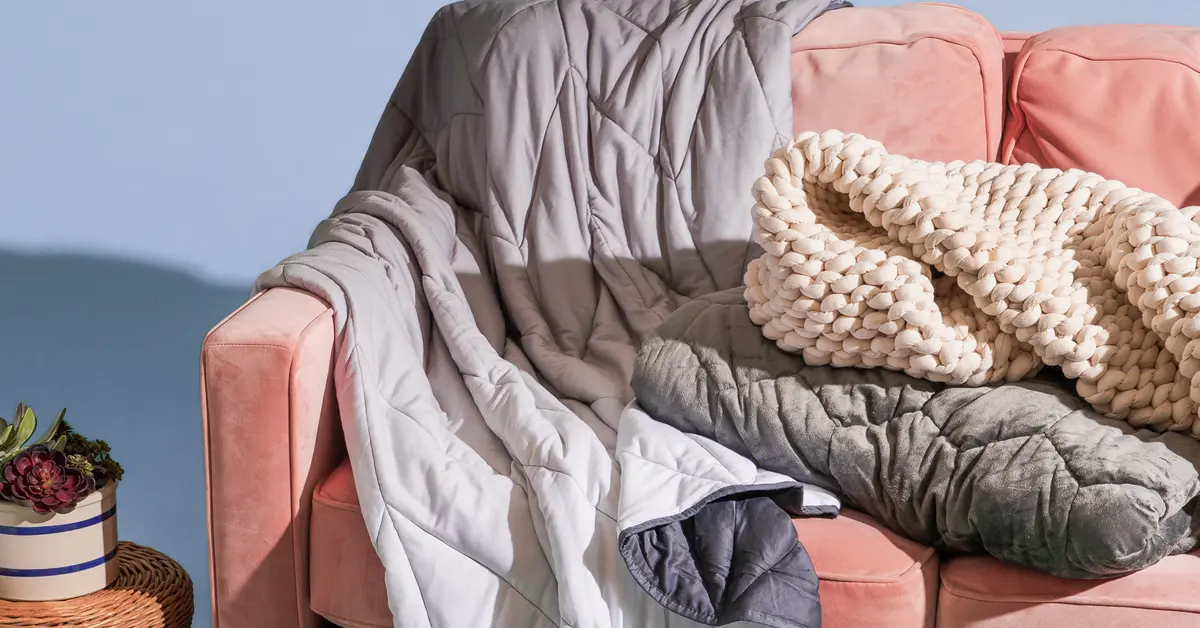
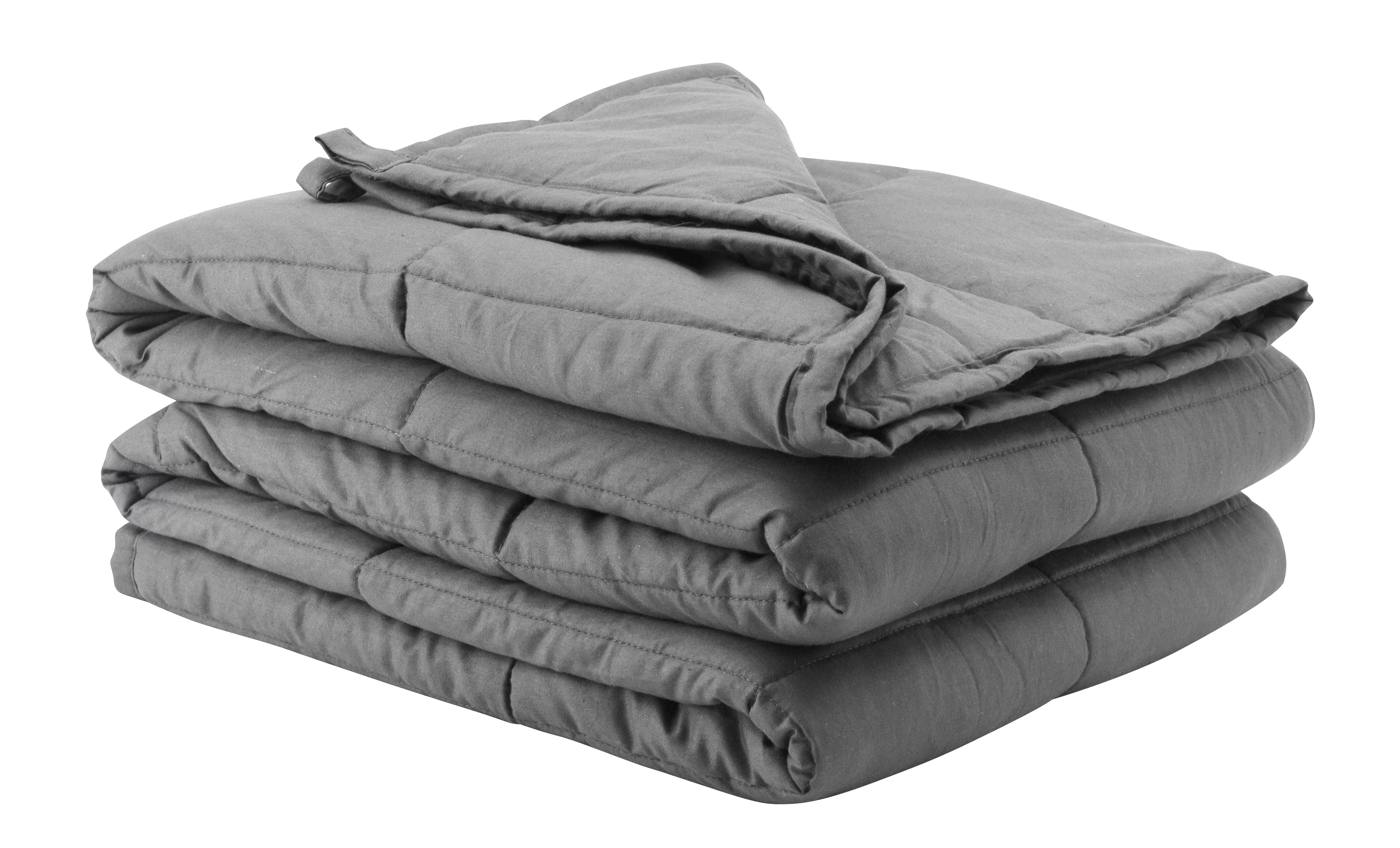
- Filled and stitched blankets place glass beads, plastic pellets or another weight material inside small quilted pockets or channels. Smaller compartments can limit long-distance movement of the fill, but the result still depends on seam quality, fill amount and how the blanket is handled.
- Knitted weighted blankets obtain much of their weight from thick yarn and an open or dense knit rather than loose beads. The size of the openings, stretch, snag risk and finished weight matter more than the word “knitted.”
Clinical studies have also used blankets containing metal chains, plastic chains, balls or dense fiber. A result from one of those products does not establish that a retail bead-filled or knitted blanket will feel or perform the same way.
Total weight is only part of the specification. A given weight spread over a large blanket produces a different load pattern from the same weight in a smaller blanket. Pocket size, channel direction, fill shifting and which part of the body is covered can change the sensation again.
What the research actually shows
The evidence is mixed, and the difference between a person's report and a measured sleep outcome matters.
A 2024 systematic review included eight randomized trials with 426 participants who had mental disorders. Five studies produced a small pooled reduction in anxiety ratings. The initial pooled analysis of three insomnia studies did not find a statistically significant difference, although a sensitivity analysis that removed one heterogeneous study did. Half of the included studies had a high risk of bias, and the populations, products and outcomes varied substantially 3. That supports further research, not a general treatment claim.
Adult insomnia findings are not uniform
In one four-week trial, 120 adults with insomnia plus major depression, bipolar disorder, generalized anxiety disorder or ADHD received either a 6- or 8-kilogram metal-chain blanket or a light plastic-chain control. Self-rated insomnia severity improved substantially with the weighted blanket. However, actigraphy did not show a significant overall change in total sleep time or wake time after sleep onset, even though participants reported better sleep maintenance 4.
A later pilot trial assigned 102 adults with diagnosed insomnia to a 5.5-kilogram glass-bead blanket or a 3.5-kilogram ordinary blanket for one month. The weighted group reported a larger improvement on a broad sleep-quality questionnaire, but not on the Insomnia Severity Index. Actigraphy did not find a statistically significant difference in the change in awakenings, and no other objective sleep measure differed 2.
These trials suggest that some adults may feel or rate their sleep as better even when movement-based sleep measures change little or inconsistently. Neither study establishes that any weighted blanket treats insomnia in the general population, and neither makes the blanket a substitute for assessment or evidence-based insomnia care.
Autism and ADHD studies cannot be combined into one promise
In a randomized crossover trial of autistic children aged 5 to 16 years with severe sleep problems, a weighted blanket did not improve actigraphic total sleep time, sleep-onset latency, awakenings or the other measured sleep and behavior outcomes compared with a matched ordinary blanket. Children and parents nevertheless preferred the weighted blanket 5. Preference can be meaningful, but it is not the same as a measured treatment effect.
A different crossover trial studied 94 children with uncomplicated ADHD and verified sleep problems. Compared with a lighter control, the weighted blanket increased actigraphic total sleep time by an average of about eight minutes, raised sleep efficiency by less than one percentage point and reduced wake time after sleep onset by about three minutes. It did not shorten sleep-onset latency. Occupational therapists selected the study blankets using several child and symptom factors, and panic, anxiety or pain was reported by four children 6.
Those small average effects in one selected ADHD sample should not be transferred to every child with ADHD, to autistic children, to children with medical complexity or to adults. A weighted blanket is not a treatment for autism, ADHD, anxiety or another diagnosis.
There is no universal 10% rule
“Choose 10% of body weight” is widely repeated, but it is not a proven therapeutic dose. The earlier systematic review found that studies assigned blanket weights in different ways, which made results harder to compare 1. Later trials used fixed weights, offered a choice between weights or had occupational therapists consider several factors. They did not validate one home formula.
Some manufacturers and occupational-therapy services use no more than roughly 10% of body weight as a product-specific ceiling or starting convention. Somerset NHS guidance describes it as something manufacturers often advise, not as proof that 10% works best 7.
Choose by function instead:
- Read the exact product's user range and warnings. Do not use a marketplace listing or another model's chart as a substitute for the sewn label and manual.
- Consider weight and finished dimensions together. A wider blanket spreads the load and may hang farther over the bed. A smaller blanket of the same weight can feel more concentrated.
- Test independent removal. The user should be able to push the blanket away fully and quickly from the back, side and any usual sleep position without help, pain or panic.
- Choose the lighter workable option when uncertain. More pressure is not proven to produce more benefit. If a lighter blanket provides the preferred sensation and is easier to handle, there is no evidence-based reason to move heavier.
Body weight alone does not capture strength, fatigue, pain, joint movement, breathing, alertness or the ability to respond after a seizure or sudden illness. Those functional questions can override any percentage printed on a chart.
How to compare construction and everyday use
Check how the weight is contained
Look at the size and layout of the stitched pockets or channels, reinforcement at the perimeter, and whether reviewers of the exact model consistently report bunching, leakage or broken seams. For a knitted model, inspect the loops, joins and stretching. No construction term guarantees even pressure or durability.
Stop using a blanket if beads or pellets escape, chains or other hard components become exposed, a large amount of fill shifts into one area, knitted loops become hazardous, or seams and closures no longer contain the product. Loose fill can create additional risks around children and pets.
Treat the shell and cover as separate specifications
Cotton, polyester, fleece, rayon-based fabrics and blends can all be used in shells and removable covers. A fiber name alone does not prove that the finished blanket is cooling, breathable, hypoallergenic or suitable for sensitive skin. The number of layers, weave or knit, fill, cover and room conditions also affect heat and moisture.
If you tend to overheat, compare the complete construction and return policy rather than relying on a “cooling” label. Stop use if the blanket causes sweating, flushing, nausea, breathing discomfort or unusual heat 7.
A removable cover can reduce how often the weighted insert needs cleaning, but it also adds another layer and may shift if its ties or fasteners do not hold. Check whether the cover is included, how it attaches and whether either component has closures a child could enter 8.
Confirm that care is realistic
“Machine washable” is incomplete without the exact care label and the weight of the wet item. Check whether the insert, cover or both can be washed, the permitted cycle and temperature, drying instructions, and the capacity of your washer and dryer. Some inserts require spot cleaning or commercial equipment.
Do not assume that glass beads, plastic pellets, chains, knitted yarn or another fill can tolerate the same process across products. Follow the exact label, distribute the load safely when moving a wet blanket and dry it completely before storage or reuse. If you cannot safely lift and clean the finished item, choose a removable cover and a manageable insert or select ordinary bedding.
Measure the bed, user and overhang
Weighted blankets are often designed for one person rather than to cover a whole mattress. Compare the finished width and length with the user's body and the usable bed surface. Excess weight hanging over an edge can pull the blanket toward the floor and make removal harder. Child safety guidance specifically advises against draping a weighted blanket over the sides of the bed 97.
For a shared bed, do not assume one large blanket suits two people. Each sleeper should consent to the pressure, be able to uncover independently and have clear access to the edge of the bed. Do not let the blanket migrate onto a child, another person who cannot remove it, a pet, medical tubing or equipment controls.
Read trial, return and warranty terms before buying
Weighted blankets can be expensive to return because of their mass. Confirm whether opened or slept-under products can be returned, who pays shipping, whether the original packaging is required, and whether an exchange for another weight restarts or ends the trial.
Read what the warranty actually covers. Seam failure, leaking fill, broken ties, fabric pilling, shrinkage and uneven weight may be treated differently, and washing outside the care instructions may exclude a claim. Keep the sewn label, receipt, product name, model and written terms.
Safety comes before a sleep trial
Never use weighted sleep products for infants
The American Academy of Pediatrics advises that weighted blankets, weighted sleepers, weighted swaddles and other weighted objects should not be placed on or near a sleeping infant. Infants should sleep on a firm, flat surface without loose bedding 10. The U.S. Consumer Product Safety Commission has also warned against weighted infant blankets and swaddles 11.
A product being sold for a baby does not establish that it is safe. Do not place an ordinary weighted blanket, weighted sleep sack, weighted swaddle or weighted object in an infant's sleep space.
Older children need a stricter functional check
A child's age or weight does not establish readiness. The child should understand what the blanket is, want to use it, remain supervised, and be able to remove it completely without assistance. The blanket must stay away from the head and neck, lie loosely rather than being wrapped around the child, and never be tucked in or used as restraint.
Somerset NHS pediatric therapy guidance takes a conservative approach: supervised use only, no overnight use, and removal once the child falls asleep 7. A family considering a weighted blanket for an older child's sensory preference or sleep concern should discuss the exact product and use plan with the child's clinician or occupational therapist rather than borrowing an adult rule.
Some adults also need individualized review
A diagnosis does not create one automatic answer, but unsupervised sleep use needs extra caution when breathing, circulation, skin integrity, mobility, strength, cognition, alertness, seizure control, swallowing or coughing, panic, or temperature regulation could affect safe removal or recognition of distress. Sedating medicines, alcohol, acute illness and recovery after a procedure can change those abilities from one night to the next.
The Royal College of Occupational Therapists advises assessing medical factors and the person's ability to remove the blanket independently 9. A clinician or occupational therapist can help when the concern is functional or medical. That review is especially sensible if the person uses breathing or mobility equipment, needs help repositioning, has episodes of impaired awareness, or cannot reliably communicate discomfort.
Use it as a blanket, never as restraint
Keep the head, face and neck uncovered. Place the blanket loosely over the user rather than rolling the person inside it. Do not tuck it under the mattress or around the body in a way that blocks an exit. Do not place extra people, bedding or objects on top to increase pressure.
Remove it immediately if there is difficulty breathing, pain, numbness, nausea, overheating, panic, confusion, unusual weakness or trouble getting free. New breathing difficulty, blue or gray color, loss of consciousness or inability to wake normally requires emergency help.
Check the exact model for recalls
Search the CPSC recall database or the relevant product-safety authority in your country using the brand and model, especially before buying used. In 2023, CPSC recalled one specific children's weighted blanket because a child could unzip and enter a pouch, creating an entrapment and asphyxiation hazard 8. That was a model-specific recall, not evidence that every weighted blanket had the same design.
Avoid an unidentifiable used blanket with no sewn label or instructions. Do not resell, donate or continue using a recalled product. Follow the official remedy, which may be a refund, return or required disabling step.
A cautious trial for an eligible adult
If the safety checks are satisfied, treat the blanket as a preference experiment rather than therapy:
- Inspect the blanket, label, seams, fill containment and closures.
- Try it for a short period while fully awake. Keep it below the neck, do not tuck it, and practice removing it from every usual position.
- Use one setup at a time. Do not add a new supplement, sleep device or major schedule change during the same trial if you want to understand the result.
- Notice comfort, heat, breathing, freedom of movement, anxiety or trapped feelings, perceived sleep, awakenings and next-day function.
- Stop if safety or comfort worsens. If it feels pleasant but sleep does not improve, it may still be a comfort item, but that is not evidence that it is treating the cause of a sleep problem.
Persistent insomnia, loud snoring or gasping, marked daytime sleepiness, anxiety that limits daily life, pain, or a child's ongoing sleep difficulty deserves cause-specific assessment. A weighted blanket can be kept as an optional comfort item when it is safe and preferred, but it should not delay care or replace an established treatment.