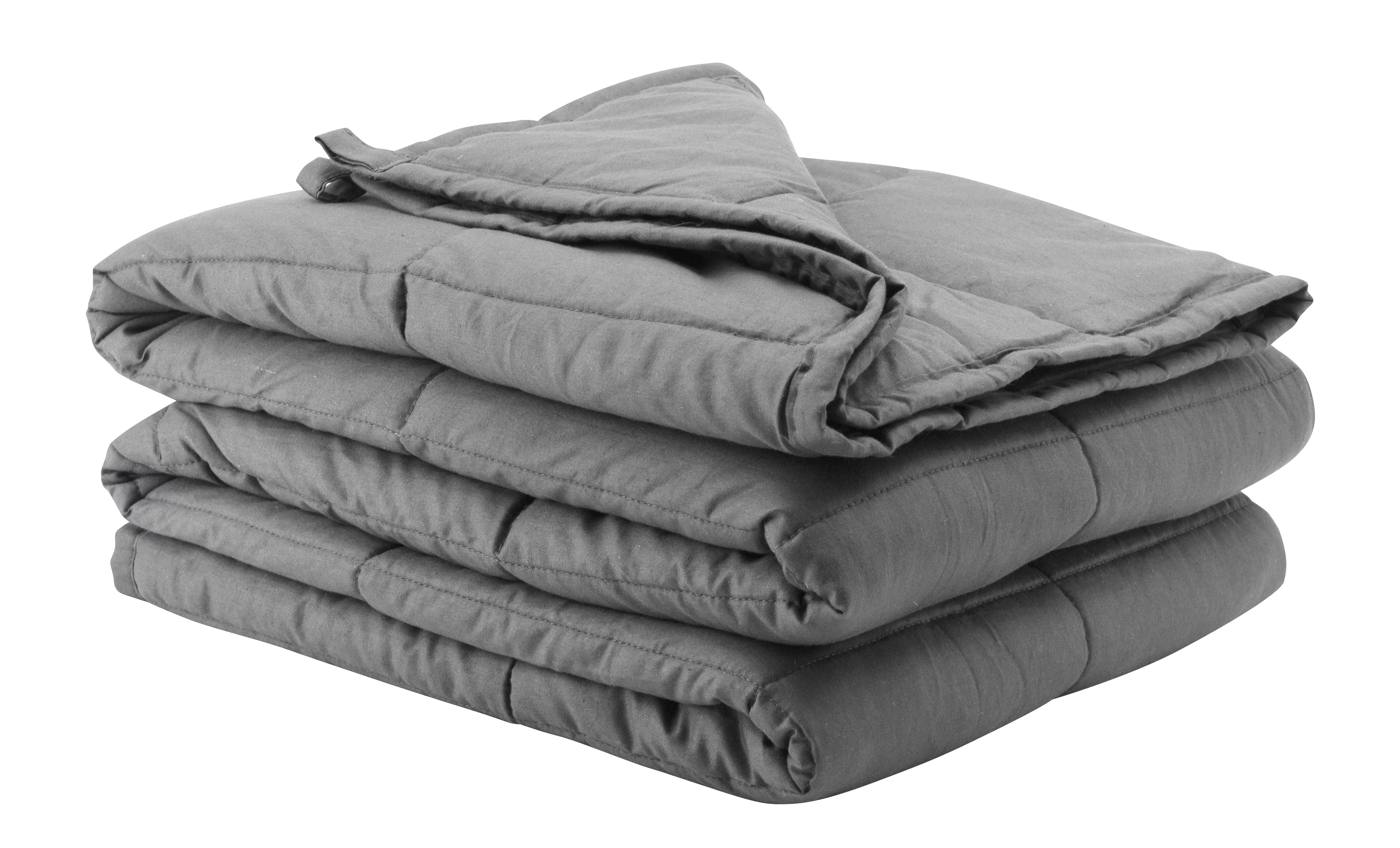


Weighted blankets and compression sheets are mechanically different products. A weighted blanket places a filled, heavy cover over the body. A compression sheet is an elastic sleeve or band anchored around a mattress, and the sleeper slides between the sheet and mattress.
That difference matters. The downward load studied in weighted-blanket trials cannot be assumed to produce the same effects as elastic tension from a compression sheet. Weighted blankets have some controlled research, although it is limited and mixed. Compression sheets do not have comparable published evidence, and neither product has been proven as a general treatment for insomnia, anxiety, autism, or sensory differences.
Weighted blanket vs. compression sheet at a glance
| Question | Weighted blanket | Compression sheet |
|---|---|---|
| What creates the force? | Added mass in beads, chains, pellets, fibers, or another fill | Stretch in elastic fabric anchored around the mattress |
| Where does it contact the sleeper? | Mainly from above and along areas where the blanket drapes around the body | From above and at the sides where the stretched fabric contacts the body |
| Is there a fixed “dose”? | The blanket has a stated total weight, but the load on any body area changes with size, drape, bunching, and position | No standard force is stated; tension changes with fabric, sheet dimensions, mattress width and depth, wear, and body position |
| Can it shift? | It can slide, bunch, or fall partly off the bed | It stays anchored to the mattress but can loosen, roll, tear, or fit incorrectly |
| How does the user get out? | Lift or push the blanket aside | Slide out through an opening or push the elastic sheet away, depending on the design |
| What about heat? | Fill, shell, cover, room temperature, and other bedding all matter | The fabric may be thin, but tension, pajamas, other bedding, and room temperature still matter |
| What about a shared bed? | An individual-size blanket can be kept to one sleeper, but it must not trap or cover a partner who cannot remove it | A mattress-spanning sheet may affect both sleepers and may not provide each person a safe, independent exit |
| How is it cleaned? | Some are washable, some have a washable cover, and some exceed home-machine limits | Many are machine washable, but heat and drying methods can damage elastic fibers |
| Is it easy to travel with? | Usually bulky and heavy | Usually lighter, but useful only if it safely fits the destination mattress |
| What does the research establish? | Possible benefit in some selected groups, with important uncertainty | No comparable evidence and no published head-to-head evidence located |
Why the pressure is not interchangeable
A weighted blanket's total weight is easy to state, but that number is not the force applied evenly to every part of the body. The mattress supports the person, and the blanket's load is distributed according to its dimensions, fill movement, drape, contact area, and the sleeper's position.
A compression sheet does not add the same kind of load. Stretching the fabric creates tension. How tightly it presses depends on the sheet's construction and how far it is stretched over the mattress and sleeper. A sheet designed for a shallow twin mattress can feel and behave differently on a deeper mattress, even when both products carry the same size label.
These products may both feel snug, but a similar description is not evidence of a similar physiological effect. Claims that either one reliably changes cortisol, serotonin, melatonin, vagal activity, the autonomic nervous system, deep sleep, or pain go beyond what product-comparison evidence can establish.
What weighted-blanket studies show
A 2020 systematic review found only eight eligible studies. The authors concluded that weighted blankets might reduce anxiety in limited settings and populations, but the evidence was too sparse to support an insomnia benefit at that time 1.
Later studies add promising findings without settling the question. A 2024 systematic review and meta-analysis included nine studies with 553 psychiatric inpatients and outpatients. It found a moderate average reduction in anxiety symptoms, but the studies differed in population, setting, duration, and outcomes. Only one randomized trial was rated at low risk of bias, and the authors emphasized the small samples and shortage of well-designed trials 2.
Two adult trials also need to be read within their boundaries:
- A Swedish randomized trial studied 120 adults who had insomnia plus major depressive disorder, bipolar disorder, generalized anxiety disorder, or ADHD. Weighted chain blankets improved self-reported insomnia measures more than a light control blanket over four weeks. The result applies to that clinical population and those study blankets, not every product or sleeper 3.
- A 2024 pilot trial randomized 102 adults with clinical insomnia to a weighted or normal blanket for one month. The weighted-blanket group reported a larger improvement on a sleep-quality questionnaire. Actigraphy did not show a statistically significant between-group difference in the change in number of awakenings, and the authors called for larger, longer trials 4.
Findings in autistic children are different. In a randomized crossover trial of 67 children and adolescents with autism and severe sleep problems, a weighted blanket did not improve total sleep time, sleep-onset latency, sleep efficiency, night waking, or behavior compared with a usual-weight blanket. Children and parents were more likely to prefer the weighted blanket 5.
Preference can matter when the goal is comfort, but it is not the same as an objective sleep improvement. The American Academy of Neurology guideline advises clinicians to explain that the reviewed trial did not show a sleep benefit in autistic children, although the study reported no serious adverse events 6.
What compression-sheet studies show
Compression sheets have a much thinner evidence base. A UK research registry describes a randomized pilot study of a commercial compression sheet in autistic children with chronic insomnia. The planned comparison used usual bedding and the compression sheet for two weeks each, with sleep diaries, actigraphy, and under-mattress monitoring 7.
As of July 26, 2026, the associated university project page lists the project as inactive and shows no research outputs 8. A registered plan is not a result. We did not locate a published controlled trial establishing that a compression sheet improves sleep, and we did not locate a published trial directly comparing a compression sheet with a weighted blanket.
This absence does not prove that nobody finds a compression sheet comfortable. It means product testimonials and weighted-blanket studies cannot establish a compression sheet's medical or sleep effects.
Safety comes before preference
Do not use either product in an infant sleep space. The American Academy of Pediatrics recommends a firm, flat infant sleep surface with only a fitted sheet and says weighted blankets and other weighted objects should not be placed on or near a sleeping infant 9.
Safety is not guaranteed by choosing a light product or following a percentage rule. A commonly repeated “10% of body weight” rule comes from product and practice guidance, not from trials that establish a universally safe or effective dose. Use the exact manufacturer's age, size, weight, installation, supervision, and exclusion instructions for the product being considered. If the instructions are missing, vague, or conflict with the user's abilities, do not improvise.
For any child or adult, do not use a weighted blanket or compression sheet:
- over the face or neck
- as restraint, punishment, or a way to prevent getting out of bed
- tucked, zipped, or layered in a way that traps the person
- if the person cannot remove it, uncover the airway, communicate distress, and exit the bed independently
- when it is torn, frayed, leaking fill, stretched out, or fitted differently from the instructions
A 2022 U.S. Consumer Product Safety Commission recall shows why construction matters. Two children died after entering a removable weighted-blanket cover and becoming entrapped. The hazard involved that recalled design, not every weighted blanket, but it supports inspecting covers, closures, seams, and any opening that a child could enter 10.
Ask a clinician or occupational therapist for an individual risk review before use when breathing, circulation, mobility, muscle strength, cognition, communication, seizure risk, swallowing, skin integrity, temperature regulation, medication-related sedation, or another condition could affect safe removal or response to distress. This is not a blanket prohibition for every person with a diagnosis. It is a reason to match the product and supervision plan to the person's actual abilities and risks.
Royal College of Occupational Therapists guidance calls for an individualized risk assessment that considers independent removal, breathing, temperature regulation, skin integrity, alertness, consent, and mental-health risks. It also says a weighted blanket must not be used as restraint 11.
Product instructions can change the answer
“Compression sheet” describes a category, not one standardized design. Product dimensions, openings, age limits, and care rules vary.
For example, as checked on July 26, 2026, the Fun and Function Snuggle Compression Sheet listing specifies twin and full sizes, labels the product for ages 5 and older, says to machine wash cold and air dry, and warns not to cover the face or restrict movement. Its general stretch-fabric guidance says to follow the product's age and size instructions, inspect for loose stitching or torn seams, and stop use if damaged 1213.
That information applies to that product and version of its instructions. It does not establish a safe age, fit, or cleaning method for another compression sheet. Before buying, save or photograph the current instructions and confirm:
- the mattress size and allowed depth
- how the sheet is installed and where the openings sit
- the user's required age, size, abilities, and supervision
- whether additional bedding can be used
- how to wash and dry it without changing its elasticity
- what damage requires replacement
Apply the same product-specific check to a weighted blanket. Confirm the exact user age and weight range, blanket dimensions and total weight, whether it may be used for sleep, whether it can hang over the mattress, how the cover closes, and whether the filled insert is safe for the available washing machine.
Which one is more practical?
Movement and exit
A weighted blanket can be pushed aside, but a heavy or oversized model may be difficult for a particular user to move. A compression sheet has no heavy fill, but its elastic tension and opening still have to allow an immediate, unassisted exit. Test that action while fully awake before considering sleep use.
Do not treat less mass as proof that a compression sheet cannot restrict movement. Do not treat a person's ability to lift a blanket once as proof that every sleep position will be safe.
Heat and skin contact
Neither category is always cooler. A weighted blanket's warmth depends on fill, shell, weave, cover, size, and other bedding. A compression sheet may use less material, but it remains in close contact and can be layered with pajamas, sheets, and a duvet.
Stop using either product if it causes overheating, sweating, skin irritation, numbness, tingling, pain, chest discomfort, breathing difficulty, panic, or a trapped feeling.
Shifting, fit, and damage
A weighted blanket can shift toward an edge, especially when it is much larger than the user or hangs over the bed. A compression sheet is anchored, but the mattress acts as part of the product. Too much stretch, too little stretch, a rolled edge, or a damaged seam can change the fit.
Check a weighted blanket for leaking fill, uneven pockets, failed stitching, and unsafe zipper access. Check a compression sheet for loss of elasticity, holes, fraying, rolled fabric, and openings that no longer remain where intended.
Shared beds
A bedding product should not make a partner responsible for moving it during sleep. An individually sized weighted blanket may be easier to keep to one side, but it still must not cover someone who cannot remove it. A compression sheet that spans the mattress may be unsuitable when it changes both sleepers' movement or exit route.
If either sleeper cannot independently reject the sensation and leave the bed, choose neither.
Laundry and travel
Read the filled insert's weight before putting a weighted blanket in a home washer. A machine may have enough drum space but not enough wet-load capacity. A removable cover can simplify routine washing, but the insert still needs a safe cleaning method.
A compression sheet is usually lighter to carry and wash. Travel introduces a different problem: an unfamiliar mattress may not match the required dimensions or depth. A compact product that fits incorrectly is not a useful travel option.
Returns and warranty
Comfort cannot be predicted from a product description. Before opening or using either product, check whether used bedding can be returned, whether a hygiene or restocking exception applies, who pays return shipping, and whether the trial period starts at purchase or delivery.
Also check what the warranty excludes. Normal elastic relaxation, heat damage, overloading a washer, leaking fill, seam failure, and commercial use may be handled differently. A long warranty is not a substitute for a usable return window.
A simple decision path
A weighted blanket may be the more reasonable comfort trial when the user:
- prefers removable downward load rather than elastic contact
- meets the exact product instructions
- can uncover the airway, remove the blanket, and exit independently
- has a safe place to use, inspect, store, and clean it
A compression sheet may be the more reasonable comfort trial when the user:
- prefers elastic tension and close fabric contact rather than added mass
- has a compatible mattress and a product with clear instructions
- can move, uncover the airway, and exit through the intended opening independently
- accepts that clinical sleep and anxiety benefits have not been established
Choose neither when the goal is to restrain movement, the person cannot exit independently, the product could cover the face or neck, the fit is uncertain, the instructions are incomplete, or the sensation causes distress. Neither is also a sensible choice when the practical burdens outweigh a possible comfort benefit.
How to run a cautious comfort trial
Treat the product as an optional comfort experiment, not as therapy.
- Read the instructions for the exact model and screen for age, size, health, mattress, and supervision conflicts.
- Inspect the product and test setup and exit while the user is awake, alert, and able to say or show that they want it removed.
- Change only this one bedding variable. Do not stack a weighted blanket over a compression sheet or combine it with other restrictive products.
- Choose one modest outcome, such as whether the user finds settling more comfortable. Keep a short note during the return window rather than relying on one unusually good or bad night.
- Stop for discomfort, distress, overheating, pain, altered sensation, breathing difficulty, skin changes, or any loss of independent exit.
Persistent insomnia deserves assessment and evidence-based care. The American Academy of Sleep Medicine recommends multicomponent cognitive behavioral therapy for insomnia for adults with chronic insomnia disorder 14. A bedding product should not delay evaluation of loud snoring, breathing pauses, unusual nighttime behavior, seizures, pain, severe anxiety, or daytime sleepiness, and it should not be used to replace or change prescribed treatment.
The bottom line
A weighted blanket adds downward load. A compression sheet creates elastic tension around the sleeper and mattress. They may both feel snug, but they are not evidence-equivalent products.
Weighted blankets have limited and mixed evidence, with some promising adult findings and a negative objective sleep trial in autistic children. Compression sheets have no comparable published clinical evidence and no published head-to-head comparison. If safety and product instructions allow a trial, choose by the kind of contact the person prefers and by practical fit, exit, heat, cleaning, and return constraints. If those conditions are not satisfied, choose neither.