
There is no single oxygen-saturation number that is normal for every sleeping person or every device. At low altitude, most healthy people have an awake fingertip oxygen saturation between 95% and 100%, and healthy adult sleep studies generally show averages in the mid-to-upper 90s. Sleep does not hold saturation at one exact value, however. Clinicians interpret the overnight baseline, repeated drops, lowest value, time spent below a defined threshold, signal quality, altitude, health conditions, and the accompanying airflow, breathing effort, heart rhythm, carbon dioxide, and sleep-stage signals 12.
A brief low point on a watch or ring is not a diagnosis. A normal-looking overnight graph also does not prove that breathing was normal. The source of the data, the duration and shape of any change, and what else happened at the same time matter more than a screenshot of one number.
SpO2 is not the same as PaO2
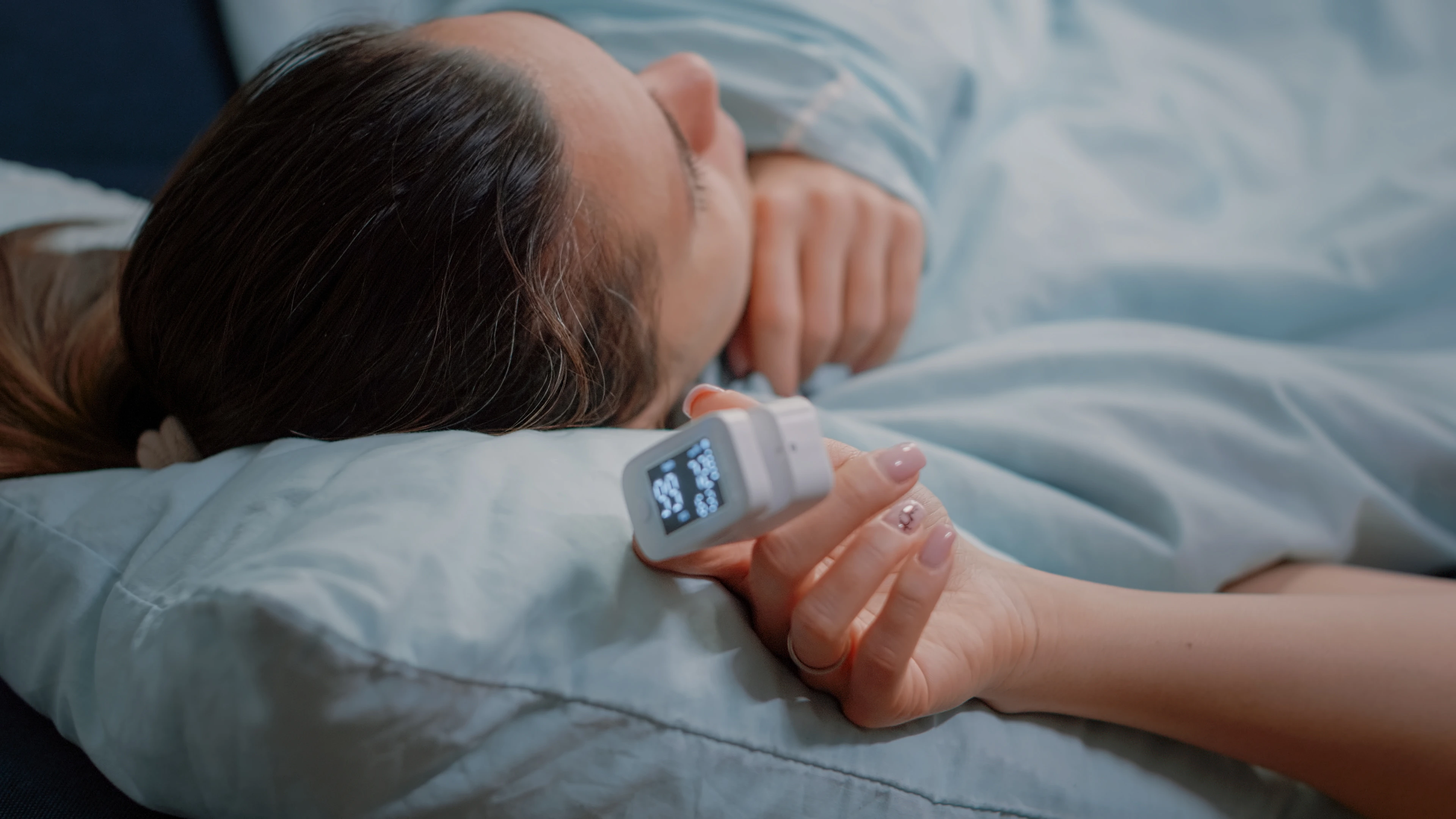
A pulse oximeter shines light through or into tissue and estimates the percentage of hemoglobin carrying oxygen in pulsating arterial blood. The result is called peripheral oxygen saturation, or SpO2.
An arterial blood gas uses blood drawn from an artery. It can measure the partial pressure of dissolved oxygen, called PaO2, as well as carbon dioxide, pH, and other values. SpO2 and PaO2 are related, but they are different measurements and cannot be substituted number for number. A pulse oximeter also does not measure carbon dioxide, so a reassuring SpO2 cannot exclude hypoventilation or carbon-dioxide retention 31.
The overnight oxygen measures answer different questions
| Measure | What it describes | Main limitation |
|---|---|---|
| Awake spot SpO2 | An estimate at one awake moment | It does not show what happened during sleep |
| Baseline or average SpO2 | The usual level across a selected recording period | An average can hide short deep drops or poor-quality segments |
| Nadir | The single lowest accepted value | One value is especially vulnerable to motion, lost contact, or another artifact |
| Time below a threshold | Minutes or percentage of the recording below a specified level, sometimes called T90 when the threshold is 90% | The threshold and denominator must be stated, and a treatment or payer cutoff is not a definition of normal |
| Oxygen desaturation index (ODI) | The number of qualifying saturation drops per hour | Results depend on the chosen drop size, duration, recording time, and artifact handling |
| Apnea-hypopnea index (AHI) | Apneas and hypopneas per hour of measured sleep in polysomnography | It is not an oxygen score and does not summarize the depth or duration of desaturation |
| Respiratory event index (REI) | Respiratory events divided by monitoring or recording time on many home tests | Because the denominator may include awake time, it can differ from a sleep-based AHI |
Overnight oximetry reports often combine several of these measures because none tells the whole story. The ODI counts qualifying drops, while AHI counts breathing events using airflow and other signals. They can disagree. A person can have repeated respiratory arousals with little oxygen change, or substantial sustained low oxygen from lung disease or hypoventilation without a matching cluster of obstructive apneas 45.
What healthy sleep data can and cannot tell you
Reference studies help describe populations, but they do not create a personal oxygen target. A meta-analysis of laboratory polysomnography in healthy adults found that both mean and minimum oxygen saturation changed with age. The included cohorts, scoring methods, equipment, and laboratory settings varied, which is why a population reference cannot turn one home-device nadir into "normal" or "abnormal" by itself 2.
It is reasonable to expect many healthy adults at low altitude to spend most of the night close to their awake baseline. A small change from wakefulness can occur during sleep. What deserves interpretation is the entire pattern:
- Was the baseline already lower before sleep?
- Was the low value one isolated point or a sustained period?
- Were there repeated drops and recoveries?
- Did the changes occur with reduced airflow, continued or absent breathing effort, snoring, body position, or a particular sleep stage?
- Was the sensor signal credible at the same time?
- Was the person at altitude, acutely ill, using prescribed oxygen or PAP, or living with a lung, heart, neuromuscular, or sleep-related breathing condition?
A threshold used by an insurer, oxygen supplier, clinical trial, or home-oxygen guideline answers a specific eligibility or treatment question. It is not a universal boundary between healthy and unhealthy sleep. The American Thoracic Society home-oxygen recommendations, for example, address selected adults with chronic lung disease and define eligibility using stable clinical measurements and disease context, not one consumer overnight dip 6.
Why a reading may be falsely low or falsely reassuring
Pulse oximetry is an estimate. Before interpreting a surprising value, consider the quality of the signal.
Motion and contact
Movement, loose contact, or a sensor that shifts during sleep can distort the pulsatile signal and produce abrupt spikes, drops, or missing data. A single sharp nadir surrounded by signal loss deserves more skepticism than a stable low period with a credible pulse signal 1.
Cold hands and low perfusion
A pulse oximeter needs enough pulsating blood flow at the sensor site. Cold skin, poor circulation, low blood pressure, or some heart-rhythm problems can weaken the signal. The FDA advises using a warm, relaxed hand, staying still, and waiting for a stable number when taking a fingertip spot reading 1.
Nail products and light interference
Nail polish and some artificial nails can interfere with a fingertip reading. Remove polish from the measured finger when practical and follow the exact device instructions. Probe position, ambient light, skin thickness, and tobacco use can also affect performance 1.
Skin pigmentation
The FDA continues to evaluate evidence that pulse-oximeter performance can differ across skin pigmentation. Some devices may overestimate saturation or fail to recognize low arterial oxygen more often in people with darker skin, but the size and direction of error are not identical for every device, person, or reading. This is a reason to consider trends, symptoms, device performance, and confirmatory testing together, not to apply a correction number based on skin tone 1.
The device may not be intended for medical decisions
Medical-purpose pulse oximeters and general-wellness products do not go through the same review. A watch, ring, phone feature, sport oximeter, or aviation product may estimate SpO2 without being evaluated for diagnosis or treatment decisions. Check the exact model and exact feature, not the brand name alone. FDA clearance of one product or function does not validate every product from the same company 1.
Carbon monoxide can fool a standard pulse oximeter
A conventional two-wavelength pulse oximeter cannot accurately distinguish ordinary oxygenated hemoglobin from carboxyhemoglobin when carbon monoxide is present. The displayed SpO2 may therefore look reassuring during carbon-monoxide poisoning. Suspected exposure requires an exposure history and appropriate carboxyhemoglobin testing, not a normal fingertip number 7.
If a carbon-monoxide alarm sounds, several people in the same space develop headache, nausea, dizziness, confusion, or weakness, or there is a possible generator, heater, vehicle, fire, or fuel-burning exposure, leave for fresh air and call emergency services or the appropriate poison service. Do not stay inside to repeat the pulse-oximeter reading 8.
What can cause genuinely low oxygen during sleep?
Oxygen alone cannot identify the cause. The same low pattern can arise through different mechanisms, and more than one may be present.
| Pattern or context | Possibilities a clinician may consider | What separates them |
|---|---|---|
| Repeated drops and recoveries | Obstructive sleep apnea, central sleep apnea, periodic breathing, or artifact | Airflow, chest and abdominal effort, sleep stage, position, arousals, and signal quality |
| A lower sustained baseline | Chronic lung disease, sleep-related hypoventilation, some neuromuscular conditions, heart or circulatory disease, altitude, or prescribed-oxygen settings | Awake measurements, carbon dioxide, lung and heart evaluation, altitude, treatment use, and the shape of the trace |
| A new change during illness | Pneumonia or another respiratory infection, asthma or lung-disease flare, fluid in the lungs, a blood clot, or another acute cardiopulmonary problem | Symptoms, examination, repeated medical-grade measurements, and cause-directed testing |
| Lower readings after ascent | Reduced oxygen pressure at altitude, acclimatization, and altitude-related periodic breathing | Elevation, timing of ascent, symptoms, prior baseline, and relevant medical conditions |
These are categories for differential assessment, not diagnoses that can be made from the shape of an oxygen trace alone 9110.
At higher altitude, the oxygen pressure in inhaled air is lower, so a value that would be unusual near sea level may be expected for that elevation. The CDC notes that hypoxemia is greatest during sleep at altitude and that periodic breathing becomes very common above about 2,700 meters. People with preexisting hypoxemia, lung or heart disease, or sleep-disordered breathing should make an altitude plan with a clinician rather than transferring sea-level targets to the trip 10.
OSA can produce repeated oxygen drops, but not every obstructive event causes a large desaturation. The AASM's recommended hypopnea scoring recognizes reduced airflow accompanied by either an arousal or at least a 3% oxygen drop. This means oxygen-only monitoring can miss clinically relevant arousal-based events 5.
Central apnea and hypoventilation require different interpretation. Airflow and breathing-effort signals help distinguish an obstructed airway from absent or reduced respiratory drive. Carbon-dioxide monitoring or an arterial blood gas may be needed when hypoventilation is suspected. Treating all low overnight oxygen as OSA can delay the right evaluation 93.
Which test answers which question?
Clinician-directed overnight oximetry
Medical overnight oximetry records SpO2 and pulse across the night. It can document a trend, quantify cumulative low time, and help a clinician decide whether broader testing or treatment review is needed. It cannot by itself show whether a change came from obstruction, central apnea, hypoventilation, lung disease, wakefulness, or artifact.
Home sleep apnea testing
A technically adequate home sleep apnea test usually combines oxygen with airflow, respiratory effort, pulse or heart rate, and sometimes position or another validated signal. The AASM recommends it as an option for selected uncomplicated adults who have signs and symptoms suggesting moderate-to-severe OSA. A negative, inconclusive, or technically inadequate home test should be followed by polysomnography when OSA remains a concern 9.
Polysomnography
In-laboratory polysomnography records sleep and arousals along with breathing signals, oxygen, heart rhythm, and other channels. It is the standard diagnostic test when OSA is suspected and is preferred over routine home testing when there is significant cardiorespiratory disease, possible respiratory-muscle weakness, awake or suspected sleep-related hypoventilation, chronic opioid use, previous stroke, or severe insomnia 9.
Blood gas or co-oximetry
An arterial blood gas can directly assess PaO2, PaCO2, and pH when a noninvasive estimate does not answer the clinical question. Multiwavelength co-oximetry can measure abnormal hemoglobin species such as carboxyhemoglobin when carbon-monoxide exposure is suspected 37.
Why normal wearable oxygen does not rule out sleep apnea
A normal average or overnight range from a consumer device cannot exclude OSA because:
- the feature may not be intended or validated for diagnosis
- wrist or ring contact and algorithms differ from a medical finger probe
- some obstructive events end in an arousal without a qualifying oxygen drop
- consumer summaries may omit raw signal, artifact flags, airflow, breathing effort, and measured sleep time
Loud habitual snoring, witnessed pauses, gasping, unrefreshing sleep, morning headaches, or excessive daytime sleepiness still deserve a clinical sleep evaluation even when a wearable reports "normal" oxygen. Do not use the graph to change PAP pressure, stop PAP, select oxygen, or decide that driving while sleepy is safe 59.
How to respond to a concerning home result
If you are awake, feel stable, and a fingertip result is surprising:
- Check the device and context. Confirm that the exact device is intended for the use, follow its instructions, and note whether you are at altitude or using prescribed oxygen or PAP.
- Improve the spot-reading conditions. Use a warm, relaxed hand below heart level, remove polish from that finger, sit still, and wait for a stable number. Check that the displayed pulse is plausible 1.
- Repeat once on another suitable finger if the instructions permit. A string of rapid repeats can add variable readings without explaining the cause.
- Record the useful facts. Note the stable value, symptoms, time, device model, altitude, recent illness, and prescribed treatment in use. For an overnight result, save the pattern and signal-quality information, not only the nadir.
- Contact the clinician who knows your baseline. Follow any individualized action threshold already provided. If a new low result remains confirmed, recurs overnight, or is meaningfully below the person's usual level, seek prompt medical advice even if symptoms are mild.
An awake repeat cannot prove that the overnight trace was accurate or explain why it occurred. A clinician may compare the device with a medical instrument, order directed overnight oximetry, arrange a sleep study, or investigate a lung, heart, blood, medication, or ventilation issue.
Do not hold your breath to "test" the oximeter. Do not borrow an oxygen concentrator, increase or decrease prescribed oxygen, add oxygen to PAP, change PAP settings, or stop PAP based on a wearable or home oximeter. Supplemental oxygen is a prescribed treatment with condition-specific assessment and equipment safety requirements 6.
When to get urgent help
Call emergency services for ongoing or severe difficulty breathing, inability to speak normally because of breathlessness, blue or gray lips, face, or skin, new confusion or difficulty waking, fainting, or chest pain or pressure. Act on these symptoms even if the pulse oximeter looks normal, and do not delay help while troubleshooting a device 1112.
Seek prompt medical advice for a confirmed new low reading that persists after a careful repeat, repeated overnight low periods, a meaningful change from a clinician-set baseline, worsening cough or breathlessness, new swelling, fever with breathing symptoms, or returning sleep-apnea symptoms. A person with chronic lung or heart disease may have an individualized target and action plan that differs from general consumer guidance.
The bottom line
Overnight oxygen is a pattern, not a single decisive number. Baseline and average saturation, nadir, cumulative low time, ODI, AHI, signal quality, altitude, health conditions, and other sleep signals describe different parts of the picture.
Treat a lone consumer nadir as a reason to check the measurement, not a diagnosis or a treatment instruction. Repeated or confirmed low readings deserve clinician review. Serious breathing, color, neurologic, fainting, or chest symptoms need emergency care regardless of what a wearable or fingertip display says.