
A plush mattress is a mattress that its seller places toward the softer or more deeply cushioned end of its own feel range. "Plush" is a relative feel label. It is not a standardized firmness number, construction type, support level, quality grade, or medical category.
A model called plush by one company may feel firmer than a model called medium by another. Even two plush models from the same seller can feel different when they use different quilting, comfort layers, transition layers, support cores, or covers.
Plush describes surface feel, not one mattress design
A plush mattress can be all-foam, latex, innerspring, hybrid, or another construction. Its upper layers may use polyurethane foam, memory foam, latex foam, fibers, microcoils, or a combination.
It can also have a tight top, Euro top, or pillow top. These terms describe how the upper upholstery is built or finished, while plush describes the seller's intended feel. The Better Sleep Council defines a pillow top as an additional upholstery layer sewn onto the mattress and notes that the layer can contain different fibers and foams 1. A pillow top is therefore not automatically plush, and a plush mattress does not need a pillow top.
Surface firmness and deeper support are different observations
Surface firmness is the resistance you notice as the cover, quilting, and upper comfort layers begin to compress. A plush surface usually allows more initial cushioning than a firmer option in the same product line.
Deeper support is the resistance you meet after the upper layers compress and the transition and support layers become more involved. A mattress can have a soft first contact followed by a much firmer response below. Another can stay compressible through a greater depth.
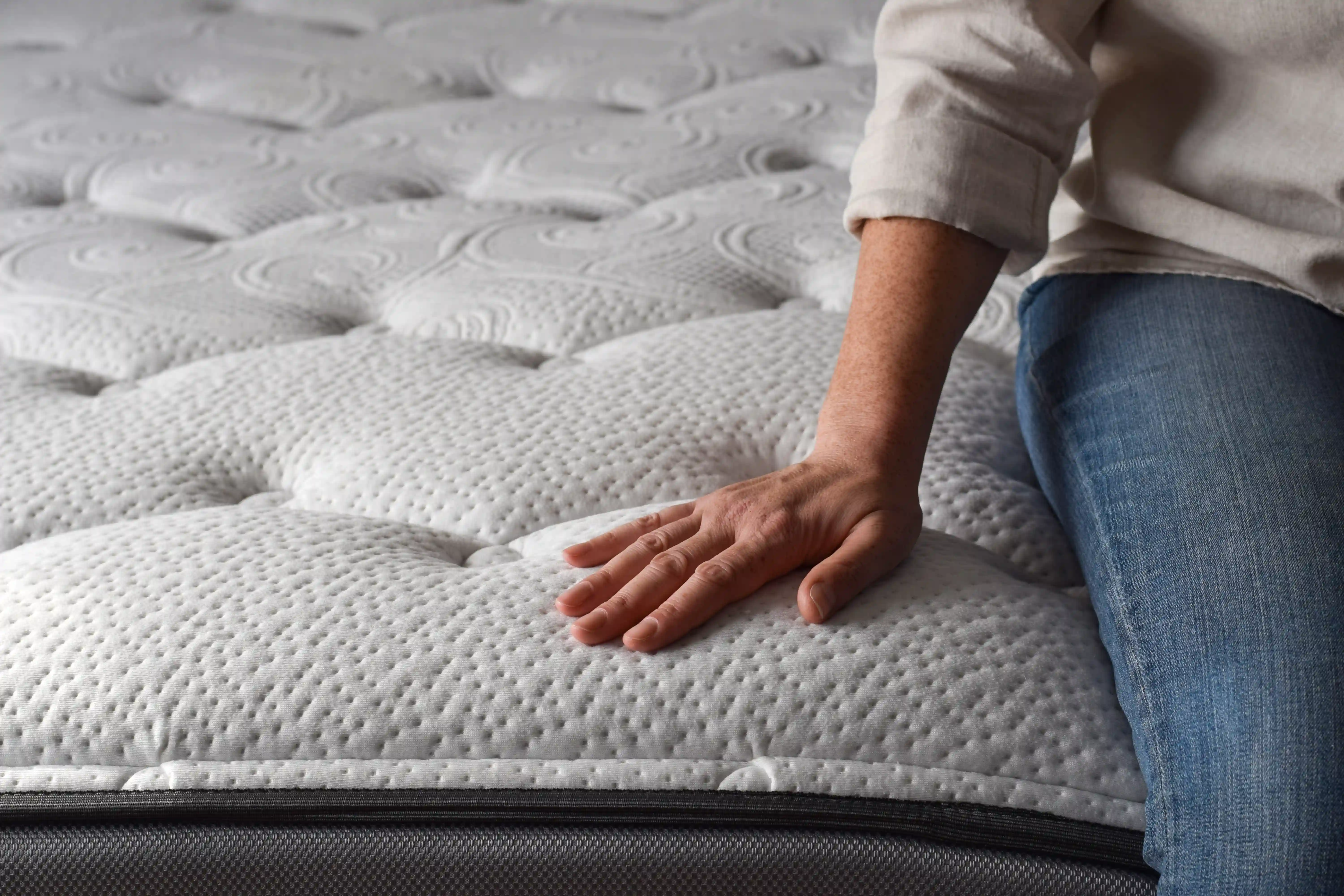
The plush label does not tell you where that change occurs or whether you will like it. A quick hand press mostly samples the upper surface. Lying on the mattress shows how the layers behave together under a larger load and over more time.
What creates a plush feel
Several design choices can soften the first part of the mattress's response:
- More compressible quilting or fiber near the cover
- Softer foam or latex in the upper layers
- Greater depth of cushioning before a firmer transition
- A transition layer that changes resistance gradually
- A cover that stretches enough to let the layers below compress
None of those features works alone. A thick comfort system can still feel relatively firm if its materials resist compression. A thin layer can feel soft at first but allow the sleeper to reach a firmer layer quickly. Density is not a synonym for firmness 2, and a material name such as memory foam, latex, wool, or microcoil does not supply the missing feel information.
Firmness scales and IFD or ILD numbers need context
Retailers often place mattresses on a numbered or named scale. Those scales are useful for comparing options within the same seller's range, but there is no universal conversion that makes one company's plush, soft, medium, or firm label equal to another's.
Foam specifications may include indentation force deflection (IFD), indentation load deflection (ILD), or another indentation-hardness result. These measurements can help describe a tested foam sample, but they do not automatically describe the feel of a complete mattress.
Test method and conditions matter. ISO 2439 contains several indentation-hardness methods for flexible cellular materials and states that results relate only to the specified test conditions 3. CertiPUR-US technical guidelines, for example, specify the sample dimensions, indentation percentage, and ASTM method used for a polyurethane foam IFD result 2.
Before comparing numbers, ask:
- Which material and layer was tested?
- What method, sample thickness, indentation percentage, conditioning, and units were used?
- Is the figure for a component sample or the finished mattress?
- Are both numbers from comparable tests?
Without that context, do not translate an IFD or ILD number into a cross-brand firmness ranking.
Judge the exact model by what you can observe
| Question | What to check on the exact mattress |
|---|---|
| Ease of movement | Whether you can change position and get out of bed without fighting a slow or deep surface |
| Edge use | How the edge behaves while sitting, lying near it, and getting up |
| Temperature | Your experience with the actual cover, protector, sheets, room conditions, and amount of contact with the surface |
| Partner motion | What you feel when the other person turns, sits down, or leaves the bed on the intended frame |
| Bottoming through | Whether the upper layers compress until you feel an abrupt, much firmer layer below |
| Mattress height | Whether the combined mattress and base height works for getting in and out of bed and for the bedroom furniture |
| Sheet fit | Whether fitted sheets and protectors accommodate the finished height and stay secure without tightening the surface |
These observations depend on the person and the complete model. Plush does not guarantee easier movement, better edge stability, less partner motion, or a particular sleep temperature. It also does not identify one suitable body weight or sleep position.
Use a short store comparison
Start within one product line, where the seller's labels are most likely to be internally useful.
- Compare the plush option with the next firmer option on the same type of base.
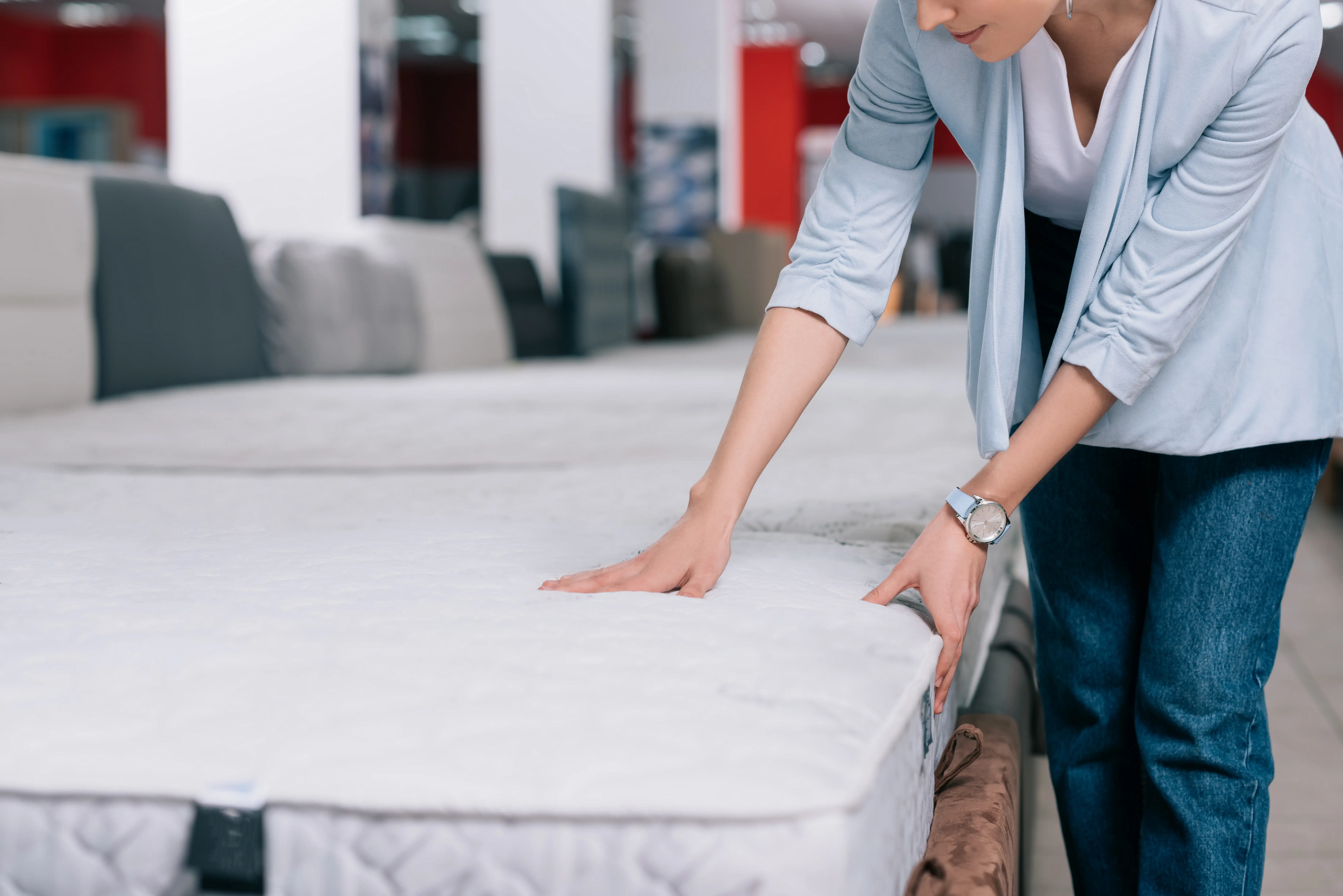
- Lie in the positions you actually use instead of relying on a hand press or sitting only at the edge.
- Change position, move toward the edge, and get out of bed.
- If two people share the mattress, repeat the movement checks together.
- Notice both the first contact and what happens after the upper layers compress.
A showroom sample may have a different age, use history, temperature, protector, or base from the mattress delivered to your home. Treat the store comparison as a way to narrow the choice, not as proof that a new mattress will feel identical.
Make the home trial do the final work
Before ordering, read when the trial begins, whether a minimum-use period applies, how an exchange differs from a return, and who pays pickup, shipping, restocking, or disposal costs. Check whether opened products, floor samples, exchanges, or mattresses with marks or odors are treated differently.
During the trial:
- Use the foundation, frame, center support, and slat spacing required for that model.
- Use the protector and sheets you expect to keep, since a tight or padded layer can change the surface.
- Judge ordinary movement, edge use, temperature, partner disturbance, and whether you reach a firmer layer below.
- Keep the law tag, receipt, packaging instructions, and written trial terms.
- Decide before the return window closes rather than assuming a comfort concern will be covered by the warranty.
Also confirm adjustable-base compatibility, total mattress and base height, delivery access, setup service, and whether the mattress can be rotated. Do not flip or rotate it unless the care instructions allow it.
A body impression is not automatically a warranty defect
A body impression is a visible or noticeable change where the mattress has been used. A warranty defect is whatever the written warranty defines. The two are not synonyms.
As checked on July 26, 2026, one mattress warranty separates a visible indentation measured without weight from normal softening and comfort preference, and it ties coverage to use on an adequate base 4. That is an example of how a policy can work, not a universal threshold for plush mattresses.
The Federal Trade Commission advises reading a warranty before purchase because coverage, exclusions, remedies, claim steps, and possible shipping or labor costs can differ 5. Ask these questions while you can still compare sellers:
- What indentation depth is covered, and how is it measured?
- Are softening, comfort preference, quilting settlement, or body impressions excluded?
- What base, frame, center support, or slat spacing is required?
- What photos, measurements, receipt, and law-tag information are needed?
- Who inspects the mattress, and who pays transport or inspection costs?
- Is the remedy repair, replacement, store credit, or a prorated charge?
A plush mattress is worth considering when you prefer the exact model's cushioned surface and can still use the bed comfortably during a meaningful trial. The label starts the comparison. The construction, observed behavior, setup, and purchase terms finish it.