

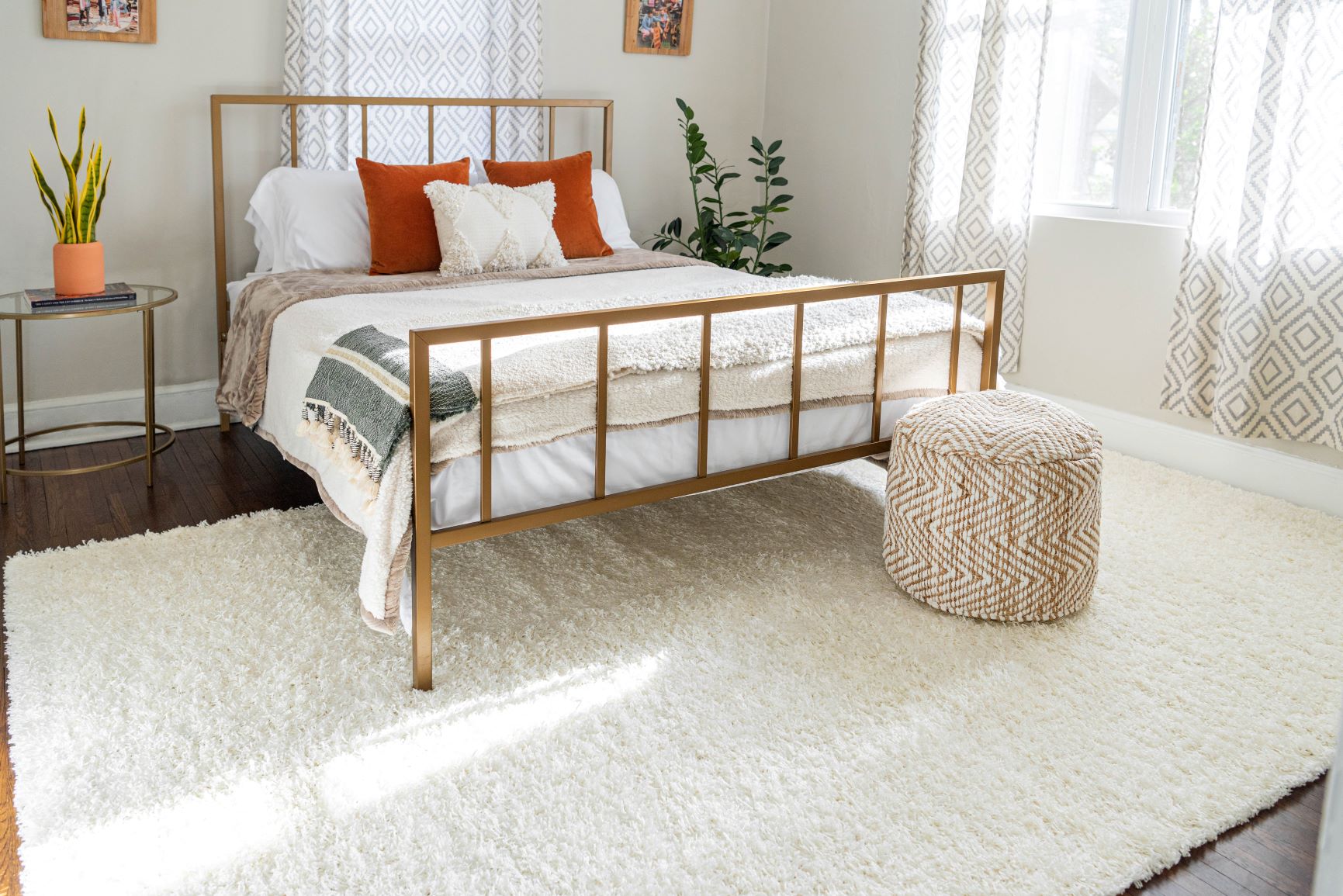
No single rug size is required under a king bed. The right dimensions depend on the complete bed frame, any nightstands or bench you want on the rug, the rug's position, the room's usable clearances, and where you want your feet or mobility aid to land.
Each of these common nominal sizes can work in a different plan: 8 by 10, 9 by 12, or 10 by 14 feet. Those labels are starting points, not answers. Measure the layout first, then compare it with the rug's actual finished dimensions.
Start with the bed you actually have
A standard U.S. king mattress is nominally 76 inches wide by 80 inches long. A California king is 72 inches wide by 84 inches long 1.
| Mattress category | Nominal width | Nominal length |
|---|---|---|
| Standard king | 76 inches | 80 inches |
| California king | 72 inches | 84 inches |
These measurements describe the mattress, not the assembled furniture. Side rails, upholstery, shelves, a headboard, and a footboard can add several inches. For one concrete example, as checked on July 26, 2026, an IKEA king frame made for a 76-inch-wide mattress had a published outer width of 82 1/4 inches 2. That example is not a size rule. It shows why measuring the frame matters.
Record these dimensions:
- The bed frame's widest point, including projecting upholstery or hardware
- The frame's full length, including the headboard and footboard
- The location of every leg or floor contact point
- The combined outer span of the nightstands if they may sit on the rug
- The depth and leg positions of a bench or chest at the foot
- The rug-free distance needed for doors, drawers, vents, and walking routes
If you have not selected the bed yet, use the manufacturer's outer dimensions rather than adding a guessed allowance to the mattress.
Choose the layout before the size
The rug only needs to cover the parts of the plan that matter to you. Four layouts are practical starting points.
Full bed on the rug
In this layout, all bed legs sit on the rug. The headboard may be on the rug, behind its edge, or mounted to the wall. Nightstands can remain on the floor or join the bed on a wider rug.
Mark the outermost bed legs and the area where each sleeper steps down. If the nightstands are included, measure from the outside of one nightstand to the outside of the other. Check that every furniture leg is supported evenly. A nightstand or bench that straddles the rug edge may tilt or wobble because the rug and pad create a change in height.
Lower two-thirds or another partial-bed placement
“Lower two-thirds” is common shorthand for a rug that begins below the nightstands and passes under the lower part of the frame. This can put rug beneath the side landing areas and at the foot without covering the whole bed.
Do not select the start line by calling it exactly one-third or two-thirds of the bed. Sit in the positions where you normally get in and out, mark where your feet land, and place the proposed rug edge far enough toward the head of the bed to keep that landing area on the rug. Then measure from that start line to the farthest footboard, bench leg, or desired rug edge.
Runners beside the bed
One runner on each occupied side can cover the standing area without going under the frame. A foot runner is another separate option.
Measure each open floor strip after placing the bed and nightstands. A runner should not enter a door swing, sit beneath an unstable furniture leg, or end where a person pivots out of bed. Secure edges and evaluate whether multiple floor transitions create a problem. For someone at increased risk of falling, small area rugs or runners may be a poor choice even when they fit.
Oversized rug beneath the furniture group
A larger rug can include the bed, nightstands, and bench. Measure the bounding rectangle around every item that should sit on it, then add only the exposed rug area you actually want.
An oversized plan still has to preserve the route through the room. Do not let the rug reach a closet track, block a floor register, interfere with drawers, or remove the clear space needed to turn a wheelchair or position a walker.
How common rug sizes compare
Retail catalogs offer rectangles labeled 8 by 10, 9 by 12, and 10 by 14 feet, but availability does not make any one size correct for a king bed. As checked on July 26, 2026, these were among the nominal sizes in one seller's guide 3.
| Nominal rug size | Dimensions in inches | What to test under a king bed |
|---|---|---|
| 8 by 10 feet | 96 by 120 inches | With the 120-inch side across the bed, test a lower-bed layout or a measured full-bed layout that leaves the required landing area |
| 9 by 12 feet | 108 by 144 inches | With the 144-inch side across the bed, test whether the added width includes the landing areas, frame, or selected nightstand legs |
| 10 by 14 feet | 120 by 168 inches | Test an oversized layout, including any bench or nightstands, against room, door, vent, and mobility clearances |
Rotate the dimensions if your room and layout require it. The long side does not have to run across the bed, although that orientation often provides more side coverage.
Nominal size can also differ from finished size. As checked on July 26, 2026, Rugs USA told its own customers that products from its vendors may vary by up to 5 percent from published dimensions 4. That is one seller's tolerance, not an industrywide rule. Ask the seller for the expected finished range and measure the delivered rug before positioning heavy furniture.
Use an exact measuring method
A fixed rule about how many inches a rug must extend beyond a bed ignores frame width, foot placement, and the room. Use this method instead:
- Place or tape the complete frame footprint. Include the headboard, footboard, side rails, and every floor contact point.
- Add the other furniture. Tape the nightstand and bench footprints in their planned positions.
- Mark the functional zones. Sit on each occupied side and mark where feet land. Mark the path to the door, bathroom, closet, and dresser. Add the space used by a walker, wheelchair, cane, or transfer aid.
- Choose the rug start and end lines. Decide which furniture legs and landing zones belong on the rug. Keep other legs fully off it.
- Measure the resulting rectangle. Record its width and length in inches. Include fringe only if it occupies usable floor space, but do not count fringe as stable support beneath furniture.
- Tape the candidate rug size. Open every door and drawer. Walk the routes, sit and stand from the bed, and move any mobility aid through the full plan.
- Add the pad and pile height. Confirm that the combined thickness clears doors, mechanisms, furniture, and any low storage drawers.
- Compare actual product dimensions. Check the seller's finished-size tolerance, backing, edge construction, and return terms before installation.
Here is a worked example, not a rule. Suppose a frame measures 84 inches wide and you decide, after marking your foot positions, that you want 20 inches of exposed rug on each side. The required rug width is 84 + 20 + 20, or 124 inches. An 8-by-10 rug turned with its 120-inch side across the bed would be four inches too narrow for that plan. A 9-by-12 turned with its 144-inch side across would meet the width requirement if the room and other clearances also work.
Change the inputs and the answer changes. If the frame is narrower, the landing area is smaller, or the rug covers only the lower part of the bed, an 8-by-10 may work. If the nightstands span more than 144 inches, a 9-by-12 cannot hold them fully even though it is often marketed for king bedrooms.
Check the room before ordering
Doors, closets, drawers, and walking paths
Open the bedroom door, closet doors, and drawers through their full travel over the taped outline. Check the rug plus pad and pile height, not the bare rug alone. A door that clears painter's tape may catch a thick edge.
Walk the route in low light as well as daylight. Keep cords, footwear, and other objects out of the path. If the rug edge lands in a frequent turn or transfer point, move the rug, change the layout, or omit it.
Vents and floor registers
Do not cover supply or return openings with the rug, pad, or furniture. ENERGY STAR home guidance specifically advises keeping heat registers and vents clear of furniture and rugs to preserve airflow 5.
Mark each register before taping the rug. Leave enough access to remove the grille or service the opening according to the HVAC system's instructions.
Accessibility and mobility aids
The right clearance is personal to the user and their equipment. Test the actual wheelchair, walker, cane, transfer board, or caregiver position in the taped room. Pay attention to rug edges, fringe, soft pile, pad movement, and transitions between the rug and hard floor.
In settings covered by the ADA Standards, an accessible route is generally 36 inches wide and a circular turning space is 60 inches in diameter. The standards also restrict changes in level within required clear and turning spaces 6. These values can inform planning, but they are not a blanket legal rule for every private bedroom and may not be sufficient for a particular person or device. Use any applicable housing requirements and an occupational therapist's or accessibility professional's measurements when access is a priority.
Prevent slipping, curling, and unstable furniture
A rug that fits geometrically can still create a hazard. The National Institute on Aging advises keeping carpets firmly fixed to the floor and avoiding throw rugs or small area rugs as part of fall prevention for older adults 7.
Before putting the bed in place:
- Use a pad or securing method that the rug maker and flooring maker permit
- Keep the pad inside the rug perimeter so it does not create an exposed edge
- Flatten shipping curls and inspect bound edges and fringe
- Confirm that every bed, nightstand, and bench leg sits level and stable
- Recheck the rug for shifting, ripples, curled corners, damaged backing, and pad movement
- Remove the rug if it cannot stay flat and secure for the people using the room
A thick or soft pile may change how a walker rolls, how a cane tip plants, or how stable a narrow furniture leg feels. Test the complete rug-and-pad system rather than judging pile from a sample alone.
Account for an adjustable base
A powered base adds moving links, motors, cables, a power supply, and sometimes two independently moving halves. The rug, pad, fringe, and any loose edge must remain clear of all moving and electrical components.
Follow the exact base manual. Tempur-Pedic's troubleshooting guidance, for example, tells owners to check under the base for cords or bedding obstructing movement 8. Its EASE 4.0 manual requires two people to move the base, says not to drag it across the floor, and directs users to test the functions before placing the mattress on it 9.
Before installation:
- Return the base to the position specified by its manufacturer and disconnect power if instructed.
- Route the power supply and cables exactly as the manual shows.
- Keep rug edges, pad, fringe, and securing materials outside every moving or pinch area.
- Confirm that all legs contact the same stable surface unless the manufacturer approves another setup.
- Restore power and test the full range while watching beneath and around the base.
If the manufacturer does not address rugs, ask it whether the selected placement and pile height are permitted. Do not assume that clearance under one adjustable-base model applies to another.
Choose material and pile for the room's use
Rug material does not determine one universal best choice. Compare the exact product on:
- Finished dimensions and dimensional tolerance
- Pile and pad thickness
- Edge, fringe, and backing construction
- Compatibility with the finished floor and any radiant-floor system
- Shedding and whether fibers can reach a moving base
- Vacuum settings and clearance beneath the frame
- Spot-cleaning, drying, and professional-cleaning instructions
- Whether heavy furniture can remain in place during cleaning
- Return conditions after the rug has been unrolled or placed under furniture
A large rug beneath a king bed is difficult to remove for cleaning. If the care plan requires frequent lifting or rotation, a lower-bed layout or secured side rugs may be easier, provided those smaller pieces do not create a fall risk. Choose from the maintenance you can actually perform, not from material labels alone.
Plan the installation before moving the bed
A king mattress, frame, or split adjustable base can be heavy and awkward. Do not try to pull a large rug into place while the assembled bed is partly lifted.
Remove bedding and the mattress, then disassemble or move the frame only as its manufacturer directs. Protect cables and hardware, use the required number of people, and hire qualified help when the product weight or room makes handling unsafe. Lay and secure the rug and pad, verify their final position, then reassemble the bed and confirm that every support point is stable.
Photograph cable routing and hardware before disassembly. Keep the rug's care instructions and the bed or base manual available for future cleaning, service, or removal.
The bottom line
An 8-by-10, 9-by-12, or 10-by-14 rug can fit under a king bed, but none is a universal answer. Standard king and California king mattress dimensions are only the beginning. The complete frame, furniture, foot landing, room clearances, vents, mobility needs, rug pad, and mechanisms determine the required footprint.
Choose the layout first, tape and test it, then buy from actual finished dimensions. If the rug cannot remain flat, clear, stable, cleanable, and compatible with the bed, a different size, runner arrangement, or no rug is the better fit.