
Best for
- Couples who want an adjustable-firmness design.
- Couples comparing split-feel or adjustable mattresses.
- People who want firmness tuning more than a simple foam or hybrid feel.
Pick one or more traits above and we will show the strengths and watch-outs that matter for this mattress.
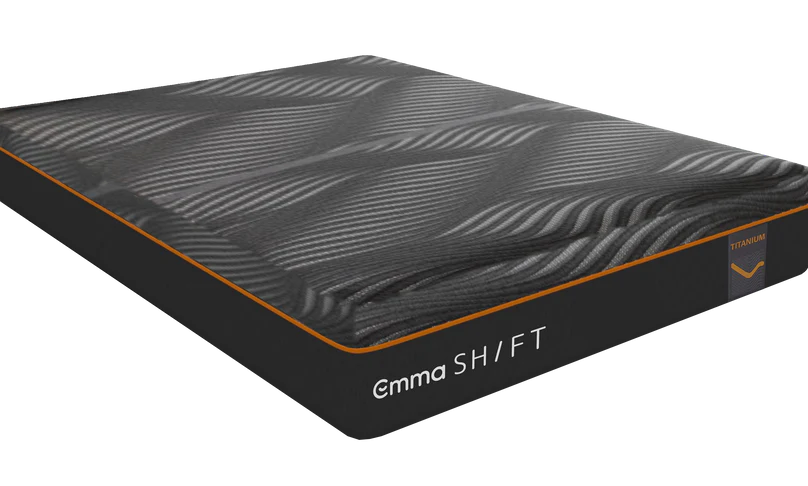
Choose the Emma Shift if adjustable firmness and independent side settings matter more than a simple construction. Compare a conventional mattress if you do not want inserts, components, or setup complexity.
Evidence basis: pressure relief scored 8.9/10. Sinkage measured 1.66–1.72″ and the comfort system measured around 7.0″, giving it enough surface cushioning to help many side and combination sleepers without feeling deeply engulfing.
Evidence basis: support scored 8.7/10. Sinkage measured 1.66–1.72″, lying-edge support was rated Excellent, and the 13.5″ measured profile gives the support system enough depth for many back and combination sleepers.
Evidence basis: peak-to-peak acceleration measured 4.78–4.98 m/s², supporting the Exceptional motion-isolation score. That low transfer is especially useful when partners choose different firmness settings.
A fixed 12 lb load creates the impact while an accelerometer records the movement that crosses the mattress.
Evidence basis: cooling scored 8.9/10. The measured 1.66–1.72″ sinkage keeps sleepers from sinking too deeply into the surface, which helps the mattress avoid the close, heat-trapping feel of deeper memory-foam beds.
Evidence basis: sitting-edge compression measured 2.94–3.06″ and lying-edge support was rated Excellent. The stable perimeter makes more of the surface usable for sitting and sleeping.
We measure seated compression, then check how secure the surface remains while lying directly along the edge.
Evidence basis: the surface mostly recovered in 0.39–0.41 seconds and fully recovered in 1.18–1.22 seconds, while bounce measured 5.97–6.21″. Position changes feel controlled rather than springy.
Evidence basis: the 13.5″ profile, 7.0″ comfort system, and Excellent edge performance are encouraging structural signs. Long-term usefulness also depends on the condition of the adjustment components and whether replacement parts remain available.
Confirm the written purchase protections attached to the specific listing before buying.
The appeal is adjustability for couples and pressure-relief tuning.
The strongest performance claims stay tied to testing, not to brand copy alone.
Emma's brand and policy pages establish availability and policy context. Trial, return, and warranty protections follow the exact seller's written terms.
Emma's brand and policy pages establish availability and policy context. Trial, return, and warranty protections follow the exact seller's written terms.
Shows that Emma Shift is not presented as a standard current catalog item.
Documents current Emma policy and warranty context.
Model checkedJun 20, 2026Discontinued
Configuration reviewedAdjustable foam and air · 13.5″ · Adjustable from Medium 5/10 to Slightly firm 7/10; complete suite tested at Medium firm 6/10
The latest model check found that the brand no longer sells this model new.
Memory foamMemory foam · Top
2.0″The top memory-foam layer supplies contouring and pressure relief above the adjustable chamber. Memory foam conforms under sustained load, spreading pressure over a larger contact area. Its thickness and position influence contour depth and how quickly the sleeper reaches firmer layers below.
Why it matters: Across the Emma Shift Mattress, pressure-relief testing landed around 8.9/10. This is one of the layers most responsible for shoulder and hip cushioning; sleepers who dislike a close contour should compare it with the mattress’s recorded sinkage and recovery.
Adjustable air chamber and foam perimeterCentral air chamber surrounded by polyurethane foam · Comfort
5.0″A non-electronic side dial changes chamber pressure and can tune each side independently; the foam perimeter helps stabilize the edge. This reinforcement is intended to resist perimeter compression, helping the outer sleeping surface remain usable when someone sits or lies near the side.
Why it matters: For the Emma Shift Mattress as a whole, sitting-edge compression measured around 3.00″. The meaningful check is the finished mattress’s seated compression and lying stability, not the presence of an edge-support label by itself.
Transitional poly foamPolyurethane foam · Transition
2.0″Transitional foam separates the adjustable chamber from the base and spreads load into the support core. This layer buffers the sleeper from the firmer support core and controls how gradually resistance increases as the body sinks deeper.
Why it matters: In the finished Emma Shift Mattress, sinkage measured around 1.69″. It becomes especially important for higher-weight sleepers and back or stomach sleepers, who engage more of the mattress depth than lighter sleepers.
Support foamHigh-density polyurethane support foam · Support
4.5″The base foam supports the adjustable comfort system and completes the 13.5-inch profile. This foundation resists deep compression and keeps the comfort layers working on a stable plane; it is not intended to provide the mattress’s initial plushness.
Why it matters: Across the Emma Shift Mattress, edge support scored 9.2/10. Its thickness and material quality are more relevant to long-term shape retention and bottoming-out resistance than to surface softness.
Choose if: You want two firmness options in one current mattress without adjustable hardware.
Watch out: Both sleepers must use the same side at a given time.
Read reviewChoose if: You want soft, medium, or firm options with a simpler fixed construction.
Watch out: Firmness cannot be changed at home after purchase.
Read review