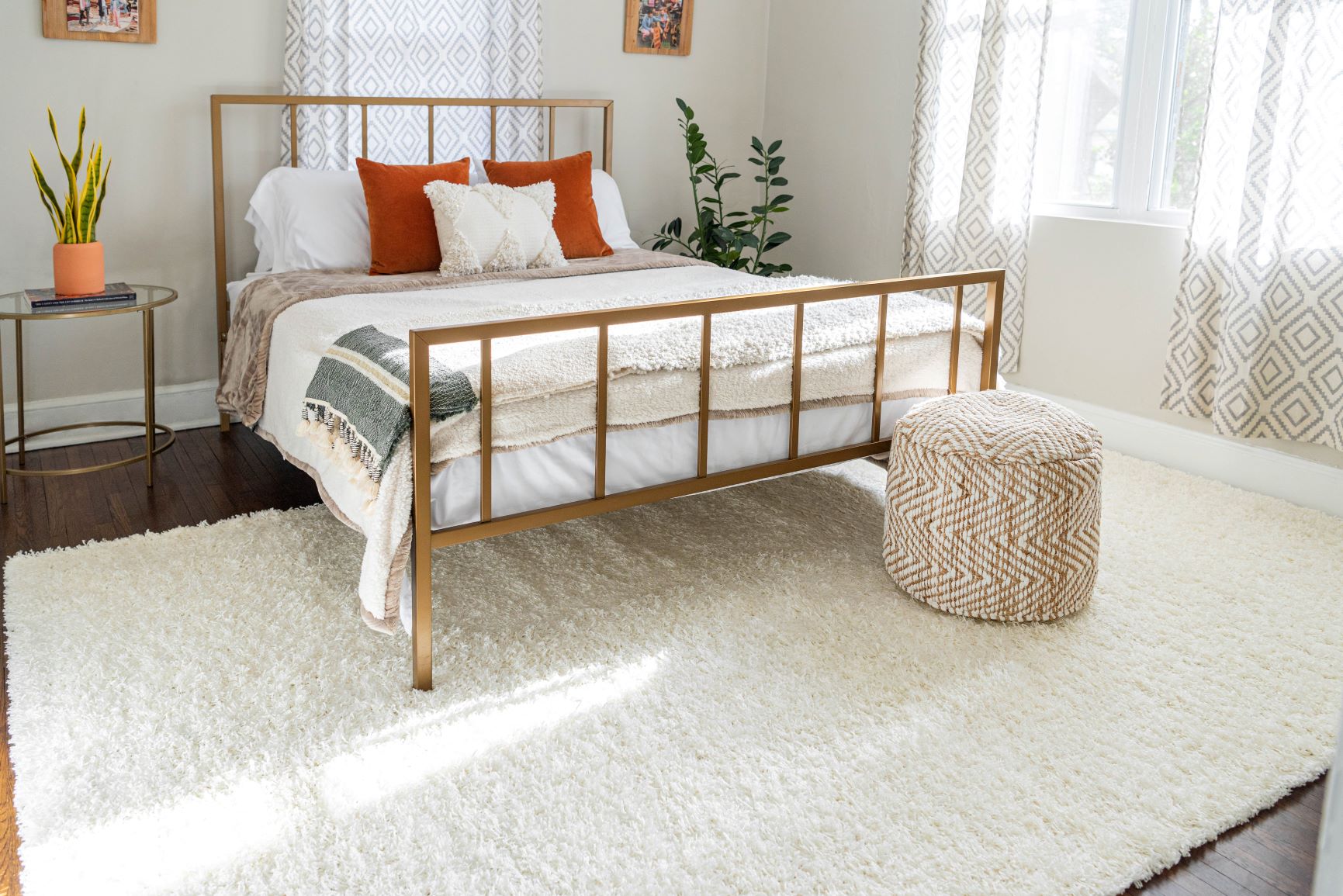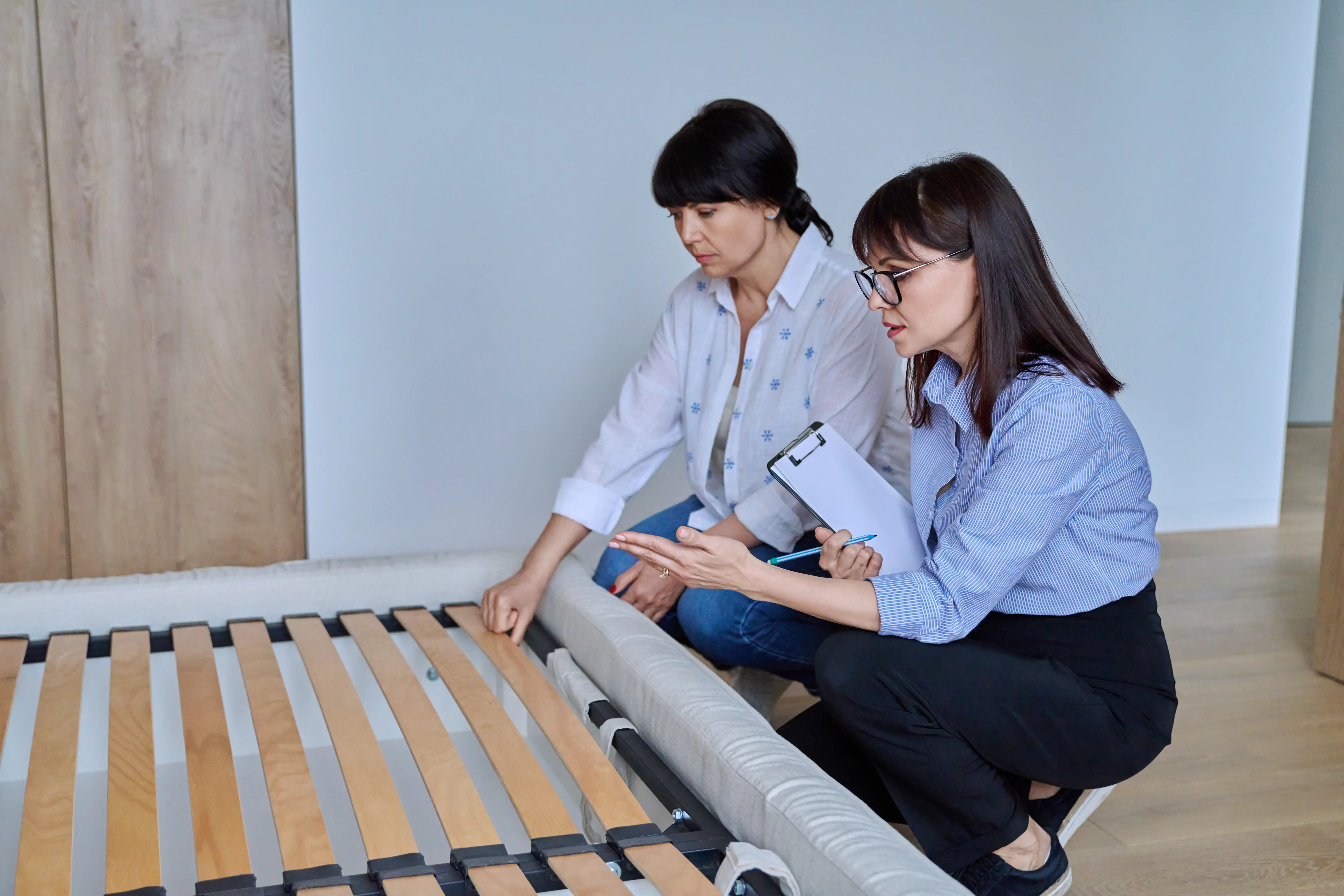


A good bed frame is one that safely supports your specific mattress, fits the room, and can handle the total load placed on it. Style matters, but it comes after compatibility. A frame that looks right can still be the wrong choice if its slats are too far apart, it lacks required center support, or an adjustable base cannot move freely inside it.
Start with the mattress instructions and warranty, then compare them with the frame manual. Both sets of requirements have to be met. There is no universal slat gap, load limit, or rule about box springs that applies to every mattress and frame.
Bed frame, platform, foundation, or box spring?
Product names overlap, so look at what each piece actually does:
| Part | What it is | What to check |
|---|---|---|
| Bed frame | The outer structure, often with side rails and legs. It may hold a mattress directly or hold a separate base. | Whether it includes a support deck, slats, center rail, and required legs. |
| Platform bed | A frame with an integrated solid or slatted surface for the mattress. | Whether that surface meets the mattress maker's requirements without another foundation. |
| Foundation | A usually rigid, mattress-sized base that sits under the mattress, often upholstered to resemble a box spring. | Whether the mattress maker approves it and what must support the foundation underneath. |
| Box spring | A base containing springs or flexible components, traditionally paired with some innerspring mattresses. | Whether the mattress was designed for a flexible box spring. Many current mattresses are not. |
| Adjustable base | A powered or manual base that raises and lowers sections of a compatible mattress. | Mattress flexibility, interior frame dimensions, leg or zero-clearance setup, power access, and moving clearances. |
| Headboard | A panel attached to the frame, base, or wall. Some frames include one, but it is not usually the mattress support. | Attachment method, wall or frame compatibility, and stability. |
A decorative style such as a sleigh, canopy, Japanese-inspired low bed, or upholstered bed may use any of several support systems underneath. The style name does not tell you whether the mattress can rest directly on it.
Check mattress support before choosing the frame
Find the current care or warranty document for the exact mattress model. Record its requirements for:
- approved support types, such as a solid platform, slats, a rigid foundation, or an adjustable base
- maximum space between slats and any minimum slat width or thickness
- a center rail, center legs, or a specific number of legs
- whether a traditional box spring is allowed
- ventilation or floor-clearance requirements
- adjustable-base compatibility
Manufacturer rules can differ by a small but important amount. For example, Tempur-Pedic says a qualifying slatted frame for its mattresses may have slats at least 3 inches wide and no more than 4 inches apart. It also says a traditional box spring is not approved for those mattresses 1.
Purple's current mattress warranty uses a maximum gap of 3.5 inches for slats without an added foundation. It also calls for center support and at least five to six legs for queen, king, and California king sizes 2.
These are examples for those companies' products, not general bed-frame standards. Check the documents supplied with your own mattress and frame. If the manuals conflict or do not answer the question, ask both manufacturers before buying or modifying anything.
Do not assume a board will fix wide slats
Adding plywood or a bunkie board may seem like a simple fix, but it can change ventilation, loading, and warranty coverage. Some manufacturers allow a specific type of board and others do not. Use one only when both the mattress and frame instructions permit it.
Check the entire support chain
Support does not stop at the mattress surface. A rigid foundation may still need a perimeter frame with a center rail and legs. An adjustable base placed inside a decorative bed may still depend on the surrounding frame's rating or cross supports.
Add up every part of the load:
- mattress
- foundation or adjustable base, if the frame carries it
- all sleepers
- children or pets that may climb onto the bed
- bedding and anything stored or placed on the frame
Then confirm what the advertised load rating includes. A "user weight" rating, a total static limit, and the amount a motor can lift are not necessarily the same. Ratings may also apply to each half of a split base rather than to the whole bed.
One Tempur-Ergo Smart manual, for example, gives separate limits for the powered base and for a furniture bed or platform supporting that base. That distinction is specific to the named model, but it shows why the subject of each rating matters 3.
Measure the mattress, frame, and room
A size label is only a starting point. Mattress dimensions can vary slightly, and the outside of a frame can be much larger than the mattress because of rails, upholstery, a headboard, or a footboard.
Before ordering, measure:
- the mattress's actual length, width, and height
- the inside dimensions and support height of the frame
- the frame's full outside footprint
- the finished bed height with every layer included
- doors, stairs, elevators, corners, and ceiling height along the delivery path
- usable floor space around the bed
- drawer, trundle, or lift-up storage clearance
- outlets and cord routes for a powered base
Mark the outside footprint on the floor with removable tape. Open nearby doors and drawers while the outline is in place. Leave enough room for the people using the bed to walk, change bedding, and reach storage without squeezing around sharp corners.
If you are considering a canopy, bunk, loft, or wall bed, measure vertically as well. Include the mattress thickness, guardrail height, sitting headroom, ceiling fixtures, and the full path of any part that opens or folds.
Choose a usable bed height
Frame height is only one layer. Add the frame support height, foundation, and mattress to estimate the finished height. If getting in and out is a concern, compare that measurement with a bed or stable chair that is already comfortable to use.
A low platform can make a room feel open and may leave little storage underneath. A taller frame can create more storage but also raises the step up and the distance of a possible fall. There is no ideal height for everyone.
Choose a frame type by how the room is used
Traditional perimeter frame
A simple metal or wood perimeter frame often supports a separate foundation, which then supports the mattress. Some versions include crossbars or slats for direct mattress support, while others do not. Confirm the intended setup from the assembly diagram.
This type can be easier to move than a large platform, but a frame with only a perimeter and no suitable cross support should not be treated as a platform bed.
Platform bed
A platform combines the visible frame and the support surface. It can have fixed slats, roll-out slats, a metal grid, or solid panels. Check the gaps, fasteners, center supports, and airflow rather than relying on the phrase "no box spring required."
Storage bed
Storage beds may use drawers, shelves, a trundle, or an ottoman-style lifting deck. Measure the space needed to open every component. Ask whether the listed load capacity includes stored items, and keep storage clear of center legs, vents, electrical cords, and moving mechanisms.
A lifting deck has hinge and pinch areas. Use its handles, keep hands clear of the mechanism, and do not let a child operate or play inside the storage compartment. If a gas strut, hinge, or latch is damaged, stop using the lift until the maker supplies the correct repair.
Adjustable base
An adjustable base usually replaces a fixed foundation. The mattress must be approved to flex with it. A decorative frame can sometimes surround the base, but only if the interior dimensions, support method, and moving clearances match the base manual.
Check whether the base uses its own legs or is rated for a zero-clearance setup on another platform. Make room for motors, linkages, retainer bars, power supplies, and cables. Do not store objects where the base can catch or crush them.
Bunk, loft, and wall beds
These are specialized structures, not ordinary frames placed higher or attached to a wall. Buy a complete, labeled product that meets the rules where it is sold, and use only its specified mattress size, hardware, guardrails, supports, and anchors. Do not copy a safety-critical setup from a photo.
Materials and construction
Wood, engineered wood, and metal can all make a stable frame. Material alone does not establish strength or lifespan. A well-braced frame with sound joints can be more reliable than a heavier-looking frame with weak connectors.
Look at:
- how side rails connect to the head and foot
- the number and placement of cross supports
- whether center legs reach the floor without leaning
- welds, brackets, and bolt holes
- the thickness and attachment of slats
- replacement-part availability
- the published load rating and warranty exclusions
Upholstery adds cleaning needs and can hide some fasteners, so find out how inspection points are accessed. With a secondhand frame, locate the model label and manual before assembly. Skip it if key hardware, structural parts, safety labels, or guardrails are missing.
Under-bed storage and cleaning access
Measure from the floor to the lowest real obstruction, not just to the side rail. Center legs, crossbars, motors, and fabric linings may reduce usable space.
Closed drawers keep contents contained but need pull-out room. Open space accepts flexible bins and is easier to inspect, but stored items can touch slats or interfere with airflow. Do not block heating vents, cover a power supply, or pack items against an adjustable mechanism.
For a child's room, avoid leaving a space that encourages climbing into a moving storage compartment. Secure nearby top-heavy dressers and other furniture according to their instructions. The CPSC advises following manufacturer directions and installing the anti-tip devices supplied with top-heavy furniture 4.
Prevent noise and protect the floor
A squeak does not automatically mean the frame is weak, but a new noise is a reason to inspect it. Common contact points include loose bolts, slats rubbing against rails, a headboard touching the wall, an uneven leg, or metal parts moving against each other.
Remove the bedding and press one area at a time to locate the sound. Then:
- Confirm that the frame is level and every required leg reaches the floor.
- Tighten the specified hardware in the sequence and to the tightness described in the manual.
- Check that slats, caps, and retainers are seated correctly.
- Use only manufacturer-approved pads, washers, or lubricants.
- Stop using the frame if a joint, weld, slat, rail, or fastener is cracked, bent, stripped, or pulling free.
Felt pads can protect hard floors under stationary legs, while suitable cups can spread the load under casters or narrow feet. Choose pads that do not let the bed slide or make a required center leg too short. On carpet, check that every leg reaches the same firm level rather than resting on a soft rug edge.
Assemble and move the frame safely
Read the full manual before opening every hardware bag. Confirm the model, parts list, required tools, wall type, and number of people needed. Keep children and pets away from packaging, small hardware, and an incomplete structure.
During assembly:
- use the supplied fastener in each named location
- do not substitute a similar-looking bolt or drill new holes unless the manufacturer approves it
- support long rails and heavy panels while they are being connected
- install every cross brace, center leg, retainer, and safety lock
- square and level the frame before final tightening
- test for movement before adding the mattress
Do not drag a large assembled frame across the floor. Follow the disassembly instructions, label the hardware, and carry parts with enough help. Powered bases may have a required flat position and approved lift points. One Tempur adjustable-base manual, for example, calls for two people and specifically says not to drag the base across the floor 3.
Recheck the structure after a move. If parts have loosened, use the maker's tightening or replacement procedure. Do not repair a structural crack with tape, glue, or an improvised bracket.
Safety checks for special frames
Bunk and loft beds
In the United States, bunk beds are subject to federal requirements intended to reduce falls and entrapment. Upper bunks require guardrails, and the CPSC rules control openings around the guardrail, mattress foundation, and bed ends. The guardrail must remain at least 5 inches above the top of the mattress, which is why the product's maximum mattress thickness matters 5.
Follow the warning label and use the exact mattress size and thickness it names. Do not place a child under age 6 on the upper bunk 6.
Keep both guardrails installed, use the intended ladder, and do not tie ropes, belts, cords, or similar items to the bed. Regularly inspect guardrails, ladder connections, slat supports, welds, and all structural hardware. Stop using a bunk if a support is loose, cracked, or missing.
Wall beds and wall-mounted headboards
A wall bed must be anchored to the wall structure exactly as its manual specifies. The correct fastener depends on whether the wall is wood framing, masonry, or another construction. If the instructions call for professional installation, or you cannot identify the wall structure, hire a qualified installer.
This is not a cosmetic detail. CPSC recalls have involved wall beds that could detach from the wall and fall, creating impact and crushing hazards 7.
A wall-mounted headboard also needs the specified bracket and suitable wall fasteners. A frame-mounted headboard should use the matching brackets and should not rock when gently tested. Do not add a wall anchor to a frame merely because another model uses one.
Adjustable bases and pinch points
Keep people, pets, bedding, cords, and stored items away from the moving mechanism. Check underneath before changing position, and use a child lock if the model provides one. Tempur-Pedic's Ergo Smart manual warns that children and pets can be trapped in moving parts and instructs users to engage its remote lock when appropriate 3.
Unplug the base before inspecting connections or removing an obstruction, unless its manual gives a different emergency procedure. Do not open a motor or control box or force a stuck section by hand.
Warranty checks that are easy to miss
Read the mattress warranty and frame warranty before purchase. Look for:
- required foundation or frame construction
- exclusions for inadequate support, moisture, modification, commercial use, or moving damage
- proof-of-purchase and product-label requirements
- whether photos of the mattress support system are needed for a claim
- who supplies replacement hardware
- whether coverage transfers to a second owner
Purple, for example, says it may require proof that a sufficient foundation and frame were used consistently for a mattress warranty claim 2.
Save the receipt, manual, model and serial labels, hardware list, and a few clear photos of the completed support system before the mattress is placed on it. If you later change the foundation or adjustable base, check compatibility again.
Bed frame buying checklist
Before committing to a frame, confirm:
- The mattress maker approves the support type.
- Slat gaps, slat dimensions, center support, and legs meet both manuals.
- The whole support chain is rated for its actual load.
- The mattress and any foundation fit inside the frame.
- The finished height works for the people using it.
- The outside footprint, storage movement, and delivery path fit the room.
- Adjustable parts have enough clearance and safe power access.
- Required anchors, guardrails, locks, and hardware are included.
- Replacement parts and warranty terms are clear.
The best frame is not a particular material or style. It is the one whose dimensions, support system, rating, and instructions match the mattress, the room, and the way the bed will be used.