
Choose a blanket by its finished width and length, not by the word queen, king, or throw on the package. Measure the mattress and decide how the blanket will be used, then compare those measurements with the product specifications.
There is no universal blanket chart that guarantees a fit. Pendleton, for example, lists one Full/Queen blanket at 90 by 90 inches 1. IKEA lists one Full/Queen blanket at 88 by 92 inches 2. The same nominal label can therefore describe different proportions, and ranges also vary by brand and region.
Measure the bed before choosing a size
Use a flexible tape measure and record these numbers:
- Mattress width: Measure across the top from side to side.
- Mattress length: Measure the top from head to foot.
- Mattress height: Measure from the top surface to the bottom edge of the mattress. Do not assume the advertised profile still applies after adding a topper or pad.
- Side drop: Measure from the top edge of the mattress to the point where you want each side of the blanket to end.
- Foot drop: Measure from the top edge at the foot to the desired endpoint.
- Head offset or fold-back: Note whether the blanket starts below the pillows and whether you want extra length to fold back at the head.
A quick calculation gives a useful target:
| Target measurement | Calculation |
|---|---|
| Blanket width | Mattress width + left side drop + right side drop |
| Blanket length | Mattress length - head offset + foot drop + fold-back allowance |
If both side drops are equal, blanket width is the mattress width plus twice the side drop. If you want the blanket to reach the bottom edge of the mattress, the side drop is roughly the mattress height. Add any desired overhang below that point.
These calculations describe a flat blanket. Thick, lofty, or stiff products may lose some usable coverage as they curve over sleepers and the mattress edge. When fit is close, trace the planned path with the flexible tape, or arrange a sheet to the proposed dimensions and test it on the bed.
Functional coverage and decorative overhang are different
A sleeping blanket only needs enough drop to keep the user covered without being pulled away by normal movement. A bedspread or decorative top layer may extend to the lower edge of the mattress, bed frame, or nearly to the floor. That larger visual drop is not automatically a better sleeping fit.
Check that a long blanket will not rest on a dusty floor, block a vent, or become a trip hazard. A shorter blanket can also be intentional when it will sit between a top sheet and a comforter rather than dress the whole bed.
Tucking changes the calculation
For a blanket tucked at the foot, measure from its planned top edge, along the mattress, down the foot, and under the mattress to the desired stopping point. Repeat across the width if the sides will also be tucked.
There is no reliable universal tuck allowance. A thin cotton blanket and a bulky wool blanket take different amounts of fabric to turn under the mattress. Deep mattresses and tight platform frames can also make a theoretically generous tuck impractical.
Measure the people using it
Bed measurements describe how a blanket looks on the mattress. Body measurements determine whether it works while someone is under it.
For one person, check that the blanket can cover from the intended upper point to beyond the feet, with enough width to turn over without uncovering the back. For two people, decide whether one blanket must cover both bodies and still leave usable material at each outside edge. Two individual blankets can be a better fit when sleepers prefer different warmth, pull bedding in opposite directions, or use separate adjustable mattress sections.
A throw is usually chosen for a person, chair, or sofa rather than a mattress. Measure shoulder-to-foot coverage for lounging, then add the amount needed to wrap around the body. The label throw does not promise a particular size.
How bed labels affect the choice
Bed names are useful search filters, but they are not substitutes for measurement. A current Sealy collection, for example, lists Twin Long, California king, and split sizes with specific dimensions and notes that individual mattresses may vary 3.
| Bed or use | What to check |
|---|---|
| Twin and twin XL or dorm bed | Twin XL is intended to be longer than twin, so verify blanket length as well as width. Measure the dorm mattress because its height and supplied topper can change the required drop. |
| California king | It is commonly longer and narrower than a standard king in the same U.S. product line. A king blanket may have enough width but too little foot coverage, so compare actual dimensions. |
| Split king or split California king | Measure the combined bed for one shared blanket. Measure each mattress separately for independent blankets, especially when adjustable sides move at different times. |
| RV, antique, custom, or other nonstandard bed | Ignore the nearest retail name. Measure the sleep surface, height, clearances, and desired drop directly. |
| Daybed, sofa bed, or bunk | Check walls, rails, frames, and moving parts. A large decorative drop may be unusable even when the top dimensions match. |
Adjustable beds need a movement check
Measure an adjustable bed while flat, then raise the head and foot to positions that are actually used. Confirm that the blanket still covers the sleepers, does not become tightly trapped, and stays clear of moving hardware as directed by the base manufacturer.
On a split adjustable bed, one wide blanket can bridge the center but may move when only one side changes position. Separate blankets preserve independent movement. The right option depends on whether shared coverage or independent adjustment matters more.
Blankets, comforters, and duvet covers are sized differently
A bed blanket is a flexible layer that may be tucked, stacked, or used only over the body. A comforter or duvet insert is usually a loftier top layer, so its finished width and length determine both body coverage and visible drop.
A duvet cover must fit the insert itself, not merely carry the same bed label. Compare the actual width and length, closure, and any internal ties or loops. IKEA lists one Full/Queen duvet cover at 86 by 86 inches 4. Its Full/Queen SKOGSFRÄKEN insert is also listed at 86 by 86 inches 5. That pairing is specific to those products and should not be transferred to another brand's Full/Queen system.
An insert that is substantially smaller than its cover can shift and leave empty edges. One that is substantially larger can bunch. If mixing brands, compare the numbers and the attachment design before buying.
Read every dimension on the package or product page
Look for finished product dimensions. Shipping-package measurements describe the folded parcel, not the opened blanket. On the IKEA Full/Queen example above, the blanket is listed at 88 by 92 inches, while its package is 15 by 15 by 9 inches 2.
Also check:
- whether the order is width by length or length by width
- whether fringe, trim, or tassels are included in the measurement
- whether stated dimensions are before or after washing
- whether the maker gives a manufacturing tolerance
- whether the care instructions warn of shrinkage
- whether the return policy allows the item to be washed or opened
The same IKEA product warns of maximum shrinkage of 4 percent 2. That is a product-specific allowance, not a rule for fleece or for all IKEA blankets. If a 90-inch dimension could shrink by 4 percent, it could finish near 86.4 inches. Use the percentage stated for the exact product, and ask the manufacturer whether listed dimensions are prewash or postwash if the page is unclear.
Follow the care label. Buying extra fabric cannot compensate for washing or drying a product in a way its instructions prohibit.
Layering and sharing can change the best size
Blankets in a layered bed do not all need the same footprint.
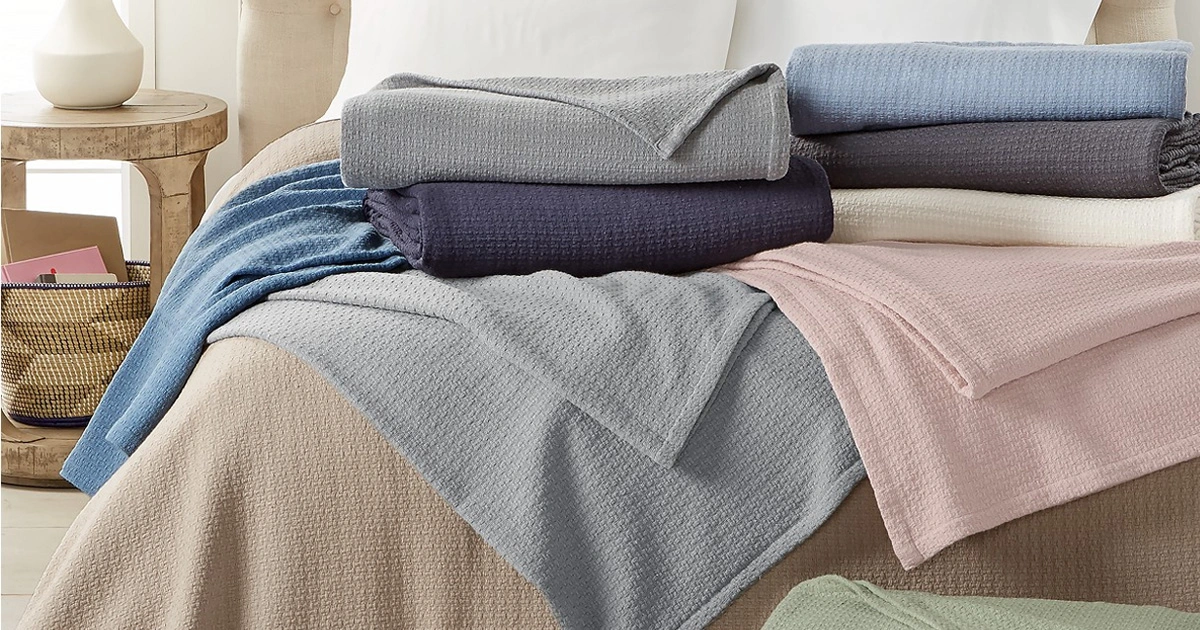
- A lower blanket can end near the mattress edge while a comforter provides the decorative drop.
- A folded blanket at the foot can be chosen for the width of the bed or intentionally stop short at both sides.
- A shared sleeping blanket needs enough width for both sleepers, even if a narrower decorative cover goes over it.
- Two smaller blankets can sit beneath one larger comforter on a shared bed.
Consider the practical weight and wash load too. A larger blanket may provide more coverage but be harder to lift, store, or fit into a home washing machine. Check the care instructions before treating the next nominal size up as the safer choice.
What to do when your target falls between sizes
Compare the shortfall or excess on each dimension rather than automatically sizing up.
Choose the larger option when the smaller one cannot cover the sleepers, mattress height, or required tuck. Choose the smaller option when the larger one would drag, interfere with a frame, overwhelm a compact washer, or add unwanted weight. Separate blankets, a custom size, or a different brand may solve the problem more cleanly than accepting a poor fit.
Before committing, mark the proposed outline on the bed with a sheet, string, or removable tape. This shows where each edge will land and whether the result works with pillows, a footboard, and bedside clearance.
Weighted blankets need a different sizing decision
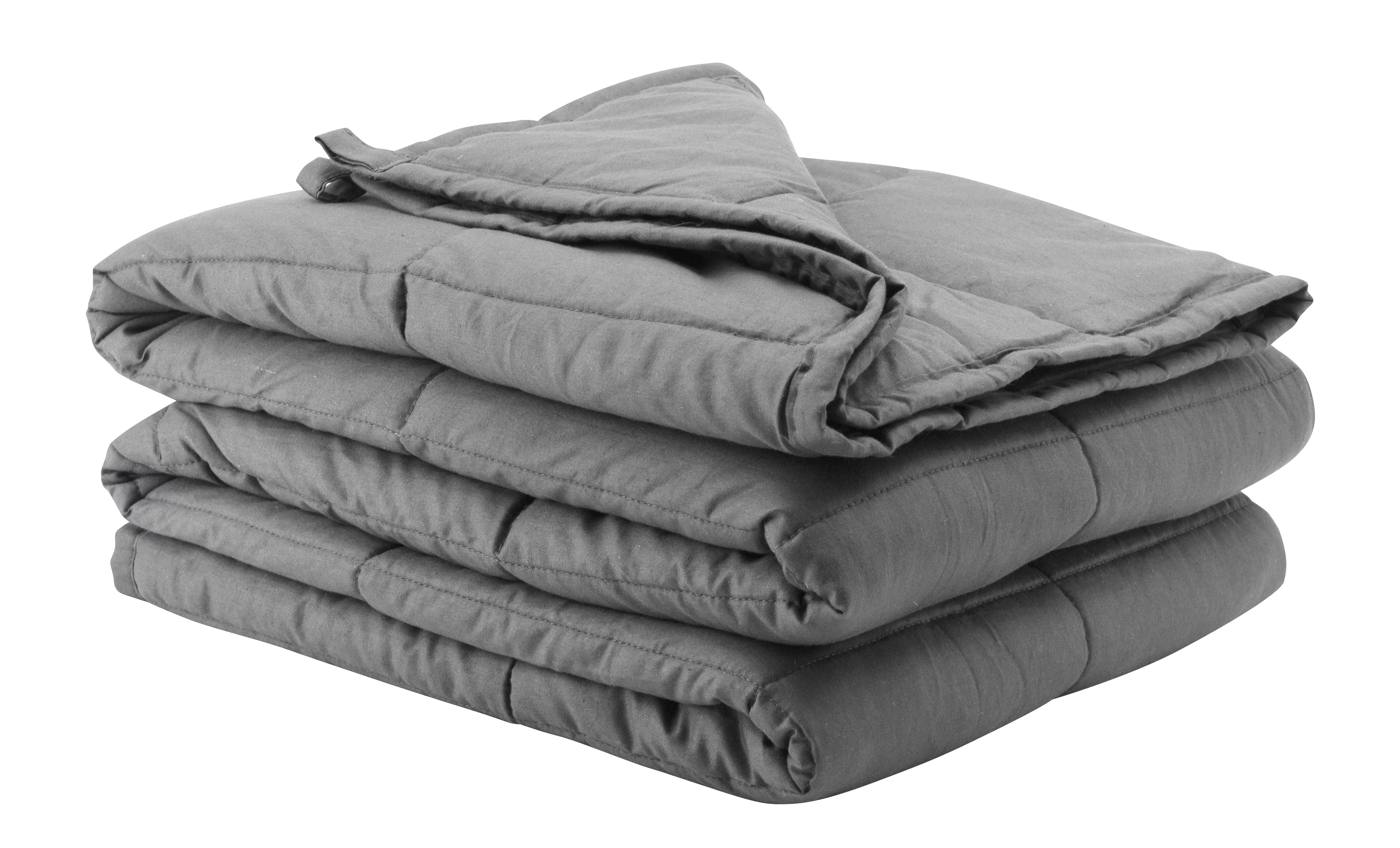
A weighted blanket is selected for the user, not for a decorative mattress drop. Follow the size and weight instructions for the exact product rather than applying a universal body-weight percentage.
The user must be able to move freely and remove the blanket independently. Keep the head and neck uncovered, do not roll or restrain someone in it, and do not let the weighted blanket hang over the bed sides. Guidance from an NHS occupational therapy service also advises considering conditions or medicines that affect breathing, circulation, skin, temperature control, alertness, or the ability to remove the blanket 6.
Ask a clinician or occupational therapist before use when those concerns apply. A child requires product-specific age guidance and a safety assessment, not a scaled-down adult formula.
Blankets do not belong in an infant sleep space
No size of loose blanket is safe bedding for an infant. The U.S. Consumer Product Safety Commission advises keeping cribs, bassinets, and play yards bare except for a fitted sheet, and specifically says not to add blankets or use weighted blankets or weighted swaddles 7.
A product sold as a baby blanket, crib blanket, or cradle blanket may be useful during supervised awake time, but its label does not make it safe for infant sleep. Do not tuck a loose blanket around an infant and do not use one for sleep in a car seat or stroller.
For warmth, the NIH Safe to Sleep campaign suggests suitable sleep clothing or a wearable blanket instead of adding items to the sleep area 8. Choose a nonweighted wearable product using that manufacturer's height, weight, neck, and armhole instructions, and check it for correct fit and recalls.
For an older child who is past infancy, choose a blanket the child can move and remove easily. Check the product's age guidance, finished dimensions, care label, and current recall information rather than relying on a generic child-size chart.
Final fit check
Before removing tags, place the unwashed blanket on the bed and confirm:
- the measured width covers both sleepers and reaches the intended side endpoints
- the length covers the body and reaches the intended foot endpoint
- the blanket works with pillows, a footboard, layers, and any tuck
- adjustable or split sections can move as intended
- no edge drags, snags, or creates a trip hazard
- the care method and possible shrinkage still leave enough coverage