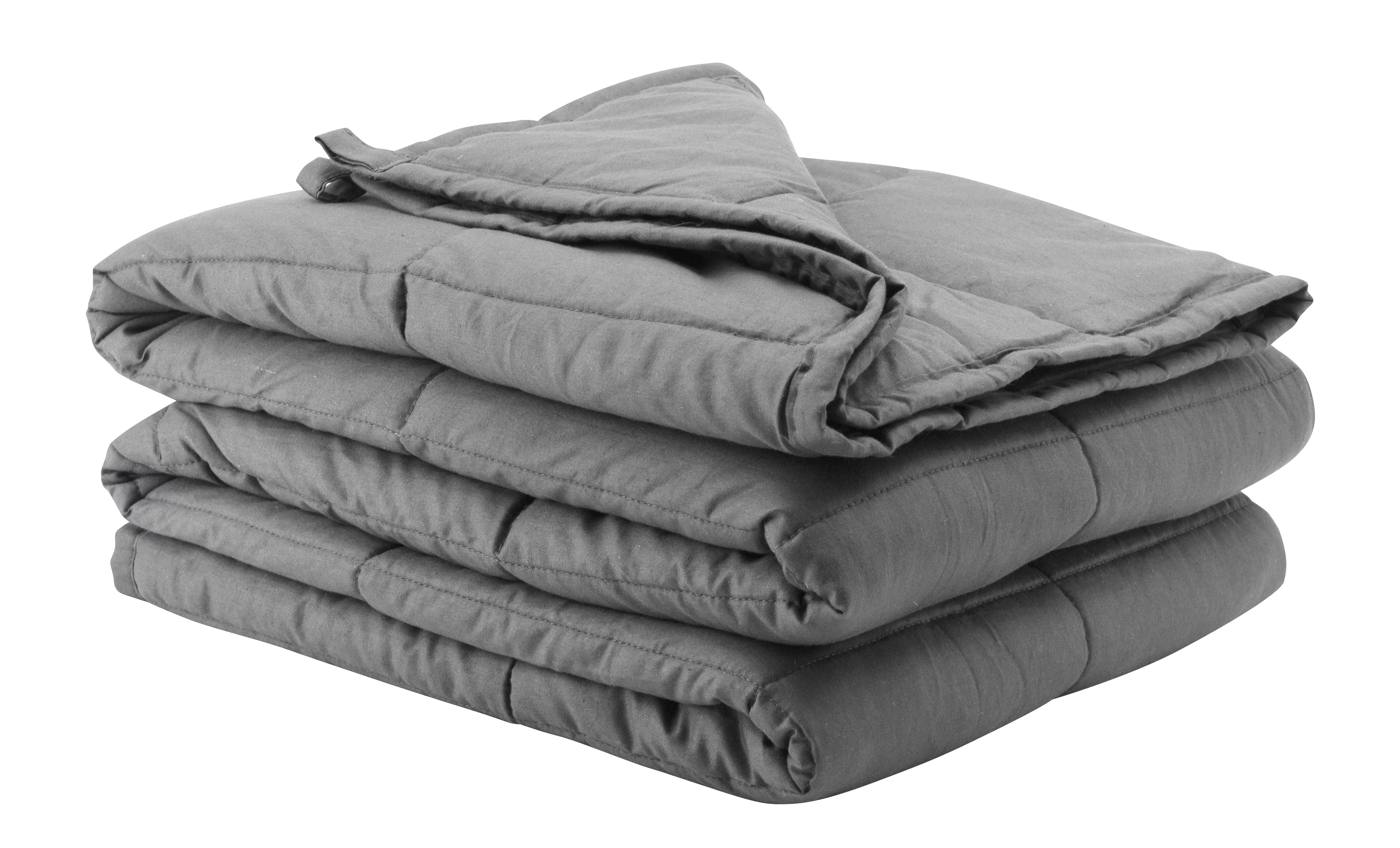


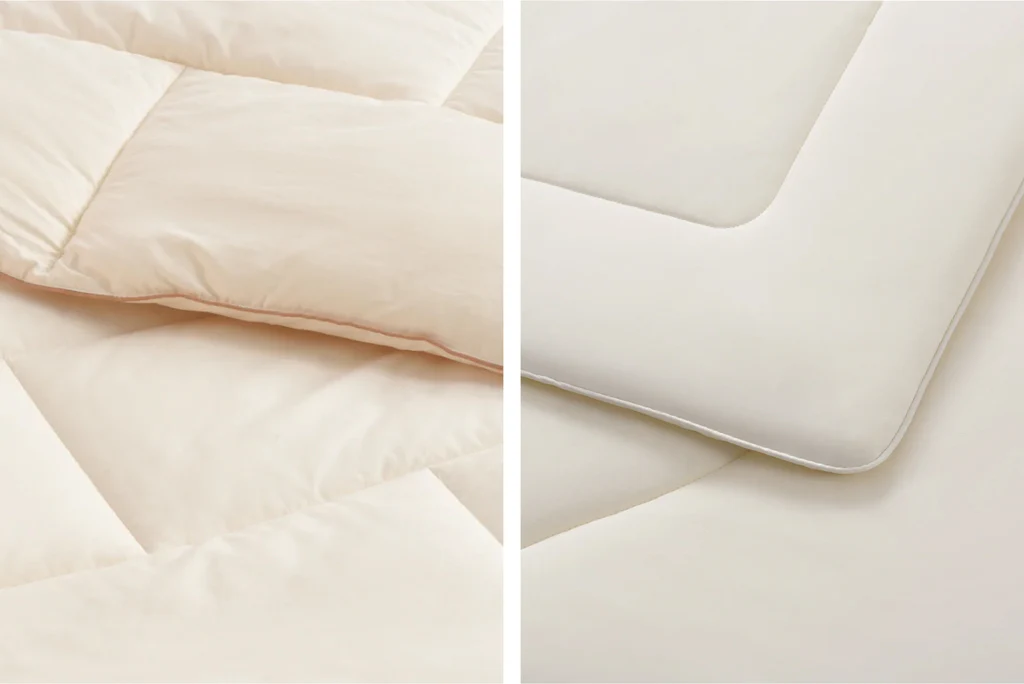
A duvet commonly means a filled insert intended for a removable duvet cover, while a comforter commonly means a finished quilted bed covering used without a separate cover. The terms are not strict product standards, however. Regional usage overlaps, and retailers may use "duvet," "duvet insert," and "comforter" for the same item 1 2 3.
The dependable comparison is therefore not the name on the product page. Check whether you are buying one piece or an insert-and-cover system, then compare the fill, shell, stitching, actual dimensions, care label, and complete price.
Duvet vs. comforter at a glance
| Feature | Typical duvet setup | Typical comforter setup |
|---|---|---|
| Pieces | Filled insert plus removable cover | One finished filled covering |
| Bed setup | Insert must be placed and aligned inside the cover | Ready to place on the bed |
| Routine surface cleaning | Cover can usually be removed and washed separately | Whole comforter is cleaned, unless you add a separate cover |
| Style changes | Change the cover while keeping the insert | The visible shell is part of the comforter |
| Shifting risk | Fill can shift within the insert, and the insert can shift within the cover | Fill can shift within its stitched compartments |
| Warmth | Depends on the specific insert and cover | Depends on the specific comforter |
| Cost | Add the insert, cover, and any spare covers | Usually one main purchase, unless sold with or placed in a cover |
These are common arrangements, not universal definitions. A product sold as a comforter may have corner loops for a duvet cover. A product sold as a duvet insert may also be described as a comforter in its specifications. Oxford's learner dictionary even gives "comforter" as a North American alternative for duvet 1.
Start with the construction, not the name
Both products usually begin with a fabric shell around an insulating fill. The meaningful difference is how the finished item is meant to be used.
A typical duvet system
The insert supplies most of the loft and warmth. A separate cover encloses it like a large pillowcase. Buttons, a zipper, snaps, or ties close the cover. Interior ties may attach to loops on the insert.
The cover gives you a washable exterior and lets you change color, pattern, or fabric without replacing the insert. It also adds weight and another fabric layer. Changing it can take time, especially on a large bed or when the insert has no attachment loops.
A typical comforter
The visible shell, fill, and quilting form one finished piece. You can place it directly over a top sheet or other bedding. The color and texture are fixed unless you put the comforter inside a separate duvet cover.
"One piece" does not mean the fill cannot move. Quilting, channels, and internal baffles divide the fill into compartments, but the amount of movement depends on compartment size, fill type, and construction.
Why the names overlap
Retail catalogs show how fluid the terminology is. One current IKEA page is titled "duvet insert" but repeatedly calls the same product a comforter. Naturepedic sells one item as a "Down Duvet Insert" and also calls it a comforter 2 3.
Treat "duvet" and "comforter" as useful clues, then verify:
- Is a removable cover included, sold separately, or not expected?
- Is the item itself decorative, or is it a plain insert?
- Does it have corner loops or tabs?
- What are the exact dimensions?
- What do the product label and care instructions call for?
Fill and shell materials
A duvet insert and a comforter can use the same materials. The category does not tell you what is inside.
Common fills include:
- down
- feathers
- a down-and-feather blend
- polyester or another manufactured-fiber fill
- wool
- cotton batting
- silk or other specialty fibers
Common shells and covers include cotton, polyester, lyocell, rayon, linen, silk, wool, and blends. Each combination can differ in weight, hand feel, sound, air permeability, drying time, and care.
In the United States, comforters and other household bedding fall under federal textile-labeling requirements. Covered products generally must identify fiber content, country of origin, and the responsible manufacturer or marketer. Fill used for warmth must be disclosed separately where needed to avoid deception 4.
Read the shell and fill lines independently. "Cotton comforter" may describe the shell while the fill is polyester. "Down alternative" is a product category, not one specific fiber, so the label should tell you what the alternative actually is.
Down is not the same as feather
Down consists of soft waterfowl clusters, while feathers have a more defined structure and quill. A down-and-feather blend can feel and behave differently from a high-down-content fill 5.
A U.S. label that says "100% down" must be truthful. The Federal Trade Commission says an unqualified "down" claim should contain more than 70% down when efficient modern processing is used, and stated percentage claims should allow only modest, unavoidable manufacturing variation. State tagging rules may add requirements 6.
This is why "goose," "duck," "down," and "feather" should not be treated as interchangeable. Check the actual down percentage and species claim rather than assuming a goose image or the word "luxury" describes the fill.
What about allergies and sensitivities?
Do not assume that "natural," "down alternative," or "hypoallergenic" identifies the best choice for every person. If you need to avoid a known material, read both the shell and fill disclosures and ask about finishes or treatments that are not clear.
Also check whether the item can be cleaned using the method you need. A removable washable cover may make routine surface cleaning more manageable, but it does not make the insert maintenance-free. If a clinician has given you a specific allergen-control plan, make sure the product's care limits fit that plan before buying.
Quilting, baffles, and fill distribution
Construction affects loft and shifting in both duvets and comforters.
- Sewn-through boxes: The top and bottom shells are stitched directly together. The seams limit fill movement but create lower-loft lines.
- Baffle boxes: Fabric walls connect the top and bottom shells, creating deeper compartments. The American Down and Feather Council describes baffles as allowing down to enter each box while helping limit later movement between boxes 5.
- Channels: Long compartments permit some redistribution along one direction. This can be useful for adjustment or annoying if fill collects at one end.
- Decorative quilting: The pattern may hold batting in place, but appearance alone does not show how much fill is in each section.
Smaller compartments generally restrict movement more than large open ones, but no design guarantees perfectly even fill forever. Examine whether the compartments look consistently filled and whether the maker gives instructions for shaking, airing, or redistributing the product.
With a duvet system, there are two possible movement problems: fill shifting inside the insert and the whole insert shifting inside the cover. Matching dimensions and compatible corner ties or loops help with the second problem. They cannot correct poorly distributed fill inside the insert.
Which is warmer?
Neither category is automatically warmer. A light duvet insert can be cooler than a heavily filled comforter, and a warm comforter can exceed a low-insulation duvet.
Warmth depends on the whole assembly:
- fill material, amount, and loft
- stitched or baffled construction
- shell and cover fabrics
- product dimensions and how well it seals around the sleeper
- other layers on the bed
- bedroom conditions and the sleeper's own warmth preference
Retail warmth names such as "light," "all season," and "extra warm" are useful within one manufacturer's range. They are not standardized temperature guarantees across brands.
Fill power is not the same as fill weight
Fill power measures the volume, in cubic inches, occupied by an ounce of down under a specified test. It describes down's loft and warmth-to-weight potential, not the total quantity of down in the product 5.
Fill weight is how much fill the item contains. It must be considered with the product's dimensions, fill power, and construction. A king-size item will usually need more fill than a twin-size item for a comparable build, so raw ounces are not meaningful without size.
The difference is visible in current product specifications. The Company Store sells one down comforter in light, medium, and extra warmth versions using the same stated 600-to-650 fill-power down; the amount of fill changes between warmth versions 7.
A high fill-power number does not, by itself, prove that one finished product is warmer than another. A small amount of high-fill-power down can make a light item. More lower-fill-power down can make a heavier, warmer item. The shell, baffles, and fill distribution still matter.
Fill power also does not describe polyester, wool, cotton, or silk in a directly comparable way. Use the manufacturer's tested warmth category, fill amount or density when provided, and return policy rather than forcing unlike specifications into one ranking.
Thread count is not a complete quality score
Thread count describes fabric density, not the entire product. It does not tell you the fill composition, fill amount, stitching strength, weave, finishing, shrinkage, warmth, or ease of care.
For a shell or cover, inspect fiber content, weave or surface feel, seam quality, down-proof construction when relevant, and care instructions alongside thread count. A larger number is not a substitute for those details.
Cleaning and everyday care
A duvet system usually makes the outermost layer easier to wash because the cover is smaller and less bulky than the insert. That is helpful with pets, children, frequent spills, or limited washer capacity. The tradeoff is removing, washing, drying, and reinstalling the cover.
A comforter avoids cover changes, but cleaning usually means handling the entire filled item. Whether that is difficult depends on its size, weight when wet, care instructions, and your washer and dryer capacity.
Do not infer care from the category or fill alone. Current manufacturer instructions differ even among down products. IKEA specifies machine washing and complete tumble drying for one down-and-feather duvet insert, while Naturepedic recommends professional laundering for best results and gives a different home-washing process for its down insert 2 3.
Use this sequence:
- Read the sewn-in care label and current manufacturer instructions.
- Check that the item can move freely in the washer and dryer. Do not force a bulky item into an undersized machine.
- Follow the stated water temperature, cycle, detergent, drying method, and restrictions.
- Dry a filled item completely before using or storing it. The shell can feel dry while interior fill remains damp.
- Repair an opening or failed seam before washing so fill cannot escape.
A removable cover does not create a universal schedule for washing the insert, and a comforter does not automatically require dry cleaning. Follow the exact item's soil level and instructions rather than a fixed replacement or cleaning calendar.
Sizing, overhang, and cover fit
"Queen," "king," and combined names such as "full/queen" do not guarantee the same dimensions across brands. Compare inches or centimeters, not only the size name.
For a rough side-drop estimate:
Side drop = (covering width minus mattress width) divided by two
This does not account for how much length you want at the foot, whether pillows are covered, or how the item shifts during use. A thick mattress may need a wider covering to create the same visible drop.
For a duvet system, compare the insert with the cover as well as the mattress. A large mismatch can leave empty fabric or force the insert to fold and bunch. Look for:
- exact insert and cover dimensions
- the same number and position of loops and ties
- a closure that is comfortable to use
- enough opening width to insert and remove the fill
A comforter can go inside a duvet cover if the dimensions and attachment method work. It may shift more if it lacks loops, and the extra cover changes the weight, feel, appearance, and care routine.
Durability, style, and total cost
A duvet cover can shield the insert's shell from direct wear and can be replaced if the décor changes. That can extend the useful life of the insert, but it does not guarantee a longer lifespan. Fill breakdown, seam damage, repeated compression, laundering, storage, pets, and daily handling all matter.
A comforter has fewer pieces to buy and manage. If its visible shell stains, fades, or no longer suits the room, however, changing the look may mean adding a cover or replacing the item.
Compare total ownership cost rather than the first price:
- duvet insert or comforter
- duvet cover and any spare cover
- matching shams or pieces you actually want
- home machine capacity, laundromat use, or professional cleaning
- return shipping and warranty terms
- likely repairability of seams, closures, ties, and loops
A low-cost set is not automatically the cheapest long-term option, and an expensive insert is not automatically more durable. Construction and care fit matter more than category.
How to choose
A duvet system may fit better if:
- you want to wash the exterior separately from the bulky insert
- pets, children, spills, or frequent style changes make a removable cover useful
- you want to swap inserts for different seasons while keeping the same cover
- you have space to store an extra insert or cover
- you are willing and physically able to remove, align, and secure the cover
A comforter may fit better if:
- you want one-piece setup and do not want to manage a cover
- you like the finished shell and plan to keep that look
- the whole item fits your available laundry method
- the product's warmth, weight, and dimensions suit the room and sleeper
- its purchase price includes the pieces you need
Use the same checklist for either one
- Measure: Record the mattress width, length, depth, and desired overhang.
- Read both material lines: Check shell and fill separately.
- Check the warmth variables: Look beyond fill power to fill amount, construction, cover, and product-specific warmth level.
- Inspect shifting controls: Compare compartments, loops, ties, and cover fit.
- Plan the laundry: Confirm permitted care, machine capacity, drying access, and what you can realistically handle.
- Account for the household: Consider spills, pets, children, known material sensitivities, and weight preferences.
- Add the real cost: Include the cover, spare pieces, and cleaning.
- Keep an exit route: Check the return window after trying the item under normal room conditions.
Frequently asked questions
Is a duvet the same as a comforter?
Sometimes the words refer to the same filled bed covering. In the common two-piece distinction, the duvet is the insert used inside a removable cover and the comforter is the finished one-piece covering. Confirm the construction and included pieces instead of relying on the name.
Can you use a duvet insert without a cover?
You can if the product is finished for direct use and its instructions allow it. Without a cover, the insert's shell is exposed to more direct soil and wear, and you will need to clean the filled item according to its care label.
Can you put a comforter inside a duvet cover?
Yes, if the dimensions and attachment method are compatible. Check whether the comforter has corner loops and whether the cover has matching ties. A large size mismatch can cause bunching or empty corners.
Is a duvet or comforter better for hot sleepers?
Choose the lower-insulation product that suits your room and weight preference, regardless of its name. Compare the manufacturer's lightest warmth option, fill amount, construction, shell, and any added duvet cover. Avoid assuming that natural fill is always cooler or that synthetic fill is always warmer.
Which option is easier to wash?
A removable duvet cover is usually less bulky than a whole comforter, so routine exterior washing may be easier. The duvet insert still needs care, and some comforters are fully machine washable. The answer depends on the exact label and whether your machines can handle the item.
Does higher fill power mean a warmer duvet?
Not by itself. Fill power describes how much volume an ounce of down occupies. Finished warmth also depends on how much fill is used, the item's size and construction, and the other layers on the bed 5 7.
The bottom line
The practical difference is usually a removable-cover system versus a finished one-piece covering, but the words duvet and comforter overlap too much to make a buying decision on terminology alone.
Compare the actual insert, cover, shell, fill, stitching, dimensions, warmth option, care instructions, and full cost. The better choice is the one you can comfortably use, clean, and keep aligned in your own bedroom.