
Latex foam density is calculated by dividing the foam’s mass by its external volume. A laboratory conditions a representative specimen, measures its dimensions and mass under a named test method, and reports the result, usually in kilograms per cubic meter (kg/m³) or pounds per cubic foot (lb/ft³, often shortened to PCF).
That number tells you how much a specified volume of foam weighs. It does not directly tell you how firm, supportive, pressure-relieving, cool, durable, natural, organic, or medically beneficial a mattress will be.
What latex density actually measures
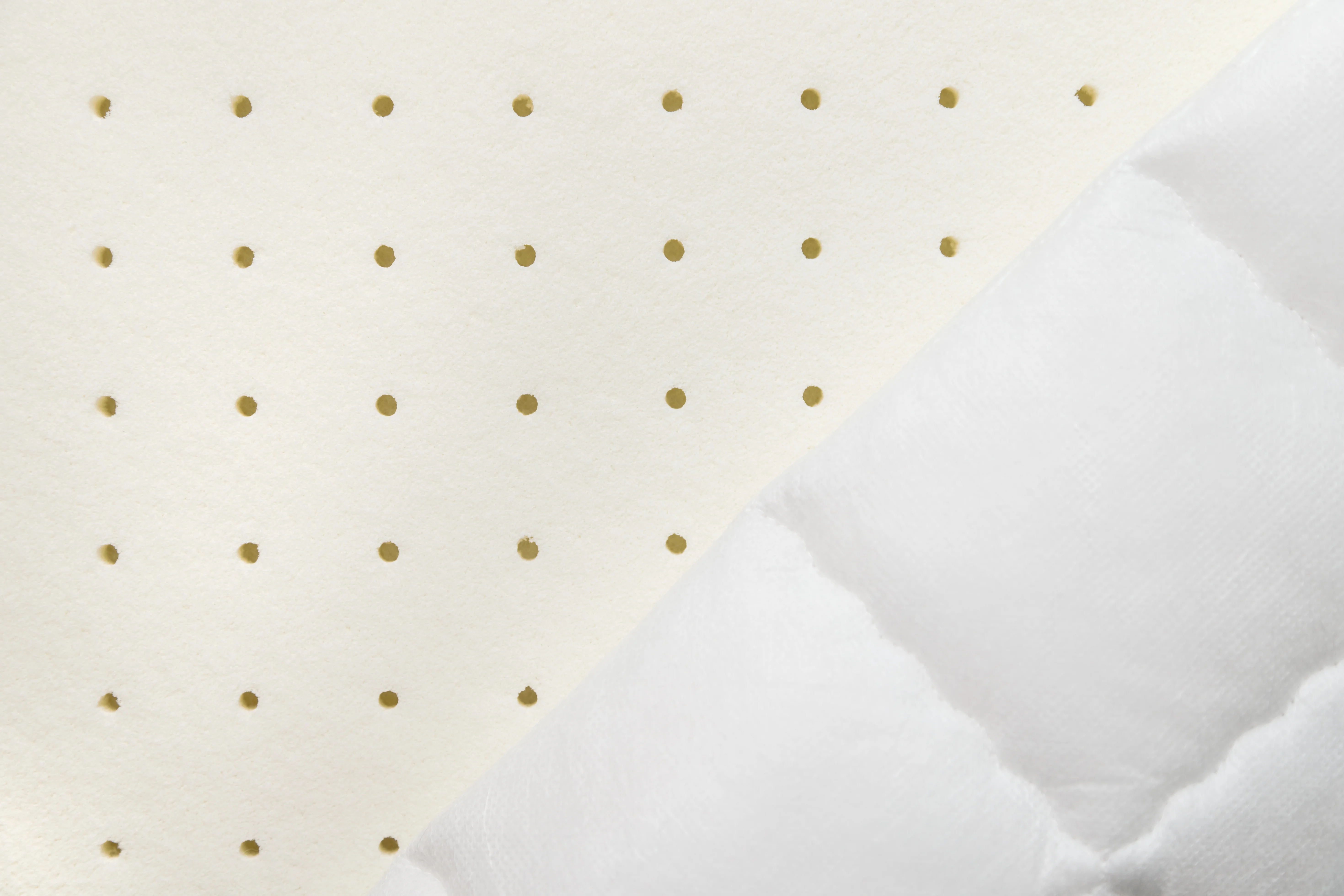
Latex foam contains a rubber matrix and a network of cells. Mattress layers may also have molded pin-core holes or channels. The density listed for foam is an apparent density: the specimen’s mass is divided by the volume bounded by its outside dimensions. It is not the density of solid rubber with every air space removed.
ISO 845 is the current international method for determining apparent overall density and apparent core density in cellular plastics and rubbers. The distinction matters when a molded piece has a surface skin. An overall-density specimen retains that skin, while a core-density specimen does not 1.
The basic equation is:
Density = mass ÷ volume
In SI units:
Density (kg/m³) = mass (kg) ÷ volume (m³)
In U.S. customary units:
Density (lb/ft³) = mass (lb) ÷ volume (ft³)
For a rectangular specimen, volume is length × width × thickness. Suppose a conditioned piece measures 0.30 m × 0.30 m × 0.05 m and has a mass of 0.36 kg:
- volume = 0.30 × 0.30 × 0.05 = 0.0045 m³
- density = 0.36 ÷ 0.0045 = 80 kg/m³
The arithmetic is simple. Producing a comparable value depends on how the specimen was selected, conditioned, measured, and reported.
How a laboratory measures latex foam density
A standardized density test is more controlled than putting a mattress layer on a household scale.
1. Define the material and result
The laboratory identifies the foam, where the specimen came from, and whether the requested result is apparent overall density or apparent core density. This prevents a value from a skinned molded piece being confused with one from its interior.
Pin cores, zoning, molded profiles, bonding, and sampling location can affect how representative one piece is. A useful report therefore describes the material and specimen rather than presenting a number without context.
2. Prepare and condition the specimen
The specimen needs a shape whose volume can be measured without crushing or stretching the cells. ISO 845 refers to standardized conditioning atmospheres and to ISO 1923 for measuring the linear dimensions of cellular materials 1 2.
Conditioning controls avoid comparing one piece immediately after production, packing, or compression with another piece that has stabilized in a different temperature and humidity. The exact preparation and conditioning details belong in the cited method or laboratory report.
3. Measure dimensions without compressing the foam
The appropriate instrument depends on the dimension and the foam’s flexibility. ISO 1923 specifies equipment selection and procedures for sheets, blocks, and specimens of flexible or rigid cellular materials 2.
A soft layer can deform under a ruler, caliper, hand, or uneven surface. Even a small thickness error changes the calculated volume and therefore the density. A laboratory follows the method’s measurement procedure rather than pulling a tape tightly across a mattress.
4. Measure mass and calculate density
The specimen is weighed with a suitable balance, then its mass is divided by the calculated volume. The ISO 845 preview specifies a balance capable of measuring specimen mass to 0.1% accuracy and measuring instruments that follow ISO 1923 1.
The report should state the unit, test method and edition, result type, and any required averaging or rounding. If the number is a production target rather than an individual test result, it should be identified as nominal and accompanied by the manufacturer’s tolerance.
Converting kg/m³ and PCF correctly
NIST gives the conversion factor:
1 lb/ft³ = 16.01846 kg/m³ 3
Use these conversions:
- PCF to kg/m³: multiply by 16.01846
- kg/m³ to PCF: divide by 16.01846
For example, 5.0 PCF is about 80.1 kg/m³, while 80 kg/m³ is about 4.99 PCF. Round only after doing the conversion. A seller’s 5 PCF and 80 kg/m³ descriptions may therefore refer to the same nominal specification, not two different foams.
Watch for unit mistakes. Pounds per cubic foot is not the same as pounds per square foot, and kg/m³ is not the same as kg for an entire layer. A layer’s total weight cannot be converted to density unless its own volume is also known.
Why weighing a finished mattress does not reveal latex density
Dividing a whole mattress’s shipping weight by its outside volume gives, at best, a rough average for the entire product. That mass may include:
- several latex layers with different specifications
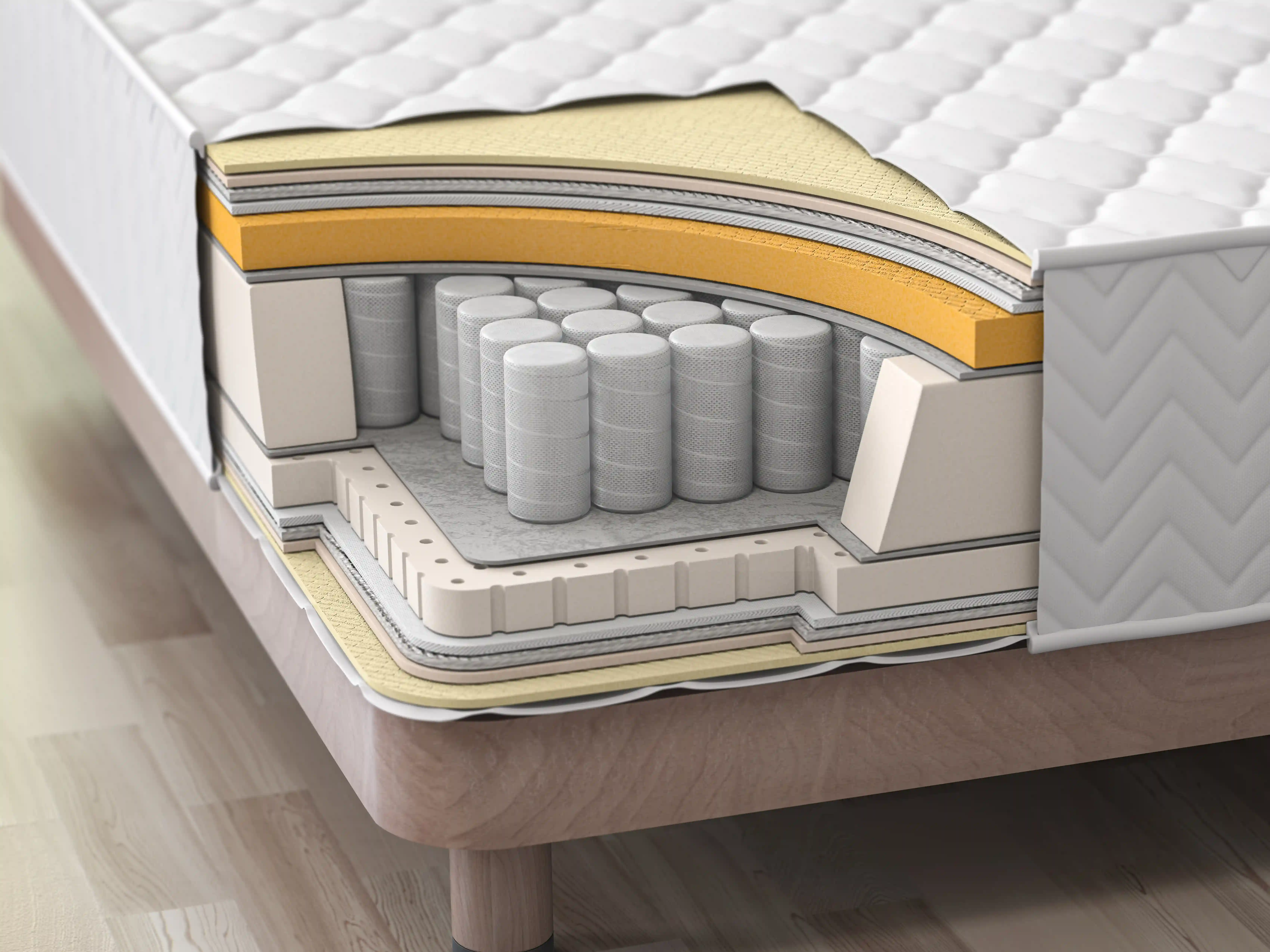
- springs, polyurethane foam, fiber, adhesives, and fire-barrier materials
- the cover, quilting, handles, and zippers
- moisture and ordinary manufacturing variation
The outside dimensions may also be rounded, and a soft mattress does not form a perfect rectangular block. The result is not the density of any one latex layer.
Do not cut a finished mattress or topper to create a test specimen. Cutting can permanently damage the foam, cover, fire barrier, or other components and may affect the trial, return, or warranty terms. Removing a zippered cover is not automatically permitted either. Ask the manufacturer for layer-level specifications and read the product terms before opening or altering anything.
A bare, uniform, removable latex layer can produce a rough household estimate if its mass and dimensions are accurately known. It still is not equivalent to a conditioned laboratory result, especially when the layer is zoned, profiled, perforated, bonded, or irregular.
Density is not firmness
Density measures mass per volume. Firmness describes the force needed to indent the foam under specified conditions.
Retailers may call the firmness value ILD, for indentation load deflection, or IFD, for indentation force deflection. ISO 2439 calls it indentation hardness and includes several methods with different indentation percentages, dwell times, and purposes. The standard warns that results relate to the stated test conditions 4.
This means two ILD or IFD numbers are not safely comparable unless the seller can identify the method and conditions. Specimen thickness, indenter size, percentage of compression, preconditioning, dwell time, and reporting convention can all matter.
Density and firmness can move together within one manufacturer’s tightly controlled product line, but they are not interchangeable. Formulation, cell structure, vulcanization, pin-core pattern, and other production choices can produce different indentation behavior at the same apparent density.
Other properties shape the finished feel
ISO’s foam-properties technical report treats density, hardness, resilience, hysteresis, support factor, compression set, airflow, and fatigue resistance as separate characteristics. It also cautions that laboratory methods may not reproduce real use and are best used for broad comparison 5.
For a mattress shopper, the main distinctions are:
- Indentation firmness: The force recorded at a specified compression. This is closer to initial firmness than density is.
- Compression behavior: How quickly resistance rises as the foam is pressed more deeply. A single firmness number does not describe the entire force-indentation curve.
- Resilience and hysteresis: How the foam rebounds and how much energy it loses through a compression-and-release cycle. These affect responsiveness but are not density.
- Layer thickness: The same foam can feel different as a thin comfort layer, a thick core, or part of a multilayer stack.
- Pin cores, profiles, and zoning: Hole size, spacing, surface cuts, and zones can change local compression and airflow. They can also complicate sampling.
- Layering and bonding: A soft layer over a firmer core behaves differently from either layer alone. Adhesives and transition layers can also change the response.
- Cover and quilting: Stretch, tension, padding, wool, fiber, and the fire barrier can alter surface feel. The foam number does not include these effects.
- The complete sleep system: The foundation, adjustable base, pillow, sleeper, and position influence the experience of the finished mattress.
Density alone therefore does not identify the best latex for a side, back, or stomach sleeper, or for a particular body weight. Those decisions require the complete construction, firmness information, and a realistic trial or return option.
Natural, synthetic, and blended latex labels
A density value does not reveal which rubber polymers were used.
- Natural-rubber latex foam uses natural rubber derived from latex collected from rubber trees, along with the ingredients needed to foam, gel, cure, wash, and stabilize the material.
- Synthetic-rubber latex foam uses a manufactured rubber latex, commonly based on styrene-butadiene rubber.
- Blended latex foam contains natural and synthetic rubber. The word “blend” does not disclose the ratio.
Do not infer natural content from weight, color, smell, feel, density, or a process name. Ask for the manufacturer’s composition claim and the exact scope of any supporting certificate. Terms such as “natural latex,” “made with natural latex,” and “100% latex” can answer different questions.
Dunlop and Talalay are process labels
Dunlop and Talalay describe families of foam-making processes, not fixed recipes or density grades. In a conventional Dunlop process, compounded latex is mechanically foamed, placed in a mold, gelled, and vulcanized. Talalay adds process steps that use a partially filled closed mold, vacuum expansion, and freezing before curing. Production details and formulations can vary 6.
These processes can produce different cell structures and mechanical behavior, but the label does not establish one universal density range. It also does not prove:
- a specific natural-to-synthetic rubber ratio
- a particular ILD or IFD
- better pressure relief, cooling, resilience, or support
- longer service life
- organic status or lower emissions
- superior quality for a mattress core or comfort layer
Compare the actual layer specifications. Do not substitute “Dunlop” or “Talalay” for the missing density, firmness, composition, or warranty information.
What a higher density does and does not mean
If two specimens have the same external volume, the higher-density specimen has greater mass. That is the direct conclusion.
Within one consistent formulation and process, density may be useful for production control or for distinguishing grades. Across different manufacturers, formulations, pin patterns, and methods, it is not a universal quality score. A higher number does not automatically mean:
- firmer or more supportive
- more pressure-relieving or “orthopedic”
- cooler or more breathable
- more durable or longer lasting
- more natural, sustainable, or safer
- better for a sleep position or body weight
Durability requires direct evidence such as fatigue, compression-set, and aging tests performed under identified methods. Sustainability requires information about raw materials, processing, energy, supply chain, use, and end of life. Medical benefits require product-specific clinical evidence. Density cannot stand in for any of them.
Certifications answer different questions
A certification only supports claims within its scope.
CertiPUR-US does not certify latex foam. Its official program guide says it certifies flexible polyurethane foam, including memory foam, and explicitly places latex foam outside the certification scope. A mattress containing both materials may carry the mark for its polyurethane layer, not its latex 7.
GOLS concerns organic natural-rubber latex products and their supply chain. Control Union describes requirements involving organic origin, processing, traceability, permitted substances, emissions, and polymer and filler percentages 8. A valid GOLS certificate can support claims included in its exact scope. It does not, by itself, verify a retailer’s published density number unless the applicable certificate or test documentation expressly includes that value.
OEKO-TEX STANDARD 100 tests articles for harmful substances. Its requirements vary with intended use and skin contact 9. That is not a density test, a durability test, or proof of natural or organic rubber content.
Look up the certificate or label number in the issuer’s official database when available. Check the named company, product or component, validity, and scope. A supplier certificate for one layer does not automatically cover every material in the finished mattress.
Density also cannot establish emissions, allergen status, organic status, natural-rubber percentage, expected lifespan, or a medical benefit. Each of those claims needs its own relevant evidence.
A practical latex-layer comparison
Ask the seller for a specification for each latex layer, then compare in this order:
- Layer identity: Which model and which layer does the value describe?
- Density: Is the number in kg/m³ or lb/ft³? Is it an individual result, an average, a range, or a nominal target?
- Method and tolerance: Which standard and edition were used? Is the result overall or core density? What manufacturing tolerance applies?
- Rubber description: Is the foam described as natural-rubber, synthetic-rubber, or blended, and what evidence supports the claim?
- Process: Is it Dunlop, Talalay, or another process? Treat this as process information, not a quality rank.
- Firmness: What ILD, IFD, or indentation-hardness method and test conditions produced the firmness value?
- Construction: Record the actual layer thickness, zoning, pin-core pattern, profile, bonding, cover, quilting, and the materials above and below it.
- Independent claims: Check the exact scope and validity of any GOLS, OEKO-TEX, or other certification.
- Ownership terms: Review the sleep trial, comfort-exchange process, return costs, required foundation, cover-removal rules, and warranty exclusions.
If a seller gives only “high-density natural latex,” ask for the number, unit, layer, method, and tolerance. If it gives only an ILD, ask for density and the firmness test conditions. The best comparison is not the product with the largest isolated number. It is the product whose specifications describe the same properties clearly enough to compare.