
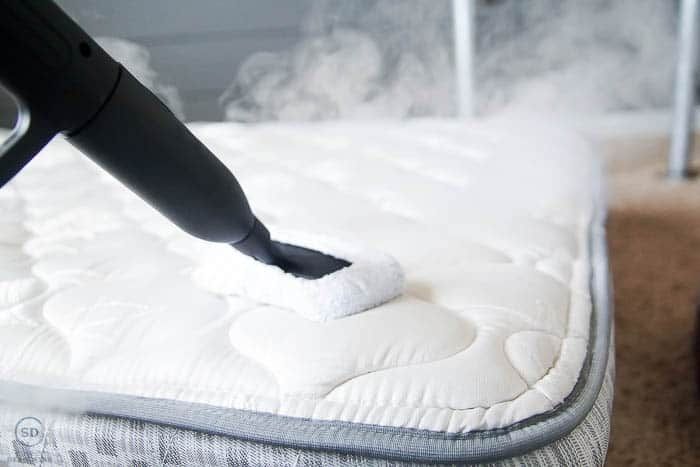
Steam cleaning a mattress is safe only when the instructions for that exact mattress permit it and you can keep moisture out of its inner layers. If the label prohibits steam or gives only a vacuuming or spot-cleaning method, follow that method instead.
This is a product-specific decision. Tempur-Pedic says its foam material should never become wet, Avocado advises against steam because excess heat can damage natural latex, and Sleep Number tells owners to use very little water when spot cleaning its smart mattresses 123. Other models may have different instructions. A generic guide cannot overrule the care label, user manual, or warranty for your bed.
Check these things before using steam
Find the model name and read its current care instructions. If the instructions do not mention steam, ask the manufacturer rather than interpreting silence as permission. Also check:
- whether the cover is removable and washable, because a zipper does not necessarily mean that it should be removed
- which cleaners, attachments, temperatures, or moisture levels are allowed
- whether the mattress contains memory foam, latex, glued layers, air chambers, sensors, warming parts, hoses, or electrical connections
- whether the cover is torn or a seam, zipper, or inner layer is exposed
- whether the warranty limits damage caused by heat, liquids, or an unapproved cleaning method
There is no general requirement to steam a mattress every season. For routine dust, hair, or crumbs, vacuuming with the attachment and technique permitted by the manufacturer is usually the lower-moisture option. Tempur-Pedic and Sleep Number illustrate why the model instructions still matter: their official care pages give different directions for covers, foam, water, and vacuum contact 13.
What steam can and cannot do
A suitable steamer may loosen surface soil or expose some pests to lethal heat when it is used correctly. That does not make one household pass a deep-cleaning or sterilization process.
Cleaning, disinfecting, and sterilizing are different outcomes. The CDC defines cleaning as removing dirt and many germs, while disinfection uses an appropriate product or process to kill remaining germs 4. Controlled steam sterilization uses direct saturated steam contact at specified temperature, pressure, and exposure time. A handheld steamer moved across a thick, porous mattress does not reproduce those controlled conditions throughout the bed 5. Do not describe a steamed mattress as sterile or assume that the heat reached its inner layers.
Match the response to the actual problem:
Routine surface dust or stale odor
Strip and launder washable bedding according to its label. Vacuum the mattress only as its instructions allow, then air the room and address any humidity or leak problem. A persistent musty odor is not a cue to cover the smell with fragrance. It may indicate moisture below the surface.
Do not add essential oils, vinegar, detergent, disinfectant, or fragrance to a steamer unless its own manual expressly permits that exact additive. Some steam-cleaner manuals allow water only and warn of scalding and electrical hazards 6. An approved spot-cleaning method may use a cleaner, but that does not mean the cleaner belongs in the steamer reservoir.
A small spill or surface stain
Blot promptly without rubbing the liquid farther into the mattress. Use only the cleaner and amount of moisture allowed by the care label, preferably applied to a clean cloth rather than poured onto the bed. Test the method on a hidden area first.
A removable cover should be washed only if its label says it is washable. Tempur-Pedic, for example, tells owners to verify that the cover is removable and gives separate instructions for the cover and the moisture-sensitive foam beneath it 1. If liquid has soaked into the core, contact the manufacturer or a cleaner experienced with that mattress construction.
Dust mites or respiratory allergies
Steam is not a reliable one-step way to remove the mite allergen reservoir from deep inside a mattress. For people whose asthma is triggered by dust mites, the CDC recommends a broader approach: allergen-proof mattress and pillow covers, weekly washing and complete drying of bedding, regular HEPA-filter vacuuming, and indoor humidity around 30% to 50% 7. Follow the mattress maker's vacuuming instructions because some models require a particular attachment and warn against direct vacuum contact 3.
Bed bugs
Do not treat a quick steaming pass as proof that an infestation is gone. University of Minnesota Extension reports that properly applied steam can kill exposed bed bugs at all life stages, but bugs that do not contact the steam survive. It also advises against clothing steamers and carpet-cleaning machines for this job and notes the burn risk from hot, pressurized steam 8.
Contact a licensed pest-management professional or follow an evidence-based integrated treatment plan. If steam is part of that plan, both the mattress manufacturer and the pest guidance must permit it. Encasements, monitoring, repeated inspection, and treatment of other hiding places may also be necessary.
Bodily fluids or illness
A small surface stain from urine, vomit, blood, or another body fluid is not the same as deep saturation. Follow the manufacturer's contamination and stain instructions, wear suitable disposable gloves, and use only products approved for the surface. Do not mix cleaning chemicals 4.
Steam alone does not prove that a porous mattress has been disinfected. If a large amount of fluid has reached the interior, the source is medically concerning, the sleeper is especially vulnerable to infection, or the maker cannot provide a safe method, ask the manufacturer or a professional cleaner whether the mattress can be treated. Replacement may be the safer option when contamination cannot be removed and the mattress cannot be dried.
Mold, a persistent musty smell, or deep dampness
Stop adding moisture. The EPA explains that mold can grow within the spaces of porous materials and may be difficult or impossible to remove completely; moldy porous items may need to be discarded 9. Do not steam over visible mold or use fragrance to mask a musty odor. Correct the leak or humidity source, isolate the mattress from use, and ask the manufacturer or a qualified remediation professional whether it is salvageable.
Floodwater or sewage
Do not try to rescue a flood-soaked or sewage-contaminated mattress with a household steamer. CDC disaster-cleanup guidance specifically lists mattresses among items to discard when they cannot be cleaned and dried quickly, and it directs people to discard materials contaminated with sewage or floodwater 10. Follow local disposal guidance and avoid carrying contamination through the home.
If the manufacturer explicitly permits steaming
Use the mattress instructions and steamer manual together. The following sequence is a safety framework, not a replacement for either document:
- Prepare the bed and room. Remove only the layers the care instructions allow you to remove. Inspect for damage, exposed filling, dampness, mold, and electrical parts. If it is a powered or smart mattress, follow its shutdown instructions and keep steam away from controls, cords, hoses, sensors, and connectors.
- Remove loose debris. Vacuum only with the permitted attachment and contact level. If the sleeper has asthma or a dust allergy, it may be better for someone else to vacuum while they leave the room because cleaning can stir particles into the air 7.
- Test a hidden area. Use the approved device, upholstery attachment, steam setting, distance, and pass speed. Let the test area dry, then check for shrinkage, discoloration, texture change, loosened adhesive, or odor.
- Use as little moisture as possible. Keep the tool moving as directed. Do not saturate the cover, seams, tufting, zipper, foam, edge materials, or underside. Do not substitute an iron, garment steamer, carpet cleaner, or another appliance unless the mattress instructions explicitly approve it for this use.
- Protect people and electricity. Keep children and pets out of the area. Direct steam away from skin and never open or refill a pressurized hot unit contrary to its manual. Keep the cord, plug, outlet, and mattress electronics dry 6.
- Ventilate and verify drying. Use safe room ventilation and fans if the mattress maker allows them. Do not stand, bend, flip, prop up, or put a mattress in direct sun unless its handling instructions permit that position and exposure.
A fixed wait such as three or six hours cannot prove that every mattress is dry. Airflow, humidity, construction, and the amount of water introduced all change drying time. Before replacing bedding or sleeping on the mattress, check the treated surface, seams, edges, and any safely accessible underside for a cool or damp feel, transferred moisture on a clean dry cloth, swelling, or musty odor. The surface can feel dry while the interior remains wet. If you suspect moisture entered the core, stop using the mattress and contact the manufacturer.
When to skip DIY cleaning
Contact the manufacturer, an appropriate professional, or your insurer when:
- the model cannot be identified or its instructions are unclear
- the care label prohibits steam, heat, or substantial moisture
- the mattress has electrical or temperature-control parts near the affected area
- a spill penetrated deeply or the mattress remains damp
- there is visible mold, a recurring musty odor, or water damage
- bodily-fluid contamination is extensive
- bed bugs may be present
- the cover, seams, or internal layers are damaged
Replacement is not necessary for every mark. It becomes more reasonable when a porous mattress is deeply contaminated, cannot be cleaned by an approved method, or cannot be dried with confidence. The goal is not to make the surface look clean while leaving heat damage, moisture, pests, or contamination inside.