
A rounded or low corner just after unboxing does not automatically mean the mattress is defective. It may still be recovering from compression, or the finished model may have rounded corners by design. The useful deadline is the expansion period in the instructions for your exact mattress, not a universal number of hours or days.
Start with simple checks that do not alter the bed. Confirm what arrived, follow the permitted setup conditions, remove external pressure, and document what you see. If a corner remains collapsed after the model's stated recovery period, or if you find damage or the wrong product, contact the seller or manufacturer before trying to reshape it.
Start with the exact mattress instructions
Expansion guidance varies even among well-known compressed mattresses. Purple currently tells customers to allow its mattress to bloom for several hours, with full blooming potentially taking longer, and says bedding may be added during that process 1. Tuft & Needle says its mattresses may take longer to reach full dimensions but can be slept on immediately 2. IKEA also says its rolled mattresses can be used immediately while taking about three days to regain their shape and comfort 3.
These are brand-specific examples, not instructions for every foam mattress. Find the setup card, product page, care guide, and warranty that match the model name and version on your order or law tag. Check:
- How soon the sealed roll should be opened after delivery.
- Which side faces up and which end belongs at the head of the bed.
- The stated expansion window and permitted room conditions.
- Whether bedding may be added and whether the mattress may be slept on during recovery.
- The required support surface and any size-specific center support.
- Whether rotating, flipping, lifting, or handling the foam in another way is allowed.
- How the manufacturer wants dimensions or defects photographed and measured.
If the instructions are missing or conflict with a retailer page, ask the manufacturer which current instructions apply to the model and manufacturing date you received.
A safe troubleshooting path
1. Confirm that unboxing is complete
Check that all shipping plastic, wrap, and bands identified in the setup instructions have been removed. Do not confuse the mattress's sewn or zippered outer cover with shipping packaging.
Compare the law tag, order confirmation, and box label. Verify the model, firmness option, thickness, and size. Also compare the mattress with the manufacturer's current product photos. Symmetrical rounded corners or a tapered edge may be part of the design. A wrong size, wrong model, upside-down mattress, or displaced cover needs a different response from slow foam recovery.
If packaging appears to be trapped inside a seam, the fabric is torn, or the mattress was cut while opening the plastic, stop and photograph the area. Do not pull at the seam to investigate it.
2. Follow only the permitted recovery conditions
Put the mattress in the orientation and on the support surface specified for that model. Follow its allowed temperature range and expansion time. A generic room-temperature target cannot account for every foam formulation, cover, shipment, or warranty.
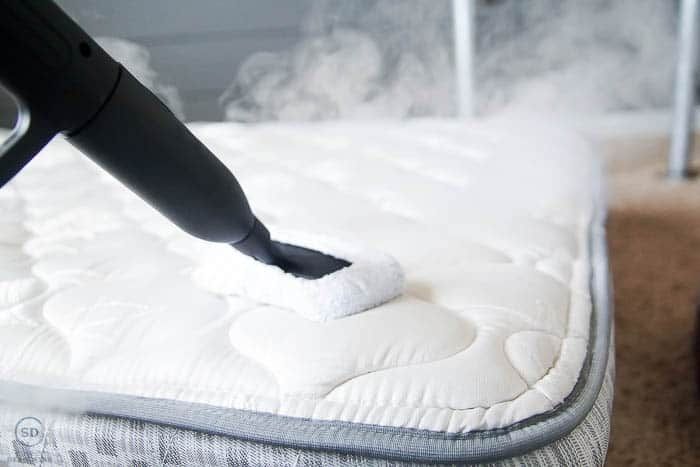
Do not place a hair dryer, heat gun, space heater, heating pad, or steamer against the corner. Do not soak or spray the foam. Direct heat and moisture can damage materials and complicate a return or warranty review 4. Use a method involving heat, moisture, pressure, or movement only when the exact manufacturer's current instructions expressly allow that method for your model.
3. Check for an external constraint
Remove pillows, sheets, blankets, toppers, and a removable protector briefly so you can see the mattress outline. This is an inspection step, not a claim that ordinary bedding blocks foam expansion. Follow the product instructions about when to remake the bed. Purple, for example, expressly permits bedding during its stated blooming period 1.
Look along the affected side without pulling on it:
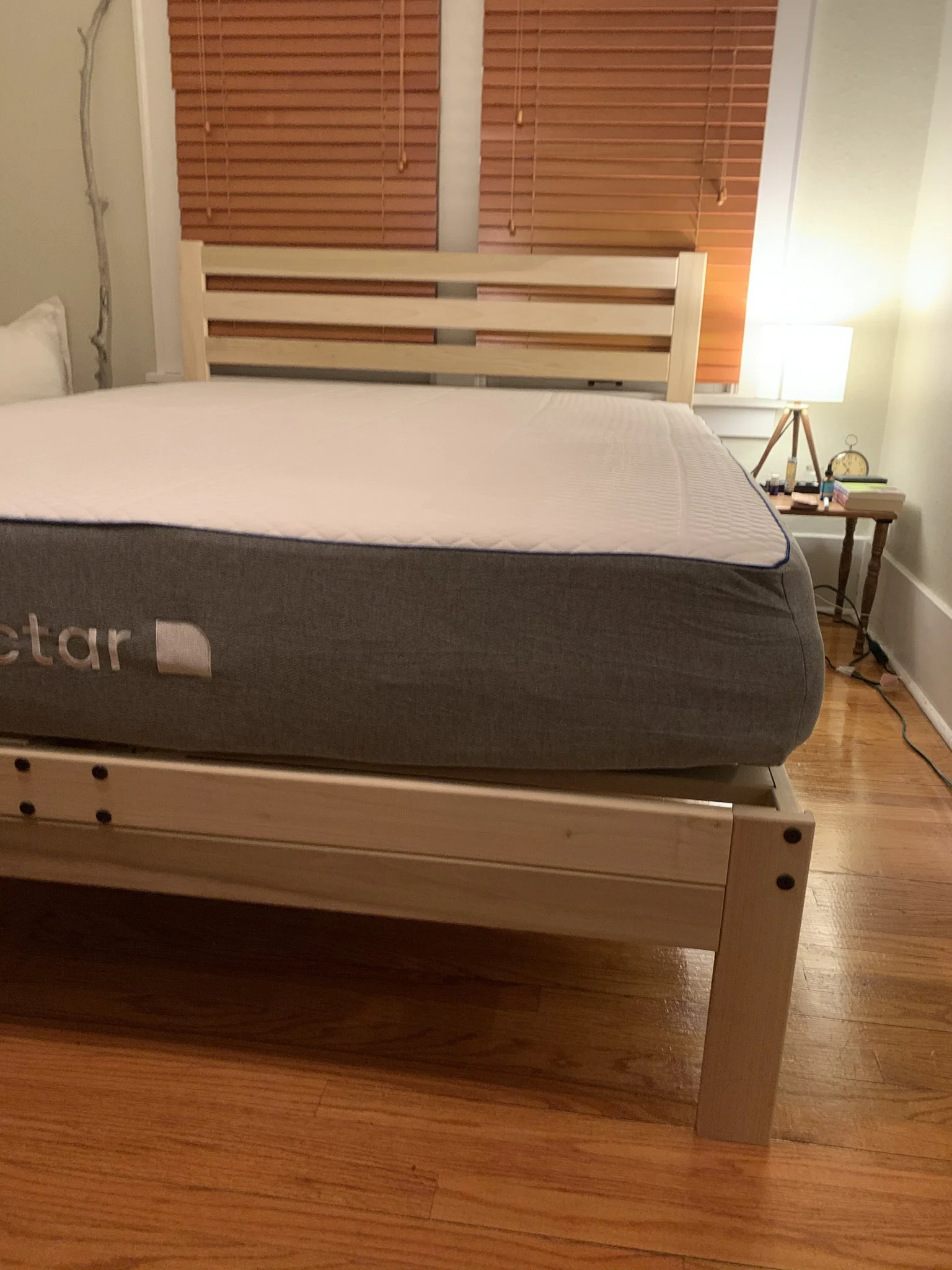
- Is a frame rail, corner bracket, retainer bar, headboard, or footboard pressing into the mattress?
- Is the mattress caught beneath a lip or sitting partly outside the support surface?
- Is the base bowed, broken, uneven, or missing support directly below the area?
- Is a fitted protector or sheet too small, twisted, or hooked under the corner?
- Does the outer cover have a diagonal wrinkle, bunched seam, or visibly shifted top panel?
Compare those observations with the exact base and cover requirements. There is no universal maximum slat gap for all memory foam mattresses. If the bed must be lifted to inspect the foundation, follow its handling instructions and use enough people to avoid folding or dragging it.
4. Document the shape without forcing it
Take clear photos before trying any approved adjustment:
- The entire uncovered mattress from above.
- All four corners from the same height and angle.
- The affected corner from the top and side.
- The whole support system and the area beneath that corner.
- The law tag, model label, order information, and visible packaging damage.
Record when the mattress was delivered and opened, along with the conditions requested by the manufacturer. If measurements are needed, place a ruler, tape, or straightedge beside the surface without pressing down, stretching the cover, standing on the bed, or loading the low point. Ask support for its measurement method when the warranty does not explain one.
This matters because warranty definitions are not interchangeable. Tuft & Needle's current claim guidance asks customers to check the foundation and describes its own unloaded measurement threshold 5. Purple uses different criteria for dimensions and indentations, requires evidence of proper support, and tells customers not to remove the cover while assessing a claim 4. Neither policy supplies a universal cutoff for a newly unboxed corner from another brand.
5. Decide whether the change looks like recovery, design, or a problem
Signs more consistent with normal design or delayed recovery include:
- All corners have a similar curve that matches official product images.
- The mattress is the correct model and size, with no torn fabric or damaged packaging.
- The edge is gradually approaching the stated dimensions during the permitted window.
- The cover is smoothing as the layers recover.
Reasons to contact support promptly include:
- One corner or edge stays markedly lower while the others recover.
- The area stops improving or remains outside the model's stated dimensions after its expansion window.
- A ridge, void, shifted-looking layer, deep fold, split, tear, or damaged seam is visible.
- The mattress does not match the ordered model, size, thickness, or orientation markings.
- Shipping damage, a puncture, or trapped packaging is visible.
- The frame or foundation interferes with the edge and the correct remedy is unclear.
An outside photo cannot prove whether foam is permanently damaged or an internal layer has shifted. Describe what you can observe rather than cutting into the mattress to find a cause.
Do not reshape the corner before support responds
Unless the exact manufacturer expressly authorizes it for your model, do not:
- Walk, kneel, roll, press, massage, pull, or place body weight on the corner.
- Fold the mattress sharply or flip it when it is designed for one-sided use.
- Recompress it with a household vacuum or try to reroll it.
- Apply direct heat, steam, hot water, or another liquid.
- Cut fabric, open a seam, unzip the cover, or remove an inner sock or fire barrier.
A zipper does not prove that a cover is removable. Tuft & Needle says that most of its mattress covers are not meant to be removed and that some zippers are used only during manufacturing 6. More broadly, the California Department of Public Health warns that some mattresses contain fiberglass beneath the outer cover and advises keeping mattress covers sealed 7. This does not mean every foam mattress contains fiberglass. It means the label and exact care instructions should determine whether any part of a cover can be opened.
If fibers have already escaped from a torn or opened mattress, stop handling it, keep people and pets away from the area, and follow public-health and manufacturer guidance rather than continuing the expansion check. Seek medical advice for eye, skin, or breathing symptoms 7.
Contact the seller or manufacturer before the deadline
Do not wait beyond a trial, return, delivery-damage, or warranty reporting deadline just to see whether the corner changes. Send support:
- The order number, seller, delivery date, and unboxing date.
- The model, size, thickness, and law-tag photos.
- Full-mattress, corner, measurement, base, and packaging photos.
- The setup instructions you followed and the observed changes over time.
- A description of any frame contact, torn cover, wrong label, odor, fibers, or shipping damage.
Ask whether the shape is within that model's tolerance, whether support wants a specific measurement or video, and whether you should continue using the mattress. Get permission in writing before attempting a hands-on correction. Preserve the mattress, law tag, receipt, and any packaging the return instructions require until the claim is resolved.
A persistent corner problem may end with further observation, a setup correction, a return, or a warranty claim. The manufacturer needs the unaltered mattress and clear documentation to make that decision.
FAQs
Can I sleep on the mattress while its corners expand?
Follow the exact model's instructions. Some manufacturers permit immediate use, while others tell customers to wait for a stated blooming period. If the corner is badly collapsed, damaged, or unstable, ask support before using the bed.
Should I remove the sheets or mattress protector?
You can remove top bedding briefly to inspect and photograph the outline. Do not assume bedding is preventing expansion, and do not remove the mattress's own cover unless the exact care instructions say that part is removable.
Will a warmer room help the corner expand?
Use only the ambient conditions allowed in the instructions for your model. Do not aim a heater, hair dryer, heat gun, heating pad, or steamer at the mattress.
Should I flip, roll, walk on, or massage the corner?
Not unless the current instructions for that exact mattress expressly permit the method. Unapproved handling can damage the cover or foam and make a return or warranty review harder.
When should I report a corner that still looks compressed?
Contact the seller or manufacturer if it remains outside the model's expected shape or dimensions after the stated expansion window, stops improving, appears damaged, or does not match the product ordered. Report it sooner if a return or damage-claim deadline is approaching.