
A bunk bed is the practical choice when you need two or more stacked sleeping places. A loft bed usually has one raised sleeping place and leaves the area below open for a manufacturer-designed desk, storage, seating, or simply usable floor space. Neither is automatically better for children, teenagers, adults, guests, or small rooms.
Choose between them by answering five questions: How many people need a bed? Who will use the raised level? Does the exact model allow that user and load? Does the entire structure fit the room safely? Can it be assembled, climbed, inspected, and maintained as the manufacturer directs?
| Question | Bunk bed | Loft bed |
|---|---|---|
| How many sleep surfaces? | Usually two, although some models stack three or use different mattress sizes | Usually one raised mattress |
| What occupies the lower area? | Another sleep surface | Open space or only the desk, storage, seating, or other components designed for that model |
| When is it the more direct choice? | When the room needs multiple permanent sleeping places | When the room needs one sleeping place plus usable floor area |
| What must be checked? | Every sleeping level, the upper access, mattress specifications, load limits, and full footprint | The raised level, access, mattress specifications, load limit, ceiling clearance, and intended use of the area below |
These are category descriptions, not promises about capacity, price, comfort, or safety. A twin-over-full bunk, a low twin bunk, a full-size adult loft, and a children's loft-and-desk system can have very different instructions.
Why some loft beds are regulated as bunk beds
In everyday speech, a bunk bed has stacked mattresses and a loft bed has open space below. The U.S. Consumer Product Safety Commission uses a broader regulatory definition: a bunk bed is a bed with the bottom of at least one mattress foundation more than 30 inches above the floor. Under that definition, many loft beds are bunk beds even though they have only one mattress 1.
Federal requirements for general-use or adult bunk beds are in 16 CFR Part 1213, while requirements for children's bunk beds are in 16 CFR Part 1513. The applicable certification also differs. This is why a seller's use of the word "loft" does not remove guardrail and entrapment questions, and why a large mattress does not prove that a model is rated for an adult 1.
The federal rules focus heavily on entrapment. They address spaces between an upper mattress foundation and guardrail, openings in headboards and footboards, and the possibility of a child becoming trapped between a bed and wall. Fall protection, structural support, access, labeling, intended use, and the exact product instructions still matter too.
Check the room before choosing a model
A floor plan that shows only the mattress footprint is not enough. Find the assembled dimensions for the exact configuration, then measure all of the following.
Ceiling and overhead clearance
Measure from the floor to the lowest part of a flat or sloped ceiling, then compare the model's full height, mattress position, maximum mattress thickness, and stated minimum ceiling height. The sleeper needs room to enter, sit up as appropriate, and use the ladder without striking the ceiling. There is no one ceiling height that works for every design.
Product requirements can be quite specific. For example, one current twin loft model lists a minimum ceiling height, maximum mattress thickness, total width including its ladder, load limit, and a requirement to anchor that particular product. Those specifications belong to that model and should not be copied to another bed 2.
Keep the raised mattress and access route clear of ceiling-fan blades, hanging lights, exposed bulbs, beams, and other overhead objects 3. Do not place the bed where it blocks or conflicts with a sprinkler. In a rental, dorm, or room with a fire-suppression system, ask the property manager about required clearance rather than guessing.
Windows, cords, heat, electricity, and exits
Keep the bed and ladder away from windows. A raised bed can provide direct access to glass, an open sash, or a screen that is not designed to prevent a fall. CPSC advises moving beds and other furniture away from window-covering cords, preferably to another wall; cordless coverings are the safest option when young children are present 4.
Check radiators, baseboard heaters, portable heaters, vents, outlets, charging cables, and lamps. Follow the heat-producing product's clearance instructions, and do not trap electrical cords against the frame or route them through ladder and guardrail openings.
Preserve a usable path to the room door and any required emergency exit. Include the space taken by an angled ladder, staircase, drawers at full extension, cabinet doors, and a desk chair pulled out. A loft that technically fits but blocks the door, closet, window, or walking route has not saved usable space.
Delivery and daily access
Measure doors, stairs, halls, elevators, and tight turns for the packaged components. Confirm whether assembly needs two people or professional installation. Before buying, also decide who can safely make the upper bed. If changing sheets would require balancing on a desk, storage unit, chair, or loose stool, choose a lower design or another layout.
Guardrails, mattress height, and entrapment
A rail that looks tall before the mattress arrives may be too low after a thick mattress or topper is added. Federal rules require at least one upper guardrail on each side. The wall side, or the side opposite the ladder, must run continuously from one bed end to the other, apart from a very small connection gap allowed by the rule. The other side may have a limited access opening. Guardrails must be secured so they cannot be casually lifted or pulled off 1.
The top of each upper guardrail must be at least 5 inches above the top surface of the mattress. This is a finished-surface rule, not a requirement to buy a rail that is merely 5 inches tall. Use the mattress size and maximum combined mattress-and-foundation thickness shown on the bed's permanent label and instructions. A topper adds height and can reduce the protective rail margin 15.
The mattress must also fit the specified length and width. Do not substitute a nearly matching mattress, add a foundation or box spring that the instructions do not allow, or fill a gap with cushions or improvised material. Check that every slat, support wire, center support, and retaining part specified by the manufacturer is present and secured. Unsecured or damaged support parts can allow a mattress or sleeping level to fall 63.
Entrapment rules apply to more than the visible gap under a side rail. Openings in the upper and lower end structures and some spaces around the ladder are evaluated with prescribed probes. A household ruler check cannot certify an unfamiliar or modified bed. Do not remove a rail, add an aftermarket rail, enlarge an access opening, drill a new ladder position, or alter the frame.
What the age-six warning means
Children under 6 must not use the upper bunk or a high loft sleeping level. That warning applies to the elevated level, not automatically to every part of a bunk bed 56.
A lower bunk may be suitable for a younger child only if the exact product instructions allow it and the sleep surface is appropriate for that child. Do not treat the upper-bunk warning as proof that any lower bunk is suitable for an infant or toddler.
Age 6 is a minimum boundary, not a readiness certificate. A child also needs to follow the rules consistently, climb up and down using the intended access while sleepy, understand that the bed is not play equipment, and remain within the guardrails. If the child often jumps from furniture, climbs outside rails, gets up disoriented, or cannot use the ladder reliably, choose the lower bed.
Infants need a separate sleep product that meets infant-sleep requirements. CPSC recommends a crib, bassinet, play yard, or bedside sleeper intended for infant sleep, with the infant placed on their back and the space kept bare except for a fitted sheet. A lower bunk, the open space under a loft, a portable nest placed on a bed, or a mattress on top of an adult bed is not a substitute 7.
Decide who can use the raised level
Children, teenagers, adults, and guests
Do not assume a child will outgrow a bunk bed at 16, that a teenager belongs in a loft, or that a full-size upper mattress is rated for two adults. Read the intended age or user category, maximum load for each level, permitted number of occupants, mattress limit, and any restriction on commercial, dorm, or rental use.
The load rating is model-specific. It may also be described as a static load, which does not authorize jumping or multiple people gathering on the upper level 2. For a guest, confirm the product permits the guest's age and load and that the person can use the ladder safely. A guest who is unfamiliar with the bed should be shown the light, ladder, and route down.
Mobility, illness, seizures, and sleepwalking
A lower bed is the safer choice when pain, weakness, limited balance, reduced vision, a leg or arm injury, dizziness, sedating medicine, or an illness makes climbing unreliable. The same temporary switch makes sense when someone may need to leave bed urgently during the night.
People who sleepwalk should not use an upper bunk. NHS guidance specifically says not to let a child who sleepwalks sleep on the top of a bunk bed 8. The Epilepsy Foundation advises a low bed rather than a top bunk for people with seizures and says a child with seizures should use the lower bunk to reduce fall risk 9. Individual seizure and mobility needs can be discussed with the person's clinical team.
Pets
Plan to keep pets off the ladder, guardrails, and raised sleeping surface. Do not assume an upper-level rating or intended occupancy includes a person plus a pet. Also check whether a pet can get trapped behind a lower mattress, enter a drawer or staircase opening, chew supports, or obstruct the ladder during the night.
Buy new or used with the same safety questions
For a new bed, find the exact model number, intended user category, dimensions, load limits, mattress specifications, assembly manual, component list, warning labels, and warranty or replacement-parts route before ordering. Check the CPSC recall database using the manufacturer and model information 10.
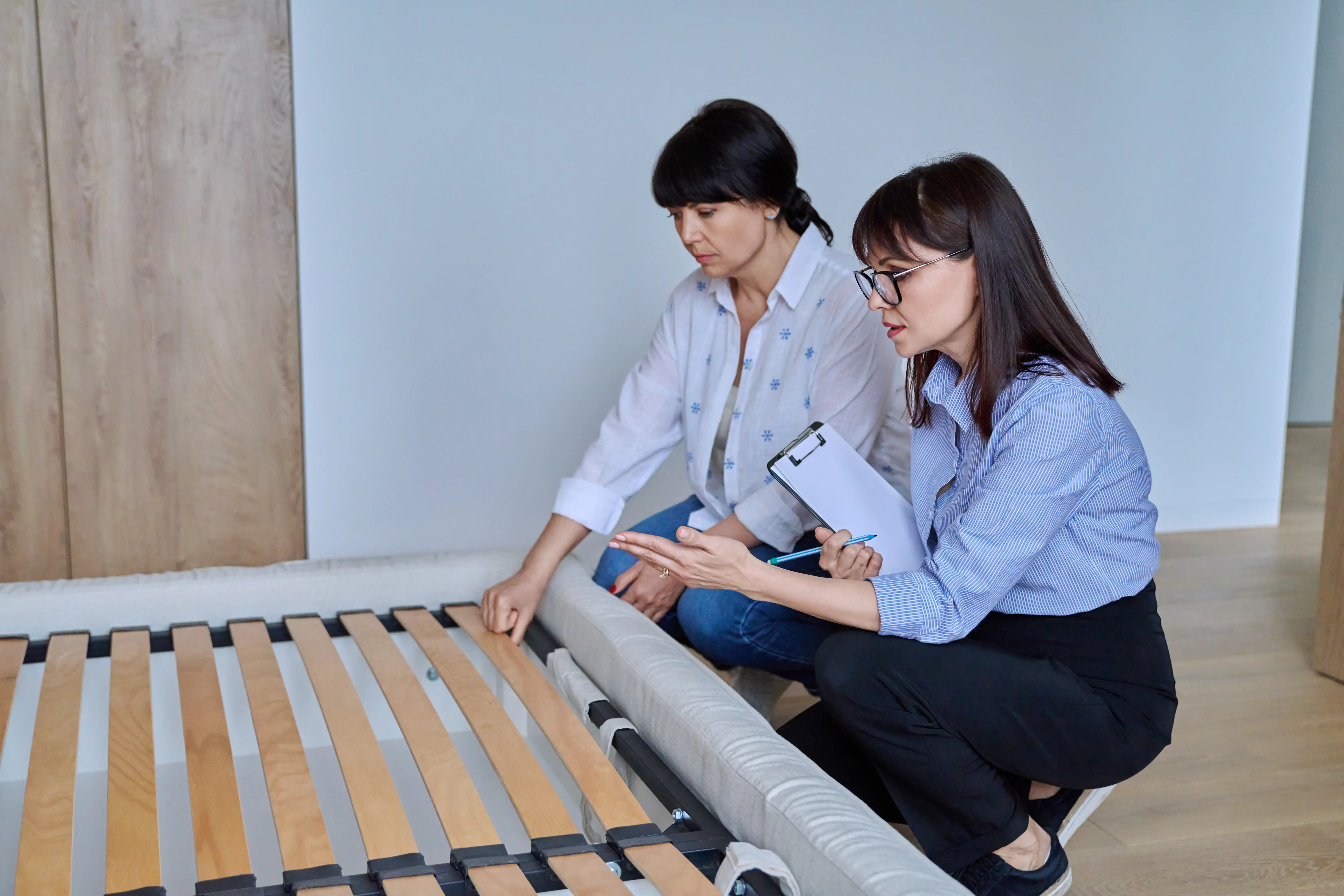
Be more cautious with a used bed. Pass on it if you cannot identify the manufacturer and model, obtain the original instructions, confirm the allowed mattress, or account for all structural parts and original hardware. CPSC's reseller guidance calls for complete assembly, required guardrails, intact components, the correct warning label, and no cracks or breaks around metal welds. It also states that recalled products cannot legally be sold 5.
Inspect a used frame for:
- cracks, splits, rust, bent parts, damaged welds, or enlarged screw holes
- missing bolts, pins, dowels, brackets, slats, support rails, labels, or guardrail hardware
- a loose ladder, guardrail, joint, mattress support, or staircase
- a frame that rocks, racks sideways, or remains unstable after correct assembly
- homemade holes, substitute fasteners, added rails, cut components, blocks under the legs, or other modifications
Do not accept a seller's reassurance that wobble is normal or that a homemade repair is stronger than the original. Missing original parts should come from the manufacturer. Health Canada likewise advises getting the original instructions, replacing missing parts with manufacturer parts, and avoiding do-it-yourself changes 3.
Assemble only the configuration that was designed
Follow the manual in sequence and use every specified fastener, slat, bracket, guardrail, ladder attachment, and locking component. Do not substitute similar-looking hardware or leave parts out because the frame appears stable. If the instructions are missing or a hole does not align, stop and contact the manufacturer.
Attach the bed to a wall only when the manufacturer instructs you to do so, using the specified method and suitable fasteners for the wall. Some loft products require anchoring, but that does not make arbitrary wall fastening a universal repair for instability 2. Do not add larger legs, shim the frame, screw through unapproved locations, or rely on wall attachment to compensate for loose joints or damaged supports.
Use the space under a loft only as designed. Add a desk, shelf, wardrobe, seating module, lower bed, curtain, or play feature only when the manufacturer identifies that component or configuration as compatible. Do not remove structural bracing to create more headroom. Separate convertible bunks into individual beds only if the manual permits it, and follow its instructions for connectors, rails, and unused parts.
Rules for everyday use
- Use the attached ladder or staircase for every climb. Keep the route lit and the floor around it clear. A night-light can make the access point easier to see 6.
- Do not jump, wrestle, bounce, lean over the guardrail, climb the outside of the frame, or treat the bed and ladder as play equipment 63.
- Follow the model's upper-level occupancy and load limit. Keep heavy objects and large toys off the upper bed 3.
- Never tie or hang belts, ropes, scarves, bags, jump ropes, cords, pet leashes, or similar items from the frame, ladder, or guardrail. They can create a strangulation or snag hazard 53.
- Keep the upper access opening clear. Do not drape bedding over the ladder or add storage that changes the climbing route.
- Do not let someone sit or sleep beneath a level while it is being assembled, adjusted, or inspected.
Inspect, correct, or stop using the bed
Use the inspection schedule in the manual. Also inspect after assembly, a move, unusually rough use, a noticeable impact, or any new movement or noise. Check guardrails, ladder attachments, joints, slats, supports, fasteners, welds, wood around hardware, and the mattress position 3.
Stop using the affected raised level if the bed wobbles, racks, cracks, has missing or loosening hardware, damaged slats or supports, bent metal, cracked welds, or a loose guardrail or ladder. Keep people away from it until the manufacturer or an authorized service provider gives the correct repair, replacement part, or disposal instruction. Tape, extra screws, improvised rails, blocks under the legs, and unapproved brackets are not substitutes 53.
If the model is recalled, follow the exact CPSC and manufacturer remedy. A recall may call for stopping upper-bunk use, disassembly, an official repair kit, replacement, refund, or disposal. Do not donate, resell, or move a recalled bed to a guest room while waiting 105.
The better choice is the bed that provides the sleeping places you actually need while fitting the specific room, user, mattress, and maintenance plan. If either option requires ignoring a label, altering the frame, squeezing it around a fan or window, or assigning the raised level to someone who cannot use it safely, choose a different model or a conventional lower bed.