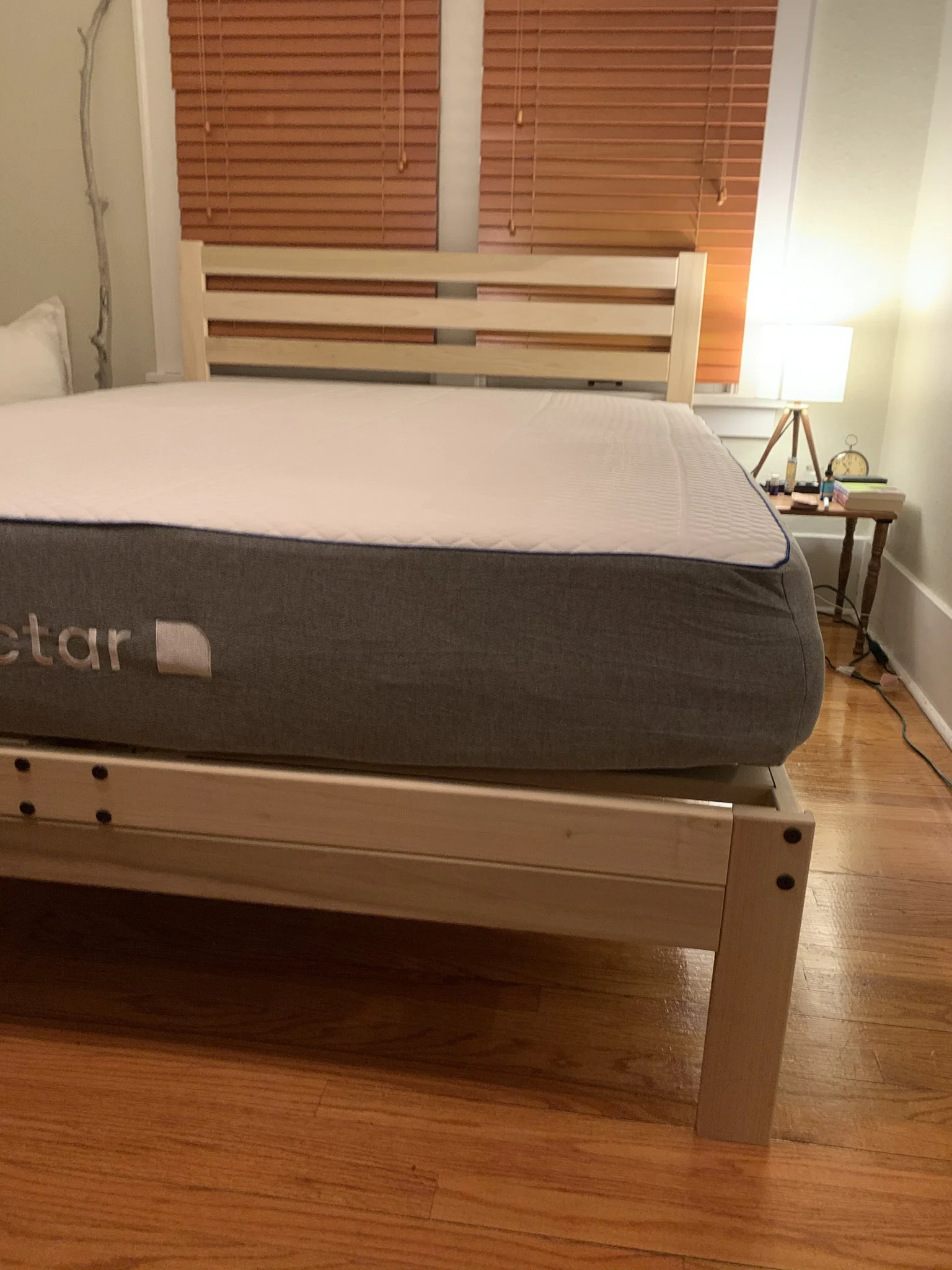

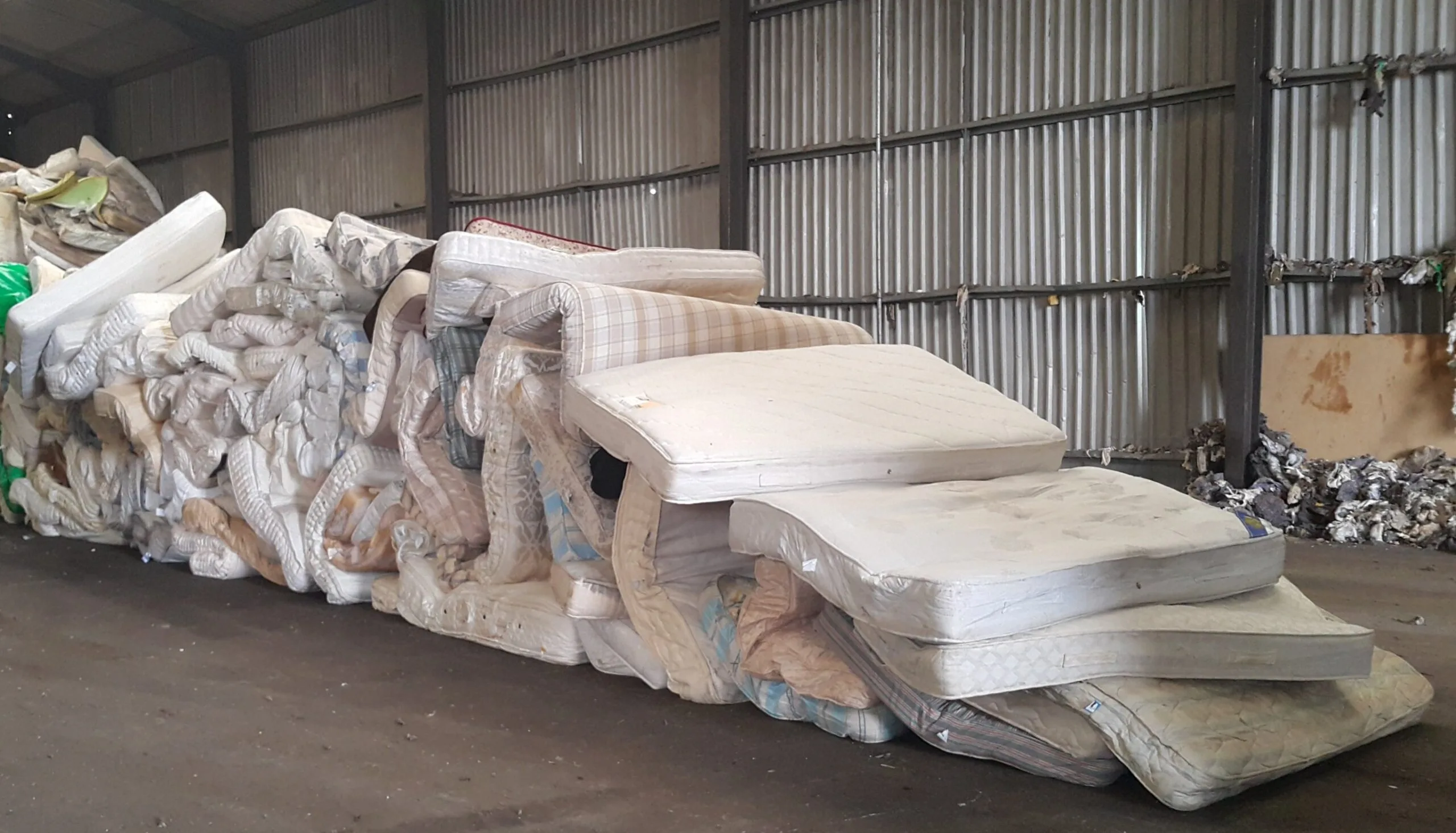
Many conventional mattresses and fabric-covered foundations can be dismantled so that some of their steel, foam, fiber, and wood enter material recovery streams. That does not mean every mattress is recyclable at every facility. The answer depends on the program serving your address, the exact bed product, its condition, and what the receiving site is equipped and authorized to handle.
A mattress does not belong in a household recycling bin. Curbside pickup is not universal, and a recycling symbol on one component does not establish that a local facility can process the whole bed. The U.S. Environmental Protection Agency identifies dedicated mattress programs in California, Connecticut, Oregon, and Rhode Island, while also advising facilities and households to check local options and acceptance limits 1.
Start with the address and the exact product
Before moving the bed, identify:
- The service address and whether it is inside a municipal, county, tribal, or state program.
- Whether the item is a mattress, foundation or box spring, futon mattress, air mattress, waterbed, topper, or adjustable or powered base.
- Its size, quantity, condition, and whether it contains motors, pumps, electronics, or a battery.
- Whether it is part of a retailer return, sleep trial, warranty claim, or safety recall.
Then use this order:
- Seller, warranty, or recall route. Ask the seller about take-back when a new bed is delivered. Follow trial and warranty instructions before surrendering the old mattress. Search the U.S. Consumer Product Safety Commission database for a recall and follow the exact remedy. CPSC notes that recall remedies vary and may involve a repair, replacement, refund, new instructions, or disposal 2.
- Eligible reuse or donation. Consider this only if the mattress is safe, clean, dry, structurally usable, pest-free, and not subject to an unresolved recall. The receiving organization must confirm that it accepts used mattresses and that the item meets its current rules. Do not leave an unapproved mattress outside a charity or offer an unsafe one to another household.
- Official mattress program. Search the state or local environmental agency and the approved program locator for the exact address. Confirm the product and condition with the listed collection site, since participation, residency, and unit limits can still vary.
- Verified recycler or collection service. If no public program applies, contact a dedicated mattress recycler. Confirm its legal business name, physical destination, the products it accepts, and whether it dismantles the units itself or transfers them to a named processor.
- Bulky collection or permitted disposal. When reuse and recycling are unavailable, use the municipality, contracted waste hauler, or a permitted transfer or disposal facility. Our mattress disposal guide covers those general logistics without assuming that the item will be recycled.
Current U.S. statewide mattress programs
As of July 25, 2026, four states have industry-run mattress stewardship programs operated by the Mattress Recycling Council. A visible assessment on a sale funds the applicable state program. It is not proof that every collection site will accept every product, and it does not create a universal home-pickup service.
| State | Sales assessment as of July 25, 2026 | What to know |
|---|---|---|
| California | $18 per covered mattress, futon mattress, or foundation | The $18 rate took effect April 1, 2026 3. When a retailer or its contractor delivers a new mattress, California requires the retailer to offer no-additional-charge take-back of a used one at delivery. For common-carrier deliveries, the retailer must offer to arrange take-back within 30 days 4. Delivery or setup charges may still be separate. |
| Connecticut | $16 per covered mattress or foundation through September 30, 2026; $19.50 beginning October 1, 2026 | The scheduled fee change comes from the program administrator 5. Municipal participation is voluntary, so the state advises residents who find no nearby program result to contact their local recycling coordinator 6. Ask the retailer about take-back rather than assuming it is included. |
| Rhode Island | $22.50 per covered mattress or foundation | The rate took effect January 1, 2026 7. Use the program locator, then confirm residency, unit limits, access requirements, and any pickup arrangement with the listed site or local waste provider. |
| Oregon | $22.50 per covered mattress or foundation | The statewide program began January 1, 2025, and Oregon DEQ directs consumers to its collection-site locator 8. The program recycles units received through participating locations and retailers, but does not itself collect a mattress from a consumer's home 9. |
Each mattress and each separate foundation generally count as their own unit. The assessment paid when buying a new product is different from a delivery, removal, municipal, or private pickup fee. Ask what is included before the delivery date.
Outside these four states, a municipal program, landfill ban, transfer station, retailer, private recycler, or special collection event may still provide a route. Use an official address-level source rather than assuming that a neighboring city or state has the same rules.
Which bed products may be accepted
The product name matters as much as the material. The Mattress Recycling Council's current definitions illustrate the differences, but a recycler outside its network may use another acceptance list 10.
Conventional innerspring, hybrid, latex, and foam mattresses: A fabric-covered sleep surface with resilient material generally fits the program definition of a mattress. A whole foam mattress can qualify even without coils. A loose foam slab, pad, or topper may not.
Foundations and box springs: Fabric-covered foundations are generally included and may be dismantled for wood, steel, fiber, and other components. A separate foundation usually counts as a separate unit for fees and quantity limits.
Futons: The futon mattress is included in California's stewardship program, but not in the Connecticut, Oregon, or Rhode Island programs. The futon frame is separate. A local recycler outside those programs may make a different decision.
Air mattresses and waterbeds: Air mattresses with no upholstery and waterbeds with no upholstery are excluded from all four Mattress Recycling Council programs. Do not place the whole item in curbside plastic recycling. Ask the local waste authority whether the empty shell, pump, hose, heater, control, or metal frame belongs in separate streams.
Adjustable and powered bases: A foundation covered in ticking or fabric may meet the program definition even if it is adjustable. An exposed metal adjustable base does not. Motors, controls, wiring, pumps, and electronics may require appliance, scrap-metal, or electronics handling instead. A removable battery requires its own accepted route. EPA says rechargeable batteries and lithium-ion batteries should not go in household trash or municipal recycling bins; nonremovable battery devices can be taken to an electronics recycler or local household hazardous waste program 11.
Do not disassemble a powered base or remove an embedded battery unless the manufacturer says the part is user-serviceable. Give the receiving facilities the model and component details and let them tell you whether separation is required.
What happens inside a mattress recycling operation
A dedicated recycler may inspect and sort incoming units, open accepted mattresses with controlled equipment, and separate steel, foam, textiles or fiber, and foundation wood. Materials may then be baled, compacted, shredded, or prepared for an appropriate downstream buyer.
Possible outlets include steel scrap processing, rebonded foam products, fiber applications, and wood recovery or energy use. These are examples, not promises about your mattress. Construction, contamination, local equipment, buyer specifications, commodity markets, and program rules affect what can be recovered. Adhesives, mixed textiles, pocketed coils, fire barriers, and damaged components can leave residual material that goes to permitted disposal 12.
Ask a private recycler what it means by "recycling." Useful answers identify the processing facility, the main material streams, how downstream buyers are checked, and where residual waste goes. A collection company that cannot name its destination or explain whether the mattress is dismantled has not substantiated a broad diversion claim.
Condition can change recycling into disposal
Mattress collection programs protect workers, other units, equipment, and downstream material from contamination. Mattress Recycling Council guidance for collection sites excludes units that are excessively wet or frozen, severely twisted, punctured, or crushed, infested with bed bugs or other living organisms, or exceptionally soiled or moldy 12. A different facility may have stricter rules or a separate handling route.
Call before moving a mattress that is:
- Wet, moldy, or exposed to a flood, sewage, bodily fluids, or another contaminant.
- Known or suspected to have bed bugs or another active pest infestation.
- Burned, charred, smoke-damaged, badly torn, crushed, or structurally unsafe to carry.
- Subject to an unresolved safety recall.
- Releasing fiberglass or another internal fire-barrier material.
Do not donate, sell, or give away these units as ordinary used bedding. Tell the program the full condition and follow its containment, labeling, pickup, and disposal directions. A mattress that cannot enter material recycling may still need an authorized waste route.
If fiberglass has escaped from a mattress, do not unzip the cover or cut the mattress apart. The California Department of Public Health advises covering the mattress before removal to reduce the spread of fibers and using a HEPA-filter vacuum rather than sweeping during cleanup 13. Tell the collector about the released fibers before scheduling service. If the seller, manufacturer, public-health agency, or local waste authority gives more specific instructions, follow those instructions.
Bed-bug containment and marking rules are local. Contact the waste program, building manager, and pest professional when involved before carrying the mattress through a home or shared hallway. Bag, wrap, label, or deface it only as the responsible local program directs.
Confirm the details before pickup or drop-off
Photograph the law tag or other product label, model and serial information, condition, and any retailer receipt before surrendering the item. Keep warranty, trial, and recall correspondence until the claim is closed. Do not remove the law tag merely to prepare the mattress for recycling.
Ask the destination:
- Does it accept this exact product, size, condition, and service address?
- Are the mattress and foundation counted separately?
- Is proof of residence, identification, a law tag, receipt, or appointment required?
- Is there a household quantity limit or a different process for commercial loads?
- Is drop-off free, or is there a site, transport, access, or handling fee?
- Must the item be dry, uncovered, bagged, labeled, or prepared in a particular way?
- For pickup, will the crew enter the home, use an elevator or stairs, collect from a loading area, or require curb placement?
- Will the unit be dismantled for material recovery, transferred to another processor, or disposed because of its condition?
Get the appointment address and instructions from the actual program or facility. Directory listings and old social posts can outlive a service.
Do not turn recycling into a safety or dumping problem
Do not cut open or reupholster a mattress at home to reach its steel or foam. Sharp springs, staples, dust, pests, and fire-barrier fibers can be exposed, and separated pieces are not automatically accepted in household recycling.
Do not burn a mattress or its foam, fabric, or wood. Do not leave it beside a recycling bin, outside a closed facility, in a vacant lot, or at the curb without an authorized collection. Do not leave a usable-looking contaminated or recalled mattress where someone may take it.
The practical answer is local: identify the whole product, disclose its condition, confirm an approved destination, and prepare it exactly as that destination requires. When a recycler accepts the unit, material recovery is possible. When it does not, use the permitted disposal route for your address rather than forcing an unsafe item into recycling.