

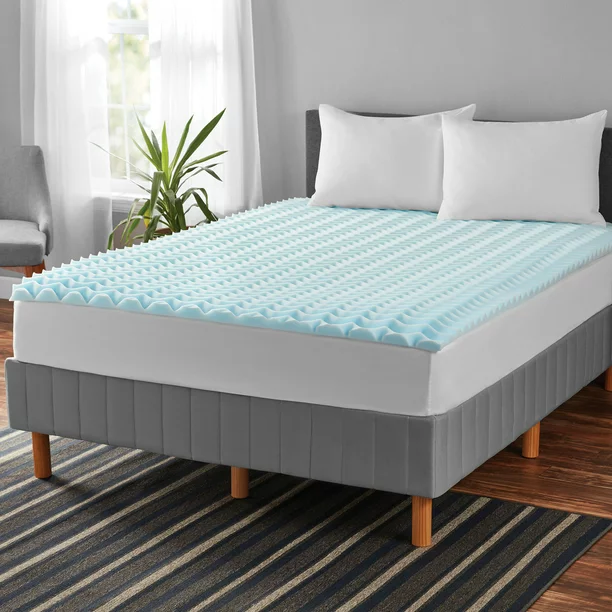
Choose a mattress topper by measurement, not by the size name alone. Measure the actual top surface of your mattress, then compare those numbers with the topper maker's stated finished width and length. Also check the topper's thickness, acceptable size variation, attachment system, bedding depth, and compatibility with the rest of the bed.
A queen topper is intended for a queen mattress, but "queen" does not guarantee an identical edge-to-edge measurement across products. Some toppers are listed slightly inset from nominal mattress dimensions. Handmade and compressed products may also have stated variation or expansion instructions.
Topper, pad, and protector are not interchangeable
A mattress topper is an added comfort layer placed on an adult or youth mattress to change its surface feel. The U.S. Consumer Product Safety Commission describes a topper as a thin, flat mat or cushion intended for use on top of a mattress 1.
A mattress pad is usually thinner and may add light cushioning. A protector is mainly intended to shield the mattress or sleep system from moisture, stains, allergens, or pests, depending on its design. Product names are not perfectly consistent, so check the construction, function, and installation instructions instead of relying on the label.
This guide is about physical fit. For help choosing a material, firmness, or feel, use our mattress topper guide.
Common size names are nominal
These familiar U.S. dimensions are useful shopping references, not a substitute for measuring:
| Nominal size | Common reference width | Common reference length |
|---|---|---|
| Twin | 38 inches | 75 inches |
| Twin XL | 38 inches | 80 inches |
| Full or double | 54 inches | 75 inches |
| Queen | 60 inches | 80 inches |
| King | 76 inches | 80 inches |
| California king | 72 inches | 84 inches |
The finished topper may not use those exact numbers. For example, Avocado lists its 2-inch Eco Organic topper at the common reference dimensions, including 60 by 80 inches for queen 2. Tempur-Pedic lists its queen toppers at 59 by 79 inches, with other sizes also inset from the nominal mattress dimensions, and says individual topper dimensions may vary 3.
Neither chart is a universal standard. It shows why the size name, retailer filter, or an old mattress receipt is not enough to confirm fit.
Measure the mattress that will receive the topper
Strip off the sheets, pad, protector, and existing topper so you can see the mattress's top panel and edge. Leave the mattress flat on its normal base.
- Confirm the model and labeled size. Record the law-tag size, model, and any terms such as split, split head, short queen, RV queen, three-quarter, Olympic queen, or custom.
- Measure the top width. Run a flexible tape straight across the center of the usable sleep surface from edge to edge. Do not wrap the tape down the side or press the border inward.
- Measure the top length. Measure through the center from the head edge to the foot edge, again without compressing foam, quilting, or piping.
- Check more than one point. If the sides bow, the corners taper, or the top is not a simple rectangle, measure near the head, middle, and foot. Record the smallest and largest values.
- Note the corner shape. Square, rounded, radius, beveled, or cut corners can affect edge coverage, skirt fit, and anchor straps even when the center measurements match.
- Measure mattress height separately. Measure from the bottom edge to the highest point of the bare mattress without compressing the top. This number is for skirts, protectors, and fitted sheets, not for choosing width or length.
A rigid ruler can bridge over curves and give a misleading reading. One topper maker specifically recommends a flexible tailor's tape because its handmade toppers have curved edges and subtle size variation 2.
Measure the mattress, not the bed frame, foundation, or advertised room footprint. If the mattress is visibly bowed, deeply indented, or sagging, record that condition too. A topper cannot make a distorted sleep surface rectangular again.
Compare the finished topper, not just the menu name
On the exact product page or specification sheet, find:
- Finished width and length for the selected size.
- Thickness or loft after the product has fully expanded or settled.
- Any manufacturing tolerance or statement that dimensions may vary.
- Whether the measurement includes a fabric border, cover, piping, or skirt.
- Whether the product is expected to arrive compressed.
- The attachment method and the mattress-height range it can fit.
Decide what fit you will accept before ordering. Full edge coverage can make the surface feel more continuous. A small, even inset may be within the product's design or stated tolerance and can make a fitted cover easier to install. A large exposed band can create a noticeable transition near the edge. Overhang can bend downward, interfere with fitted bedding, or encourage migration and bunching.
A minor, even mismatch is not automatically dangerous on an ordinary adult bed. The practical question is whether the topper remains flat, stable, comfortable, and compatible with the bedding. Guardrailed beds and infant sleep products have stricter boundaries covered below.
Check how the topper stays in place
Size is only one part of fit:
- Corner straps must reach the mattress corners without distorting the topper or slipping beneath rounded edges. Check the maker's mattress-height range.
- A fitted skirt must stretch around the mattress plus any layers it is designed to enclose. Its pocket depth is a separate specification from topper width and length.
- A nonslip underside depends on the surfaces touching it. A slick mattress cover, protector, or adjustable movement may change how well it grips.
- A full encasement or zip connection may be designed for only one mattress family or installation order.
Straps and skirts can limit ordinary migration, but they do not correct a topper that is materially too narrow, too long, or shaped for another bed.
Add the topper to the bedding-height calculation
Add together the mattress height, topper thickness, and any pad or protector that will sit inside the fitted sheet. Compare that total with the fitted sheet's stated pocket depth and stretch range.
A deeper pocket is not the same as buying a larger bed size. A king fitted sheet has the wrong width and length for a queen mattress even if it offers more fabric. Choose bedding made for the mattress's nominal width and length with enough pocket depth for the complete stack.
Check the protector separately. A protector that fit the bare mattress may become too shallow once the topper is added. An oversized protector may bunch or loosen. If the topper has its own skirt or cover, follow its instructions before deciding which layers must enclose which others.
There is no universal layering order. One model may call for the topper directly on the mattress with a protector over both. Another may require a fitted topper skirt, a model-specific encasement, or a protector beneath the topper. Use the topper, mattress, protector, and heated-product instructions together.
Split and specialty beds need an exact configuration
King versus split king: A standard king topper is one piece. A split king bed usually consists of two Twin XL mattresses. Two Twin XL toppers preserve the lengthwise split and allow independent sides to move, but they also leave a partner seam. One king topper can bridge that seam, but it can couple the two sides and may not flex correctly when an adjustable base raises them independently.
Two separate toppers: Partners can use separate toppers when they want different surface feels or when the base moves independently. Compare the finished length, thickness, and edge shape of both pieces. Unequal heights or insets can make the center seam more noticeable.
Split-head designs: A split-head king or split-head California king is not the same as a standard king or a full-length split pair. Confirm the overall dimensions, the depth of the head split, and the exact base model. Use a topper specifically made for that configuration.
RV, antique, three-quarter, short, and custom mattresses: Measure the sleep surface and corner shape. An "RV queen" or "short queen" label can cover more than one finished size. Confirm whether the maker offers that exact dimension or a made-to-order product.
Do not plan to trim a standard topper to fit. Cut foam only when the topper manufacturer explicitly permits customization, provides the method, and confirms that cutting will not compromise the cover, fire-safety construction, warranty, or return terms.
Check the whole bed system
Adjustable bases: Confirm that the topper is flexible enough for the base and that its straps, skirt, or nonslip layer will not obstruct movement or get pulled out of position. With independently moving halves, decide whether preserving the split is necessary.
Air and smart beds: Check the bed maker's accessory instructions before adding a topper. Do not cover access points, hose exits, connections, sensor layers, magnets, air channels, or moving attachments. Sleep Number, for example, uses different encasements for mattresses whose hoses exit at the side and those whose hoses exit at the head, and compatibility also depends on the base configuration 4. That is a model-specific example, not a rule for every air bed.
Heated products: Check both manufacturers before putting a heated mattress pad or electric blanket above or below a topper. Material response, wiring position, temperature limits, and layering instructions differ. Tempur-Pedic, for example, advises against using an electric blanket or heating pad with its topper 5. Do not transfer that instruction to every brand, and do not assume compatibility without checking.
Upper bunks and guardrailed beds: Add the topper thickness to the mattress height and compare the result with the bed's maximum mattress mark or manual. Under the U.S. bunk-bed rule, the top of the guardrail must remain at least 5 inches above the top of the mattress 6. A topper raises the finished sleep surface, so do not use it if the resulting height exceeds the bed's stated limit or reduces the required rail clearance.
Cribs, bassinets, play yards, and infant sleep products: Do not add a topper. CPSC's safe sleep guidance says an infant sleep space should contain nothing but the fitted sheet and should use a product intended for infant sleep 7. CPSC also says to use only the mattress sold with a play yard 8. For a crib, bassinet, bedside sleeper, or other infant product, use only the sleep surface its maker supplies or expressly approves. Extra padding and ill-fitting surfaces can create entrapment or suffocation hazards.
Thickness changes feel, not the mattress structure
Thickness affects how much added material you feel, how easily you turn or get out of bed, the finished bed height, fitted-sheet depth, and how readily the layer bends on an adjustable base. It does not create one body-weight cutoff or prescribe a product for a sleep position.
A topper can change surface cushioning. It cannot repair a sagging support core, broken springs, split foam, a failed edge, or an unsuitable base. Added foam may temporarily cover a dip while continuing to follow it. Inspect the mattress and base first if the surface is uneven or unstable. Our sagging mattress guide explains how to separate a mattress problem from a base problem.
Review returns before opening the package
A compressed topper may be difficult or impossible to place back in its shipping carton. Return rules vary sharply. Tempur-Pedic says it accepts topper returns only for delivery damage or a product defect, while Saatva lists a 180-night home trial for its toppers 910. Read the policy for the exact seller, product, and country rather than assuming that a mattress trial also covers accessories.
Before opening:
- Confirm the size, model, thickness, order number, delivery condition, and return deadline.
- Photograph the shipping label, product label, sealed package, and any visible damage.
- Measure the mattress and save a screenshot or copy of the topper's dimension and tolerance specifications.
- Check whether opening, removing the law tag, discarding packaging, using the topper, or cutting it changes return eligibility.
Open the package on a clean, dry, flat area large enough for the topper to unfold without catching on a sharp frame corner. Follow the maker's tool and handling directions so a blade does not cut the cover or foam. Keep children and pets away from plastic packaging.
Give a compressed product the expansion time and room conditions stated by its maker. Do not apply one guaranteed timetable to every foam, latex, fiber, or down-alternative topper. Tempur-Pedic says its toppers typically expand within 48 hours but can sometimes take up to 72 hours 11. That range applies to its product, not all toppers.
Once the maker's expansion period has passed, lay the topper flat and measure it without stretching or compressing the edges. If the dimensions, corners, thickness, or expansion fall outside the listed specification or tolerance, photograph the discrepancy with the tape visible and contact the seller before sleeping on, washing, altering, or cutting the topper.
The right size is the topper whose finished dimensions work with the measured mattress and the complete bedding system. The nominal name narrows the shelf. The measurements, attachments, height, compatibility instructions, and return policy decide whether it fits.