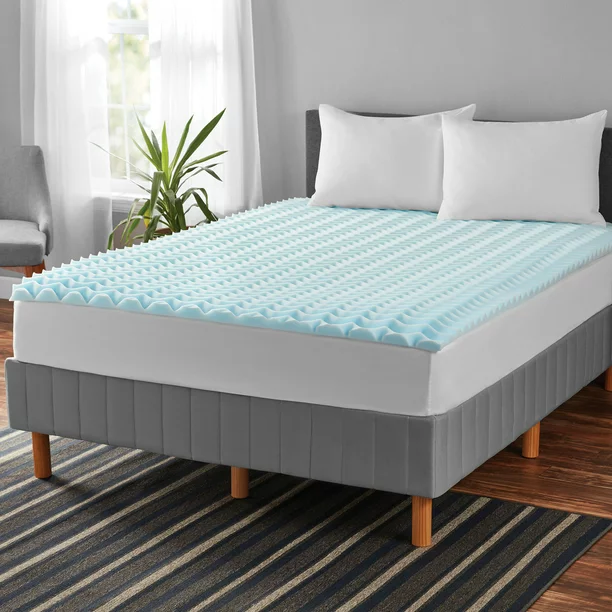
The main mattress topper types are latex foam, memory foam and other polyurethane foams, wool, polyester or other fiber fills, and feather-and-down constructions. Some products add phase-change materials, gel, graphite, zones, convoluted surfaces, or microcoils.
Those names are useful starting points, not guarantees. Two latex toppers can have different firmness, thickness, hole patterns, covers, and manufacturing methods. Two memory foam toppers can respond differently to pressure and room temperature. A wool or feather topper can differ greatly in fill amount, chamber design, and care requirements.
A topper may change the cushioning, firmness impression, surface response, or initial temperature feel of a mattress. It cannot restore collapsed foam, broken springs, a damaged edge, or an unsuitable foundation. If the mattress has a visible hollow, a structural fault, or support that no longer feels level, investigate the mattress and base before adding another layer.
Topper, pad, and protector are not interchangeable
Retailers do not use these three names consistently, so inspect what the product is built to do.
- A topper is usually bought to make a noticeable change to the bed's surface feel. It may be a slab of foam, a filled and quilted layer, or a more complex construction.
- A pad is often thinner and may add light cushioning, absorbency, or both. Under the U.S. Consumer Product Safety Commission's rules, some products sold as mattress pads have specific smoldering-flammability and labeling requirements, while foam pads are treated differently. The marketing name alone does not establish which rule applies 1.
- A protector is primarily a barrier against liquid, stains, allergens, or wear. Waterproofing, breathability, and whether it changes the feel depend on the exact membrane and fabric.
One product may combine two roles. Read the construction, law label, care label, and warranty instead of deciding from the product name.
Mattress topper types at a glance
| Type | How the layer is built | What can vary most | What to verify |
|---|---|---|---|
| Latex foam | A continuous layer made with natural rubber latex, synthetic latex, or a blend | Formulation, firmness, thickness, hole pattern, molded or cut construction, and cover | Exact material disclosure, firmness test and method, finished dimensions, latex-allergy considerations, and certificate scope |
| Memory foam | Viscoelastic polyurethane foam designed to respond over time to load and temperature | Formulation, thickness, density, firmness, recovery speed, temperature response, and additives | Exact foam specification, cover, odor and ventilation instructions, care, return terms, and certification |
| Other polyfoam | Flexible polyurethane foam without a memory-foam response, sometimes sold as comfort, responsive, or high-density foam | Firmness, density, resilience, profile, and cover | Do not treat “high density” as a feel description; compare measured specifications and the return policy |
| Wool | Wool batting or fleece quilted or tufted inside a textile shell | Fiber source, fill weight, thickness, quilting, compression, and care | Whether measurements describe new or settled loft, cleaning limits, animal-fiber sensitivities, and certification scope |
| Fiber or down alternative | Polyester or another manufactured fiber held in channels or quilted boxes | Fiber type, fill weight, loft, chamber design, anchoring, and washability | Full fiber label, care method, expected redistribution, and whether the listed depth is gusset height or filled loft |
| Feather and down | Feather, down, or a blend in one or more baffled chambers | Species, percentages, fill power where given, fill weight, shell, baffling, and quill containment | Exact label, care, leakage and compression terms, sourcing claim, and return policy |
| Cooling or phase-change | Any base construction plus a surface treatment, fiber, gel, graphite, phase-change layer, or active heating and cooling system | Mechanism, location and amount of material, test method, duration, room conditions, and power needs | Whether evidence applies to the finished product and whether the claim is initial cool touch, passive heat buffering, or active temperature control |
| Zoned, convoluted, or microcoil | Foam cut into regions or peaks, or a layer that combines small springs with foam or fiber | Zone placement, orientation, cut depth, spring layout, total height, and cover | Whether the zones match the product orientation, whether the design can be rotated, and the complete return and warranty terms |
Latex foam toppers
Latex toppers can be made from natural rubber latex, synthetic latex, or a blend. “Latex” alone does not tell you the percentage of natural rubber, the firmness, or whether the foam was molded with one manufacturing process or another.
Latex foam is commonly described as responsive because it tends to recover promptly after load is removed. That does not mean every latex topper is firm or bouncy. Finished feel changes with formulation, indentation hardness, thickness, hole pattern, cover, and the mattress below.
A small laboratory study compared one latex mattress with one polyurethane foam mattress in 20 healthy young adults who lay in three positions for six minutes. The latex sample produced lower peak pressures in several measured regions, but the study did not test toppers, pain treatment, overnight comfort, durability, or every latex and polyurethane formulation 2. It shows why the performance of a tested sample should not become a universal material rule.
Natural rubber latex contains proteins that can cause allergic reactions in people with latex allergy. Processing and a textile cover change the exposure route, but they do not justify calling every latex topper hypoallergenic. If you have a diagnosed or suspected latex allergy, discuss the product with your clinician and ask the manufacturer whether natural rubber latex appears in the core, adhesives, elastic, or other components 3.
For an organic-latex claim, look for the exact Global Organic Latex Standard certificate and the product or component it covers. GOLS applies to products made with organically grown natural rubber latex and permits specified additional materials and accessories; it does not mean every component is latex or organic 4.
Memory foam and other polyurethane foams
Memory foam is a type of viscoelastic polyurethane foam. It deforms under load and recovers over time, and its response can change with temperature. A 2026 laboratory study demonstrated strong temperature effects in the experimental viscoelastic foams it tested, but its exact formulations and extreme test range do not predict how every commercial topper will feel 5. Other polyfoams may recover faster and feel less conforming, but product formulas vary.
Do not use density, firmness, and quality as synonyms:
- Density is mass per unit volume.
- Indentation hardness or deflection describes the force measured at a stated compression under a defined test.
- Subjective firmness is how the complete topper and mattress feel to a person.
ISO 2439 includes several indentation methods for open-cell latex, urethane, and PVC foams. The standard cautions that results apply to the specified test conditions and generally cannot be used directly for design purposes 6. A seller's ILD, IFD, or hardness number is therefore useful only when the material, specimen thickness, conditioning, method, and units are clear. A number from one test is not automatically comparable with a number from another.
Thickness changes how much material is available to deform, but it does not tell you whether the topper is softer, firmer, more durable, or suitable for a particular body weight or sleep position. A thick firm foam can change the surface less than a thinner, much softer foam. Product-specific testing or a returnable home trial is more useful than a universal thickness chart.
CertiPUR-US applies to flexible polyurethane foam and evaluates sampled foam for program criteria covering content, emissions, and durability. It does not certify latex, wool, down, the entire finished topper, or a medical benefit. Verify that the foam producer or participating company appears in the program directory 7.
Wool toppers
Wool toppers use fiber batting, fleece, or a combination of wool with another cushioning system. They usually create loft rather than the continuous, shape-holding layer of a foam slab. Fill amount, fiber preparation, tufting, quilting, and chamber size affect how the new topper feels and how it settles.
Wool fibers can absorb and release moisture vapor 8. That material property does not prove that every wool topper will keep every sleeper cool. The cover, fill density, bedding, mattress, room temperature, humidity, and sleeper all affect the bed microclimate. Compare a finished product's evidence rather than relying on “temperature regulating” as a category promise.
Care is especially product-specific. As of July 2026, Naturepedic lists a three-inch wool topper that is spot-clean only, while its shell and fill carry specific GOTS claims 9. Other wool-filled products may permit a wool cycle or professional cleaning. Follow the sewn-in label for your exact product and dry it completely before returning it to the bed.
GOTS covers certified organic textile fibers and processing. It can apply to a cotton shell, wool fill, or a finished textile product, depending on the certificate and label grade. It does not certify a latex foam core merely because the same topper has a GOTS-certified cover 10.
Fiber and down-alternative toppers
These toppers use polyester or another manufactured fiber to create a quilted, pillow-like layer. “Down alternative” describes the intended style, not one standardized fiber or performance level. Check the generic fiber names and percentages rather than assuming a product is cotton, bamboo, recycled, hypoallergenic, or free of animal-derived components.
For covered U.S. textile and wool products, the Federal Trade Commission requires fiber-content labeling by generic name and percentage, along with country of origin and the responsible business identity. Structural fillings may be treated differently, but voluntary fiber claims still must not be deceptive 11. A trademarked fiber name does not replace the generic fiber disclosure.
Construction matters as much as fill. Quilted boxes, baffles, and anchor bands change where the fill can move. The listed “depth” may describe the empty gusset rather than the amount of resilient cushioning after someone lies on it.
Current products also show why care cannot be inferred from the category. As of July 2026, The Company Store lists a 1.5-inch down-alternative topper with recycled polyester fill, a cotton shell, elastic anchor bands, and machine-wash instructions for a commercial front-loading washer 12. A similarly named product from another company may be spot-clean only.
Featherbeds and down toppers
A featherbed may use feathers for structure, down for softer loft, or both in separate chambers. Down percentage, feather percentage, fill weight, fill power, baffle construction, shell fabric, and finished depth answer different questions. A high gusset does not prove that the filled layer will remain that deep under load.
Expect the feel to change as fill shifts and compresses. Check whether the manufacturer calls for shaking, rotating, professional cleaning, spot cleaning, or a separate washable protector. Inspect the return policy before opening the package because some bedding companies restrict returns once a personal-use item has been opened.
Do not assume that “down alternative” is safer for every allergy or sensitivity. It removes down and feathers, but the shell, fill, finishes, elastic, and cleaning residues can still matter. Use the full component label and your known triggers.
Cooling, gel, graphite, and phase-change toppers
“Cooling” can describe several different mechanisms:
- A cool-to-the-touch cover changes the first contact sensation.
- A phase-change material absorbs and releases heat around a designed transition range.
- Gel, graphite, or another additive may change a material's thermal behavior.
- Perforations or a convoluted surface may change geometry and air spaces.
- An active system circulates air or water and requires power.
These mechanisms are not interchangeable, and none guarantees an all-night result in your room. In a study of 20 participants who lay on two mattresses for 20 minutes, the phase-change sample limited the rise in back skin temperature but did not improve reported thermal comfort or thermal perception 13. The experiment tested exact mattresses for a short period, not every topper or an overnight sleep outcome.
Ask what was tested: the raw material, a fabric swatch, the topper alone, or the complete bed system. Look for room temperature, humidity, test duration, comparator, repeated cycles, and whether the outcome was surface temperature, skin temperature, sweating, reported comfort, or sleep. A cold first touch is not evidence of sustained heat removal.
Zoned, convoluted, and microcoil designs
A zoned topper changes material, firmness, cut pattern, or spring response across regions. A convoluted topper has peaks and valleys cut into the foam. A microcoil topper adds small springs, usually with textile or foam layers.
These are construction choices, not medical treatments. A zone map labeled for shoulders, waist, or hips does not prove improved spinal alignment, pain relief, or suitability for every person in a sleep position. Height, body proportions, mattress firmness, and whether the topper is turned or rotated can move the intended zones away from the body areas shown in a diagram.
Convolution removes material and changes local geometry. It does not establish that the product is cooler, softer, or less durable without a comparison of the finished designs. Microcoils can also differ in wire, count, layout, surrounding materials, and total height. Judge the exact product, not the feature name.
How to read certifications and chemical claims
A certification answers a defined question. It does not certify every desirable property.
- CertiPUR-US concerns participating flexible polyurethane foam. It is not an organic certification and does not cover an entire mixed-material topper 7.
- OEKO-TEX Standard 100 tests the certified textile article or components against its harmful-substance criteria. Use the label check to confirm the certificate number and scope. It does not establish comfort, durability, organic content, or medical benefit 14.
- GOLS concerns organically grown natural rubber latex and the standard's permitted additional materials. Check the certificate and the exact product 4.
- GOTS concerns certified organic textile fibers and processing. Confirm whether the claim covers the shell, fill, or finished item 10.
Avoid labels such as “chemical-free,” “non-toxic,” or “toxin-free.” Every topper is made of chemicals, including natural fibers and rubber. A useful claim names the substance, test, threshold, component, laboratory or certifier, and current certificate.
New-product odor is not, by itself, proof that a product is dangerous or safe. Follow the manufacturer's unpacking and ventilation instructions. Stop using the topper and seek emergency care for trouble breathing, throat or tongue swelling, faintness, or another severe reaction after exposure 3.
Choose a topper by the change you want
1. Check the mattress and base first
Remove the bedding and look across the surface in good light. Check for permanent hollows, split foam, broken or protruding components, uneven support, missing slats, or a base that does not meet the mattress warranty. A topper may mask a shallow surface impression temporarily, but it cannot restore the structure underneath.
If the mattress may be defective, document it before adding a topper and read the mattress warranty. Some warranty claims require photographs of the bare mattress, its law tag, and its support system. Also check whether the mattress or adjustable-base manufacturer restricts extra layers, heating products, total height, or nonapproved accessories.
2. Describe the surface change in plain language
Decide whether you want more shallow cushioning, deeper contouring, quicker recovery, a lofted pillow-like surface, or a modestly firmer initial feel. Do not begin with a material name. Different constructions can create similar changes, and products within one material category can feel unlike each other.
If possible, compare the topper on a mattress similar to yours. A topper does not feel the same on a hard showroom platform, a soft mattress, and a mattress with a deep body impression.
3. Verify the complete fit
Compare the topper's finished length and width with the actual mattress, not only the size label. Add mattress height, topper height, any pad or protector, and the amount of sheet pocket needed to wrap underneath. Check whether a headboard, footboard, fitted cover, safety rail, or adjustable base creates a conflict.
Straps, skirts, grippy fabric, and a fitted sheet can reduce movement, but none guarantees a secure fit on every mattress. Check the allowed mattress depth and whether the topper may be rotated or flipped. On an adjustable base, ask both manufacturers whether the topper bends safely and stays positioned through the full range of motion.
4. Read care and ownership terms before purchase
Find out whether the core, cover, or entire topper is washable. Foam cores are often not washable even when their zippered covers are. Filled toppers may need a large commercial machine, spot cleaning, or professional care.
Product terms differ even inside one category. As of July 2026, Tempur-Pedic lists removable washable covers on its current foam toppers but says not to wash or dry-clean the foam core, and it does not accept returns on those toppers 15. The current Company Store down-alternative example is machine washable and has a stated return window 12. These differences can matter more than the generic material name.
Confirm:
- trial length and whether opening or using the topper changes eligibility;
- return shipping, pickup, compression, packaging, and sanitation rules;
- warranty coverage for permanent compression, tears, cover defects, or shifting fill;
- exclusions for stains, moisture, misuse, the wrong base, electric blankets, or heating pads;
- the care steps needed to preserve warranty coverage.
5. Use the trial as a controlled comparison
Keep the mattress, base, pillow, bedding, and room conditions as stable as practical. Record the issue you are trying to change and whether it improves, stays the same, or creates a new problem. Do not cut the foam, remove labels, discard packaging, or add a second topper until you understand the return conditions.
Persistent or severe back, joint, or nerve symptoms need a health assessment rather than repeated bedding purchases. A topper can alter surface pressure and comfort, but no topper material is a treatment for arthritis, sciatica, spinal disease, or another medical condition.
Do not add a topper to an infant sleep surface
A crib, bassinet, or play yard should have a firm, flat, level surface intended for that product, covered only by a fitted sheet. The CPSC's “Bare is Best” guidance says not to add soft objects or extra bedding to an infant sleep space 16. Do not use an adult topper, wool pad, foam insert, or feather layer to soften a baby's mattress.
The practical bottom line
Material tells you what a topper is made from. Construction and exact specifications tell you how that particular topper may behave. Start with the surface change you want, reject the purchase if the mattress or base has a structural problem, and compare finished dimensions, firmness method, care, certifications, trial, and warranty for the exact model.