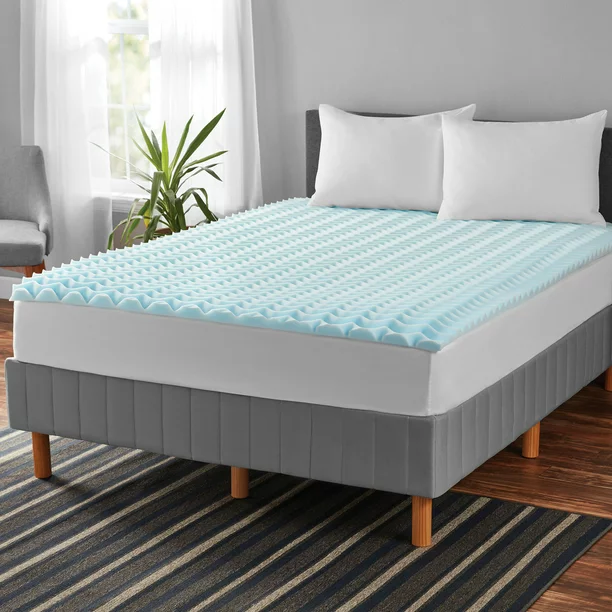


A mattress topper is a removable layer that sits on top of a mattress. It can change surface cushioning, contouring, responsiveness, temperature feel, and bed height. It may be useful when the mattress and its base are still sound but the immediate sleep surface does not feel right.
A topper cannot rebuild a sagging core, repair a broken coil, restore a failed edge, correct an unsuitable base, or make a contaminated mattress safe. It also cannot reliably turn a deeply soft mattress into a supportive one because the layers beneath it still compress. Diagnose the problem before adding another layer.
Start with the mattress, base, and problem
Remove the bedding and inspect the complete sleep system. Look for:
- A visible dip, ridge, or body impression that remains when nobody is on the bed
- A weak edge, broken component, torn cover, or foam that feels permanently collapsed
- Loose slats, missing center support, a bowed foundation, or an incompatible adjustable base
- Dampness, mold, pest activity, or an odor that suggests the mattress itself needs attention
- A comfort problem that disappears when the mattress is placed on the support surface required by its maker
Check the mattress and base warranties before adding a topper. The documents may define an approved base, measurement method for impressions, stain exclusions, or accessory restrictions. Photograph a suspected defect and contact the seller or manufacturer before covering it.
If the system is sound, describe the change you want in testable terms. “My shoulder feels compressed on my side” is more useful than “I need more support.” “I struggle to turn because the surface holds me” is more useful than “I need a firm topper.” The same topper can solve one problem while creating another.
How topper materials differ
Material names describe ingredients or broad construction families. They do not establish how the finished topper will feel, sleep, or age.
| Topper type | What may change | Specifications that matter | Limits to keep in mind |
|---|---|---|---|
| Memory foam or other polyurethane foam | Cushioning, contouring, response speed, and motion feel | Foam type, firmness, density, thickness, cut, perforations, cover, and temperature sensitivity | Density is not firmness. “Gel” or “open cell” does not prove cooler sleep. |
| Latex foam | Cushioning with a range of response speeds and firmnesses | Natural, synthetic, or blended latex; process; firmness; thickness; perforations; cover | Latex is not universally cool, durable, mold-proof, dust-mite-proof, or suitable for people with natural-rubber latex allergy. |
| Wool | Surface cushioning and moisture feel | Wool form, fill weight, loft, quilting, backing, compression, and care | “Temperature regulating” does not predict one person's result. Loft can settle and cleaning may be restricted. |
| Down or feather | A plush, shifting layer with little structural correction | Down-to-feather ratio, fill power, fill weight, baffle construction, leakage control, and care | Fill can migrate or compress. Animal material and allergy concerns need an individual decision. |
| Fiber or down alternative | Surface padding without down or feathers | Fiber type, denier, crimp, fill weight, loft, quilting, and wash instructions | Loft and feel vary widely, and a washable cover does not mean the whole topper is washable. |
| Microcoil | A spring-based comfort layer that may feel more responsive | Finished height, coil design, gauge, count, zoning, edge construction, cover, and layers around the coils | Coil count alone does not prove comfort, airflow, durability, or support. |
| Other constructions | Buckling-column gels, layered hybrids, air, water, or active heating and cooling can create different surface effects | Exact layer diagram, controls, test data, power needs, noise, maintenance, and compatibility | A category label cannot substitute for the model's manual, trial, and return terms. |
Memory foam is a viscoelastic type of polyurethane foam, but products using that name can respond at very different speeds and temperatures. Conventional polyfoam can also range from soft and flexible to firm and springy. Compare the finished topper rather than assuming memory foam always contours deeply or all polyfoam feels the same.
Latex labels also need translation. “Natural,” “synthetic,” and “blended” describe the rubber source. “Dunlop” and “Talalay” refer to production processes, not universal firmness or quality grades. A perforated soft latex layer and a dense-feeling firm latex layer can behave very differently even when both listings simply say “latex topper.”
With loose or quilted fills, the internal construction matters as much as the fiber. Baffles can limit migration, while fill weight and loft help describe how much material is present and how high it sits. Neither figure alone tells you how quickly the layer will compress under your body.
Thickness, density, firmness, fill, and construction are different
These specifications answer separate questions:
- Thickness is the unloaded height of the topper. More thickness gives the material more room to compress and can create a larger change, but it does not guarantee more support or comfort.
- Density is mass per unit volume. For flexible polyurethane foam, density is independent of firmness 1. It can be relevant to the amount of polymer and some performance properties, but a density number alone does not predict the finished topper's feel or life.
- Firmness describes resistance to compression under a defined test. Foam IFD, formerly called ILD, is the force needed to indent a sample by a stated percentage. Sample thickness, size, and test method affect the result, so numbers are most useful when measured on comparable samples 2.
- Fill weight is the amount of loose or quilted material in a defined size. It is not the same as loft, firmness, fill power, or resistance to compression.
- Loft is the uncompressed height or fullness of a fill. It can change with use, humidity, laundering, or redistribution.
- Construction includes layers, zoning, holes, cuts, quilting, baffles, coil design, cover stretch, and attachments. These details can change the result even when headline specifications match.
Do not choose a 2-, 3-, or 4-inch topper from body weight or sleep position alone. Thickness changes the amount of material available to compress, but the material's firmness, response, construction, and the mattress beneath it determine whether you feel cushioned, trapped, unstable, or as if you are bottoming out.
A seller that provides an IFD or ILD number should also state the material, sample thickness, indentation percentage, and test method. Without that context, comparing numbers across brands can be misleading.
Test the change you actually need
A softer topper may reduce sharp surface pressure, but too much sink can make turning harder or allow a hip or shoulder to bottom out against the mattress. A firmer topper may make the first contact feel more stable, but it cannot stop a soft mattress or weak base from yielding beneath it. Test the topper as part of the complete bed.
Use your usual pillow, protector, sheets, and sleepwear. Spend time in every position you use, then check:
- Do shoulders, hips, ribs, or knees develop pressure or numbness?
- Does the pelvis feel as if it keeps sinking after the surface should have settled?
- Can you turn, sit up, and get out of bed without excessive effort?
- Does the edge remain usable for sleeping, sitting, or transfers?
- Can each partner use their normal area without rolling toward a softer section?
- Does one partner's movement travel farther, or does the topper damp it?
- Do you notice heat, clamminess, noise, odor, or shifting with the complete bedding stack?
A topper that feels comfortable for ten minutes may behave differently after warming under the body or after a full night. This is why a realistic home trial and workable return process matter more than a category promise.
A topper is not a back-pain or joint-pain treatment
Comfort changes can affect how a painful body feels in bed, but a generic topper has not been established as treatment for back or joint pain. One frequently cited randomized trial found better pain-related outcomes with a medium-firm mattress than a firm mattress among adults with chronic nonspecific low-back pain 3. That study compared complete mattress systems. It did not test toppers and cannot tell you which topper material, thickness, or firmness will treat pain.
Use pain as information during the trial, not as proof that one material is therapeutic. The National Institute of Arthritis and Musculoskeletal and Skin Diseases advises seeing a doctor when back pain does not improve or occurs with warning signs such as numbness, weakness, fever, or bladder problems 4. A topper should not replace evaluation of those symptoms.
Allergies, odor, temperature, and certifications
Allergies and sensitivities
“Hypoallergenic” is not a complete material or exposure description. Ask what is in the foam, fill, fabric, adhesive, backing, elastic, and treatments.
Natural-rubber latex contains proteins that can trigger allergic reactions in sensitive people. The U.S. Food and Drug Administration distinguishes natural-rubber latex from synthetic latex and advises people concerned about natural-latex allergy to check ingredients and contact the manufacturer when needed 5. Do not assume that a fabric cover or a “hypoallergenic” claim makes a natural-latex topper suitable for a person with a known allergy.
Down and feather are animal-derived materials. A down-alternative label generally means another fill, often synthetic, but it does not prove that the complete product is free of every relevant allergen or irritant. Check the exact fill, fabric, treatments, leakage, and care requirements.
A topper is not a dust-mite or bed-bug control plan. If that is the goal, read our mattress protector and mattress pad comparison for the distinct role of tested, fully closing encasements.
Odor and emissions
Odor intensity does not identify the chemical, dose, or health risk. A product can emit compounds that have little odor, and a noticeable smell does not tell you which compounds are present. The U.S. Environmental Protection Agency notes that indoor-air certification programs may not assess every VOC emitted by a product 6.
Follow the exact model's unpacking, expansion, and ventilation instructions. Do not use a universal waiting time. If an odor or symptom concerns you, increase ventilation if the instructions allow, leave the room, stop using the product, and contact the manufacturer or a health professional as appropriate.
Temperature claims
“Cooling,” “breathable,” “moisture wicking,” “gel,” “open cell,” “perforated,” and “phase change” describe different materials or claims. None guarantees a cooler night. Room temperature, humidity, how deeply the body sinks, the cover, protector, sheets, sleepwear, and a partner all affect the result.
Ask what was tested, whether the test covered the complete topper, how long the measurement lasted, and whether it measured surface temperature, heat flow, humidity, or only one material property. A cool first touch is not the same as maintaining comfort through the night.
Certification scope
Read what a certification covers. CertiPUR-US, for example, applies to flexible polyurethane foam and evaluates specified content, emissions, and durability criteria. It does not certify latex foam 7. The mark does not prove that the whole topper is allergen-free, odor-free, chemical-free, cool, comfortable, or appropriate for a medical condition.
Apply the same discipline to textile and emissions labels. Confirm whether the certificate names the foam, fabric, fill, component, or finished product, and whether the exact model appears in the certifier's directory.
How to choose the exact model
Create a shortlist only after defining the problem. Then compare:
- The promised change: Does the maker describe cushioning, contouring, response, firmness, or temperature in a way you can test?
- Complete construction: Are material, thickness, firmness method, fill weight, layers, cover, adhesives, and attachments disclosed?
- Actual dimensions: Compare the topper's stated width and length with your measured mattress. Use our mattress topper size guide to understand size names, then use the exact model dimensions for the purchase.
- Finished bed depth: Add the mattress, topper, pad or protector, and any other layer. Confirm fitted-sheet pocket depth without relying on the advertised mattress depth alone.
- Stability: Check straps, fitted skirts, grip surfaces, ties, and non-slip layers. None guarantees that a topper will stay aligned on every cover or adjustable base.
- Trial conditions: Confirm whether sleeping on the topper is allowed, whether a protector is required, whether there is a minimum trial period, and what condition the item must be in for a return.
- Return logistics: Ask who pays return shipping, whether compressed packaging must be recreated, whether pickup is offered, and whether fees or final-sale exclusions apply. The Federal Trade Commission recommends checking the seller's refund policy, return deadline, shipping costs, and restocking fees before buying online 8.
- Warranty terms: Check what counts as a defect, how an indentation is measured, what base and care are required, and whether the warranty covers the topper, the mattress, or neither when one damages the other.
Keep the product page, terms, order confirmation, receipt, and photos of the topper after expansion. Policies can differ by seller even for the same model.
Fit, layering, and powered-bed compatibility
Do not assume there is one correct order for every topper, protector, pad, and fitted sheet. A protector placed over the topper may guard both layers but can alter the feel or fit. One placed below the topper leaves the topper exposed. Follow both products' instructions and make sure the stack does not bunch, pull corners upward, block airflow, or exceed the fitted sheet's range.
For split beds, confirm whether you need one full-width topper or separate pieces. A full topper can bridge the split and restrict independent movement. Separate toppers can leave a center seam or move apart.
Adjustable bases need a topper that can bend repeatedly without sliding, buckling, separating, or blocking retainers. Air beds, smart beds, and actively heated or cooled systems may have hoses, sensors, magnets, vents, cables, or moving joints that must remain clear. Physical fit is not proof of compatibility. Start with the bed maker's manual and approved-accessory list.
Heated blankets and mattress pads also require model-specific checks. Heat can change the feel of temperature-sensitive foam, and powered bedding may prohibit certain layers or bed types. Tempur-Pedic, for example, advises against electric blankets or heating pads with its toppers, gives limited-use instructions if one is used, and says the topper foam itself should not be washed or dry-cleaned 9. Those instructions apply to its products, not to every topper.
Care and replacement depend on condition
Read the sewn label and manual before cleaning. A removable washable cover does not make the foam, fill, adhesive, or internal construction washable. Do not assume every topper should be vacuumed, exposed to sunlight, rotated, or flipped. Some have one sleep side, attached zones, fragile fills, or care restrictions.
Deal with a spill promptly using the maker's method. Dry every reusable layer completely before remaking the bed. If liquid reached the mattress, inspect and address that layer too. A topper should not be used to hide mold, pests, bodily-fluid contamination, or material that cannot be cleaned safely.
There is no useful universal replacement age. Replace or pursue a warranty claim when condition or performance calls for it, such as:
- An impression, lump, compressed zone, or firmness change that no longer recovers
- Foam that cracks, crumbles, hardens, or tears
- Fill that remains clumped, displaced, or flat after permitted care
- A broken cover, exposed component, or failed attachment
- Persistent sliding, bunching, poor fit, or interference with the base
- Odor or contamination that cannot be resolved safely
- A change in comfort, mobility, or health needs that the topper no longer meets
Higher price, thicker material, a long warranty, and a premium label do not establish how long a topper will remain suitable in your bed.
Safety checks before adding bed height
Do not add a soft topper to an infant sleep surface. The American Academy of Pediatrics recommends a firm, flat, noninclined surface and states that mattress toppers designed to soften the surface are not appropriate for infants younger than 1 year 10.
On an upper bunk, a topper raises the sleep surface and reduces the effective height of the guardrail. The U.S. Consumer Product Safety Commission's bunk-bed guidance requires guardrail tops to remain at least 5 inches above the mattress 11. Follow the bunk label and manual's maximum mattress thickness, counting the topper if the manufacturer treats it as part of the sleep-surface height.
Extra height and edge compression can also affect transfers. Before keeping a topper, have the sleeper test sitting with feet supported, standing, getting into and out of bed, reaching mobility equipment, and using the edge as they normally would. A topper that improves lying comfort is not a good trade if it makes a safe transfer less stable.
The practical decision
A topper is most defensible when the bed is structurally sound, the desired surface change is specific, and the exact model can be tested and returned. Start with the problem, translate the specifications, verify compatibility and safety, and judge the complete bed over real nights. If the underlying mattress or base is failing, address that failure instead of covering it.