
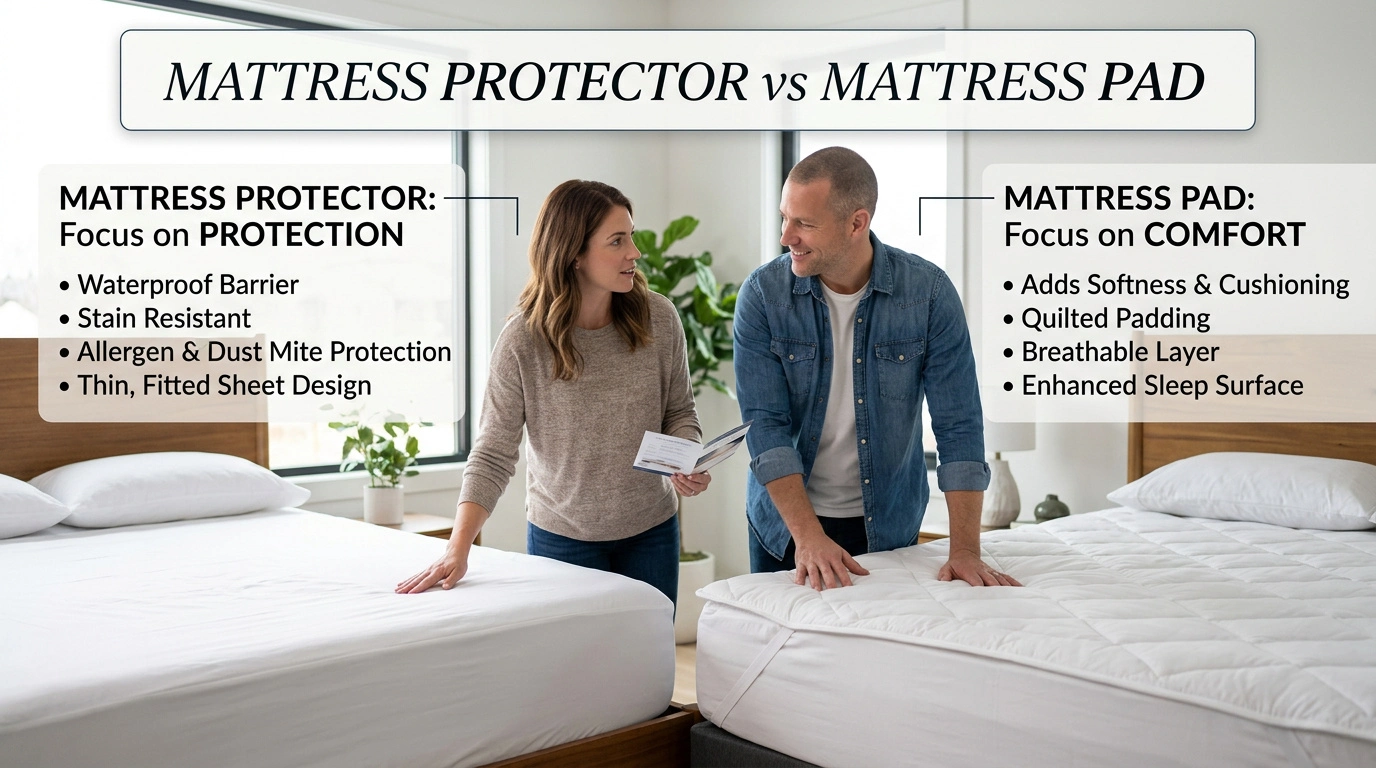
A mattress pad usually adds a modest amount of cushioning. A mattress protector usually puts a barrier between the sleeper and the mattress. Those are useful starting points, not standardized definitions.
A seller can call a quilted, filled, waterproof product a mattress pad, while another calls a thin waterproof fitted cover a protector. Current official products provide both examples 12. Read the construction and coverage instead of choosing by the name alone.
The practical differences
| Product construction | Main purpose | Typical coverage | Main limitation |
|---|---|---|---|
| Quilted or filled mattress pad | Modest surface cushioning, sometimes with a liquid barrier | Top surface, held by a fitted skirt, straps, or elastic | May change feel, add height, bunch, or provide no liquid barrier at all |
| Fitted or top-only protector | Barrier against the spills or soils named by the maker | Sleep surface, often with a non-waterproof fitted skirt | The sides, seams, and underside may remain exposed |
| Five-sided protector | Barrier across the top and four vertical sides | Top and sides, usually fitted like a sheet | The underside remains open and the exact seam coverage still matters |
| Full encasement | Specialized all-side barrier with a zipper closure | Top, bottom, and four sides | Installation, zipper integrity, fit, heat, feel, and compatibility need closer attention |
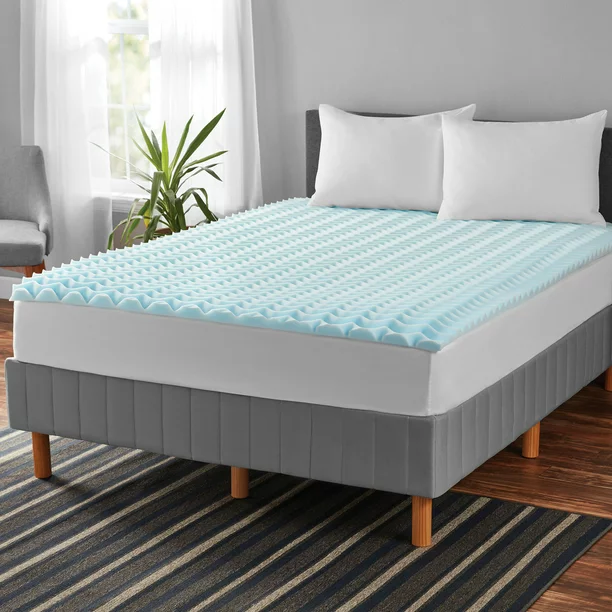
| Mattress topper | Noticeable change in surface feel or cushioning | Sits on top of the mattress and may use straps or a fitted cover | Its thickness can affect support, fit, heat, movement, and every layer placed above it |
The five-sided label should mean the top and four sides are covered, but verify where the liquid membrane actually extends. One official five-sided product, for example, specifies a waterproof lining over the top and sides 3. A full encasement surrounds the mattress and closes with a zipper. Neither label tells you whether every seam, zipper end, or damaged area will resist a particular spill.
A mattress topper is the better comparison when you want a substantial change in feel. Product names can overlap, so focus on fill depth and function. A thin quilted pad may make a small surface change. A thick foam, latex, fiber, wool, or feather layer should be treated as a topper for fit and feel decisions even if its listing uses another name. The mattress topper guide covers those larger comfort changes.
A simple decision path
Choose the problem before the product:
- You want a little more surface cushioning: Start with a pad. If you need a clear change in softness, contouring, or height, compare toppers instead.
- You want a barrier against spills or body fluids: Start with a protector or a pad whose listing identifies the liquid barrier, coverage, seams, and care limits.
- You need both cushioning and a liquid barrier: A combined padded waterproof product may be simpler than two layers. Using separate products is also possible if both manufacturers allow the fit and order.
- You have confirmed dust-mite allergy or exposure-related asthma symptoms: Discuss a complete allergen-impermeable encasement as one part of a targeted plan. A fitted top protector is not the same product.
- You are managing bed bugs: Look for a full encasement specifically tested or certified for bed-bug entry and escape, then use it within a complete room-level control plan.
- The bed has sensors, air hoses, powered heating or cooling, or an adjustable base: Start with the bed manual's approved accessories. Generic fit is not enough.
If you have no cushioning, spill, allergen, pest, or model-specific reason to add a layer, you may not need either product.
Compare liquid protection by coverage, not by one word
“Waterproof” does not answer every practical question. Check:
- Which surfaces have the barrier?
- Are seams sealed or left as needle holes?
- Is the zipper backed and protected at its end?
- Is the top absorbent enough to hold liquid, or could a spill pool and run toward an uncovered edge?
- What liquid amount, contact time, and pressure were used in any test?
- Does the warranty cover the protector only, or defined damage to the mattress too?
- Which laundering conditions preserve the barrier?
A liquid-resistant surface is not necessarily vapor-tight. Some allergen-barrier fabrics are designed to block particles while allowing air and water vapor to pass 4. That may help with moisture transport, but it does not prove the finished bed will feel cool. A membrane, absorbent fabric, quilting, sheets, room conditions, and the sleeper all affect heat and moisture near the skin.
A protector can reduce the chance that a covered spill reaches the mattress. It cannot guarantee that the mattress will stay dry through an uncovered side, an open zipper, a damaged membrane, a large event, or incorrect laundering. It also cannot prevent mold by itself. If liquid reaches any layer, remove wet bedding promptly, follow the care instructions, and let every reusable layer dry completely before remaking the bed.
Do not assume an antimicrobial finish blocks all bacteria, makes a product hygienic indefinitely, or treats a health condition. Some treatments are designed only to limit odor or deterioration in the treated fabric. The scope of the exact claim matters.
Cushioning, feel, stretch, noise, and temperature
A pad is more likely to change the surface because it contains fill, but the amount and effect vary. A protector can also change the bed if its membrane is stiff, its fabric is textured, its elastic is tight, or it fits with wrinkles.
Consider each feature separately:
- Cushioning: Look at fill material and thickness. A pad may soften the immediate surface, but it cannot repair broken coils, restore failed foam, level a sag, or correct an unsuitable base.
- Feel and stretch: Stretch matters on highly conforming foams, split or flex-top mattresses, air beds, and adjustable systems. A taut nonstretch layer can change how the surface moves.
- Noise: Waterproof products are not universally quiet. Fabric, membrane, fit, and movement determine whether you hear rustling.
- Heat and moisture: “Breathable,” “cooling,” and “moisture wicking” describe different claims. Ask for the test behind the exact claim. None guarantees that you will sleep cooler.
- Durability: Fill can flatten, elastic can relax, membranes can peel or crack, and zipper systems can fail. Price and warranty length do not establish how a product will perform after your laundering routine.
- Price: Material, size, coverage, closure, testing, warranty, and brand can all affect cost. A higher price does not prove better cushioning, liquid protection, comfort, or durability.
Do not expect a pad to treat pressure pain, improve sleep quality, or preserve a mattress's support. If pain is driving the purchase, address the health question separately instead of treating extra cushioning as a cure.
Measure the finished bed and check compatibility
Measure the mattress's actual length, width, and depth. Include any topper or permanent pad already in the stack. Then compare those measurements with the product's stated range.
A pocket that is too shallow may pull at corners, compress a soft edge, strain a zipper, or come loose. A pocket that is too deep may wrinkle or bunch. Extra layers can also make the fitted sheet release from the corners.
Check more than dimensions:
- Does the bed bend on an adjustable base?
- Does it have split, flex-top, or divided zones?
- Must a hose, cable, sensor, magnet, retainer, air intake, or vent remain accessible?
- Does the manufacturer require a particular amount of stretch or airflow?
- Will elastic cross a control, connection, or moving joint?
Sleep Number, for example, sells different encasement versions according to where a bed's hoses exit and which base is used. Its instructions also place one named mattress pad over its encasement 5. Tempur-Pedic directs owners of its ActiveBreeze system to a specific water-resistant cover intended to preserve airflow, while its general protector has a different construction and purpose 2.
Those are model-specific arrangements, not universal layering rules. A product that physically stretches over a smart or powered bed may still interfere with sensing, air movement, articulation, temperature control, or warranty terms.
Dust-mite encasements can reduce exposure, but they are not treatment alone
For dust-mite control, the relevant product is a complete allergen-impermeable encasement, not any cover marketed as “hypoallergenic.” It should fully enclose the mattress, fit without tears or open gaps, and keep the zipper securely closed. A clinician may also recommend encasing the box spring and pillows as part of a broader plan.
Allergy practice guidance reports that suitable woven microfiber encasements can contain dust-mite allergen while allowing air and water vapor through. It also notes that fabric construction and measured allergen passage matter more than a generic pore-size or “breathable” claim 4.
Reducing exposure does not guarantee symptom improvement. The 2020 U.S. asthma guideline found that impermeable mattress and pillow covers used alone did not improve asthma exacerbations, control, or quality of life. It conditionally recommends them only within a multicomponent, allergen-specific strategy for people whose symptoms are related to exposure by testing or clinical history 6.
An encasement should not replace prescribed asthma or allergy treatment. If you are unsure whether dust mites are a relevant trigger, discuss the pattern and testing with a clinician instead of buying a cover as a diagnostic test.
A bed-bug encasement is one control tool
A full encasement designed for bed bugs can trap bugs already in a mattress or foundation and make inspection easier. Certification or laboratory testing should address the complete containment path, including fabric, seams, zipper teeth, and the zipper-end closure. For example, one manufacturer's posted entomology report separately evaluated fabric feed-through, zipper feed-through, and escape through the closure 7. That evidence applies to the tested encasement, not to every zippered cover.
An encasement does not prevent a bed bug from entering the room, eliminate bugs in a frame or furniture, or prove an infestation is gone. The U.S. Environmental Protection Agency includes mattress and box-spring encasements within integrated pest management alongside monitoring and other nonchemical or chemical measures 8.
Follow the encasement's instructions for installation, inspection, repairs, and how long it must stay closed. Do not apply a pesticide to a mattress, encasement, or bedding unless the EPA-registered product label specifically permits that site and use.
Pads and protectors do not automatically preserve a warranty
A barrier may prevent a type of damage that a warranty excludes, but it does not extend coverage, prove a defect, or guarantee a successful claim. Mattress warranties and separate protector stain plans can have different terms.
The Federal Trade Commission says a written warranty must be available before purchase and advises saving both the warranty and receipt 9. Read the mattress warranty, the pad or protector warranty, and any return policy before buying.
Check:
- Whether stains, liquid damage, odors, or an unsanitary condition affect inspection or coverage
- Whether any protector is required, recommended, or optional
- Whether a named accessory is required and, if so, what the written terms say
- Whether the pad or protector has a separate mattress-stain benefit
- Purchase-timing, registration, reporting, laundering, documentation, and claim deadlines
- Whether opened bedding can be returned
Requirements differ even when a company strongly recommends protection. Tempur-Pedic, for example, says a protector is not required for its mattress, while warning that spills or stains could affect the limited warranty 10. That is one manufacturer's current policy, not a rule for another mattress.
Can you use a pad and protector together?
Yes, if the full stack fits securely and every product's instructions allow it. There is no universal order.
If the liquid barrier sits directly over the mattress, it protects the mattress but not necessarily the pad or topper above it. If the barrier sits above a pad or topper, it may protect more of the stack but change the feel, stretch, noise, and moisture behavior closer to the sleeper.
Work through the decision in this order:
- Check the mattress and powered-system manuals for prohibited or approved layers.
- Decide which layer needs protection.
- Follow any specified order for an encasement, topper, pad, protector, sensor cover, and sheet.
- Recalculate the finished depth and confirm every skirt, zipper, strap, and sheet fits without excessive tension.
- Articulate an adjustable base through its allowed range while watching for bunching, bridging, pulled corners, obstructed hoses, or pinched cords.
- Remove a layer if the bed no longer feels, moves, senses, heats, or cools as intended.
Do not assume that more layers provide more protection. A poor fit can create openings and wear while making laundering harder.
Wash according to events, use, and the care label
There is no evidence-based household schedule that applies to every pad and protector. Wash promptly after a spill or bodily-fluid event when the label allows it. Otherwise, use the product label, visible soil, odor, household needs, allergy plan, and available washer and dryer capacity to set the routine.
Before laundering, check:
- Water temperature and cycle
- Allowed detergent and whether bleach, stain remover, fabric softener, or dryer sheets are prohibited
- Whether the fill, foam, membrane, or encasement must be washed separately
- Dryer temperature, line-drying instructions, and whether commercial machines are allowed
- Whether the zipper should be open or closed
- Whether a cord or controller must be detached
Similar-looking products can require different care. Saatva's current quilted waterproof pad specifies a cold gentle wash, no bleach, and tumble drying 1. Sleep Number gives cold washing for one encasement and warm washing for another, with low-heat or line-drying instructions 5.
Let the product dry completely before putting it back on the bed. Inspect the barrier, seams, zipper, elastic, and fit after washing. Replace or contact the maker about a product that peels, cracks, tears, opens at the closure, no longer fits, or fails within its documented use.
The mattress protector cleaning guide covers stain response and material-specific care in more detail.
Infant, child, and heated-product boundaries
An adult pad, topper, plush protector, or extra mattress must not be added to an infant sleep space. The American Academy of Pediatrics recommends a firm, flat, noninclined surface designed for the crib, bassinet, portable crib, or play yard, covered by a fitted sheet with no other bedding or soft objects. It specifically says mattress toppers are not appropriate for infants younger than 1 year 11.
Follow the infant sleep product's instructions for any permitted waterproof cover. It must not soften the surface, create a gap, interfere with the fitted sheet, or change the mattress's fit. A product marketed for children is not automatically safe for an infant sleep space.
An electrically heated mattress pad is an appliance, not an ordinary cushioning pad. Its manual controls who may use it, compatible beds and layers, cord routing, washing, drying, storage, and inspection. One current Sunbeam manual, for example, prohibits use with infants or children, people unable to sense heat or operate the controls, mechanically adjustable beds, and another electrically heated product. It also warns against pinching or bunching the wired area and requires the product to be completely dry before reconnection 12.
Apply those restrictions to that product rather than assuming every heated pad has identical rules. For any heated bedding, follow the exact manual and stop using it if the cord, controller, connector, or wired fabric is damaged or behaves abnormally.
Pre-purchase checklist
Before ordering, confirm:
- The primary job: cushioning, liquid barrier, allergen encasement, bed-bug encasement, or a documented combination
- Top-only, five-sided, or full-encasement coverage
- Barrier location, seam construction, zipper closure, absorbency, and test details
- Fill material and how much the surface is likely to change
- Exact mattress dimensions, finished bed depth, pocket range, elastic, straps, and zipper fit
- Stretch, texture, noise, and water-vapor information that matters to you
- Adjustable-base, split-bed, sensor, hose, airflow, heating, and cooling compatibility
- Washer and dryer capacity plus all care restrictions
- Product return policy, warranty scope, stain-plan terms, and required records
- Total price for the exact size and function, without treating price as a quality score
Choose a pad when modest cushioning is the main need. Choose a protector when a defined barrier is the main need. Choose a specialized encasement only for the exposure or pest purpose it is designed to address. When one product combines roles, judge each function from its construction and evidence rather than its name.