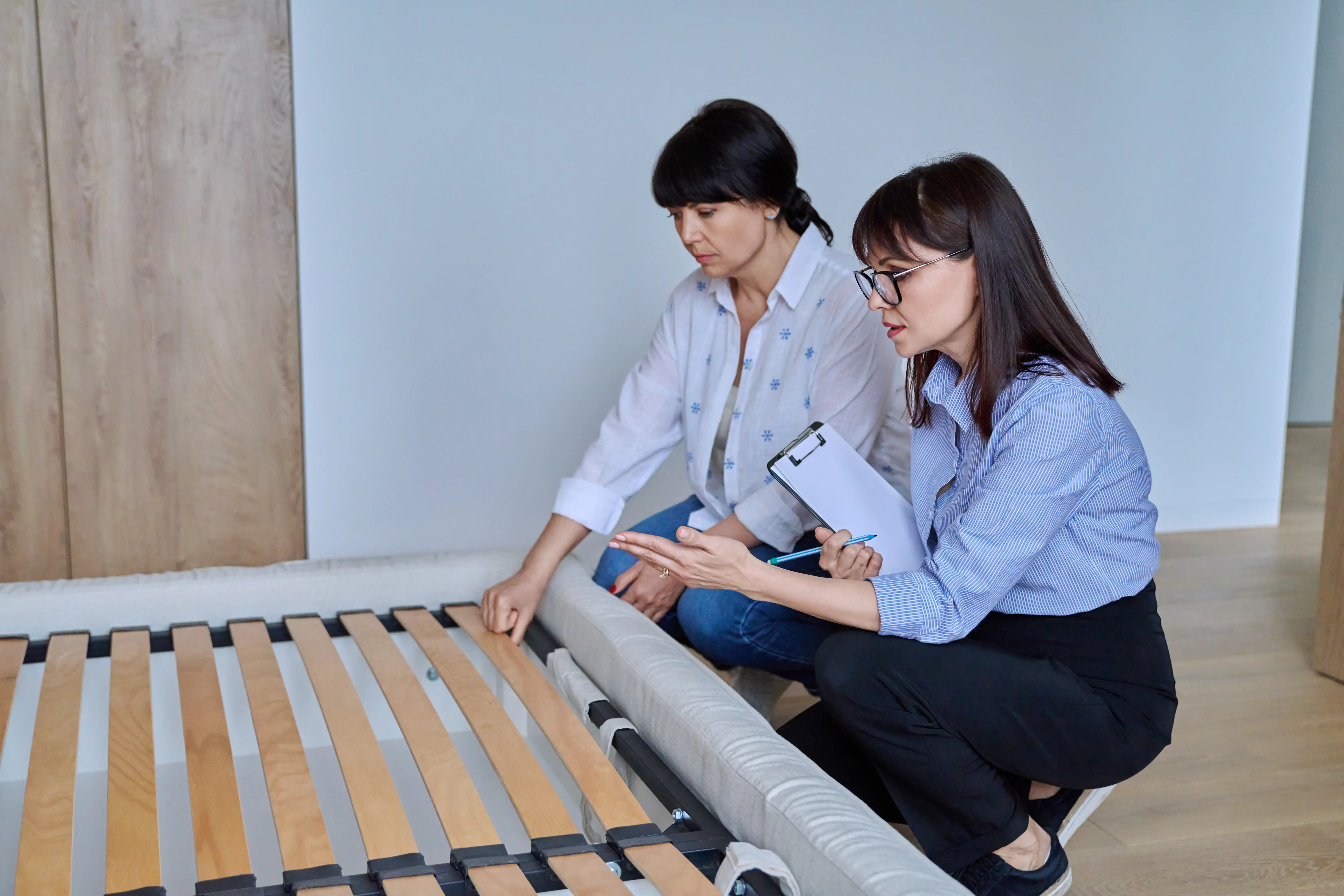


A Murphy bed can free a room for other uses, but only while the bed is closed and the opening area remains clear. The right one is not simply the largest mattress that fits the wall. It is a specific system that fits the room in both positions, can be anchored to the available structure, works with an approved mattress, and can be raised and lowered safely by the people who will use it.
Serious failures have occurred when wall beds detached or fell. A 2022 U.S. Consumer Product Safety Commission recall covered about 129,000 Bestar wall beds after one death and 60 additional incidents involving beds detaching and striking people 1. Start with the installation manual and model identity, not a generic Murphy-bed checklist.
What is a Murphy bed?
“Murphy bed” and “wall bed” commonly describe a mattress platform that pivots into a cabinet or wall unit when not in use. The cabinet may be secured to a wall, floor, or both, depending on the design. A spring, piston, counterweight, motor, or manual system may assist movement. Those labels do not tell you the attachment method, force required, or failure behavior.
Products with similar marketing names can work very differently:
| Product label | What usually moves | What you need to verify |
|---|---|---|
| Wall or Murphy bed | A mattress platform pivots into a cabinet secured as the model requires | Structural anchoring, opening sweep, mattress limits, counterbalance, locks, legs, and load limit |
| Cabinet or chest bed | A usually freestanding cabinet unfolds into a low platform, often with a folding mattress | Extended footprint, included mattress, stability, load limit, setup effort, and storage |
| Sofa, desk, dining, or library wall bed | A wall bed moves with or around another furniture element | Separate anchoring, item-removal rules, shelf or desk loads, utilities, and all moving clearances |
| Vertical or horizontal wall bed | The platform pivots from its head end or long side | Cabinet height and width, open projection, ceiling clearance, and access to the bed |
| Murphy bunk bed | One or more sleep surfaces fold into a wall system | Bunk-bed compliance, guardrails, ladder, exact mattress, anchoring, and child-use rules |
A freestanding cabinet bed is not an unanchored version of a true wall bed. It is a different product with its own mattress, stability, opening, and load requirements. Likewise, a sofa or desk combination is not automatically safe to operate with objects left in place. The exact instructions control.
Decide how the room and bed will be used
Begin with the room's everyday job. A guest bed that opens a few times a year creates different priorities from a bed used every night.
For daily use, consider:
- whether the user can reach the handle and control the bed through its entire travel
- the force needed to start, lower, and raise it with the approved mattress installed
- bed height, edge support, and clear space for sitting, standing, or transferring
- access from one or both sides for each sleeper
- where pillows and bedding go before the bed closes
- how often the surrounding furniture must be moved
A person with limited strength, balance, reach, or mobility does not automatically need to rule out a wall bed. They do need a model and room layout they can operate without overreaching, stepping backward into obstacles, or relying on unsafe assistance. Test the actual mechanism when possible. A motorized model can reduce lifting effort, but it still needs clear controls, safe stopping behavior, power planning, and manual or service procedures for a fault.
A cabinet bed may suit a renter who cannot make structural attachments, but it can take more floor depth when open and may use a thinner folding mattress. A conventional bed or sleeper sofa may be the better choice when the wall cannot be altered, the deployment zone cannot stay clear, or the intended user cannot control the system safely.
Measure the room in both states
Record the exact product's finished dimensions rather than relying on the nominal mattress size. Twin, full, queen, and king describe the sleep surface, not the cabinet.
Measure:
- The closed envelope: cabinet width, height, depth, side units, trim, handles, crown, and required gaps.
- The open envelope: full projection from the wall, bed width, leg position, any sofa or desk movement, and the complete opening arc.
- Usable circulation: room to approach the handle, lower the platform, walk beside it, open doors, and exit the room.
- Overhead and wall conflicts: ceiling slope, light fixtures, fans, sprinklers, windows, radiators, vents, outlets, switches, thermostats, baseboards, and door swing.
- The installation surface: wall and floor flatness, wall construction, stud or masonry location, trim thickness, flooring changes, and any required floor fasteners.
- The delivery route: package dimensions and weight, entry doors, elevators, stairs, landings, turns, and space for safe assembly.
Mark the closed outline and open projection on the floor and wall with removable tape. Then move doors, chairs, task lighting, and other furniture through their normal range. A room may fit the open mattress but still fail because a door is trapped, a ceiling fan crosses the opening arc, or there is no safe path around the bed.
Manufacturer specifications show why a generic size chart is misleading. Resource Furniture currently lists its vertical queen Penelope at 65 3/4 inches wide, 86 5/8 inches high, and 84 1/4 inches deep when open, with a 7-inch mattress. Its installation must be completed by a professional 2. A current Lori vertical queen is listed at 65.9 inches wide, 84.1 inches high, and 86.3 inches deep when open, while its wall-mounting and mattress rules differ 3. These are scoped examples, not standard queen dimensions.
Match the exact mattress to the mechanism
A mattress is part of the moving system. Verify all of these in the wall-bed manual and the mattress warranty:
- exact length and width, not only the nominal size name
- maximum and minimum thickness, if specified
- approved weight or weight range
- permitted constructions and suitability for upright storage
- whether a topper or protector counts toward the thickness and weight limit
- required support surface, mattress bar, straps, or other retainers
- occupant and total load limits
Foam and latex are not the only possible choices. Some models accept an innerspring or hybrid mattress, while others require a particular mattress. One current Lori system says it accepts any mattress up to 10 inches thick and around 70 to 130 pounds. Resource Furniture's Penelope assembly manual specifies a mattress around 66 pounds and 7 inches thick 34. Neither rule can be transferred to another bed.
Mattress weight affects counterbalance. A bed that drops, rises on its own, feels unusually heavy, or no longer locks after a mattress change needs model-specific correction before use. A piston does not make a wall bed unable to fall, and a lock does not compensate for wrong anchoring or an incompatible mattress.
For nightly sleep, compare comfort on the exact approved mattress and platform. Check pressure relief, edge behavior, heat, partner movement, and the support required by the mattress warranty. A king is not inherently more supportive, and a larger size may make access, operation, anchoring, and room circulation worse.
Do not close the bed with wet bedding or a damp mattress. If the room has condensation, a leak, or persistent humidity, let the sleep surface dry and address the moisture source before storage. Follow the model's rule for leaving bedding in place. Straps may retain a fitted sheet and light bedding on one system, while another may require pillows, a topper, or all bedding to be removed. Resource Furniture's Penelope Sofa instructions, for example, require pillows to be removed and bedding tucked and strapped before closing, and warn against forcing the bed if the bedding is too thick 5.
Treat installation as structural work
Confirm approval and the mounting surface
Before ordering, obtain any landlord, condominium, building-management, or local approval required for drilling, electrical work, or a heavy installed furnishing. Ask what the wall contains and whether drawings or a qualified site inspection are needed.
A wall that looks solid may contain wood studs, light-gauge metal studs, masonry, plaster and lath, utilities, or a nonstructural partition. Locate electrical cables, plumbing, and other concealed services before drilling. Do not choose anchors by appearance or use generic drywall fasteners unless the exact instructions permit them for the verified construction.
The bed must be anchored to the building structure exactly as its manual specifies. That may mean designated wood or metal studs, rated masonry anchors, floor anchors, a prepared support, or a combination. Use the required number, position, size, and type of fasteners. Do not omit an anchor because it conflicts with a stud, baseboard, outlet, or pipe.
Exact instructions differ even among current products. Lori says its current system attaches with six screws into three wood or metal studs and requires different fasteners for concrete or masonry; it must not be mounted to drywall alone 3. The Penelope 2 manual requires four wall anchoring locations selected for the wall material and states that installation and later adjustment must be performed by a licensed contractor or trained professional 4.
Use a professional installer when the manufacturer requires one, when the structure or utilities are uncertain, when floor anchoring or electrical integration is involved, or when the assembly cannot be controlled safely by the required number of people. “DIY kit” does not mean every wall is suitable or that one person can handle every component.
Control the assembly sequence
Heavy wall-bed parts can be hazardous before final anchoring. A December 2025 CPSC recall covered a 215-pound wall-bed frame after two units fell during assembly while not anchored, injuring both consumers 6.
Follow the manual's sequence without improvising. Keep children, pets, and bystanders out of the work area. Use the specified number of capable adults or professionals, support tall and moving components, and do not install the mattress platform or energize a motor before the cabinet is secured when the instructions prohibit it.
Never alter a spring, piston, cable, lock, bracket, or structural panel to make parts fit. Do not substitute fasteners, reuse damaged hardware, add an unapproved mattress, or copy an installation video from a different model.
Check operation before anyone sleeps on it
The installer should complete the manual's final adjustment and operation checks. At minimum, confirm that:
- the cabinet is level, square, stable, and fully seated as designed
- every specified anchor and structural fastener is present and tight
- legs, supports, mattress retainers, guards, and locks work in the required order
- the approved mattress and permitted bedding do not interfere with closure
- the platform stays controllable throughout the full movement
- the system does not scrape, bind, twist, drop, rise unexpectedly, or move the cabinet
- any desk, sofa, shelving, lighting, or motor works without a collision
Do not force a resistant mechanism. The Penelope assembly manual tells owners to stop using the bed if the cabinet moves or its anchoring may be weak and to have it inspected by a professional 4. Apply that stop-use principle to any loose, damaged, or unstable wall bed while following its own service instructions.
Operate a wall bed safely
Before each movement:
- clear people, pets, furniture, toys, cords, and loose objects from the cabinet face, opening arc, and floor area
- check the required bedding, straps, desk, shelf, sofa, and lock position
- stand where the instructions show and use the designated handle or leg
- keep hands, feet, hair, clothing, and cords away from hinges, legs, latches, and pinch or crush zones
- support and control the platform throughout its movement as directed
Do not let children operate or play on the mechanism. Do not climb, jump, hang, or ride on a moving or partly open bed, desk, shelf, ladder, or cabinet. Resource Furniture's operating instructions specifically require the user to support the bed through its descent, keep the area below clear, engage the latches, and not stand or jump on the bed or sofa 5. Those steps apply to that system; use the equivalent instructions for your model.
Stop using the unit if:
- the cabinet or anchor moves
- a fastener, bracket, leg, hinge, cable, piston, spring, strap, guard, or latch is loose, bent, cracked, missing, or damaged
- operation becomes heavier, faster, uneven, noisy, or difficult
- the mattress changes, bedding prevents closure, or the balance changes
- the wall or floor is damaged, damp, altered, or renovated
- the unit has been moved, disassembled, or reinstalled without the required inspection
Contact the manufacturer or a qualified installer for the model-specific remedy. Do not hold a failing bed closed with furniture or add a homemade latch.
Check the model and recalls
Record the manufacturer, brand, product name, model or part number, serial number, purchase date, installer, and manual version. Keep photographs of labels and anchoring before surrounding trim or cabinetry hides them.
Search the CPSC recall database with the brand and model before buying, after installation, and when acquiring a used unit 7. Recalls may apply only to certain sizes, brands, part numbers, or sales dates. For example, a 2024 Dorel recall covered named full and queen wall-bed models that could detach from the wall and had caused 10 reported injuries 8.
If a recall applies, stop using the product and follow the recall notice. Do not donate or resell it unless the authorized remedy has been completed and resale is permitted. If a used bed has no readable identity, complete instructions, original structural parts, or verified repair history, do not install or operate it until the manufacturer or a qualified professional confirms a safe path.
Wall beds for children are not one category
An adult wall bed is not an infant sleep product. Babies should sleep in a crib, bassinet, play yard, or bedside sleeper that meets federal requirements, with only a fitted sheet in the sleep space 9.
A Murphy bunk bed also has two separate safety questions: the wall-bed mechanism and the bunk itself. In the United States, adult and children's bunk beds are subject to federal rules addressing guardrails and entrapment, and children's models have additional testing and certification requirements. Upper guardrails must work with the specified mattress, including the required height above it 10.
Do not make a folding bunk “safer” by adding a homemade rail, substituting a thicker mattress, removing a ladder, or changing the locking sequence. Confirm the exact age, mattress, guardrail, ladder, load, anchoring, and supervision rules. A product shown in a child's playroom is not automatically appropriate for a child.
Compare the full installed system
Before purchase, get written answers for:
- exact closed, open, and moving dimensions
- mattress size, thickness, weight, construction, retention, and warranty compatibility
- occupant, platform, desk, shelf, and total load limits
- wall and floor construction, anchor plan, utility clearance, and required approvals
- installer qualifications, number of workers, final testing, and responsibility for site damage
- handle height, operating force, locks, emergency or power-failure procedure, and user suitability
- bedding, pillows, topper, ventilation, and cleaning rules
- delivery method, package sizes, missing-part process, and room-of-choice service
- parts availability, service access, warranty coverage, exclusions, and reinstallation rules
- return conditions, removal, wall repair, and end-of-life handling
Add the bed, approved mattress, accessories, shipping, inside delivery, assembly, structural or electrical work, permits or approvals, professional installation, future service, and eventual removal to compare total installed cost. Wall beds are not all custom or expensive, but a low product price can be misleading when safe installation and the right mattress are excluded.
A practical decision path
- Identify one exact model and obtain its current dimensions, installation manual, operating instructions, mattress requirements, warranty, and model label location.
- Measure the room, opening arc, circulation, overhead conflicts, structure, utilities, and delivery route.
- Confirm written approval and a safe anchoring plan for the actual wall and floor.
- Confirm that the intended sleepers, mattress, bedding, and combined loads are approved.
- Make sure the intended user can operate the displayed or installed model safely.
- Check recalls, parts, service, installer responsibility, and total installed cost.
If the seller cannot provide the model-specific instructions, anchoring requirements, mattress limits, load ratings, or service path, do not treat the product as ready to install. A wall bed earns its space only when the complete system fits, anchors, operates, and can be maintained safely.