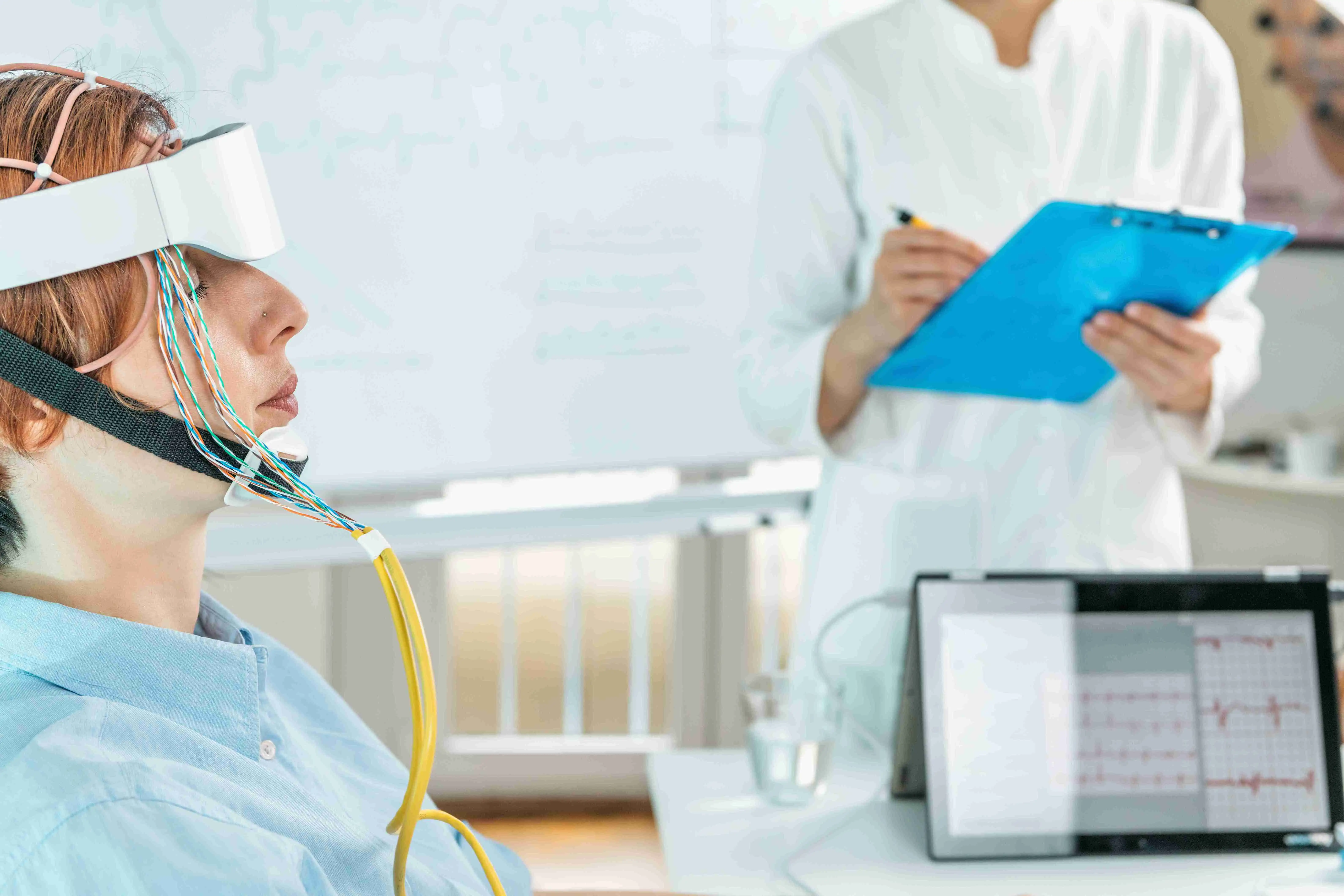

The Maintenance of Wakefulness Test (MWT) measures the ability to remain awake under standardized, quiet conditions. During four daytime trials, you sit with your head and back supported while brain, eye, and muscle signals show whether sleep begins.
A sleep specialist may use the result to assess response to treatment for a condition that causes excessive sleepiness or to add objective information when staying awake is important for personal or public safety. The MWT does not diagnose why someone is sleepy. It also does not independently clear someone to drive, operate machinery, or return to safety-sensitive work 12.
What the MWT actually measures
The MWT measures wakefulness under instruction. You are placed in a nonstimulating environment and told to remain awake for as long as possible. The main result is mean sleep latency, which is the average time from the start of each trial to the first scored epoch of sleep.
A longer latency means you maintained wakefulness longer in that setting. A shorter latency shows greater difficulty doing so on that day. Neither result identifies a cause. Sleep deprivation, a sleep disorder, circadian timing, medicines, substances, or another medical condition may contribute.
The test may answer questions such as:
- Has alertness improved after treatment for narcolepsy, sleep apnea, or another condition?
- Can this person maintain wakefulness under a standardized, low-stimulation challenge?
- Is the current treatment plan producing a measurable change compared with an earlier MWT?
It does not reproduce traffic, shift work, a long flight, rapidly changing hazards, or hours of sustained decision-making. It also does not measure reaction time, judgment, divided attention, or every brief lapse that may matter in the real world.
The current adult MWT protocol
The American Academy of Sleep Medicine (AASM) recommends a standardized four-trial, 40-minute protocol for adults 1.
Timing across the day
The first trial begins 1.5 to 3 hours after the end of the person's preceding major sleep period. Each later trial begins two hours after the start of the previous trial. The schedule therefore samples wakefulness at four points across much of the day rather than relying on one brief observation.
A light breakfast is recommended at least one hour before the first trial. A light lunch is recommended immediately after the second trial. Meal timing and the start of each trial should appear in the test record because deviations can affect interpretation 1.
Position, lighting, and instructions
For every trial, you sit in a bed or reclining chair with your back and head comfortably supported. The position should remain the same across all four trials. The room is quiet, comfortable, and very dim. AASM specifies light at 0.1 to 0.13 lux at eye level, with a small light source positioned about 12 inches from the floor and 3 feet to the side of the head 1.
Brain activity is recorded with frontal, central, and occipital EEG leads. Eye movements, chin muscle activity, and heart rhythm are also monitored, and audiovisual recording is used during the trials.
After signal checks, the standard instruction is: “Please sit still and remain awake for as long as possible. Look directly ahead of you, and do not look directly at the light.” You should not sing, fidget deliberately, slap your face, or use another tactic to create extra stimulation 1.
How a trial ends and how latency is scored
Each trial ends at 40 minutes if you remain awake. It ends sooner after either:
- three consecutive 30-second epochs of stage N1 sleep
- one 30-second epoch of any other sleep stage
These are trial-ending rules. Sleep latency is scored differently: it is the time from lights out to the first epoch of any sleep stage. If no sleep occurs, 40 minutes is entered for that trial. The mean sleep latency is the average of all four values 1.
This distinction matters. A trial can continue briefly after the first N1 epoch while the technologist waits to see whether the formal stopping rule is reached, but the latency still begins at that first scored sleep epoch.
Between the trials
You leave the bed or reclining chair and must not nap. Staff monitor you across the day. Electronic devices, cell phones, and nicotine should stop at least 30 minutes before each trial. Vigorous activity and prolonged exposure to sunlight or bright artificial light are avoided throughout the test day because they can increase alertness 1.
Between trials, ask the laboratory what quiet activities are permitted and when meals, medicines, and planned caffeine should be taken. Do not add your own alerting strategy.
Does an MWT require an overnight sleep study?
No. A preceding polysomnogram (PSG) is mandatory for a diagnostic MSLT, but not automatically for an MWT. The sleep clinician decides whether an overnight PSG would improve the answer to the specific question 1.
A PSG may be useful when a sleep disorder has not been evaluated, when acute sleep deprivation is a concern, or when the clinician needs objective information about the night before testing. In other cases, sleep at home plus a sleep diary, actigraphy, treatment download, or other documentation may better reflect the person's usual treated state.
There is no universal requirement to record six or seven hours of sleep in a laboratory before every MWT. There should still be adequate sleep before testing. If the prior night's sleep was unusually short, poor, or mistimed, tell the laboratory before the first trial. The clinician may decide that rescheduling would produce a more useful result 1.
Preparation should match the clinical question
The goal is not to create the highest possible score or to make someone artificially sleepy. It is to measure the condition that the ordering clinician intends to evaluate.
Document habitual sleep and treatment
The clinician and patient should agree on adequate sleep timing and duration before the study. AASM recommends a sleep diary and, whenever possible, actigraphy for two weeks. These records are especially helpful when no PSG is planned, the schedule varies, or insufficient sleep or circadian misalignment could affect the result 1.
When the purpose is to assess treated sleep apnea, treatment should be established and effective. The clinician should review PAP efficacy and adherence data when available or confirm use and effectiveness of a non-PAP therapy. The usual PAP or non-PAP treatment should be used on the night before the MWT, but it is not worn during the wake trials 1.
Keep medicines stable unless the clinician plans otherwise
MWT medication handling differs from preparation for a diagnostic MSLT. If the question is how well you remain awake on your usual treatment, chronic alerting or sedating medicines are generally continued at a stable dose. AASM recommends avoiding medication changes during the two weeks before testing and documenting medicines taken in the preceding 24 hours and during the test 1.
Do not stop a stimulant, antidepressant, sedative, or any other prescribed medicine on your own. Withdrawal, rebound symptoms, or loss of treatment can make the result less representative and may be unsafe. If the clinician wants an untreated baseline instead, the prescriber and sleep specialist should design that plan.
Caffeine also depends on the question. The ordering clinician should state whether usual caffeine is allowed and, if so, how much and when. When an MWT is assessing the effect of established treatment, the protocol may intentionally include the person's prescribed alerting medicine or typical caffeine use. The report should document what was consumed 1.
Alcohol, cannabis, and other sedating nonprescribed substances should be avoided on test day. Nicotine and other stimulating activities stop at least 30 minutes before each trial. A urine drug screen is not universal; AASM recommends it when the clinician believes an unreported or accidental exposure could confound the result 1.
What the score means
The report lists sleep latency and total sleep time for each trial, then calculates mean sleep latency across the four trials. It should also document recent medicines, planned caffeine, available sleep and treatment records, and any departure from the protocol.
There is no single AASM-approved number that separates normal from abnormal for every MWT purpose. Current AASM guidance states that abnormal mean-latency cutoffs have not been established. Values are interpreted against reference data, an earlier result from the same person, or the clinical question 1.
Healthy-reference findings illustrate why one number is not enough. AASM cites a mean near 30 minutes with wide variation across control participants. A multicenter study of 64 carefully screened adults reported a longer mean when it used a sustained-sleep definition. The same data produced substantially different values when the investigators shortened the trials and changed the definition of sleep onset 3.
Some clinical and regulatory contexts have treated a mean below 8 minutes as evidence of marked difficulty maintaining wakefulness. That does not make 8 minutes a universal pass-fail boundary, and a value above it is not automatic safety clearance. AASM practice parameters advise against using mean sleep latency alone to determine the presence or severity of sleepiness, certify a diagnosis, or judge response to treatment 2.
Many people remain awake for the full 40 minutes in several or all trials. This creates a ceiling effect: two people with different real-world levels of alertness can both receive the maximum value. It can also hide further improvement when a person already scores near 40 minutes 1.
Why results can vary
The MWT is standardized, but it is not isolated from biology, behavior, or the purpose of testing.
- Recent sleep opportunity: short, fragmented, mistimed, or unusually long sleep can change wakefulness the next day.
- Circadian timing: shift work, delayed sleep timing, jet lag, or a test scheduled outside the person's usual wake period can make the day unrepresentative.
- Medicines and substances: alerting agents, sedatives, caffeine, nicotine, alcohol, cannabis, withdrawal, and recent dose changes can move latency in either direction.
- Treatment use: PAP effectiveness and actual use on the preceding nights matter when the MWT is meant to assess treated sleep apnea.
- Motivation: the instruction and personal stakes encourage wakefulness. In one study of drivers who knew their licenses were at risk, even the 40-minute protocol appeared strongly influenced by motivation 4.
- Protocol differences: 20- and 40-minute trials, different lighting, posture, sleep-onset definitions, or extra stimulation do not produce interchangeable scores.
- Age: small reference studies suggest that age can influence MWT latency, but findings have not been consistent enough to create universal age-adjusted thresholds 53.
- One-day sampling: an MWT records one prepared day. It cannot show whether the same alertness will persist after a poor night, missed treatment, medication change, illness, longer task, or different time of day.
AASM describes the MWT as a single snapshot and notes that it has not been shown to predict on-road performance by itself 6. This is why the report should be read alongside actual sleepiness, near misses, treatment data, medical history, and the demands of the activity being considered.
MWT compared with other assessments
| Assessment | What it measures | What it cannot establish alone |
|---|---|---|
| MWT | Ability to remain awake when instructed under four standardized, quiet trials | The cause of sleepiness, sustained real-world performance, or fitness to drive or work |
| Multiple Sleep Latency Test | Tendency to fall asleep when instructed to nap and whether REM sleep starts unusually soon | Ability to resist sleep during a safety task |
| Overnight polysomnography | Sleep stages, breathing, limb movements, arousals, and other physiology during sleep | Daytime ability to remain awake |
| Epworth Sleepiness Scale | Self-reported chance of dozing in eight everyday situations | EEG-confirmed sleep onset or objective task performance |
| Real-world safety assessment | Symptoms, near misses, treatment use, task demands, and any occupational or regulatory requirements | A laboratory sleep latency unless testing is included |
The MWT and MSLT are not mirror-image versions of one construct. AASM reports only modest correlation between them because the instruction, posture, setting, and property being measured differ 1.
Questions to ask at the results visit
Ask for more than the final average:
- What was my sleep latency in each of the four trials?
- Did I reach the full 40 minutes in any trial, and how does the ceiling effect affect the interpretation?
- What comparison is most relevant: healthy reference data, my previous MWT, or a specific treatment goal?
- Was my preceding sleep adequate and timed to my usual major sleep period?
- Did the report include my sleep diary, actigraphy, PAP download, and actual treatment use?
- Were my medicines, caffeine, nicotine, alcohol, and cannabis handled as planned?
- Were there any naps, bright-light exposure, electronics, timing problems, or other protocol deviations?
- Does the result agree with my unintended dozing, near misses, and daily function?
- What clinical information is still needed before making a driving or work recommendation?
A reassuring MWT does not override unsafe sleepiness
Actual difficulty staying awake matters even when an MWT latency looks reassuring. If you have unintended dozing, microsleeps, a sleepiness-related near miss, lane drifting, missed exits, or trouble remaining awake during hazardous work, stop the activity. Do not use the laboratory result as permission to continue.
Arrange another driver or safe transportation and contact the treating clinician promptly. The National Highway Traffic Safety Administration advises anyone who becomes sleepy while driving to pull over in a safe place. Coffee may provide brief help, but it does not reliably overcome serious sleep deprivation or prevent microsleeps 7.
The MWT is most useful as a controlled measure of one part of alertness. A careful interpretation asks whether the protocol matched the clinical question, whether the result reflects stable treatment and adequate sleep, and whether it agrees with what is happening outside the laboratory.