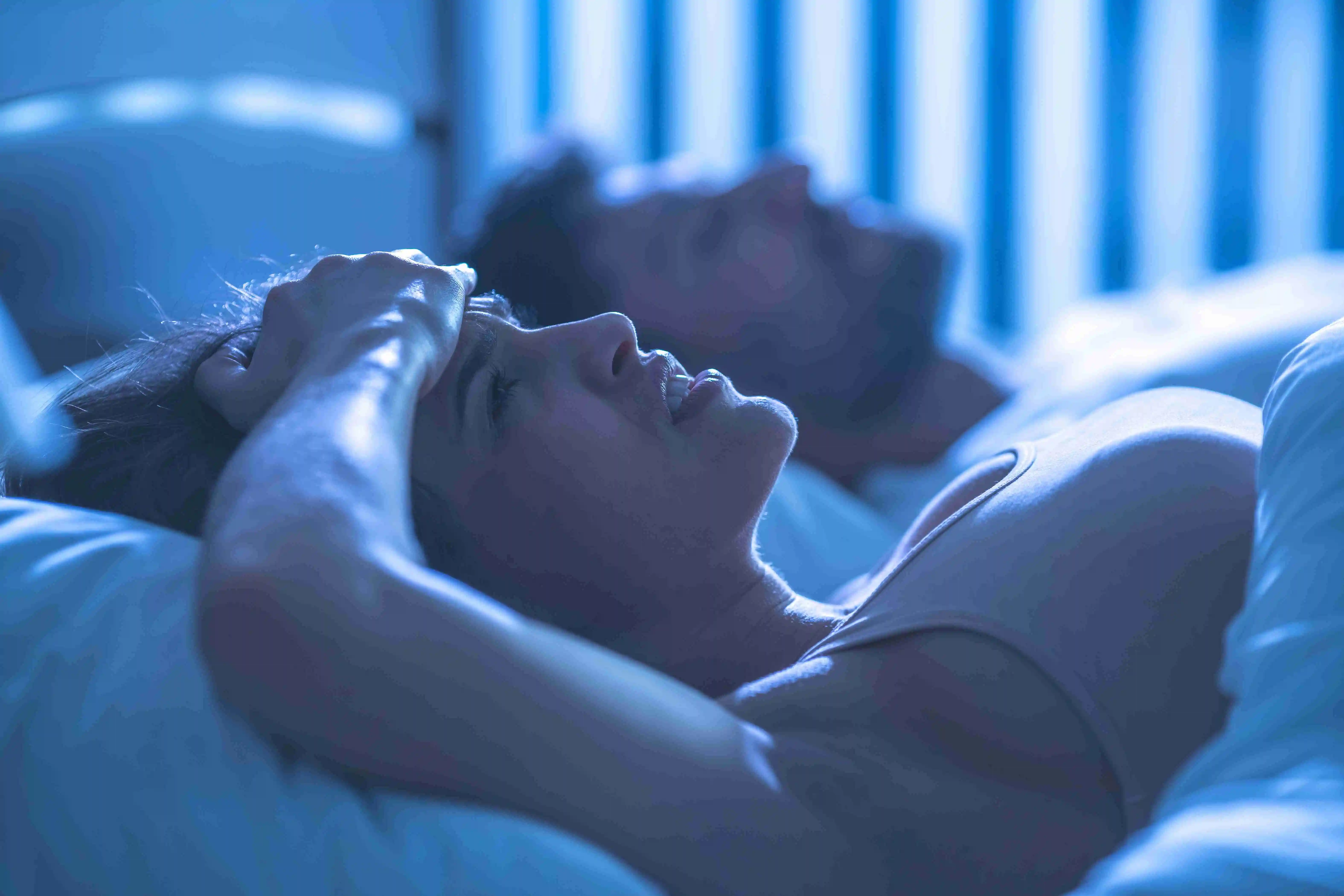


Post-traumatic stress disorder can make sleep feel unsafe or unpredictable. Some people cannot switch off a sense of threat. Others fall asleep but wake from distressing dreams, check the room repeatedly, or delay bedtime to avoid another nightmare. Once poor sleep has continued for a while, insomnia can also develop its own pattern and persist even when other PTSD symptoms improve 1.
Sleep problems after a traumatic event are not enough to diagnose PTSD. Many people have short-term stress reactions after trauma and do not develop the disorder. In adults, a PTSD diagnosis requires a qualifying exposure plus a specific pattern of re-experiencing, avoidance, changes in mood or thinking, and arousal symptoms that lasts at least one month, causes distress or impairment, and is not better explained by a substance, medicine, or illness 2.
How PTSD can interfere with sleep
Hyperarousal can keep the body on guard
Hyperarousal may involve feeling tense, scanning for danger, startling easily, or reacting strongly to noises. At bedtime, the normal loss of alertness can feel uncomfortable. A creak, a partner moving, or an unfamiliar room may trigger a rapid threat response even when the person knows intellectually that the present setting is safe 2.
This can look like difficulty falling asleep, light and fragmented sleep, or abrupt awakenings with a racing heart. These symptoms are real, but they do not show that every awakening is caused by PTSD. Pain, reflux, menopause symptoms, medicines, sleep apnea, and other sleep disorders can produce overlapping patterns.
Nightmares do not always replay the event
PTSD can include recurring dreams related to the trauma. Some dreams replay recognizable details. In others, the emotional experience is related to the trauma even when the dream does not recreate the event exactly 3.
A distressing dream is not automatically a PTSD nightmare. Clinicians consider the dream's relationship to the trauma, how often it occurs, what happens after waking, and the wider PTSD symptom pattern. Nightmare disorder, anxiety, depression, medicines, withdrawal, and other conditions can also cause recurrent nightmares.
Avoidance can move from trauma reminders to sleep itself
Avoidance is one of the core PTSD symptom groups. At night, it may mean staying busy until exhaustion, sleeping with lights or media on, avoiding the bedroom, or using alcohol or another substance to suppress thoughts. These responses can make sense as attempts to cope. They can also reduce sleep opportunity and strengthen the link between bed and alertness.
Avoidance is not the only explanation for a late bedtime. Work schedules, caregiving, delayed sleep-wake phase disorder, and ordinary preference can shift sleep later. A circadian rhythm disorder occurs when the internal sleep-wake timing is out of step with the schedule a person needs to follow 4. Someone who sleeps adequately on a later schedule but struggles mainly when trying to sleep earlier needs a different assessment from someone who cannot sleep well on any schedule.
What a useful assessment should separate
A mental health professional can assess whether the full symptom pattern meets criteria for PTSD. A sleep assessment should run alongside that evaluation rather than assuming one diagnosis explains the entire night.
Useful details include:
-
The timeline: Note when sleep changed in relation to the trauma and whether it improved, worsened, or changed form over time.
-
The sleep pattern: Record bedtime, estimated time to fall asleep, awakenings, final wake time, naps, and differences between workdays and free days.
-
Nightmares and awakenings: Note the frequency, whether the dream is trauma-related, what you remember, and what you do after waking. You do not need to write a graphic account for a basic sleep log.
-
Bedtime fear and checking: Describe delaying sleep, checking doors or windows, needing another person awake, or avoiding the bedroom.
-
Breathing and movement: Mention loud snoring, gasping, witnessed breathing pauses, morning headache, severe daytime sleepiness, uncomfortable leg sensations, or physically acting out dreams.
-
Medicines and substances: Include prescriptions, nonprescription sleep products, caffeine, nicotine, alcohol, cannabis, stimulants, and sedatives, with timing and recent changes.
-
Daytime safety: Report nodding off while driving or working, confusion after nightmares, falls, and any thoughts of self-harm or harming someone else.
A clinician may use a structured PTSD interview, an insomnia assessment, a sleep diary, or a sleep study depending on the pattern. You should not have to prove that every sleep symptom has a single cause before asking for help.
Treatment may need to address trauma and sleep directly
The 2023 VA/DoD guideline recommends individual, manualized trauma-focused psychotherapy for PTSD, particularly cognitive processing therapy, eye movement desensitization and reprocessing, or prolonged exposure. It recommends psychotherapy over medication as the primary PTSD treatment when both are available and appropriate 5.
Trauma-focused treatment may improve sleep, but insomnia or nightmares can remain clinically important. That is not proof that PTSD treatment failed. It may mean the sleep problem also needs a targeted intervention 1.
The order is individual. Some people start trauma-focused therapy first. Others begin direct insomnia treatment or move between treatments with clinicians who coordinate care. Current substance use or another co-occurring disorder does not automatically rule out evidence-based PTSD treatment, although safety, withdrawal risk, and treatment setting still matter 5.
CBT-I treats the insomnia pattern
Cognitive behavioral therapy for insomnia, or CBT-I, is a structured treatment for persistent trouble falling asleep or staying asleep. It is more than a list of sleep hygiene rules. Treatment commonly uses a sleep diary, a consistent wake time, carefully planned time in bed, stimulus control, and work on thoughts and behaviors that keep insomnia going. The plan should be adapted when a person has severe sleepiness, bipolar disorder, seizure risk, an untreated breathing disorder, or another condition that changes how sleep scheduling should be used 6.
The American Academy of Sleep Medicine strongly recommends multicomponent CBT-I for chronic insomnia in adults and advises against using sleep hygiene as the only treatment 6. In a randomized trial of 45 adults with PTSD and insomnia, CBT-I produced greater improvements in sleep and overall functioning than a monitor-only waitlist, and sleep gains were maintained at six months 7.
A 2022 systematic review of randomized trials found that sleep-focused cognitive behavioral treatments can improve insomnia and nightmares in adults with trauma symptoms. The trials used different interventions and populations, and objective sleep measures did not always change in the same way as self-reported sleep. That makes CBT-based treatment evidence-supported, but not a guarantee that every protocol will work equally well for every person 8.
What imagery rehearsal therapy can and cannot promise
Imagery rehearsal therapy, or IRT, is a psychological treatment for recurrent nightmares. During waking hours, the person changes a recurring nightmare into a less distressing script and rehearses the new version. The purpose is not to prove that the original dream was false or to recover hidden memories.
Guidance is not fully aligned. A 2018 American Academy of Sleep Medicine position paper states that IRT is useful for nightmare disorder and PTSD-associated nightmares 9. The newer 2023 VA/DoD PTSD guideline found insufficient evidence to recommend for or against IRT specifically for PTSD-associated nightmares 5.
One reason for caution is that results vary by population and comparison treatment. In a randomized trial of 108 veterans with severe PTSD and recurrent deployment-related nightmares, both CBT-I alone and CBT-I plus imagery rehearsal improved outcomes, but adding imagery rehearsal did not provide an overall advantage 10.
IRT remains a reasonable treatment to discuss, especially for a repetitive nightmare that causes distress or sleep avoidance. The evidence does not support promising that it will stop all trauma dreams. A clinician can also adapt or pause imagery work if rehearsing the dream sharply increases distress, dissociation, or loss of sleep.
Medication decisions need symptom-level precision
Medication can be part of care, but “a PTSD sleep medicine” is not one category. A prescriber needs to know whether the main target is the full PTSD syndrome, a recurring nightmare, chronic insomnia, depression, or another condition.
The VA/DoD guideline suggests sertraline, paroxetine, or venlafaxine when medication is selected for PTSD. For nightmares associated with PTSD, it suggests prazosin, but it suggests against using prazosin to treat PTSD as a whole 5. This distinction matters: evidence for one symptom does not make a medicine a complete PTSD treatment.
Prazosin lowers blood pressure and can cause dizziness or faintness, particularly when treatment starts or a dose changes. A prescriber should review blood pressure, falls, pregnancy status, and other medicines. Do not borrow it, start it without an assessment, or change the dose on your own 5.
The same guideline recommends against benzodiazepines and against cannabis or cannabis derivatives as PTSD treatments 5. If you already take a benzodiazepine regularly, do not stop it suddenly. The FDA warns that abrupt discontinuation or a rapid dose reduction can cause serious withdrawal reactions and advises a gradual, individualized taper with a clinician 11.
Do not miss sleep apnea or a substance-related sleep problem
PTSD does not explain away loud snoring, gasping, choking, or witnessed breathing pauses. Sleep apnea causes repeated pauses or reductions in breathing during sleep and may also cause unrefreshing sleep, morning headaches, difficulty concentrating, and excessive daytime sleepiness 12. These symptoms are reasons to ask whether a sleep study is appropriate.
Alcohol, cannabis, sedatives, stimulants, nicotine, and caffeine can affect sleep timing, awakenings, dreams, alertness, and treatment response. The effect depends on the substance, dose, timing, tolerance, and withdrawal. Give the clinician a factual list rather than describing a substance only as something that “helps sleep.” Also mention any recent increase, reduction, or missed doses.
What to do after a trauma-related nightmare
First check whether there is a real present danger. If there is, follow the safety plan that fits the situation and seek emergency help when needed. Grounding is not a substitute for responding to an unsafe home or environment.
If you are safe but your body still feels as if the dream is happening:
-
Name where you are and the current date.
-
Look around and identify a few concrete details you can see, hear, and feel.
-
Put your feet on the floor or touch a stable object.
-
Remind yourself that you have awakened from a dream and can decide what to do next.
-
If you remain wide awake, move to a quiet, dimly lit activity and return to bed when sleepiness comes back.
The VA's grounding tools use attention to the body and present surroundings to help a person reconnect with where they are now 13. Choose steps that feel stabilizing. A technique that increases panic or dissociation is not one you need to force.
When the situation needs prompt or urgent help
Arrange a clinical review soon if sleep problems are frequent, are worsening, impair work or relationships, or are leading you to avoid sleep. Also seek assessment for recurrent nightmares, possible sleep apnea, escalating substance use, major medicine changes, or daytime sleepiness that affects safety.
An unwanted intrusive thought, image, or memory can be a PTSD symptom. It is not automatically the same as wanting or planning to act. Tell a clinician about it clearly, including whether it feels unwanted, whether you have intent, and whether you have made a plan. Wanting to die, researching or making a plan, taking dangerous risks, and a new increase in alcohol or drug use are suicide warning signs 14.
Get immediate help if you may act on thoughts of harming yourself or another person, have made a plan and have access to carry it out, cannot keep yourself safe, or are in immediate danger from someone else. Contact local emergency services or go to the nearest emergency department, and involve a trusted person who can stay with you when possible.
Do not drive if you are struggling to keep your eyes open, drifting from your lane, or missing parts of the trip. Pull over safely and arrange another way to travel rather than relying on caffeine alone or determination to keep you alert 15.