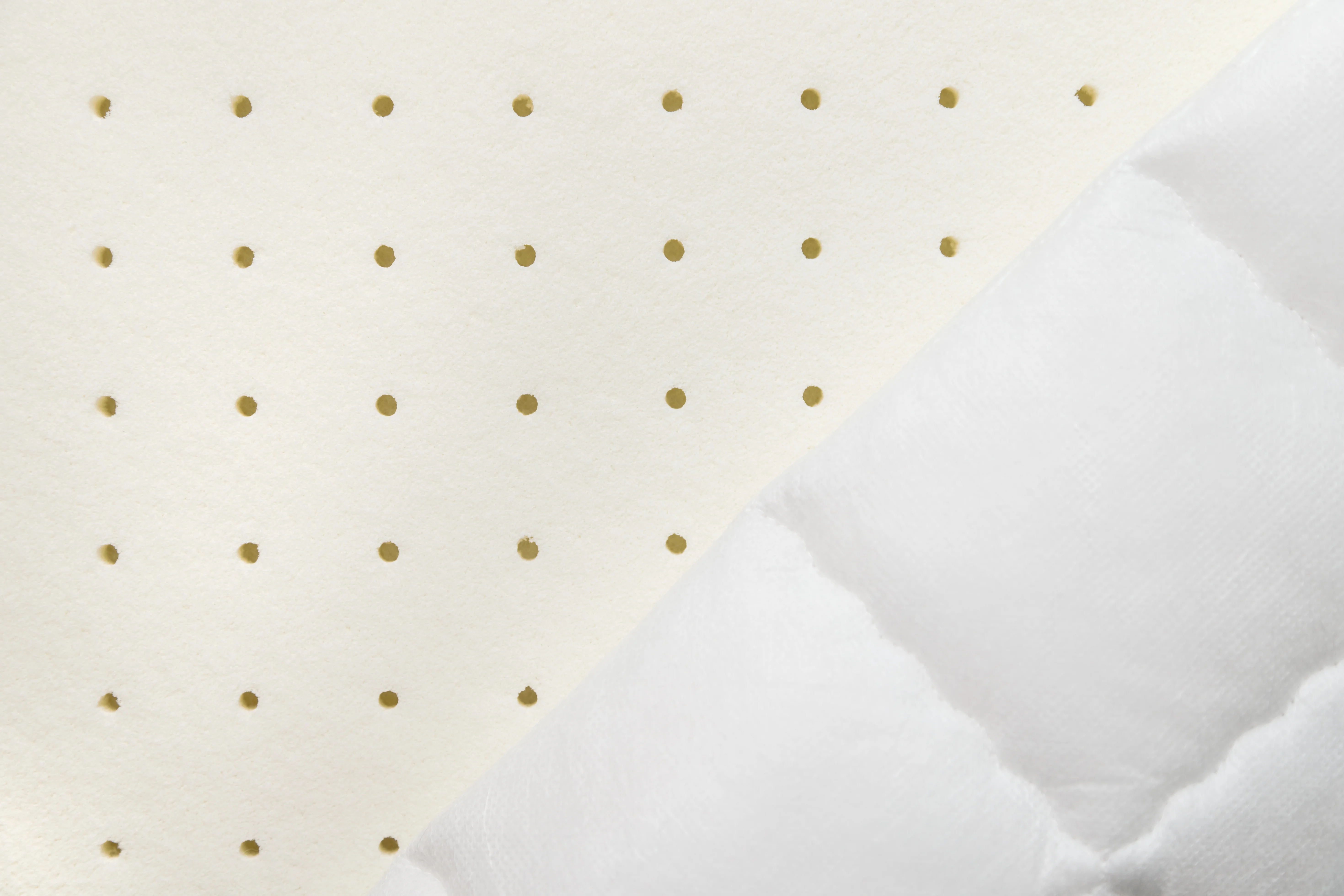

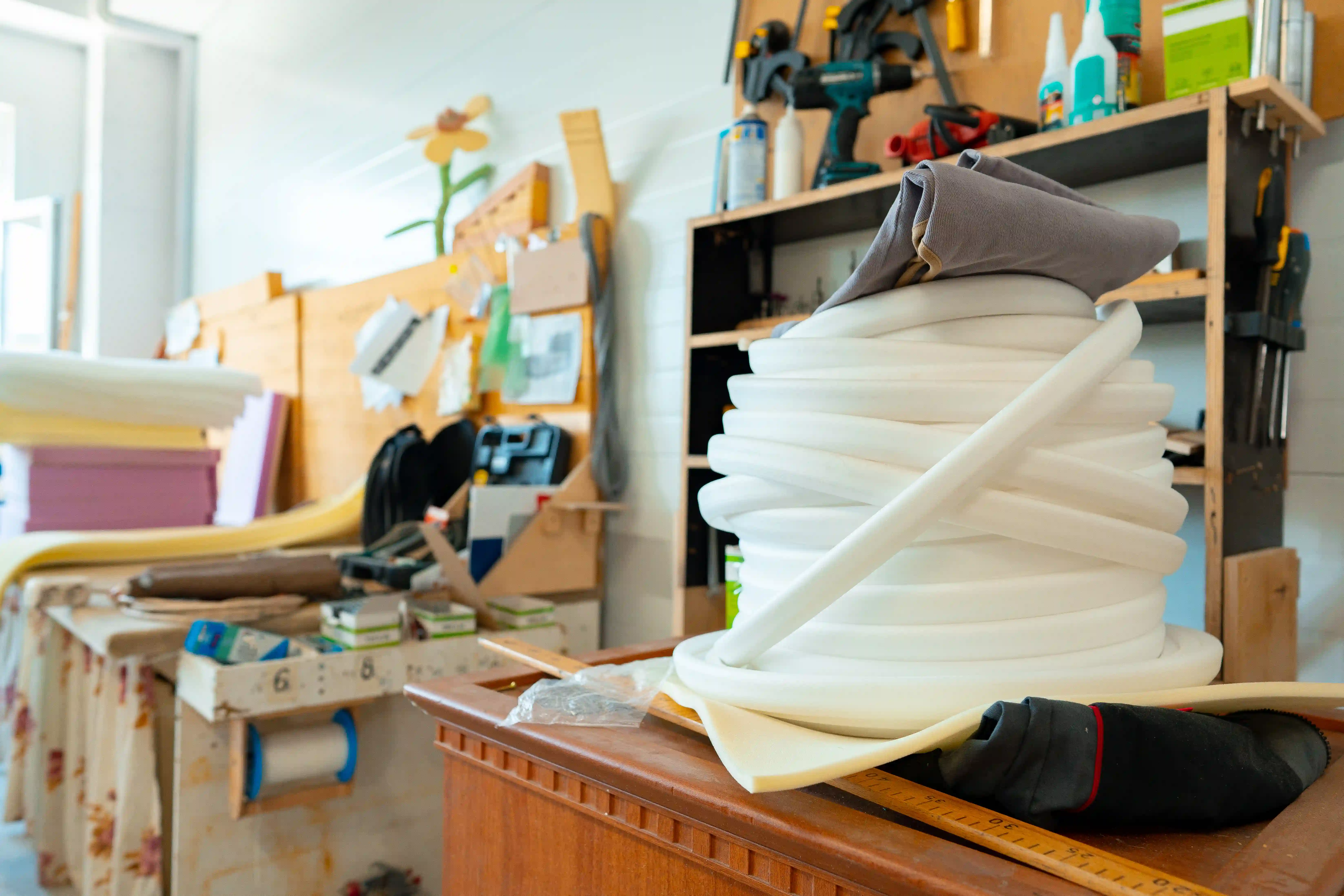
Foam density is measured by dividing the mass of a foam specimen by its volume:
Density = mass ÷ volume
Mattress specifications usually express the result as kilograms per cubic meter (kg/m³) or pounds per cubic foot (lb/ft³, often shortened to PCF). The measurement tells you how much mass is present in a given volume of the finished foam, including its cellular structure. It does not tell you how firm the foam feels 1 2.
A laboratory does more than cut any convenient piece and put it on a household scale. It follows a named method, conditions a representative specimen, measures its dimensions without distorting it, weighs it with suitable equipment, and records how the sample was prepared. ASTM D3574 Test A is the principal density method within ASTM's test suite for flexible polyurethane foam. ISO 845 covers apparent density for cellular plastics and rubbers more broadly 3 4.
What "apparent density" means for foam
A solid material has mass throughout its volume. Foam contains a network of solid or polymer material and cells, many of which contain air. The density result still uses the specimen's full outside volume, not only the volume of the cell walls.
Standards therefore use the term apparent density. ISO 845 distinguishes:
- apparent core density, measured on material without a molded or extruded outer skin
- apparent overall density, which can include those surface skins when the product has them
Most cut slab foam used inside a mattress does not have the same kind of molded outer skin as a shaped cushion, but the distinction matters when comparing molded foam parts. ASTM D3574 likewise distinguishes sampling approaches because a small result represents the area from which the specimen was taken, not automatically every part of a large molded item 4 3.
There is another useful distinction for flexible polyurethane foam. Additives and fillers can increase the measured mass. The Polyurethane Foam Association recommends clarifying polymer density, meaning the density attributable to the foam formulation without fillers or reinforcements, when density is being used as a material specification. Two foams with the same measured density may not contain the same amount of polymer or have the same physical properties 2 5.
How a laboratory determines foam density
The exact sampling plan, number of specimens, dimensions, conditioning period, and tolerances depend on the named method and the agreement between supplier and buyer. The basic sequence is consistent.
1. Define the material and test method
The report should identify the foam, where the specimen came from, and the standard used. ASTM D3574 applies specifically to slab, bonded, and molded flexible polyurethane foams. ISO 845 applies more broadly to cellular plastics and rubbers and can report core or overall apparent density 3 4.
A density number without the foam family is incomplete. Conventional polyurethane foam, viscoelastic or memory foam, and latex foam use different chemistries and structures. They should not be placed on one universal low, medium, and high scale.
2. Cut a representative specimen
The specimen should have a regular shape so its volume can be calculated. A rectangular block is convenient because its volume is length multiplied by width multiplied by thickness. The cut should preserve the cell structure and avoid obvious voids, compressed edges, or defects unless those features are intentionally part of the material being assessed.
ISO 845 calls for test pieces with a total volume of at least 100 cm³ and dimensions measured accurately enough for the calculation. ASTM D3574 Test A has separate specimen provisions for core and section density. The standard and specimen type matter more than copying a single sample size from an online demonstration 4 3.
3. Condition the specimen
Flexible foam can change after manufacture, and temperature and humidity can affect measurements. A standard method therefore specifies how long the material should stabilize after production and the atmosphere in which specimens are conditioned before testing.
For a shopper, the useful question is not whether a retailer can recite every laboratory tolerance. It is whether the value comes from conditioned material tested under a recognized method. A density estimate from a newly unpacked, still-compressed mattress layer is not equivalent to a controlled result.
4. Measure the volume
The technician measures the specimen's length, width, and thickness without pressing the foam thinner. Several readings may be needed because foam surfaces are not perfectly rigid or uniform. For a rectangular specimen:
Volume = length × width × thickness
All dimensions must use compatible units. Dimensions measured in meters produce volume in cubic meters. Dimensions measured in feet produce volume in cubic feet.
5. Measure the mass
The conditioned specimen is placed on a balance suited to its size and mass. The recorded mass and calculated volume must use a consistent unit system before division.
In everyday mattress descriptions, people often say that density is foam "weight per cubic foot." The physical quantity is mass density. A foam layer can weigh more because it is larger even when its density is identical to that of a smaller layer 1.
6. Calculate and report the result
The laboratory divides mass by volume and reports the result, usually with the test method, specimen description, units, and any agreed tolerance. A standard test method tells the laboratory how to obtain comparable data. It does not set a universal pass mark for a "good" mattress foam 3.
Density also varies within manufacturing tolerances and sometimes across a large bun or molded part. A seller should make clear whether a number is a nominal specification, an allowed range, or an actual result from a production lot.
A worked density example
Suppose a conditioned rectangular foam specimen measures:
- 100 mm long
- 100 mm wide
- 50 mm thick
- 20 g in mass
First convert the dimensions and mass to SI units:
- 100 mm = 0.10 m
- 50 mm = 0.05 m
- 20 g = 0.020 kg
Then calculate volume:
0.10 m × 0.10 m × 0.05 m = 0.0005 m³
Now divide mass by volume:
0.020 kg ÷ 0.0005 m³ = 40 kg/m³
The specimen's apparent density is 40 kg/m³. This example is mathematically complete, but a formal result would still depend on representative sampling, conditioning, measurement accuracy, and the named test method.
Converting kg/m³ and lb/ft³
The numerical values look very different because a cubic meter is much larger than a cubic foot. Use these conversion factors:
- kg/m³ to lb/ft³: multiply by 0.062428
- lb/ft³ to kg/m³: multiply by 16.01846
For the example above:
40 kg/m³ × 0.062428 = 2.50 lb/ft³
Reversing the calculation:
2.50 lb/ft³ × 16.01846 = 40.05 kg/m³
The small difference is rounding. NIST defines density as mass divided by volume and provides the underlying SI conversion factors for pounds, feet, kilograms, and meters 1 6.
Always keep the cubic unit intact. Multiplying kg/m³ by 2.2 converts the kilograms but ignores the much larger change from cubic meters to cubic feet, so it produces the wrong answer.
Why weighing a whole mattress does not work
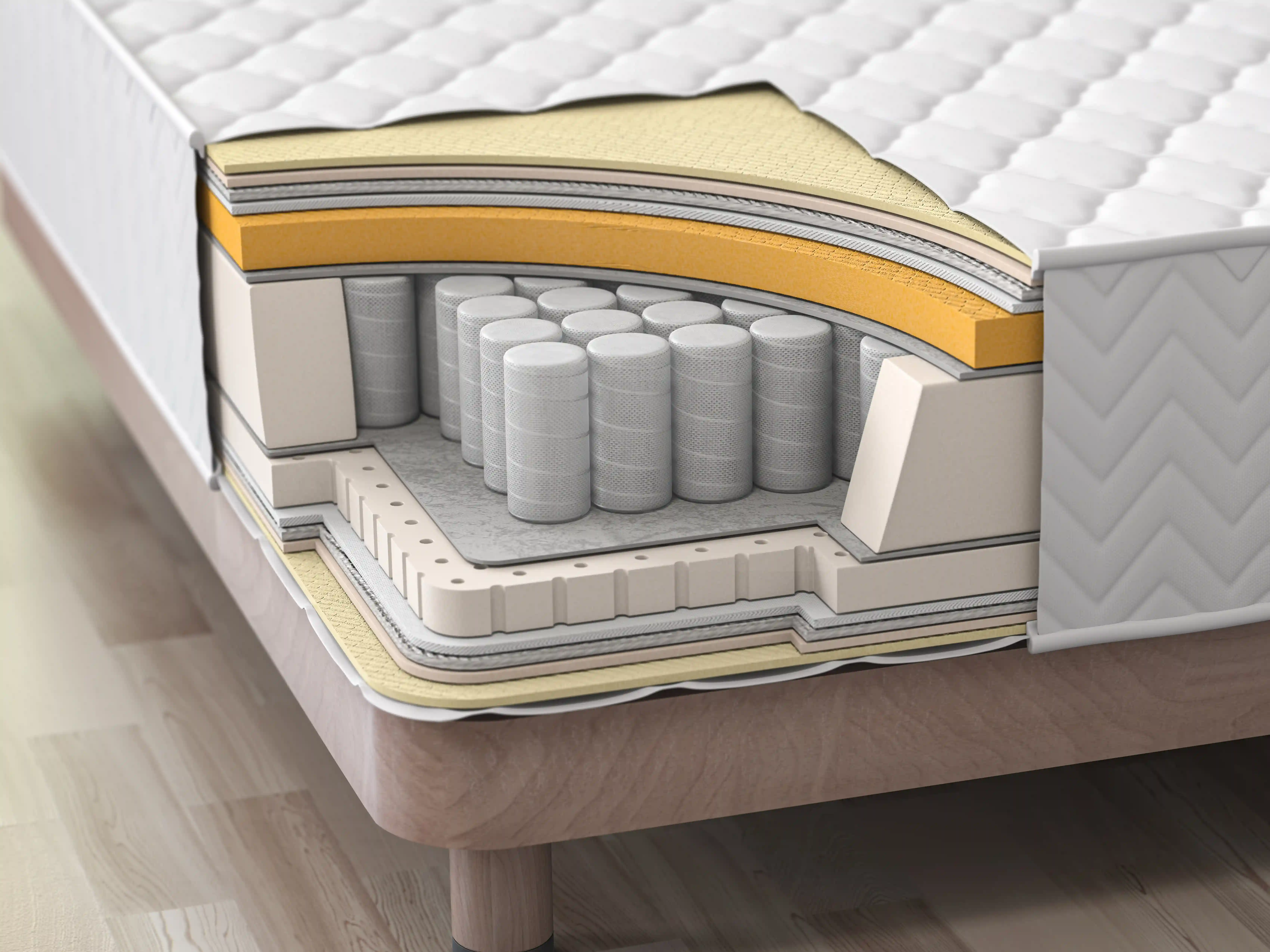
A mattress is a composite product. Its total mass can include:
- several foam layers with different densities and thicknesses
- coils, microcoils, or other support components
- fibers, batting, fabric, fire barriers, adhesives, and edge materials
- the cover, zipper, handles, and other construction details
Dividing the mattress's total mass by its outside volume gives, at best, an average bulk value for the complete product. It does not reveal the density of the memory-foam comfort layer, polyfoam transition layer, or foam support core.
Even an all-foam mattress cannot be reverse-engineered accurately from total weight unless the mass and dimensions of every layer and non-foam component are known. Layer-level specifications or representative samples are required. Small-scale component tests also cannot predict the complete sleep system by themselves because the layers and cover work together 7.
Density is not firmness, IFD, or ILD
Density measures mass per volume. Firmness measures resistance to indentation or compression.
For flexible polyurethane foam, indentation force deflection (IFD) measures the force needed to indent a standard specimen by a stated percentage of its original thickness. The older term indentation load deflection (ILD) is still common in mattress marketing. A higher force result means the tested specimen resisted that particular indentation more strongly.
Foam chemistry can produce a soft high-density foam or a firm lower-density foam. The Polyurethane Foam Association explicitly treats density and firmness as independent specifications 5.
IFD or ILD is not the whole feel of a mattress either. The result depends on the method, specimen thickness, indentation percentage, and test conditions. Finished feel also depends on:
- foam thickness and the layers above and below it
- compression behavior at shallow and deeper deflections
- resilience, recovery speed, and viscoelastic response
- cell structure and airflow
- formulation, additives, and temperature sensitivity
- zoning, convolutions, perforations, and glued interfaces
- the cover, quilting, fire barrier, and support unit
This is why a density number cannot substitute for a firmness specification or a well-described mattress construction.
What density can tell a mattress shopper
Density provides a useful, limited piece of material information.
It directly tells you:
- the apparent mass of the tested foam per unit volume
- how to compare the amount of finished material in equal volumes
- why otherwise equal-sized layers with different densities have different masses
It may also help with a durability comparison within a comparable foam family and formulation. For flexible polyurethane foam, higher polymer density often gives the structure more material with which to retain its designed properties. Industry guidance treats this as a useful tendency, not a guarantee 2 5.
A stronger durability assessment uses density alongside direct physical tests. ASTM D3574 includes separate methods for properties such as indentation force, compression set, tensile and tear strength, resilience, airflow, and fatigue. Fatigue tests repeatedly compress foam and measure changes in thickness or firmness, which is closer to the property shoppers usually mean by "holding up" 3 8.
What density cannot prove
Density by itself does not establish:
- how soft or firm the foam feels
- how far a body will sink or whether the foam will bottom out
- pressure relief, spinal alignment, or suitability for a sleep position
- support for a particular body weight
- cooling, breathability, or heat retention
- resilience, bounce, response speed, or motion isolation
- resistance to impressions or a specific service life
- the quality of additives, manufacturing, or cell structure
- finished-mattress comfort or value
- treatment or prevention of pain or any other medical benefit
Those outcomes depend on other foam properties, layer thicknesses, the complete construction, the sleeper, and use over time. Density should narrow a comparison, not decide it alone.
Why one density chart does not fit every foam
A number only becomes useful after the material is identified.
Memory foam is a viscoelastic polyurethane foam with time- and temperature-dependent behavior. Conventional polyfoam can be formulated across a wide range of firmness, resilience, and support characteristics. Latex foam uses a different material and manufacturing process and often occupies a different density range.
Calling the same numerical value "low," "medium," or "high" across all three hides those differences. Compare:
- memory foam with memory foam of a similar type
- conventional polyfoam with a comparable conventional or high-resilience polyurethane foam
- latex within the same latex process and product context
For latex-specific measurement and interpretation, see how latex density is measured. That topic needs its own material context rather than borrowing thresholds from polyurethane foam.
What do D35 and "40 density" mean?
Not enough information is present to know.
In some markets, a seller may use D35 to mean a nominal 35 kg/m³ foam. Another supplier may use a multi-digit grade in which one part refers to density and another to firmness. A bare 40 could mean 40 kg/m³, an IFD or ILD value, or an internal product code. Standards for other foam applications can use grade numbers differently again.
Do not silently add units to a marketing label. Ask the manufacturer to define:
- the full density value and unit
- the foam family and exact layer
- whether the value is nominal, minimum, or a tested range
- the measurement standard
- whether it is core, overall, or polymer density
- whether fillers or reinforcements are included
If a seller confirms that "40 density" means 40 kg/m³, it converts to about 2.50 lb/ft³. If the seller cannot define the label, it is not a usable density specification.
How to use a published density
Read the mattress layer by layer.
- Confirm the material. Find out whether the number describes memory foam, another polyurethane foam, or latex.
- Confirm the unit. A value of 2.5 lb/ft³ and 2.5 kg/m³ are not remotely equivalent.
- Identify the layer and thickness. A two-inch comfort layer and a six-inch support core have different roles, even if their density is the same.
- Ask for the test basis. Look for a named method, nominal value or tolerance, and clarity about core, overall, or polymer density.
- Request separate performance information. Firmness, compression behavior, resilience, and fatigue data answer questions that density cannot.
- Judge the finished construction separately. Layer sequence, cover, support unit, edge design, trial, warranty, and your own experience all matter.
Foam density is a precise measurement when the specimen and method are defined. Its interpretation should be equally precise: it describes mass per volume, offers a conditional comparison within like materials, and leaves the rest of mattress performance to other evidence.