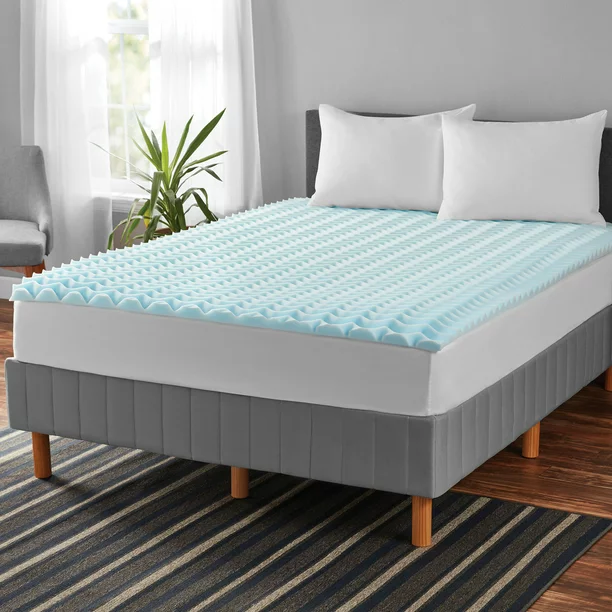

The safe way to clean a mattress topper is to identify every component first, then follow the care label or manufacturer instructions for that exact model. A zip-off cover may be washable while the core underneath must remain dry. Another topper may look similar but have a permanently attached cover, bonded layers, an internal heating or cooling system, or fill that requires professional cleaning.
Do not choose a method from the words “foam,” “latex,” “wool,” or “down” alone. Construction, adhesives, coatings, quilting, electrical parts, and the way the cover is attached can all change what is safe.
First, identify what can be separated
Strip the bedding and inspect the entire topper before adding water or a cleaner. Look for:
-
a zipper and a label that explicitly says the cover is removable
-
separate care instructions for the cover and the topper core
-
a model number, article number, purchase date, or product generation
-
layered foam, quilting, tufting, glued surfaces, gel or phase-change coatings, air channels, hoses, cords, controllers, or other components
-
existing tears, loose seams, crumbling, separated layers, or exposed fill
Photograph the labels before removing anything. A law label may identify the filling but not tell you how to clean it, so look for the care tag, owner manual, and current instructions for the exact model. If the tag is missing or unclear, contact the manufacturer before wetting the topper.
Official instructions show why this matters. Tempur-Pedic says the covers on most of its toppers can be removed and washed in cold water, but the TEMPUR core must not be washed or dry-cleaned 1. IKEA's NORDBERGET also has a removable, machine-washable cover, but its instructions call for warm water and hanging to dry 2. In contrast, Avocado says the quilted ticking on several of its latex toppers is not removable and is spot-clean-only 3. Parachute labels its dual-chamber feather and down topper dry-clean-only 4.
These are examples, not instructions for another brand or model.
Translate the care instructions before you start
| The instruction you find | What it permits |
|---|---|
| Removable cover is machine washable | Remove and wash only the cover. Keep the core dry unless the core has its own washing instruction. |
| Entire topper is machine washable | Wash the whole unit only if those exact words apply to your model and it fits the washer safely. |
| Hand wash | Wash only the named component, using the stated temperature and detergent. Do not substitute soaking or wringing unless allowed. |
| Spot clean only | Use minimal label-approved solution on the soiled area. Do not rinse, soak, steam, or shampoo the whole surface. |
| Vacuum permitted | Remove dry debris with the allowed attachment and suction level before adding moisture. |
| Dry clean or professional clean only | Tell the cleaner the model, construction, and type of soil. Confirm that the cleaner accepts it before transport. |
| Do not wash or dry clean | Blot a fresh spill and contact the manufacturer about the limited safe options. |
“Machine washable” can refer to a cover rather than the complete topper. Likewise, a zipper does not prove that the cover is intended to come off. Some covers contain fibers or layers that can be damaged or difficult to reinstall. Read the subject of each care instruction carefully.
A damage-control cleaning sequence
1. Prepare a supported work area
Clear enough space to keep the topper or core supported. A clean sheet or other clean surface can keep it off the floor. If the manufacturer says the topper must remain flat, prepare that surface before moving it.
Large toppers can be difficult to grip, and a wet washable component will be heavier than it was when dry. Get help if the item is bulky or cannot be handled without bending, twisting, dragging, or blocking your view. OSHA advises getting help with loads that are too bulky to grasp or handle safely 5.
Lift with the component supported from underneath. Do not pull it by a zipper, corner strap, hose, cord, or one edge. Do not fold, roll, shake, hang, or aggressively flex a foam or layered core unless its instructions allow that movement. If it is already torn or crumbling, unnecessary handling may spread the damage.
2. Remove dry debris only if permitted
If the care instructions allow vacuuming, use a clean upholstery attachment and the lowest effective suction. Work gently over the permitted surfaces without a rotating brush, hard nozzle, or forceful pressure. Stop if the cover pulls into the tool, fibers lift, foam tears, or a coated surface changes.
Do not treat vacuuming as mandatory. A delicate quilted surface, loose fill, fragile foam, or an active cooling layer may have model-specific restrictions. Follow the label or manufacturer cleaning method instead.
3. Blot spills before they spread
For a fresh spill:
-
Remove washable bedding and the topper cover, if the cover is designed to come off.
-
Press clean, absorbent towels into the wet area. Blot instead of scrubbing or rubbing.
-
Replace the towel as it becomes wet. Support the underside if pressure could tear or deform the core.
-
Apply a cleaner only if the topper's instructions approve that product or product type.
-
Use the smallest amount needed for the approved method. Do not flood the area in an attempt to rinse it.
Vinegar, bleach, baking soda, enzyme cleaners, dish soap, upholstery shampoo, steam, and peroxide are not universal topper cleaners. Any one of them may be allowed for a particular cover and prohibited for its core. Tempur-Pedic, for example, prohibits chlorine products and harsh stain removers on its topper covers and prohibits washing the core 1.
Never mix cleaning or disinfecting products. The CDC warns that mixing bleach or disinfectants with other cleaners can release dangerous vapors. Follow the cleaner label for ventilation and protective equipment, and store products out of reach of children and pets 6.
A remaining cosmetic mark is not a reason to keep adding liquid. Once you have reached the limit of the approved method, ask the manufacturer or a suitable professional whether another treatment is safe.
4. Wash only the component the label names
For a machine-washable cover or topper: Follow the stated water temperature, cycle, detergent, rinse, and drying instructions. Close zippers if directed. Check the washer manual and capacity before loading a large item. Distribute bulky washable items evenly, leave room for movement, and stop to rebalance an uneven load. Whirlpool similarly advises even distribution and avoiding washer overload with bulky bedding 7.
If an approved washable item cannot move freely or balance in the machine, use an appropriately sized machine or ask a professional cleaner. Do not force a topper into a home washer because the label says it is washable.
For a hand-washable component: Use a basin that supports the whole item and follow the exact temperature and detergent instruction. Plan how the water will drain before you begin. Do not twist or wring a bulky textile unless the label permits it. Ask for lifting help or use a professional service if you cannot safely move the wet load.
For a spot-clean-only component: Keep the treatment local. Blot with a well-wrung cloth and label-approved solution, then remove residue only in the manner instructed. Spot cleaning is not a smaller version of washing; the rest of the core should remain dry.
For a dry-clean-only component: Do not hand wash it as a gentler substitute. Ask the cleaner whether its process is suitable for the topper's construction and disclose body-fluid, mold, pest, or flood contamination before bringing it into the facility.
5. Dry by the label, not by a universal rule
The correct drying method may be line drying, flat drying, tumble drying at a named setting, professional drying, or no whole-item washing at all. There is no rule that every topper should go into sunlight, hang outdoors, air-dry flat, or tumble on low heat.
Support the component in the position the instructions specify so its wet weight does not stretch the cover, shift fill, bend foam, or separate bonded layers. When air drying is approved, allow airflow around the supported item and reposition it only as the instructions and its condition permit. Do not add a heater, hair dryer, steam, or direct sun unless the manufacturer approves it.
Wait until thick areas, seams, folds, and the underside are fully dry. Do not zip a cover over a damp core, place a damp topper on the mattress, add bedding, or store it. Reassemble the topper only after every component is dry and aligned according to the manual.
Situations that need a different response
Blood, vomit, urine, and other body fluids
Keep children and pets away from the area. Wear disposable gloves, absorb the spill promptly without rubbing, bag disposable cleanup material, and wash your hands after removing the gloves. Use an enzyme cleaner, disinfectant, or bleach only if both the topper instructions and the cleaner label allow it for that exact surface.
Ordinary cleaning and disinfection are different jobs. The CDC notes that cleaning with soap or detergent is enough in many household situations, while disinfection may be warranted when someone is sick 6. If a known infection, a large blood spill, or repeated urine or vomit has reached a core that cannot be suitably cleaned, contact the relevant healthcare professional, manufacturer, or specialist cleaner. Replacement may be safer than sealing contamination inside an absorbent core.
Mold, leaks, flooding, or sewage
A small clean-water spill calls for prompt blotting and the approved drying method. EPA guidance recommends drying water-damaged items within 24 to 48 hours where possible because prolonged dampness increases the chance of mold growth 8. This is a damage-control window, not permission to use heat or another drying method the topper forbids.
Floodwater and sewage are different from a drink spill. CDC disaster guidance says to discard water-absorbing items such as mattresses and foam-rubber items after flooding rather than trying to sanitize them for reuse 9. A topper that absorbed floodwater or sewage should generally be isolated and discarded under local guidance.
Visible mold, moldy odor from inside the core, or recurring odor after correct cleaning and complete drying can mean the contamination extends beyond the surface. Do not soak the topper in bleach or cover the area and keep using it. Contact the manufacturer or a qualified mold professional about whether it is salvageable. People with asthma, chronic lung disease, significant allergies, or immune suppression should not perform mold cleanup themselves 9.
Suspected bedbugs
Cleaning one topper does not treat a bedbug infestation. Do not move it from the infested area to another room. If it must be transported, use sealed plastic as directed in the treatment plan. EPA preparation guidance recommends both precautions to avoid spreading bedbugs 10. Contact building management or a qualified pest professional before deciding whether to keep or discard it.
Do not apply alcohol, outdoor pesticide, or any pesticide that is not EPA-registered and labeled for bedbugs and for the exact surface. EPA guidance warns against applying a pesticide to a bed, furniture, or clothing unless the label specifically permits that use 11.
Powered, electrical, or active cooling toppers
Turn the system off and unplug it before cleaning. Identify the cover, active layer, foam, hoses, fan, filters, controller, and power supply, then use the instructions for the exact model and generation. Do not immerse an active layer, open a sealed unit, or reconnect any damp component.
Sleep Number's DualTemp instructions show how specific this can be. Some versions have a removable machine-washable cover while the active layer and foam are spot-clean-only. Other versions have no washable cover. The hose position determines which instructions apply, and the control unit must be unplugged before cleaning 12.
If liquid reaches wiring, a controller, fan, hose connection, or another area not covered by the routine instructions, leave the system unplugged and contact the manufacturer.
How often should a mattress topper be cleaned?
There is no universal three-month or six-month deep-cleaning schedule. Clean a permitted removable cover at the interval on its label, respond to spills and visible soil promptly, and remove dry debris when the manufacturer allows it. Cleaning more aggressively than instructed can damage the topper without making it meaningfully cleaner.
Dust-mite allergy is a separate reason to use a broader exposure-control plan. A clinical practice parameter found that ordinary washing removes substantial mite allergen even without very hot water and recommends washing washable bedding weekly in warm water rather than aiming for a scalding temperature 13. That does not make a nonwashable topper core washable. Discuss persistent allergy or asthma symptoms with a healthcare professional and use only controls compatible with the topper.
A separate washable protector can reduce how often the topper itself is exposed to spills, but it is optional, not a cleaning requirement. Check compatibility first, especially with active cooling, heating, airflow, or feel-sensitive products. Follow the topper manufacturer rather than assuming every topper needs the same protector or rotation schedule.
What cleaning cannot repair
Cleaning can remove permitted surface soil. It cannot restore foam that has broken down, re-bond separated layers, repair a torn active layer, or reverse permanent compression.
Once the topper is clean and fully dry, inspect it on a flat surface. Contact the manufacturer about repair or replacement, or stop using it, when you find:
-
tears or open seams that expose the core or fill
-
foam that is crumbling, splitting, or shedding
-
delamination, which means bonded layers or coatings are separating
-
permanent clumps, bare areas, or shifted fill that approved care does not correct
-
a cover that has shrunk, stretched, torn, or no longer fits securely
-
persistent dampness, internal odor, visible mold, or contamination that the allowed method cannot remove
-
damaged cords, hoses, connectors, controls, fans, or active layers
-
a topper that slides, bunches, or no longer changes comfort as intended
A fixed three-to-five-year date cannot account for model, use, care, damage, or performance. Replace based on condition and the manufacturer's model-specific warranty or service guidance. If disposal is necessary, ask the manufacturer and local waste authority how to handle foam, textiles, electrical parts, or contaminated items. Follow the pest professional's containment instructions if bedbugs are involved.
The bottom line
Start with the exact topper, not a generic material recipe. Separate only the parts designed to separate, clean only by the methods named for each part, and complete the specified drying process before the topper returns to the bed.
When the label does not answer the question, stop before adding water, heat, chemicals, or force. The manufacturer or an appropriate professional can help decide whether another method is safe or whether replacement is the better form of damage control.