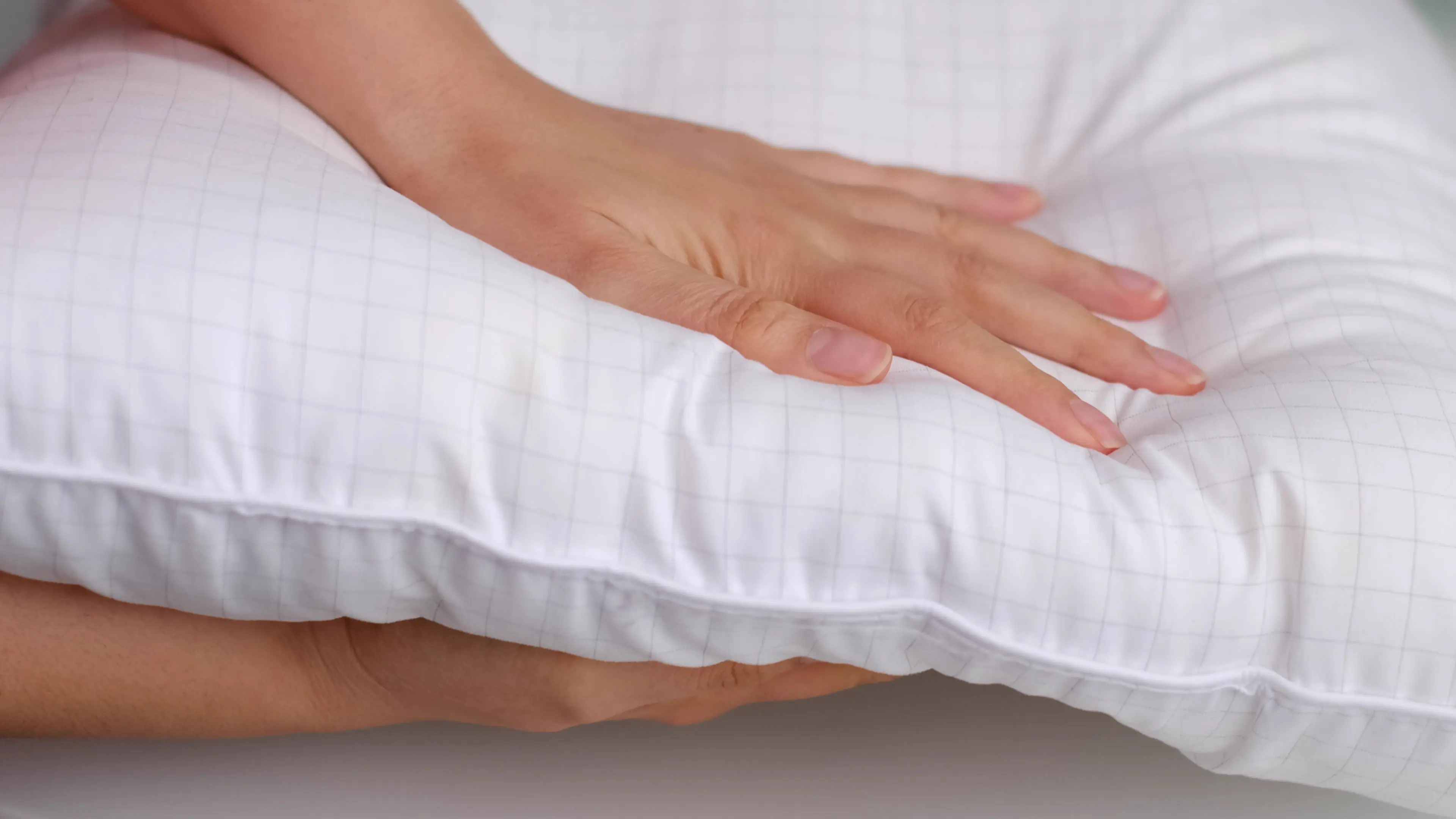

Some lumpy pillows can be improved when loose fill has temporarily compressed or migrated to one area. Gentle redistribution may make that fill more even again. Cleaning cannot restore permanently matted fill, cracked foam, separated layers, failed chambers, missing fill, damaged seams, or contamination that the approved care method cannot remove.
Before trying to fix the pillow, identify its exact model and construction. The right response depends on what moved or failed, not simply whether the label says down, foam, latex, cotton, or polyester.
Identify the pillow before handling the lump
Find the care label, model name, and current manufacturer instructions. If the label is faded, use an order record or model number rather than instructions for a similar-looking product. Determine whether the pillow contains:
-
loose down or feather fill
-
loose synthetic, plant, or animal fiber
-
shredded or cross-cut foam
-
one solid piece of foam or latex
-
contoured layers, chambers, baffles, or bonded components
-
microbeads or another small particulate fill
-
fill that the owner is meant to add or remove
-
a removable cover and a separate inner liner
-
cooling inserts, cords, pumps, speakers, sensors, or other powered parts
A zipper does not prove that a liner is meant to be opened. It may be a manufacturing closure, and opening it can release fill or damage a sealed construction. Check the instructions before unzipping anything.
Decide what kind of lump you have
Put the dry pillow on a clean, flat surface and inspect both sides, the edges, seams, zipper, and cover. Press lightly instead of forcefully kneading it.
| What you find | What it may mean | Appropriate next step |
|---|---|---|
| A full area beside a thin area in an intact loose-fill pillow | Fill may have migrated | Try gentle hand redistribution if the model permits it. |
| A uniform pillow that is temporarily flatter after use or storage | Recoverable compression may be possible | Use only the model's stated reshaping method and recovery time. |
| A hard or damp clump after washing or a spill | Fill may still be wet or may have matted | Complete the approved drying method. Stop using it if dampness, clumps, or odor remain. |
| A hard clump that stays in place when dry | Fill may be permanently tangled, fused, or matted | Do not keep pulling it apart. Ask the manufacturer whether restoration is possible. |
| A split, crack, hollow, or separated layer in solid foam or latex | The core has structural damage | Do not knead or glue it. Check warranty or replacement options. |
| Empty pockets, uneven chambers, or missing fill | Fill may have migrated across a baffle or escaped | Follow chamber-specific instructions. A sealed chamber failure is not a routine fluffing problem. |
| Feathers, foam pieces, beads, or fibers coming through the shell | The cover, seam, or liner has failed | Stop using the pillow and contain the fill before repair or disposal. |
| An even pillow that still feels too high, low, firm, or unstable | The issue may be fit rather than a lump | Adjust only an adjustable model, or try a different suitable pillow. |
A visible low spot is not always a cleaning problem. It can reflect permanent wear, an underfilled or failed chamber, or a pillow that does not suit the user's body and usual sleep position.
Try restoration only when the construction allows it
Redistribute suitable loose fill by hand
Remove only the covers designed to come off. Lay the pillow flat and support the shell with both hands. For intact loose-fill constructions, use light presses and short movements to guide fill from a crowded area toward a thin area. Work across the whole pillow rather than squeezing one lump as hard as possible.
Respect stitched baffles and separate chambers. Do not try to force fill through a seam. Stop if you hear fabric tearing, feel a sharp quill, see fill escaping, or find that the clump does not move with gentle pressure.
Shredded foam can be movable, but that does not make every shredded-foam pillow adjustable. Open the liner only when the manufacturer says it is owner-adjustable. Never open a sealed microbead, particulate, down, feather, or fiber pillow to redistribute or supplement the fill.
Do not knead, twist, punch, fold, or pull apart a one-piece foam or latex core. A crack or separated layer is damage, not a clump that force can reverse.
Adjust owner-accessible fill as instructed
If the exact model is designed for fill adjustment, follow its method for opening the liner and adding, removing, or redistributing material. Work over a clean sheet or container that can catch loose pieces. Keep children and pets out of the area, and close every liner and cover completely before the pillow returns to the bed.
Use only the compatible fill and amount the manufacturer supplies or approves. Adding craft fiber, foam scraps, another brand's fill, or fill from a damaged pillow can change the feel and create a closure or containment problem.
Coop's care instructions show how model-specific this can be. Its Original pillow has a zippered inner liner, and the company tells owners to secure that zipper before washing so the foam fill cannot spill 1. That instruction should not be transferred to a sealed shredded-foam pillow.
Wash or tumble only when the exact label permits it
Washing is part of the approved care for some pillows, but it is not a universal lump repair. An unsuitable wash can mat fill, split foam, damage adhesives, shift chambers, or harm cooling components.
Official instructions for three current products illustrate the difference:
-
Tempur-Pedic says its TEMPUR pillow core is not washable, while its removable cover can be washed in cold water and hung to dry 2.
-
Coop permits both the cover and zipped inner pillow of its Original model to be washed on a cold delicate cycle and tumble dried on low, with specific steps to contain the fill and confirm it is fully dry 1.
-
IKEA specifies a warm normal wash and medium tumble dry for its PILSPINNARE feather-and-down pillow, with drying continued until the filling is completely dry 3.
These are examples for those exact products, not general foam, feather, or adjustable-pillow rules. Use the temperature, cycle, detergent, load, drying method, and any approved dryer aid stated for your exact pillow. Do not default to cold water, a gentle cycle, mild detergent, extra rinses, low heat, 20 minutes, tennis balls, dryer balls, sunlight, or air drying.
A removable cover and the pillow core may have different instructions. Wash the cover separately when directed, and keep a spot-clean-only or do-not-wash core out of the machine.
Check the appliance and the wet load
Do not force a pillow into a washer or dryer. Check the appliance manual and capacity, leave the space required for movement, and stop an unbalanced or forceful cycle. Use an appropriately sized machine or a suitable professional cleaner if an approved washable pillow cannot move and balance safely.
A saturated pillow can be much heavier and harder to grip than a dry one. Plan where it will drain and dry before washing. Ask for help if it is too bulky to grasp or move without twisting, dropping, or blocking your view. OSHA similarly advises getting help when a load is too bulky to grasp or cannot be handled safely 4.
Follow the exact drying instruction until the center, clumps, seams, and outer shell are completely dry. A dry-feeling cover does not prove that thick inner fill is dry. Do not sleep on, cover, or store a damp pillow. If the approved method ends but damp clumps or an internal odor remain, contact the manufacturer or replace the pillow.
Sunlight is not a dependable way to disinfect a pillow or remove mold from its interior. Direct sun and added heat can also be outside the product's instructions. Use them only when the exact care guidance permits them, and do not substitute sunlight for a label-approved cleaning or disinfection method 5.
Damage and contamination need a different response
Put the pillow down and keep children and pets away if a seam opens or feathers, foam, beads, fibers, or electrical parts are exposed. Do not sleep on a pillow that sheds fill. Avoid grabbing sharp feather quills or torn components with bare hands. Contain loose material without spreading it, then ask the manufacturer whether an approved repair is available.
For an ordinary fresh body-fluid spill, blot promptly without rubbing. Follow the pillow and cleaner labels for any washable, spot-clean, or disinfectable components. Cleaning and disinfection are separate processes, and disinfecting is not routinely necessary in every household situation. The CDC advises using products appropriate for the surface, drying laundered items completely, never mixing chemicals, and storing cleaning products away from children and pets 5.
If blood, urine, vomit, or another fluid has saturated a core that cannot be washed or appropriately disinfected, ordinary fluffing will not make it sanitary. Ask the manufacturer or an appropriate professional whether the pillow can be safely cleaned. Replace it when the permitted method cannot address the contamination.
Visible mold, an odor from inside the fill, sewage, or floodwater is not a reason to add bleach or place the pillow in the sun. CDC disaster guidance lists pillows and foam-rubber items among belongings to discard when they cannot be cleaned or dried quickly after flooding 6. Isolate a pillow exposed to floodwater or sewage and follow local cleanup and disposal guidance.
For a pillow with cooling fluid, a pump, cord, sensor, speaker, or another powered component, switch it off and unplug it before inspection. Remove and wash only the component named in the exact instructions. Do not immerse the system or reconnect a component that may still contain moisture. Contact the manufacturer if liquid reaches an electrical or sealed active part.
When replacement is the better answer
There is no universal one-to-two-year replacement deadline. Decide from function, fit, damage, and whether the pillow can still be cleaned by its approved method.
Replacement or manufacturer service is more realistic when:
-
loose fill remains permanently hard, flat, bare, or uneven after the permitted restoration method
-
solid foam or latex is cracked, crumbling, permanently indented, or separating into layers
-
a chamber, baffle, sealed liner, zipper, or seam has failed
-
fill is escaping or the pillow no longer contains it securely
-
the pillow remains damp, moldy, malodorous, or contaminated
-
a cooling or powered component leaks, fails, or has been wetted
-
the pillow no longer stays stable or comfortable in ordinary use
-
an approved adjustable pillow cannot be configured to a workable fit
A pillow protector may reduce exposure to body oils and spills, but it cannot prevent every fill shift or reverse structural wear. Flipping, rotating, or frequent fluffing is useful only when the manufacturer recommends it for that construction. None of these practices guarantees a lump-free pillow.
After restoration, assess the pillow in its normal case and usual sleep position. Morning neck or shoulder discomfort can be a clue that the pillow is a poor fit, but it does not prove that the pillow caused the symptom. Pain can have many causes.
Contact a healthcare professional if neck pain persists despite simple self-care or comes with arm or hand numbness, tingling, or weakness. Seek prompt medical help for pain after significant trauma or with trouble walking, loss of bladder or bowel control, or difficulty swallowing or breathing 7.
This guide is not a way to prepare a pillow for an infant. Keep pillows and other soft bedding out of a baby's sleep area; the CDC recommends a firm, flat sleep surface covered only by a fitted sheet 8.
The bottom line
A temporary compression or fill-migration problem may improve with gentle, construction-appropriate redistribution. Start with the exact model, keep sealed parts sealed, and use water, heat, appliances, or fill adjustment only when the instructions allow it.
Stop when the problem is structural, contaminated, or unsafe to contain. Cleaning cannot rebuild worn fill or broken foam, and repeated force can turn a minor unevenness into permanent damage.