

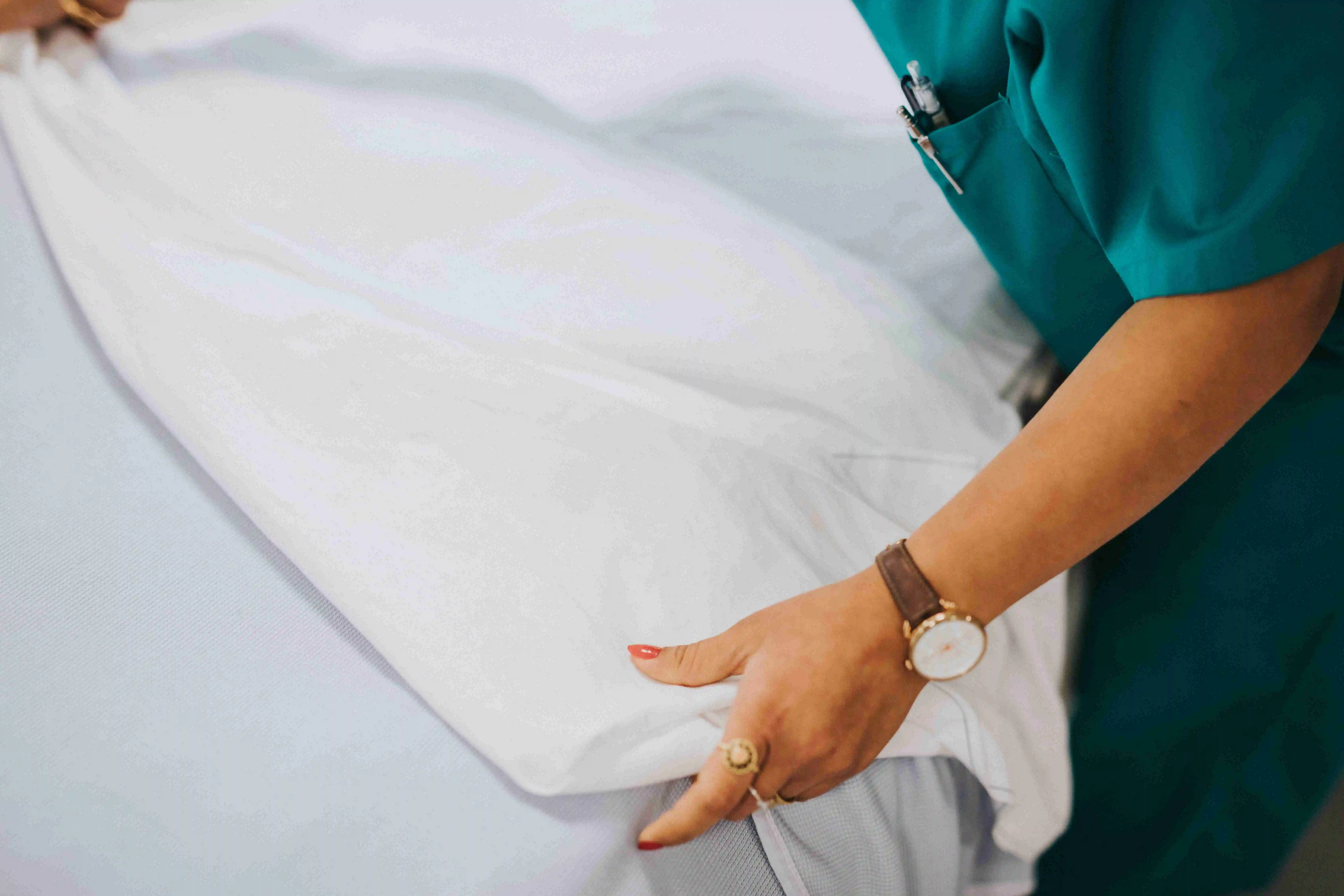
A hospital corner, also called a mitered corner, is a fold that locks a flat top sheet under the mattress so the sides lie flat and the corner finishes in a clean diagonal. The sequence is short. Tuck the whole foot end of the sheet under the mattress. Lift the side hem straight up onto the bed so it forms a 45-degree angle at the corner. Tuck in whatever is still hanging below the frame. Then lower the angled fold back over the edge 1.
Two things decide whether it will work on your bed. You need a flat sheet, because the fold is made out of loose fabric and a fitted sheet has none to spare. And you need enough sheet hanging past the side of the mattress to still reach underneath after it has covered the mattress height.
Be clear about what the fold is for. It keeps a top sheet from sliding around, and it looks tidy. There is no research showing that a tucked corner improves sleep. In the hospitals the technique is named after, staff are taught to add slack over the feet so the sheet does not press down on them 1.
What a hospital corner actually is

The fold is a way of anchoring a sheet, not a special kind of sheet or a special kind of bed. You take the fabric that hangs off the side of the mattress, fold it up and back on itself at roughly 45 degrees, and use the weight of the mattress to hold both layers in place. The visible result is a flat side with a diagonal seam running from the corner of the mattress toward the head of the bed.
It is made with the flat sheet only. A fitted sheet already grips the mattress with elastic and sewn corners, so there is nothing to miter and no reason to try. Blankets and coverlets can be folded the same way if they are large enough, though thick fabric holds the crease poorly.
Nursing programs still teach the fold as part of standard bed making, alongside instructions to smooth wrinkles out of the sheet, since ridges of fabric can injure fragile skin 1.
Check your sheet and mattress before you start
Most failed hospital corners are a sizing problem, not a technique problem. Measure the width, length, and total height of your mattress, including any topper or protector, and compare that with your flat sheet.
Manufacturer dimensions show how little margin there usually is. Boll & Branch lists a queen flat sheet at 96 by 108 inches for a 60 by 80 inch mattress, and a king flat sheet at 112 by 108 inches for a 76 by 80 inch mattress 2. In both cases about 18 inches of fabric hangs over each side. Twin and full sizes work out closer to 16 inches per side.
Now subtract the height of your mattress. On an 11.5 inch mattress, 18 inches of drop leaves about 6.5 inches to tuck underneath, which is plenty. On a 14.5 inch mattress it leaves about 3.5 inches, which will slip out within a night or two. As a working rule, plan on the mattress height plus about six inches of tuck. That puts standard flat sheets in comfortable range up to roughly a 12 inch mattress and marginal beyond it.
Length matters too, and people forget it. A queen flat sheet is 28 inches longer than the mattress 2. That 28 inches has to cover the drop at the foot, the tuck at the foot, and the fold-back you want at the head. On a deep mattress the foot end eats most of it, and the sheet ends up too short at the head.
Two practical notes on the layer underneath. Deep-pocket fitted sheets from major brands commonly top out around 16 to 17 inches of pocket depth 32, so a mattress plus a thick topper can outrun the fitted sheet before the flat sheet even becomes an issue. And mattress makers are explicit that height changes what bedding you need: Saatva notes that its 11.5 inch Classic takes standard-pocket sheets while the 14.5 inch version requires deep-pocket sheets 4. Our bed sheet size guide covers measuring in more detail.
How to make a hospital corner, step by step
These steps cover the two corners at the foot of the bed, which is where hospital corners are normally used. Work one corner at a time and finish it completely before moving to the other.
1. Start with a smooth base
Strip the bed and put on the fitted sheet first, pulling each corner fully over the mattress so the surface is flat. Run your hands across it to push out ridges. Any wrinkle you leave here will still be there when you are done 1.
2. Lay the flat sheet with the extra length at the head

Spread the flat sheet over the bed with the wide hem at the head and the patterned or finished side facing down. That looks backwards, but it is what makes the finished face show once you fold the top edge back over a blanket or duvet. Center it side to side, then slide the whole sheet toward the head until the foot end has just enough length to cover the drop and tuck under. Leaving too much at the foot is the most common reason the sheet later pulls off the head of the bed.
3. Tuck the entire foot end under the mattress
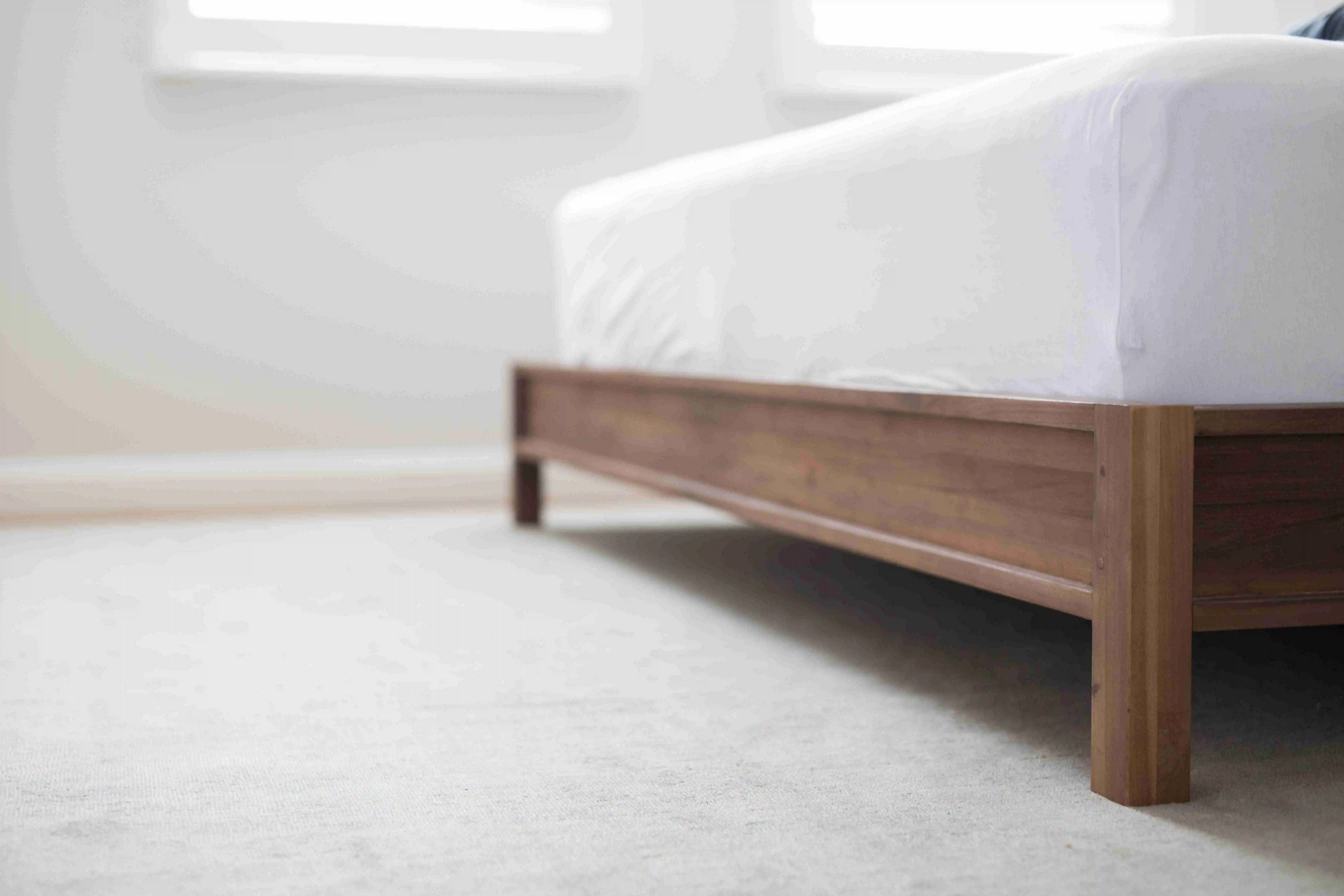
Lift the foot of the mattress and push the whole end of the sheet underneath, all the way across, before touching the corners 1. Skipping this and going straight to the corner is what produces a soft, rounded fold instead of a sharp one.
4. Lift the side hem into a 45-degree fold
Go to one corner. Lift the side edge of the sheet straight up and lay it on top of the mattress. The fabric forms a triangle with a diagonal edge running from the mattress corner toward the head of the bed 1. Picking the edge up about 12 to 18 inches from the corner is a good starting point, and you can adjust from there once you see how the triangle falls.
5. Tuck the part still hanging down
With the triangle held up on the mattress, tuck the fabric that is still hanging below the frame in under the mattress along the side. Pull it snug so there is no slack, and keep it flat rather than bunched 1.
6. Drop the fold back over the edge
Lower the triangle back down over the side of the mattress 1. You now have a choice. Leave it hanging for a softer look that is easy to get in and out of, or tuck it in along the side for the tight, flat finish. Tucking the side is optional and is the part most worth loosening.
7. Repeat and check
Do the same at the second corner, then stand at the foot of the bed and look at both. The two diagonals should start at the same point and run at the same angle. Press along the side of the mattress with a flat hand. It should feel firm and even, with no rope of bunched fabric underneath.
If you want the same treatment at the head of the bed, the fold is identical. Most home setups skip it, because the head corners are hidden by pillows and a tucked head end makes the sheet harder to fold back.
How to tell a good corner from a bad one
A good hospital corner has a flat side with no slack, one clean diagonal line, matching angles at both corners, and no bulk under the mattress. If yours is missing one of those, the table below covers the usual causes.
| What you see | Likely cause | What to do |
|---|---|---|
| Corner pulls out within a night or two | Not enough sheet left under the mattress after the drop | Measure the side overhang, subtract mattress height, and aim for about six inches of tuck. Move up a sheet size if you are short. |
| Fold is soft and rounded instead of sharp | The foot end was not fully tucked before the corner was folded | Untuck, tuck the entire foot end across the bed, then rebuild the corner. |
| Sheet slides off the head of the bed | Too much length was used at the foot | Reposition the sheet toward the head before tucking, leaving only what the foot drop and tuck need. |
| Diagonal puckers or wanders | The side hem was lifted from too close to or too far from the corner | Lift the edge about 12 to 18 inches from the corner so the triangle forms on its own. |
| Hard ridge under the mattress | Tucked fabric folded back on itself | Pull the tucked fabric out, flatten it, and feed it under in one layer. |
| Corners never look crisp on any bed | Wrinkled or heavy fabric | Take sheets out of the dryer promptly, or press the foot section. See our bedding care guide. |
Beds and sheets where it works, and where it does not
Fitted sheets
No. There is no loose fabric to fold, and forcing the elastic edge into a miter only pulls the sheet off the opposite corner. If your fitted sheet is the thing coming loose, that is a pocket depth or elastic problem, covered in our guide to keeping sheets on the bed.
Deep mattresses
Usually not with a standard flat sheet. Once the mattress passes about 12 inches, the drop consumes nearly all the side overhang. Going up one size in the flat sheet is the usual fix on a 14 or 15 inch mattress.
Thin mattresses and futons
These are the easiest case. A low mattress leaves a long tuck, and the corner holds well. Watch for the opposite problem, which is so much extra fabric under the mattress that it bunches.
Adjustable bases
Generally not, at least not on the sides. A tucked flat sheet spans the head and foot sections, so it resists the base as it articulates and works itself loose. Mattress height is a constraint here too: Saatva specifies that only the 11.5 inch version of its Classic mattress can be paired with an adjustable base 4. There is a safety point as well. Adjustable bases have moving joints and routed cables underneath, and long tucked fabric can end up in the mechanism. Check your own base's manual before tucking anything under it, since manufacturers set their own instructions for clearance around the moving sections and for what counts toward the base's weight rating.
Split beds
Skip the flat sheet tuck across the split. A split king set pairs two separate 39 by 80 inch fitted sheets with a single 112 by 108 inch flat sheet 2, so tucking that one flat sheet under both halves ties the two sides together and defeats the point of having them move independently. Tuck each side's own bedding separately, or leave the top sheet untucked.
Platform beds and storage bases
Check before you try. Run your hand down the side of the mattress. If it sits flush inside a lip, rail, or recessed deck, there is no gap to feed the sheet into, and no amount of technique will change that. Beds with built-in drawers often have the same problem.
Beds against a wall
You can only make the corners you can reach. Pull the bed out to make both sides, or accept one finished corner and leave the wall side untucked. On a wall-side corner, jamming your arm into a narrow gap to lift a heavy mattress is an easy way to strain a shoulder or your back.
Bunk beds
Usually not practical, and worth being careful about. Federal bunk bed requirements call for at least two guardrails, with one running continuously between the bed's end structures, and the top of the guardrail must sit at least five inches above the mattress surface when the thickest mattress the manufacturer allows is in place 5. Those rails block side access, and swapping in a thicker mattress to make tucking easier eats into the guardrail height the standard is meant to preserve. Make the bed at the foot end only, and do not remove a guardrail to reach a corner.
When to loosen the tuck or skip it entirely
Infants
Do not use a tucked top sheet, tucked blanket, or hospital corner anywhere an infant sleeps. Safe infant sleep guidance is that the surface should be firm, flat, level, and covered only with a fitted sheet, and it names non-fitted sheets and tucked-in blankets specifically as items to keep out of the sleep area because of suffocation, entrapment, and strangulation risk 6. The American Academy of Pediatrics gives the same instruction and suggests dressing a baby in layers or a wearable blanket instead of adding bedding 7.
Feet that cannot move freely
This is the reason nursing procedure does not simply tuck everything tight. When making an occupied bed, staff are taught to build a toe pleat, a fold of slack in the top sheet that lets the person move their feet, in order to prevent pressure 1. If someone in the bed cannot easily shift their legs, whether because of illness, injury, recovery from surgery, or limited mobility, leave that slack in rather than pulling the sheet flat over their toes.
Reduced feeling in the feet
Diabetes can damage the nerves in the feet, and when feeling is lost a person may not notice something pressing on the skin. The National Institute of Diabetes and Digestive and Kidney Diseases gives the example of not feeling a pebble in a sock or a blister, which is how small problems turn into cuts and sores, and notes that reduced blood flow makes those sores slower to heal 8. A sheet pulled tight across the toes all night is the same kind of steady, unnoticed pressure. If you or your partner has diabetes-related nerve damage, poor circulation, or an existing foot wound, leave the bedding loose over the feet and keep up the daily foot checks 8.
Your own back
A queen or king foam mattress is heavy and awkward, and each corner means lifting it at arm's length while you reach underneath. The American Academy of Orthopaedic Surgeons advises getting close to the load, bending at the knees rather than the waist, lifting with the leg muscles, avoiding twisting, and getting help with anything too heavy or awkwardly shaped to handle alone 9. In practice that means kneeling at the corner instead of bending over the bed, and asking someone to hold the mattress up while you tuck if it is a heavy one.
How to adapt the fold instead of abandoning it
You do not have to choose between a fully locked-down bed and a messy one.
- Add a toe pleat. Before tucking the foot end, gather a few inches of slack across the sheet and let it sit as a fold. Then tuck as usual. The corners still look finished, and there is room for feet 1.
- Tuck the foot, not the sides. Make the corner, then leave the triangle hanging instead of tucking it along the side. This is the version most people actually want at home.
- Buy the flat sheet one size up. On a deep mattress, a king flat sheet on a queen bed restores the overhang you need without changing anything else.
- Use sheet straps or fasteners. Elastic suspenders under the mattress hold a top sheet in place with far less tension than a tight tuck, which is useful on adjustable bases and deep mattresses.
- Loosen it at bedtime. Untuck the foot corners before getting in and remake them in the morning. A made bed and a comfortable one do not have to be the same configuration.
For the fuller styling picture, including layering and pillow arrangement, see our guide to making your bed like a hotel.
FAQs
Is a hospital corner the same as a military corner?
They are the same fold under two names. Military bed-making adds its own standards for tension and finish, but the corner itself is the mitered fold described above.
Do hospital corners help you sleep better?
There is no evidence that they do. The effects you can count on are cosmetic and practical: the top sheet stays where you put it and the bed looks neat. Any claim that a tucked corner improves sleep quality is not supported by research.
Can I make a hospital corner on a bed with a mattress topper?
Yes, as long as you measure the combined height. A topper adds to the drop on every side, so it reduces what is left to tuck and may push you past what your fitted sheet's pocket can handle, since deep-pocket fitted sheets generally stop around 16 to 17 inches 32.
Why does my corner look perfect at night and loose by morning?
Almost always because there is not enough sheet under the mattress to survive movement. Check the number rather than the technique: side overhang minus mattress height should leave you roughly six inches of tuck. Restless sleepers and shared beds need the higher end of that.
Do hospital corners damage sheets?
Normal tucking does not, but repeatedly dragging a sheet against a rough frame, bed slats, or exposed staples will wear the hem. If you are seeing wear along one edge, check what the fabric is rubbing against under the mattress.