

An oversized king is a category, not one fixed mattress size. California king has a widely recognized nominal U.S. size, but names such as Wyoming king, Texas king, Alaskan king, family bed, Alberta king, and Vermont king do not identify one universal set of dimensions 123. The seller's exact product specifications determine what you are buying.
Start with the width and length you need, then verify the finished mattress dimensions, tolerance, thickness, weight, base, outer frame size, bedding, and delivery route. A name alone is not enough to establish fit.
Standard king, California king, and split king
A current Tempur-Pedic size guide uses these nominal dimensions:
- Standard king or Eastern king: A nominal 76 inches wide by 80 inches long.
- California king: A nominal 72 inches wide by 84 inches long. It trades four inches of width for four inches of length compared with a standard king.
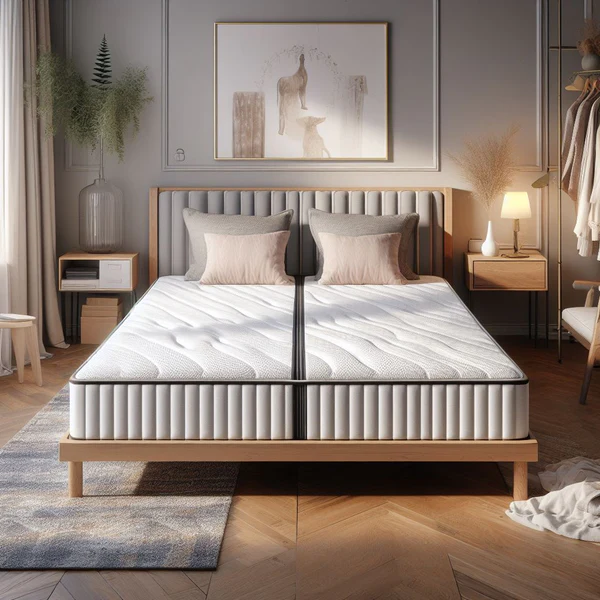
- Split king: Two Twin XL mattresses placed side by side, creating a nominal 76-by-80-inch sleep surface.
It also notes that an individual mattress may vary from the stated dimensions 4. Check the actual product sheet even when buying a mainstream size, particularly if the mattress must fit inside existing furniture.
A split king is not an oversized king. Its combined footprint is the same nominal size as a standard king, but the two-piece format can make delivery easier and may allow independent compatible adjustable-base positions 4. Confirm whether the quoted price includes one mattress or both halves and whether the model requires two foundations or base units.
Oversized king names are seller-specific
The International Sleep Products Association describes its dimensional guidance as voluntary and focused on how bedding components fit together 1. Oversized names outside the mainstream sizes are even less dependable as specifications.
The examples below are dimensions stated on specific seller pages. They show what those products measure, not universal definitions that every manufacturer must follow.
| Seller and product label | Seller's stated mattress size |
|---|---|
| Big Mattress Co. Wyoming King | 84 by 84 by 13 inches 2 |
| Big Mattress Co. Texas King | 80 by 98 by 13 inches 2 |
| Big Mattress Co. Vermont King | 96 by 96 by 13 inches 2 |
| Big Mattress Co. Family Bed | 120 by 80 by 13 inches 2 |
| Big Mattress Co. Alaskan King | 108 by 108 by 13 inches 2 |
| Big Mattress Co. Family Bed XL | 144 by 84 by 13 inches 2 |
| Von Viva Alberta King | 96 by 96 inches 3 |
Von Viva says it created the Alberta king name for its own 8-by-8-foot mattress in 2018 3. Big Mattress Co. uses a different regional name, Vermont king, for a product with the same stated width and length 2. This is why it is safer to compare exact specifications than to build a hierarchy of names.
There is no universal "largest" oversized king category. A seller may offer a wider family bed, a custom length, or an entirely custom rectangle. The useful question is which exact dimensions meet your needs and can be supported, delivered, and used safely in your home.
Choose the sleep-surface dimensions first
Measure the people who will regularly use the bed and decide how much personal space you want between sleepers. If length is the main problem, focus on usable mattress length rather than the label. If width is the problem, compare the actual width gained over your current mattress.
More surface area does not guarantee better sleep, less motion transfer, cooler sleep, or better pressure relief. Those qualities depend on the mattress construction, firmness, materials, edge design, and how each sleeper responds to the model. Keep the size decision separate from the comfort decision.
Before comparing products, write down:
- The minimum usable width and length you want.
- Whether one continuous surface or a split or modular design is acceptable.
- Whether each sleeper needs a different firmness or adjustable position.
- The maximum mattress thickness that works with the frame, headboard, sheets, and preferred bed height.
- Any mobility needs, including a stable sitting edge and a bed height that permits safe entry and exit.
Do not use a seller's claimed sleeper capacity as a substitute for these measurements. People differ in body size, preferred separation, mobility, and how much of the edge they use.
Get the exact mattress specification
Ask the seller to confirm these details in writing for the exact model and configuration:
- Finished width, length, and thickness.
- Permitted manufacturing tolerance.
- Mattress weight and whether the quoted weight is for one piece or the whole set.
- Whether the mattress arrives flat, compressed, split, or as modular components.
- The packaged dimensions and weight of every box or section.
- Which sides can be rotated or flipped.
- Whether the cover is removable and how it can be cleaned.
- The compatible foundation or adjustable-base requirements.
A mattress labeled 96 by 96 inches may not have a 96-by-96-inch frame. Side rails, upholstery, brackets, a headboard, or a footboard can extend beyond the sleep surface. Get the frame's maximum outside width and length, including any protruding hardware.
Measure the room around the complete bed
Use painter's tape to mark the frame's outside footprint on the floor. If the headboard or base has moving parts, also mark the space needed through its full range of motion.
Walk the room as you normally would and check:
- The route from each sleeper's side of the bed to the door.
- Clearance for bedside tables, lamps, and charging cords.
- Space to open wardrobes, drawers, closet doors, and the bedroom door.
- Access to windows, heating or cooling vents, radiators, and electrical outlets.
- Whether the bed blocks a required emergency exit or makes it difficult to reach one.
- Whether someone with limited mobility can enter, leave, and move around the bed safely.
- Whether you can reach the far side to change fitted sheets and clean underneath.
There is no single minimum room size for every oversized king. Frame design, furniture, door swing, mobility, and local egress requirements change the answer. The taped full-system footprint is more useful than a generic room-size rule.
Check the support system and total weight
A custom-size mattress may need a custom-size foundation or frame. Confirm all of the following with both the mattress and support manufacturers:
- Exact support dimensions.
- Slat width and spacing, if slats are allowed.
- Required center rails, legs, and contact points.
- The support's total load rating and any distribution requirements.
- Compatibility with the mattress material and thickness.
- Compatibility with an adjustable base, if one is planned.
- Whether using a third-party or custom frame changes either warranty.
Support rules are model-specific. For example, Tempur-Pedic says its mattresses need a solid, elevated surface and permits a slatted frame only when the slats are structurally sound, at least 3 inches wide, no more than 4 inches apart, and able to support the mattress and occupants 5. Those numbers are Tempur-Pedic's requirements, not a universal formula for every mattress.
An unsupported or mismatched mattress can be damaged and may lose warranty coverage 5. Do not assume that an existing king frame can be widened safely or that placing boards across it creates an approved base.
Add the weights of the mattress sections, frame or foundation, adjustable mechanism, bedding, and users. If the system is unusually heavy or the room, stairs, or floor raise concerns, have a qualified installer, mover, or building professional evaluate the route and placement. No single weight cutoff applies to every building.
Plan the delivery route before ordering
Room fit does not guarantee delivery fit. Measure the clear opening, not just the door slab, and follow the path from the delivery vehicle to the final position.
Check:
- Exterior and interior door openings.
- Hallway widths and tight corners.
- Stair width, ceiling height, landings, handrails, and turns.
- Elevator door, cabin, and load restrictions.
- Gates, porches, balconies, and any step without a safe staging area.
- Whether doors, railings, or furniture must be removed and who is permitted to do that.
- Whether the delivery service carries every component into the room or stops at the curb or threshold.
A split, compressed, or modular design can change what fits. Von Viva, for example, says its Alberta king components are delivered disassembled for movement through narrower openings and then assembled in the home 3. That does not mean every oversized mattress can be separated or compressed.
If the product arrives compressed, ask how soon it must be opened and whether opening it changes the return process. If it arrives full-size, confirm how a rejected or warranty-return mattress would leave the room. Record any custom-order, restocking, pickup, or final-sale terms before paying.
Large mattresses and powered bases can require a trained moving team. Tempur-Pedic describes its adjustable bases as heavy, motorized products and recommends professional movers rather than single-person handling 6. The relevant weight and handling instructions are the ones supplied for your exact system.
Price the complete system, not just the mattress
An oversized order may require a matching foundation, frame, protector, sheets, duvet, and delivery or assembly service. Availability and lead times can change, especially for made-to-order products. Big Mattress Co., for example, currently describes its oversized mattresses as made to order and sells matching oversized bedding 2.
Before ordering bedding, verify:
- Finished mattress width, length, and depth.
- The protector or encasement's stated fit range.
- Fitted-sheet pocket depth and elastic design.
- Whether the top sheet and duvet provide the drop and coverage you want.
- Whether custom textiles are returnable.
- Expected shrinkage and the finished dimensions after laundering.
- Whether your washer and dryer can handle the item, or whether commercial laundering will be needed.
- Replacement availability if a sheet or protector is damaged later.
A label match is not enough. A 96-by-96-inch fitted sheet may still fail if it is too shallow for the mattress or made with a corner shape that does not match the product.
Keep comfort and material choices separate from size
Once a size passes the room, support, and delivery checks, assess the exact mattress model:
- Firmness and pressure distribution.
- Ease of changing position.
- Motion transfer between sleepers.
- Edge stability.
- Heat retention and airflow.
- Noise.
- The feel of any seam in a split or modular design.
- Trial, exchange, and warranty terms.
A larger foam mattress and a larger innerspring mattress can behave very differently. Extra width cannot correct a firmness mismatch, weak edge, noticeable split, or material that sleeps warmer than you prefer.
Children, infants, and pets
Extra adult bed area does not establish a safe number of occupants. If older children or pets sometimes join the bed, consider hygiene and allergy needs, safe routes on and off the bed, whether anyone's exit is blocked, and whether the mattress edge and frame are stable for the way the bed will be used.
An oversized adult mattress is not a safe infant sleep space. The U.S. Consumer Product Safety Commission advises using an infant sleep product that meets federal requirements, placing the baby on their back, and keeping the sleep space bare except for a fitted sheet 7.
Pushing an adult bed against a wall or lining it with pillows does not make it safe for a baby. The CPSC identifies entrapment between the bed and wall, bed-frame entrapment, falls, and suffocation in soft bedding as hazards on adult beds 8. Do not use a wall gap, pillows, or a mattress against the wall as infant containment.
For an older child who can get in and out of bed independently, do not improvise a rail. Children's portable bed rails are regulated products designed for a specific developmental stage, and their safety requirements address structural strength, openings, gaps, and misassembly 9. Use only an age-appropriate rail that is compatible with the exact mattress and frame, and install it according to the manufacturer's instructions.
Powered-base safety
If an oversized or split system uses a powered adjustable base, keep children and pets away from moving parts, use the model's child-lock feature when instructed, and keep cords and bedding clear of the mechanism. The Tempur-Pedic Ease 4.0 manual warns about crushing hazards to children and pets around moving parts and explains its child lock 10. Follow the safety and clearance instructions for your own base, since controls and mechanisms differ.
Disconnect power and follow the manufacturer's moving or service procedure before anyone reaches under or relocates the base 10. Do not add a bed rail, custom bracket, or storage item where it can interfere with the mechanism.
A final oversized-king checklist
Before placing a nonstandard or custom order, make sure you have:
- The exact finished mattress dimensions, tolerance, thickness, and weight.
- The frame or base's full outside dimensions, support specification, and load rating.
- A taped room layout with doors, drawers, walkways, vents, outlets, and emergency exits checked.
- Measurements for every delivery opening, turn, stair, landing, and elevator.
- A plan for installation, future moving, and removal if the mattress is returned.
- Matching bedding dimensions and a realistic laundering plan.
- Written lead-time, cancellation, return, trial, custom-order, and warranty terms.
- A separate assessment of firmness, motion, edge feel, heat, materials, and split seams.
- A safe setup for children, pets, cords, and any powered components.
An oversized king can be a practical choice when a standard king is too short or narrow, but the product name is only a starting point. Buy from the measurements outward, and treat the mattress, support, room, delivery path, bedding, and return plan as one system.