

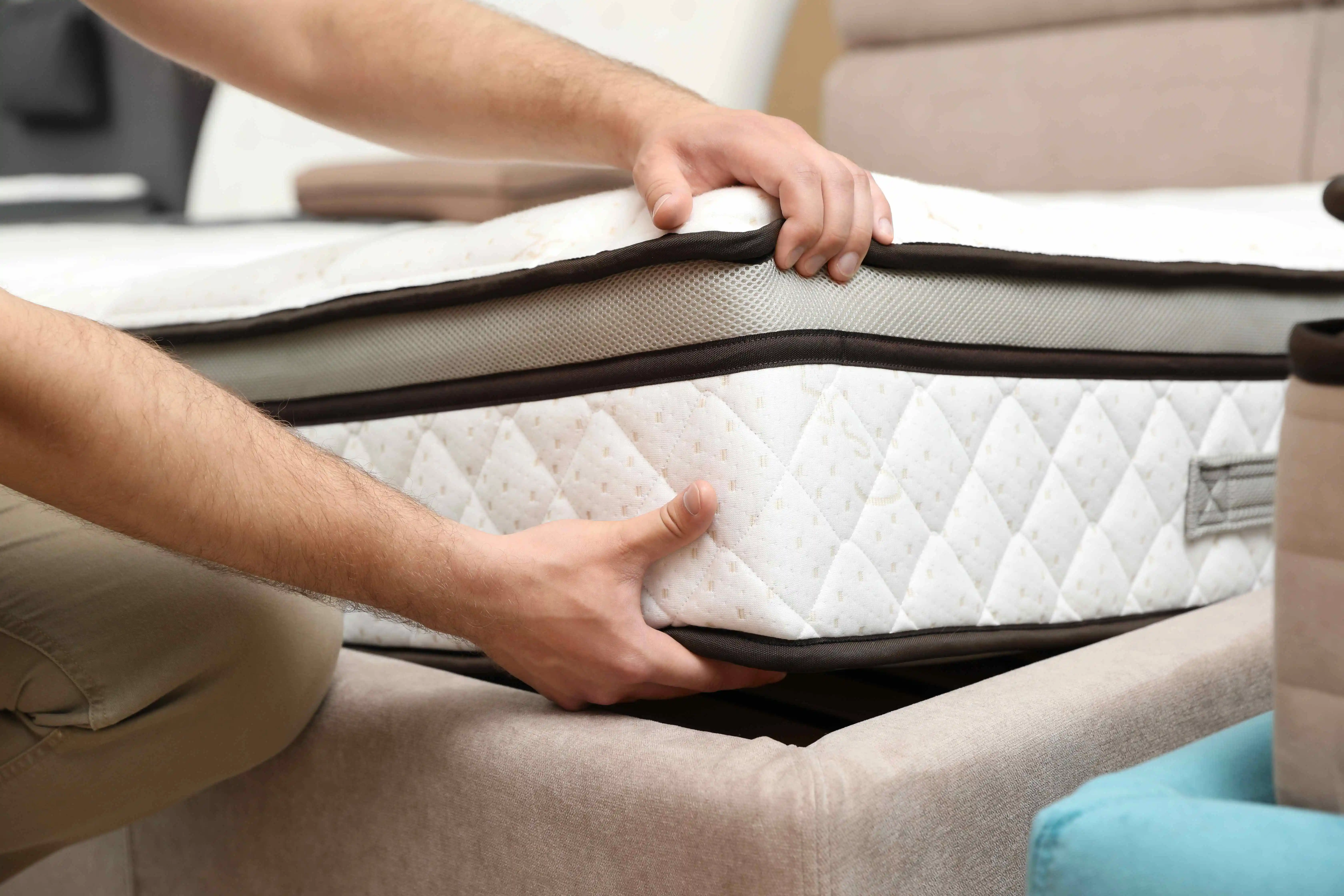
The best mattress is not a construction type, firmness number, or price range. It is the exact model that fits the sleepers, room, bed base, budget, and purchase terms, then remains comfortable during a fair trial.
A useful order is:
- Define each sleeper's needs.
- Measure the room, access route, and support surface.
- Set an all-in budget.
- Create a shortlist based on feel and function.
- Test the complete mattress.
- Compare the return, warranty, safety, and delivery details.
This approach prevents a common mistake: choosing from marketing categories first and discovering later that the mattress does not fit the frame, cannot be returned, or simply does not feel right.
1. Define what the mattress must do
List the needs of every regular sleeper before opening product pages. Include:
- Usual sleep positions and whether they change during the night
- Areas that become sore, numb, or pressure-sensitive
- Whether turning, sitting up, or getting out of bed is difficult
- Sensitivity to a partner's movement or noise
- How much of the edge is used for sleeping, sitting, or transfers
- Temperature preferences and the bedding already in use
- Differences between partners in preferred feel
- Current pain, pregnancy, disability, allergy concerns, or medical equipment
- The combined load of sleepers, pets, and anything else the bed supports
Translate the list into testable needs. For example, replace “supportive” with “my hips do not sink so far that I strain to turn,” and replace “cooling” with “I remain comfortable with my usual protector and bedding.” These observations are easier to compare than broad claims.
If partners want different feels, ask whether the model is available with a split firmness, whether the two sides can be exchanged separately, and whether a split creates a center seam. A larger shared mattress is not automatically better if it prevents the bed from fitting the room or makes delivery impractical.
2. Measure the room, route, and finished bed
A size name is not precise enough. Check the manufacturer's finished width, length, and height for the exact model and size. Nominal dimensions can differ slightly, and mattress height can change which sheets, guardrails, headboards, and transfer heights work.
Measure:
- The bed's footprint, plus space for doors, drawers, walking, and transfers
- The current frame or foundation from edge to edge
- Doorways, hallways, stairs, elevator openings, landings, and tight turns
- Ceiling or upper-bunk clearance where relevant
- The planned total bed height, including frame, base, and mattress
- Pocket depth of existing fitted sheets and protector
A mattress that arrives compressed may pass through spaces that a future replacement or return cannot. Confirm how a return is removed from the home and whether pickup is available at the address.
Our mattress size guide explains common size names. Use the seller's actual dimensions for the final decision.
3. Confirm the bed base before buying
The mattress and its support beneath it work as a system. Do not assume every foam mattress works on any platform, every innerspring needs a box spring, or every flexible mattress works on an adjustable base.
Read the installation and warranty documents for:
- Permitted foundations, platforms, and frames
- Maximum slat spacing and any minimum slat width
- Center-rail, center-leg, and floor-contact requirements
- Weight capacity for the full assembled bed
- Whether the mattress and foundation must be sold or labeled as a set
- Adjustable-base approval for the exact mattress model and profile
- Split-base and split-mattress combinations
For an adjustable bed, also confirm dimensions, retainer or corner-support requirements, how far the mattress may flex, and whether adjustment changes warranty coverage. Category labels such as “foam” or “hybrid” do not establish compatibility. See our adjustable bed frame guide for the separate base decision.
An old base should be inspected for sagging, broken parts, loose connections, inadequate center support, and dimensions that do not match. A new mattress cannot correct a failing frame.
4. Set an all-in budget
The displayed mattress price may be only part of the purchase. Add:
- Taxes and financing interest
- Delivery, room-of-choice setup, or stair charges
- Removal of the old mattress or base
- A compatible frame or foundation
- A protector and correctly sized sheets
- Possible return, pickup, donation, exchange, or restocking fees
Decide which costs are firm limits and which features are optional. A discount does not make an unsuitable mattress a good value. Compare the price you will actually pay and the terms attached to it, not a claimed reference price or countdown.
5. Choose by performance, not category promises
Mattress labels such as memory foam, latex, innerspring, and hybrid describe parts of a construction. They do not guarantee pressure relief, motion isolation, cooling, edge support, durability, or a particular feel.
Compare how the complete model performs for the needs you listed:
- Cushioning: Do the shoulders, hips, or other sensitive areas feel compressed?
- Stability: Does the middle of the body feel securely supported without uncomfortable pressure?
- Movement: Can you turn and get out of bed without feeling trapped?
- Partner disturbance: Does ordinary movement reach the other side?
- Edge use: Is the perimeter stable enough for your sleeping area and transfers?
- Temperature: Is the complete sleep setup comfortable in realistic room conditions?
- Noise: Do the mattress and assembled base remain quiet when sleepers move?
Coils may leave more open space inside a mattress, and some foams respond differently to heat and pressure. Neither fact predicts how warm one person will feel on the finished bed. Covers, comfort layers, protectors, sheets, blankets, room temperature, humidity, medicines, and health conditions can all matter. Treat “cooling” as a claim to test, not a guaranteed material property.
Our mattress type guide and mattress materials guide cover construction in more detail. For this purchase, request a layer-by-layer specification instead of relying on a proprietary name.
6. Use firmness labels as a starting point
“Soft,” “medium,” “firm,” and 1-to-10 scales are not standardized across sellers. Two models with the same label may feel different, and two people may rate the same surface differently.
Position and body size can help create a shortlist:
- Side sleepers often need enough surface give to avoid concentrated pressure at the shoulder and hip.
- Back and stomach sleepers often prefer more resistance beneath the middle of the body.
- A lighter person may compress a mattress less, while a heavier person may engage deeper layers sooner.
These are not prescriptions. Body proportions, pain, mobility, mattress construction, the base, and personal preference can change the result. A sleeper who changes position needs a workable compromise rather than a mattress chosen for one pose.
Use our mattress firmness guide to form a shortlist, then test the exact model.
7. Test comfort and support
In a store, use your usual sleep positions and pillow. Stay long enough for the surface to settle under you, turn several times, sit near the edge, and practice getting in and out of bed. Partners should test together and reproduce the movements that usually cause disturbance.
A floor sample may differ from a delivered mattress because of age, wear, room temperature, protector, base, or production changes. Record the exact model, firmness, size, height, and stock-keeping unit so the delivered item can be checked against what you tried.
At home, keep short notes on:
- Comfort at bedtime and on waking
- Pressure, pain, numbness, or stiffness
- Ease of turning and getting out of bed
- Partner disturbance
- Heat or sweating with the usual bedding
- Daytime sleepiness and sleep continuity
Normal adjustment is possible, but a seller's required “break-in” period is a return-policy term, not proof that every uncomfortable mattress will improve. Do not let a deadline pass while waiting for a promised change. Keep the mattress clean and protected according to the written return conditions.
What about back pain?
No mattress type has been shown to cure back pain. A randomized trial of 313 adults with chronic nonspecific low back pain found better 90-day pain and disability outcomes with a medium-firm mattress than with a firm mattress 1. The result does not identify one ideal retail model, because it compared two study mattresses on a particular firmness scale.
A systematic review found limited support for medium-firm or self-adjusted mattresses, but the studies used varied products, methods, populations, and outcomes 2. “Medium-firm” is therefore a reasonable place for some adults with chronic nonspecific low back pain to begin testing, not a universal medical recommendation. Retail firmness labels are not equivalent to the study scale, and the evidence does not show that a hybrid, foam, latex, or innerspring category treats the cause of pain.
Seek clinical advice for severe, new, worsening, or persistent pain, especially after injury or when it occurs with weakness, numbness around the groin, loss of bladder or bowel control, fever, unexplained weight loss, or a history of cancer. A mattress should not delay assessment.
8. Assess durability without lifespan promises
There is no reliable service life for an entire construction category. Wear may begin in the comfort layers, coil unit, edge, cover, stitching, or base. Loads, use, moisture, moving, and care also affect the result.
Ask for objective specifications when available, including layer materials and thicknesses, foam density, coil design, finished weight, load limits, and the exact support requirements. One number alone does not predict useful life. A high coil count, thick profile, high price, or long warranty is not a durability guarantee.
Look for long-term owner reports about the exact model, preferably from people with similar loads and use. Treat them as observations rather than controlled evidence, and check whether the construction has changed since the review.
Follow the model's care instructions. Do not flip or rotate a mattress unless the manufacturer directs it. Replace based on condition and function, such as persistent sagging, broken components, loss of support, or discomfort that continues after the base is checked. Our mattress care guide covers upkeep separately.
9. Compare online and store buying
Online shopping can make specifications and policy documents easier to compare, but you cannot feel the mattress before delivery. A store allows a physical comparison, but the floor sample and base may not match the mattress delivered to your home.
In either setting, identify:
- The authorized seller and the company that handles returns
- Whether the policy differs by seller, marketplace, clearance status, or floor sample
- The exact model and whether a retailer-exclusive name makes comparison difficult
- Whether delivery reaches the room and address you need
- What happens if the mattress arrives damaged, wrong, or incomplete
Get material promises from a salesperson in writing. The Federal Trade Commission advises consumers to obtain spoken warranty promises in writing and to keep the warranty and receipt 3.
10. Separate the trial, return policy, and warranty
These documents answer different questions:
- Sleep trial: The seller's rules for trying the mattress at home.
- Return or exchange policy: The steps, deadlines, condition rules, and costs for sending it back or changing models.
- Warranty: The written defects and remedies covered after purchase.
A long warranty does not promise comfort or establish how long the mattress will last. The FTC notes that warranties must be available before a purchase, online or in person, and that their coverage, limits, remedy, process, and owner costs matter 3.
Before paying, check:
- When the trial starts and ends
- Any minimum-use period
- Stain, odor, damage, protector, tag, and original-owner conditions
- Pickup, donation, drop-off, shipping, or restocking requirements
- Whether delivery charges and taxes are refunded
- Whether an exchange begins a new trial
- Whether bases, adjustable frames, and accessories are returnable
- Which indentation depth or defect qualifies under the warranty
- Base, care, stain, moving, and commercial-use exclusions
- Prorating, inspection, transport, replacement, and disposal costs
- Whether coverage transfers to another owner
Download or photograph the policies as they appeared on the purchase date.
11. Check safety and material claims
Fire performance and barriers
U.S. mattresses are subject to federal smoldering and open-flame performance tests. These rules reduce fire risk, but they do not make a mattress fireproof or require one particular barrier material 4. The required permanent label includes manufacturer, manufacture-date, model, compliance, and set information 4.
Ask the manufacturer to identify the exact fire-protection system in writing. “No added flame-retardant chemicals” does not tell you whether the barrier contains glass fiber or what other materials are present.
Fiberglass and removable covers
The California Department of Public Health warns that some mattresses contain fiberglass and that labels may not disclose it. Its advice is never to unzip a mattress cover because fibers can be released 5.
Before buying, ask whether any part of the exact model contains fiberglass, glass fiber, or glass-reinforced material. A zipper is not permission to remove the cover. Follow the model's instructions, and do not remove or wash a cover unless the manufacturer explicitly identifies that exact cover as removable and gives cleaning directions. If fibers have escaped, stop disturbing the mattress and follow public-health and manufacturer guidance.
Certifications and “non-toxic” claims
A certification applies only to the product, component, tests, and limits within its published scope. It does not automatically prove that the whole mattress is chemical-free, emission-free, natural, sustainable, hypoallergenic, or non-toxic. The FTC has challenged unsupported mattress claims involving VOCs, chemicals, health effects, natural materials, testing, and certification seals 6.
For any logo, find the certificate or issuer listing and check the exact model or component, standard, testing scope, issuer, and validity. Odor does not establish toxicity, and the absence of odor does not establish zero emissions.
Infant sleep is a separate decision
This adult mattress guide does not apply to an infant. The American Academy of Pediatrics recommends a firm, flat, noninclined surface designed for infants, such as a tight-fitting crib mattress in a safety-approved crib, with a fitted sheet and no soft objects or loose bedding. It warns against adult mattresses and soft, adjustable, or memory-foam surfaces for infants because of entrapment and suffocation risks 7.
Use only the mattress designed for the specific crib, bassinet, portable crib, or play yard. Do not add a topper, cushion, wedge, or adult mattress to make the surface softer.
12. Plan delivery and compressed-mattress setup
Instructions differ by model. Before delivery, confirm:
- Whether the mattress arrives flat or compressed
- The packaged and unpackaged dimensions and weight
- How long it may remain boxed
- Whether it can be used immediately and how long full expansion may take
- Room ventilation instructions
- The deadline and process for reporting damage or incomplete expansion
Move a sealed compressed mattress into the intended room before opening it. Clear the base and surrounding area, use enough people or suitable assistance for the weight, and keep cutting tools away from the mattress fabric and fire barrier. Open it on an approved support surface and follow the exact setup directions.
Photograph the package, labels, and mattress if it arrives damaged, wet, wrong, or incomplete. Contact the seller before discarding packaging when the policy requires it.
Final checkout list
Before paying, verify:
- Exact model, size, firmness, height, and stock-keeping unit
- Finished dimensions and delivery access
- Permitted frame, foundation, and adjustable-base setup
- Complete price and financing cost
- Trial, return, exchange, and warranty documents
- Cover-care and fire-barrier information
- Delivery, setup, old-bed removal, and damage procedures
- Seller and manufacturer contact details
Save the product page, specification sheet, receipt, warranty, return terms, and written promises together. After delivery, confirm the model and labels, inspect the mattress and support, and record any problem promptly.
Choosing a mattress is easier when every claim becomes a check. Measure the real space, compare the real construction, test the real feel, and read the real terms. No category label can replace those steps.