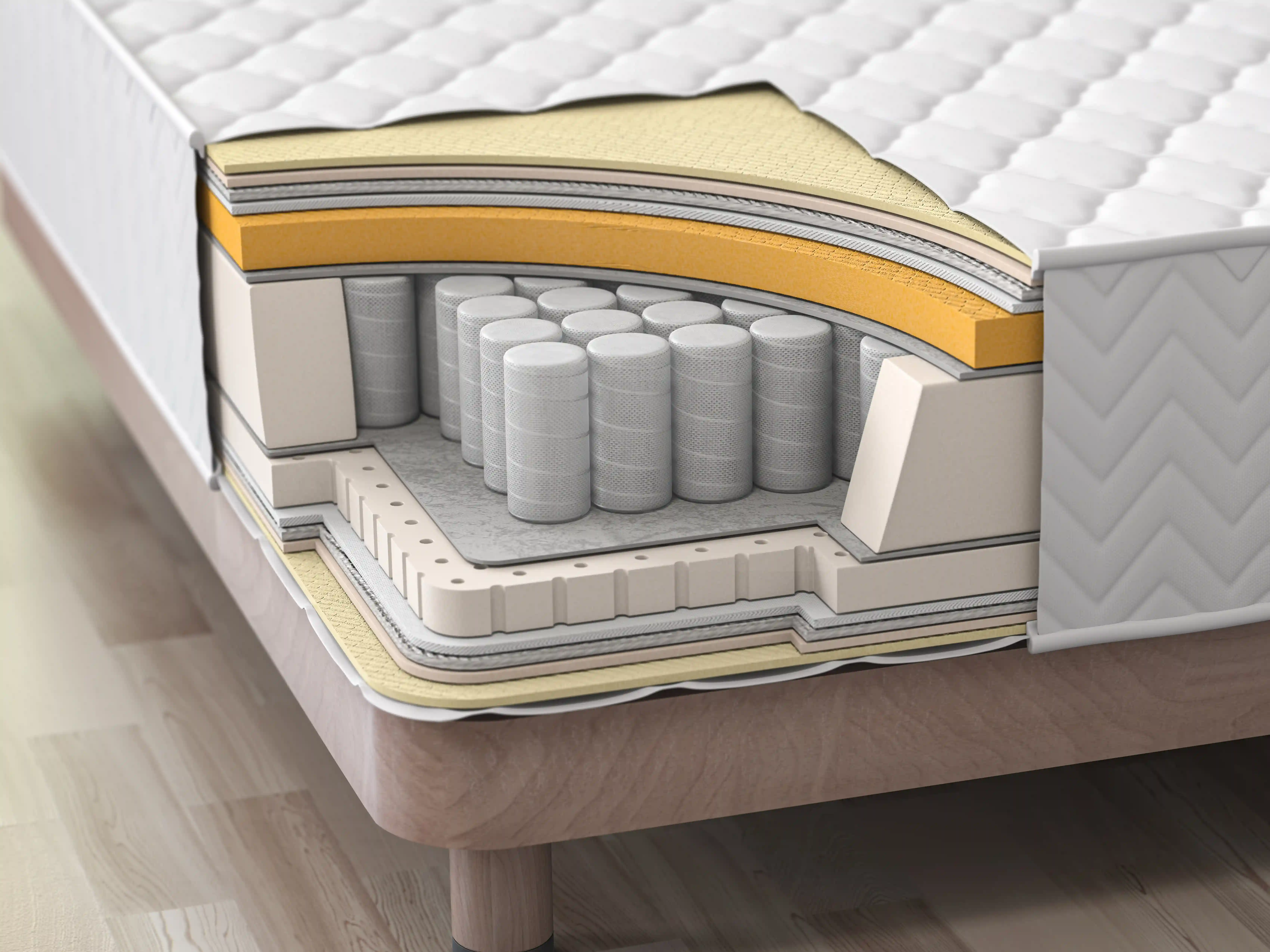


A mattress is a stack of materials, not a single block of foam, latex, or springs. The cover, surface padding, fire-protection system, comfort and transition layers, support core, edge design, and base can each change how the finished bed behaves.
Start by mapping the exact model from the outside inward. A familiar material name is useful, but it cannot predict the whole mattress's feel, support, pressure relief, movement, temperature, or useful life.
The layers in a mattress
| Layer | Common materials or components | What to verify |
|---|---|---|
| Cover or ticking | Knitted or woven cotton, polyester, rayon or viscose, lyocell, wool, or blends | Fiber percentages, fabric construction, finishes, removability, and care |
| Quilting and surface padding | Fiber batting, wool, cotton, polyester, polyurethane foam, latex foam, or microcoils | Material, thickness, tufting or quilting, and whether it is part of the removable cover |
| Fire-protection system | Model-specific barrier fabric, yarn, batting, or other compliant construction | Exact composition, location, cover-removal rules, and whether glass fiber is present |
| Comfort layers | Polyurethane foam, viscoelastic memory foam, latex foam, fibers, microcoils, gel layers, or mixed materials | Generic material, thickness, density, firmness test, geometry, and additives |
| Transition layers | Firmer foam, latex, microcoils, fiber pads, or zoning elements | Thickness, firmness, and how the layer separates cushioning from the core |
| Support core | Polyurethane foam, latex foam, steel coils, air chambers, water chambers, or a combination | Core dimensions, material specifications, zoning, edge construction, and load limits |
| Optional base | Foundation, box spring, platform, slats, or adjustable base | Whether it is part of the tested mattress set and the exact compatibility requirements |
These names describe structure, not quality. Two mattresses can list the same materials in a different order, thickness, formulation, or geometry and feel unrelated.
Cover, ticking, and surface padding
The outer fabric is called the cover or ticking. It may stretch closely over the comfort layers or hold quilted foam and fiber above them. Stretch, weave or knit, yarn size, backing, quilting pattern, and surface treatments can change how much of the layer below is felt.
Natural fibers include cotton and wool. Regenerated cellulosic fibers such as rayon, viscose, and lyocell begin with plant-derived cellulose but are manufactured into fibers. Polyester and polypropylene are synthetic fibers. Blends are common.
None of these names guarantees a cool, dry, allergy-free, durable, or sustainable surface. Fiber percentage, fabric weight, construction, finishes, quilting, bedding, room conditions, and the sleeper all matter. The FTC explains that a manufactured fiber made with bamboo as the cellulose source should be identified as rayon or viscose made from bamboo, not simply as bamboo fiber 1.
Surface batting can add loft and change the first sensation of the bed. Fiber can compress and shift differently from foam, but neither “hand-tufted” nor a thick quilt automatically establishes comfort or durability. Ask what is quilted into the cover and whether the quoted mattress height includes that padding.
Is the cover removable?
A zipper does not mean a cover may be removed or washed. Some covers are structural or enclose a fire barrier. Follow the exact model's written care instructions, and do not unzip or open a mattress merely to identify its materials 2.
The fire-protection system
U.S. mattresses must meet federal smoldering and open-flame performance requirements. These rules do not require one fire-barrier material and do not provide a complete ingredient list for shoppers 3.
Manufacturers may use different barrier fabrics, fibers, yarns, or complete constructions. Ask:
- What is the exact composition of the fire-protection system?
- Is it part of the cover, a separate inner sock, a batting layer, or another design?
- Does any component contain fiberglass, glass fiber, or glass wool?
- May the outer cover be removed, and what care method is permitted?
- Is the mattress intended for use alone or with a named foundation?
Federal labels identify information such as the manufacturer, manufacture date, model, prototype, compliance, and set configuration. They are not necessarily complete material disclosures 3. Our mattress fiberglass guide explains glass-fiber identification and release precautions.
Polyurethane foam
Flexible polyurethane foam, often shortened to polyfoam, can appear in quilting, comfort layers, transitions, edge rails, or the support core. Its performance varies with formulation, cell structure, density, firmness, resilience, thickness, shape, and the layers around it.
Density is mass per unit volume. It is commonly reported in pounds per cubic foot or kilograms per cubic meter. Firmness is separate. For flexible polyurethane foam, indentation force deflection, or IFD, measures the force needed to compress a specified sample by a stated percentage. A high-density foam can be soft, and a lower-density foam can be firm 4.
Density can help compare closely related polyurethane foams when the formulation, layer purpose, and measurement method are known. It is not a complete durability score. Fillers can affect reported mass, and layer thickness, support factor, fatigue resistance, temperature, load, and construction still matter 4.
Viscoelastic memory foam
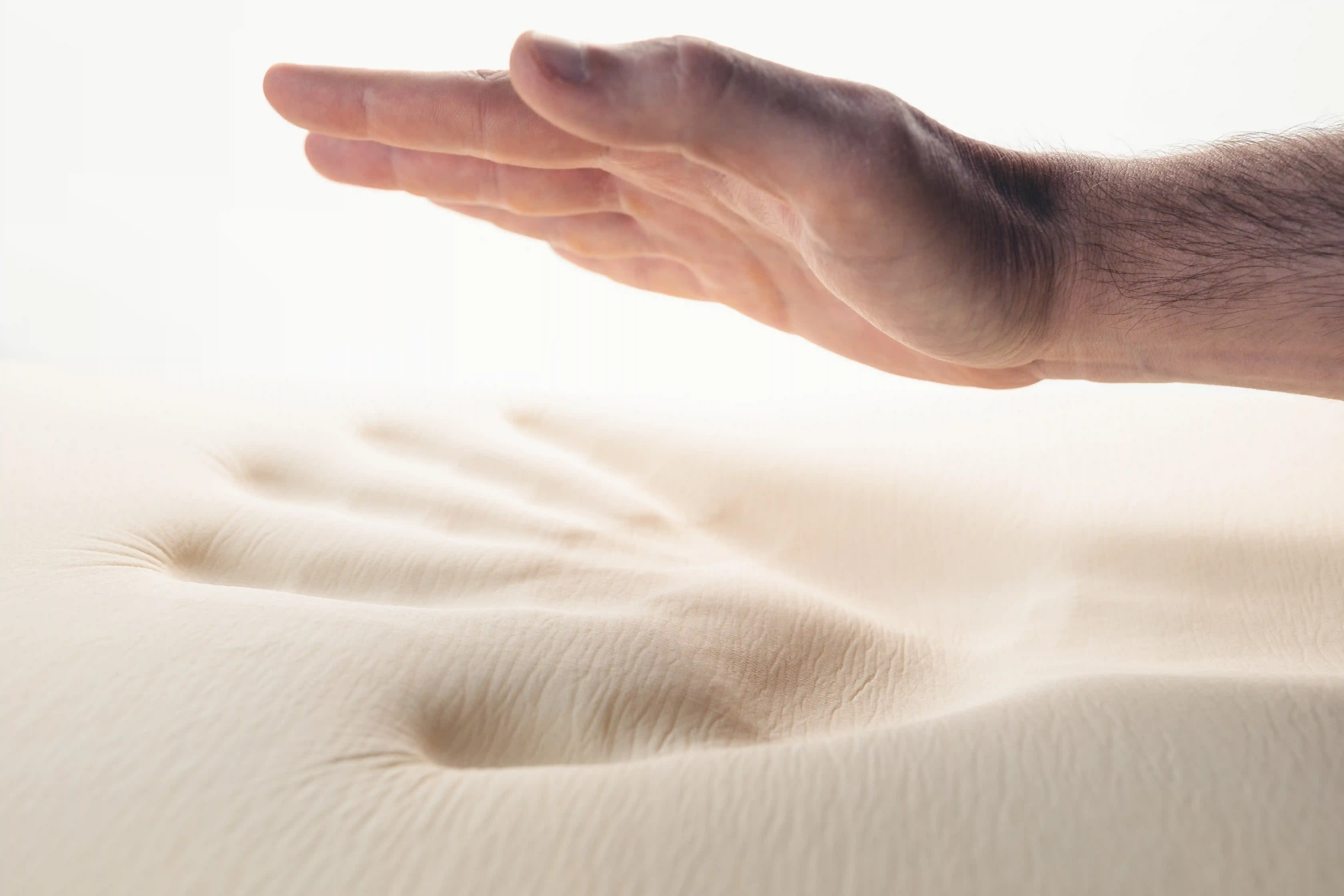
Memory foam is a viscoelastic form of polyurethane foam designed to respond more slowly after compression. Formulation and temperature can change that response. Some memory foams feel deeply conforming; others recover faster or are used in thin layers that do not dominate the mattress.
The label does not guarantee pressure relief, motion isolation, a “hug,” warmth, or a particular recovery time. Those results depend on the foam's properties, thickness, cut pattern, cover, layers beneath it, room conditions, and the person using it.
Conventional, high-resilience, and proprietary foams
Sellers may use terms such as conventional polyfoam, high-resilience foam, adaptive foam, or a trademarked name. A marketing name is not a specification. Request the generic foam family, density, IFD or other firmness measurement, thickness, and any relevant test method for each layer.
Latex foam
“Latex” can describe composition or a foam-making process, so several separate questions are needed.
Natural, synthetic, and blended latex
Natural rubber latex comes from rubber-tree fluid. Synthetic latex uses manufactured rubber polymers. A blend contains natural and synthetic rubber. Ask for the percentage of each rather than treating “latex,” “natural,” or “botanical” as a complete composition 5.
A finished latex foam also uses a formulation and curing process. “Natural latex” does not necessarily mean that every ingredient in the finished layer is tree sap 6.
Natural rubber contains proteins associated with natural-rubber-latex allergy, while synthetic rubber without natural rubber does not contain those same plant proteins 5. Mattress exposure differs from direct contact with medical gloves, so medical-device evidence does not predict a reaction to a finished mattress. A person with a known latex allergy should ask the manufacturer for exact composition and discuss avoidance needs with their clinician rather than testing an internal layer by touch.
Dunlop and Talalay
Dunlop and Talalay are processes used to make latex foam, not statements about whether its rubber is natural, synthetic, blended, organic, soft, or firm. ISO identifies both as latex-foam production processes 7.
In broad terms, both processes foam, gel, and cure a latex compound. Talalay processing adds vacuum expansion and freezing steps before curing, while Dunlop processing uses a more direct foam, gel, and cure sequence 6. These methods can produce structural differences, but formulation, density, hardness, mold design, thickness, and quality control prevent a process name from guaranteeing one feel or service life.
Density and hardness in latex
Latex density and hardness are useful only with the material composition, test method, sample thickness, and supplier context. Do not compare a latex density number directly with a polyurethane or memory-foam density number as if the scales identify equivalent quality. The material families, formulations, and test methods differ.
ILD and IFD are sometimes used interchangeably in retail copy, but a number is meaningful only when the test conditions are known. A layer measurement also does not establish the firmness of the completed mattress.
Steel coils
Steel coils usually form a support core, though shorter microcoils can appear in comfort or transition layers. The main unit may be:
- Pocketed: Individual coils enclosed in fabric and joined through fabric or adhesive.
- Non-pocketed: Bonnell, offset, or continuous-wire coils linked into a unit.
The U.S. International Trade Commission identifies pocketed and non-pocketed units as components used in both innerspring and hybrid mattresses 8. This is why “hybrid” is a construction description, not a material.
Coil count alone is not a quality or support score. Compare the mattress size, coil diameter and height, wire gauge, turns, arrangement, zoning, fabric pockets, joining method, perimeter design, and layers above and below the unit. A lower gauge usually means thicker wire within the same gauge system, but it still cannot predict the finished feel by itself.
Pocketing can allow coils to move more independently than a linked unit. It does not guarantee motion isolation, quietness, edge support, cooling, or durability once the complete mattress is assembled.
Natural, regenerated, and synthetic fiber layers
Fiber appears in covers, quilting, pads, separators, and fire barriers. Common examples include:
- Cotton or wool
- Rayon or viscose
- Lyocell
- Polyester
- Polypropylene
- Recycled or mixed-fiber felt
Ask for the generic fiber names, percentages, weight or thickness, location, backing, finishes, and whether recycled content is pre-consumer or post-consumer. A small amount in the cover does not describe the rest of the mattress.
Wool, cotton, and plant-derived fibers are not automatically organic, untreated, locally sourced, biodegradable under normal disposal conditions, or suitable for every allergy. Synthetic fibers are not automatically hotter, less durable, or more irritating. The complete fabric and the conditions of use matter.
Gels, phase-change materials, and other additives
Gel may be mixed into foam, added as beads, printed near the surface, or used as a separate polymer layer. “Copper,” graphite, charcoal, or other infusions may describe small additives rather than the main structure.
Phase-change materials are designed to absorb or release heat over a particular temperature range. Their capacity is finite, and their effect depends on how much is used, where it sits, the surrounding materials, bedding, room, humidity, and sleeper. Neither “gel” nor “phase change” guarantees that a person will sleep cooler.
Request the additive's material, location, amount when disclosed, test method, and result for the finished mattress. A thermal image or test of an uncovered sample may not represent a night of use with a protector and bedding.
Adhesives, tufting, and layer attachment
Mattresses may use adhesives to bond foam layers, attach fabric around pocketed coils, reinforce edges, or hold quilting components. Others use tufting, stitching, molded shapes, fasteners, or loose replaceable layers.
“Glue-free” may apply only to part of the construction. Ask which layers use adhesive, what type is used, and whether emissions testing covers the adhesive and finished mattress. Attachment method can also affect repair and recycling because strongly bonded mixed materials are harder to separate.
A zippered modular design can make some layers replaceable, but open it only if the exact instructions allow access without disturbing the fire-protection system.
Air, water, and powered components
Some mattresses use air chambers as the support core, with a pump and valves that change chamber pressure. Foam, fibers, and the cover above the chamber still shape the surface feel. Dual chambers may allow side-to-side adjustment, but they add hoses, seals, controls, and powered parts that can require service.
Water-chamber mattresses depend on chamber design, fill level, baffling, heater compatibility, and the supporting frame. Active temperature systems may circulate water or air through a pad or mattress component. These are systems rather than passive raw materials, so compare electrical safety information, cleaning, leak response, noise, replacement parts, warranty, and compatibility for the exact model.
Why a material name cannot predict performance
A finished mattress combines:
- Material formulation and composition
- Density and firmness or hardness
- Layer thickness and order
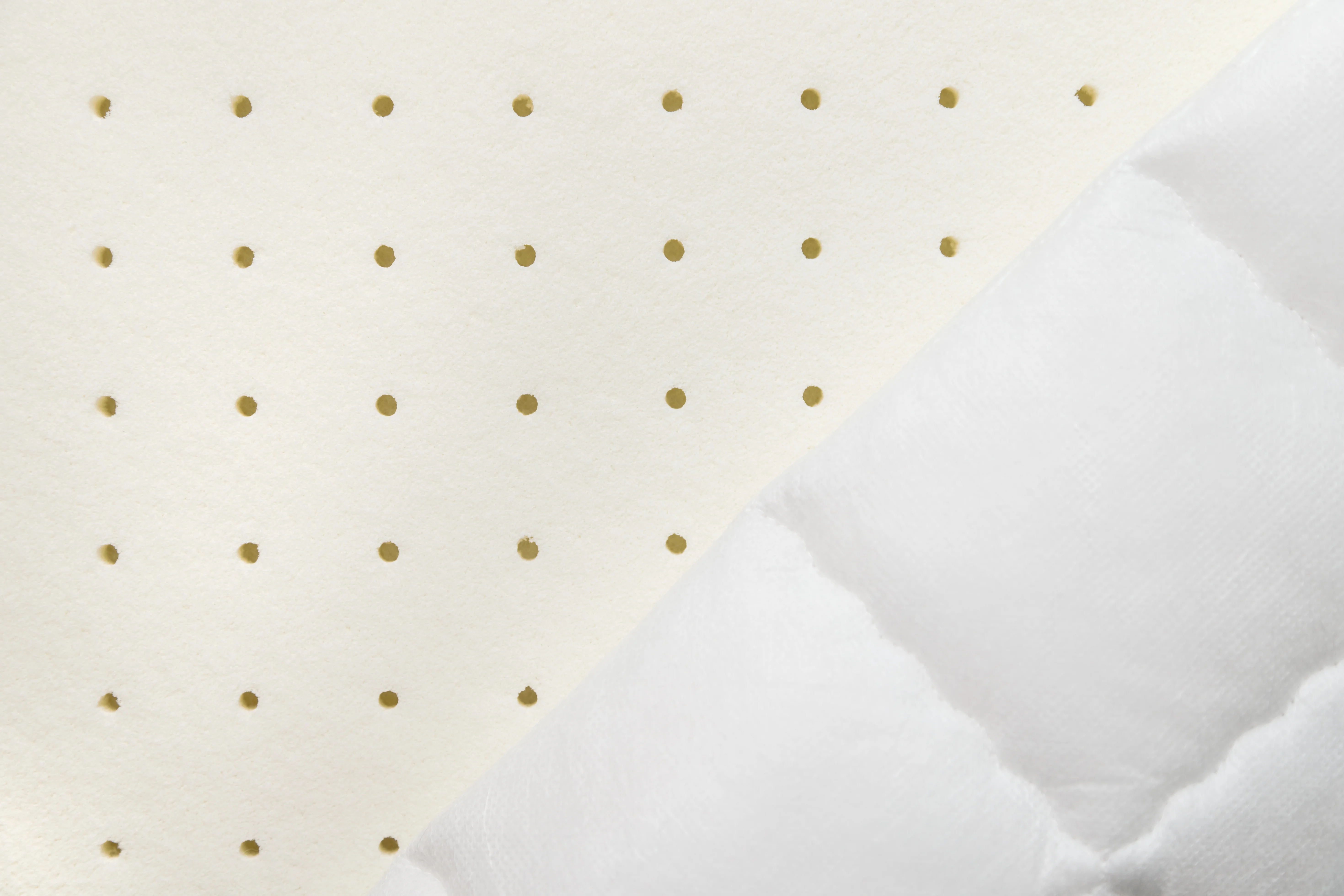
- Perforations, channels, convolutions, zoning, and edge geometry
- Coil design and attachment
- Cover stretch, quilting, and fire barrier
- The foundation or adjustable base
- Sleeper size, position changes, movement, bedding, and room conditions
Laboratory measurements help describe individual materials. They do not reproduce every use condition. ISO notes that foam tests may not simulate practical use and support only broad comparison, while the cover and final construction add factors outside the foam test 7.
This is also why one material cannot promise “spinal alignment,” pain relief, pressure relief, motion isolation, or a fixed lifespan. Those are outcomes of the complete system and the person using it.
Material disclosure and safety claims
New-mattress odor and VOC emissions
Volatile organic compounds, or VOCs, are compounds that can evaporate under ordinary indoor conditions. Foams, fabrics, adhesives, finishes, packaging, and other components may contribute emissions. EPA notes that indoor VOC programs use different definitions and test scopes and may not assess every compound relevant to indoor air 9.
Odor and measured emissions are not the same:
- A smell does not identify the compounds or concentrations present.
- A product with little odor is not necessarily emission-free.
- “Low VOC” is a test claim, not “zero VOC” or “chemical-free.”
- Results for one foam sample do not automatically apply to the cover, adhesive, barrier, or finished mattress.
In a chamber study of eight polyurethane mattresses, measured VOC emissions varied by mattress and test condition, with temperature and air exchange affecting estimated exposure 10. That study does not show that every foam mattress causes disease, nor can its results be transferred to an untested model.
Follow model-specific setup and ventilation instructions. If a new product causes persistent eye, airway, skin, or other symptoms, move away from the exposure, ventilate if it is safe to do so, contact the manufacturer, and seek medical advice when symptoms are significant or continue.
Allergies and sensitivities
“Hypoallergenic,” “antimicrobial,” “dust-mite resistant,” and “mold resistant” are claims that need an exact test, material, organism, duration, and use condition. A foam or fiber name alone does not establish any of them.
Reactions can involve a source material, processing aid, dye, finish, adhesive, contaminant, or accumulated moisture and soil. Ask for the full model composition and avoid assuming that “natural” means nonallergenic. Do not open the mattress or touch internal layers to test a suspected sensitivity.
How to read certifications
A certification is useful only within its stated scope. Verify the exact model or component, certificate number, issuing body, current status, test criteria, and whether testing covered initial content, emissions, ongoing production, or the finished product.
Examples:
- CertiPUR-US: Applies to eligible flexible polyurethane foam samples and evaluates specified content, emissions, and physical-performance criteria. It does not certify latex foam or automatically certify the entire mattress 11.
- UL GREENGUARD: Indicates that the certified product was evaluated against specified chemical-emission limits. Check whether the listing names the finished mattress or a component and which certification tier applies 12.
- GOTS: Covers qualifying textiles and their processing, manufacturing, and labeling. The standard can include mattresses, but the exact certified product, label grade, fiber content, and supply-chain scope still need verification 13.
None of these marks establishes personal comfort, support, durability, zero emissions, absence of fiberglass, or universal health safety.
Organic, natural, plant-based, and recycled claims
Identify what each claim describes and how much of the mattress it covers. “Organic cotton cover” is not the same as an organic whole mattress. “Plant-based foam” may mean that a stated portion of one input was substituted, not that the polyurethane foam is entirely plant material. “Recycled steel” says nothing about the foam or textiles.
The FTC advises that environmental claims specify whether they apply to the product, packaging, or one component. Recycled-content claims should state the relevant amount, and broad seals or terms such as “green” or “eco-friendly” can mislead when their basis is unclear 14.
Look for percentages, chain-of-custody or transaction evidence where relevant, the exact certified entity and model, and the issuer's public directory. Origin is another separate claim. A rubber species, country named in marketing, or factory location does not by itself prove where every material was grown, processed, or assembled.
Durability, repair, and end of life
No material family has one dependable mattress lifespan. Foam fatigue, compression set, tear strength, coil fatigue, fabric abrasion, seam strength, adhesive aging, moisture, load, movement, base support, and care can fail on different schedules.
Laboratory fatigue data can compare defined samples under defined conditions, but it does not convert directly into years in a household 47. A warranty term is also not a service-life estimate.
For durability evidence, ask for:
- The specifications and thickness of every major layer
- Relevant fatigue, indentation, height-loss, or rollator testing and its method
- Whether the tested sample matches the sold model
- The support-base and load requirements
- Replacement availability for covers, pumps, chambers, remotes, or modular layers
- The warranty's measured defect thresholds and exclusions
At end of life, specialized programs may dismantle mattresses to recover steel, polyurethane or latex foam, fibers, fabric, plastics, and wood 15. Actual recovery depends on local programs, mattress condition, contamination, and markets for each separated material. Bonded mixed layers and powered parts may require different handling.
Check local reuse, take-back, recycling, and disposal rules rather than relying on an unqualified “recyclable” claim. A mattress with contamination, pests, exposed fiberglass, or damaged powered components may not be suitable for reuse or ordinary collection.
Exact-model material checklist
Before comparing two mattresses, collect:
- A top-to-bottom layer diagram with generic material names and thicknesses
- Cover fiber percentages, finishes, quilting materials, and care instructions
- Fire-barrier composition and cover-removal rules
- Density, firmness or hardness, and test method for each foam layer
- Natural and synthetic rubber percentages plus Dunlop or Talalay process for latex
- Coil type, height, gauge, arrangement, zoning, joining, and edge design
- Gel, phase-change, fiber, or mineral additive location and finished-product test results
- Adhesive or mechanical attachment methods
- Certification numbers, exact scope, issuer listings, and current status
- Percentages and scope for organic, natural, plant-based, renewable, or recycled claims
- Base, adjustable-bed, load, care, repair, and replacement-part requirements
- Local take-back, recycling, or disposal options
This material map explains what the mattress is made from. Use our mattress buying guide to combine it with room measurements, comfort testing, budget, delivery, trial, return, and warranty decisions.