

The best way to care for a mattress is to follow the instructions for that exact model, keep it dry, support it correctly, and investigate changes before they become larger problems. A weekly or monthly routine copied from a generic mattress guide can do more harm than good if it conflicts with the cover, comfort layers, fire barrier, base, or warranty.
Good care can help prevent avoidable staining, moisture damage, and support problems. It cannot rebuild worn foam, repair broken coils, restore a failed base, or make a contaminated porous interior safe again. The goal is to protect the mattress you have and recognize when maintenance is no longer the right response.
Start with the mattress identity, manual, and warranty
Before rotating, cleaning, moving, or adding a new base, find the sewn-in labels and the instructions for the exact model. Photograph the labels and save the receipt, order confirmation, manual, and warranty together.
In the United States, federal mattress-set labels identify the manufacturer, month and year of manufacture, model, prototype, and whether the mattress is intended to be sold alone or with a foundation 1. A separate filling-material law tag may provide additional information under state rules. These labels can help you locate the right manual, check a recall, or document a warranty claim.
Search the manufacturer's current support site using the model and manufacture date. Then answer these questions:
- Which side is the sleep surface? Is the mattress one-sided or designed to be flipped?
- Does the maker instruct you to rotate it? If so, in which direction and under what conditions?
- What foundation, slat spacing, center support, weight capacity, and adjustable-base compatibility apply?
- Is any cover explicitly removable and washable, or is a zipper only part of assembly?
- Which protectors, cleaning products, water temperatures, heat sources, and drying methods are allowed?
- May the mattress be bent, folded, stood on edge, or carried by its handles?
Keep the labels attached and readable. Some manufacturers ask for the law tag, proof of purchase, photographs of the mattress, and photographs of its support system when reviewing a claim 2.
Use the same model information to check the CPSC recall database in the United States or the product-safety authority where you live. A recall may require a repair cover, refund, replacement, or immediate stop-use instruction, so follow the remedy for the exact model rather than inventing a fix 3.
Give the mattress the support its maker requires
There is no universal maximum slat gap or foundation type for every foam, latex, innerspring, hybrid, or air mattress. Even products from one company may have different support rules.
Saatva's warranty, for example, specifies slat spacing and center support for many mattresses, calls for a solid surface over slats for one two-sided model, and limits adjustable-base compatibility to named models and heights 4. Those are Saatva terms, not dimensions to copy for another brand.
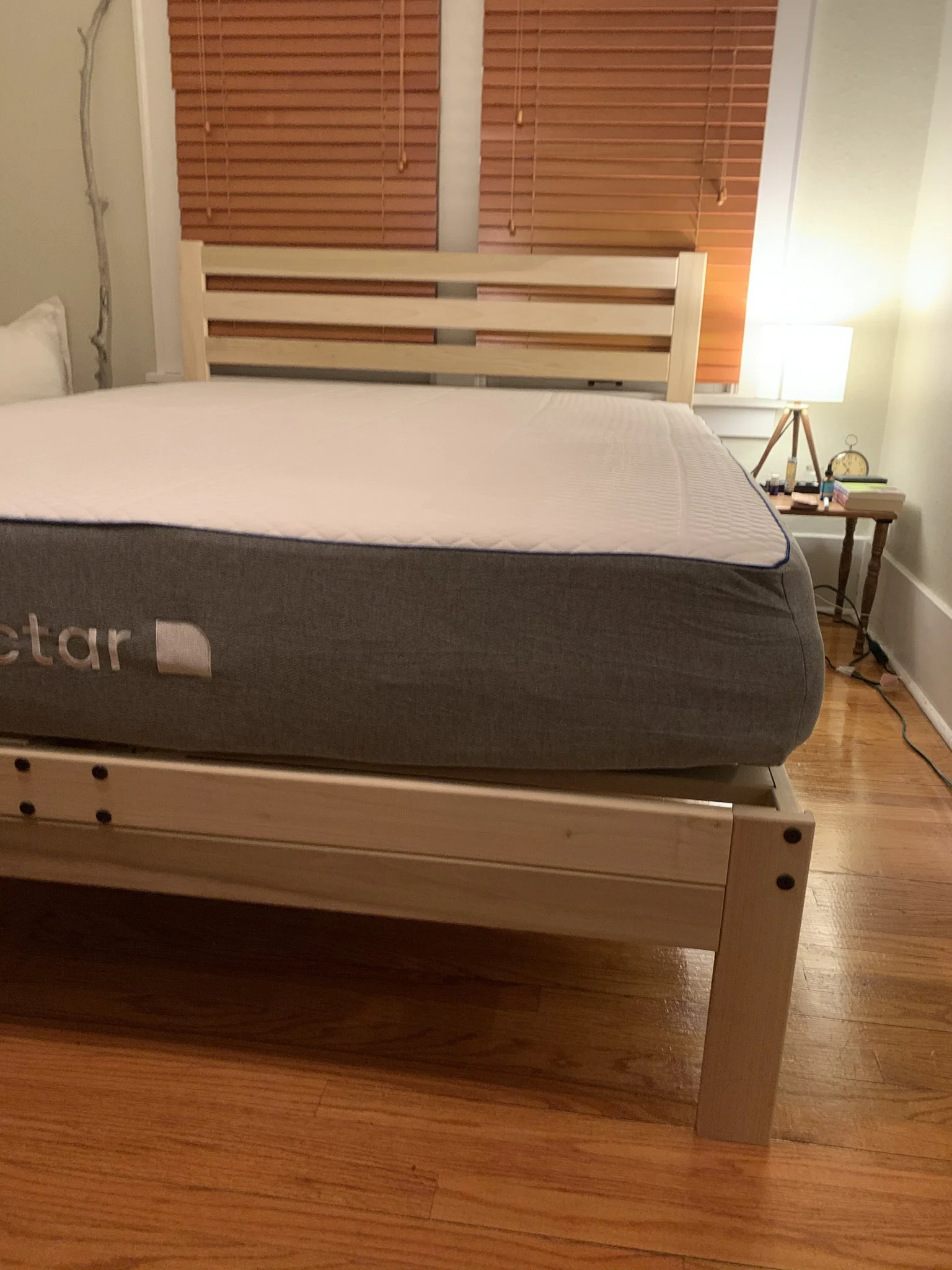
Check the mattress, foundation, and frame as one system:
- Make sure slats are present, seated, level, and not bowed or cracked.
- Confirm required center rails and legs are installed and actually reach the floor.
- Look for loose fasteners, bent rails, broken foundation parts, and movement at the joints.
- Confirm an adjustable base is compatible with the mattress and that the mattress follows the base without bridging or bunching.
- Keep hoses, air lines, sensor leads, and power cords routed as the manuals show, with nothing pinched under the frame.
Correcting a failed or wrongly assembled base may restore a level surface if the mattress itself is still sound. Do not add plywood, extra slats, blocks, or another foundation unless the mattress and bed manufacturers allow that arrangement. An improvised layer can change flex, ventilation, height, and warranty coverage.
Choose a protector for the actual risk
A protector can put a washable barrier between the mattress and sweat, body oils, pet accidents, or spills. It does not guarantee that no liquid, allergen, dust mite, or pest will ever reach the mattress, and it does not prevent structural wear.
Check that the protector:
- Fits the mattress depth without pulling the corners upward or compressing soft comfort layers.
- Is compatible with the model's cover, sensors, hoses, powered temperature system, and adjustable base.
- Provides the level of liquid resistance you need without making claims you cannot verify.
- Can be washed and dried in a way your household can follow consistently.
Protectors also differ in stretch, airflow, surface feel, noise, and heat retention. Tempur-Pedic, for example, warns that a conventional pad or cover may change how its temperature-sensitive material conforms and recommends a compatible protector instead 5. Treat that as a product-specific example.
A fitted protector is not the same as a full encasement. Encasements designed for bed bugs have secure closures and a different purpose. See our guides to choosing a mattress protector and cleaning a mattress protector for those decisions.
Respond to spills and soil without saturating the bed
When liquid reaches the bed, remove the bedding and protector, blot what you can without pressing the spill deeper, and check the model instructions before applying a product. Use only an allowed surface treatment and the least moisture needed. Leave the mattress uncovered until the treated area and every affected layer you can assess are fully dry.
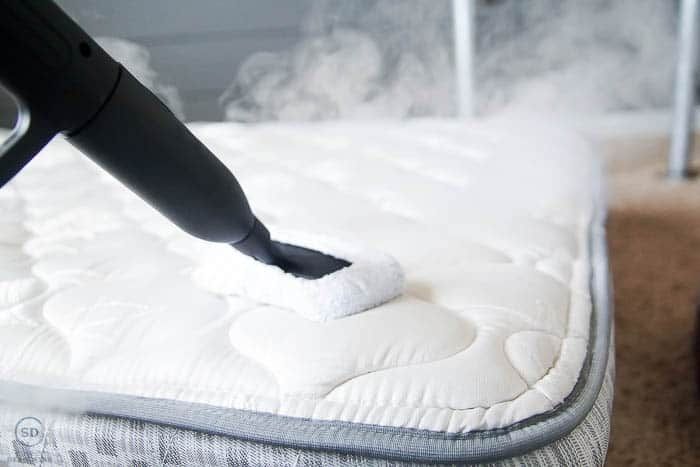
Do not assume that baking soda, vinegar, bleach, steam, an upholstery extractor, or direct sunlight is safe for every mattress. A removable cover may have separate care instructions from the material beneath it. Tempur-Pedic, for example, says its foam material should not be washed or become wet and advises air drying after excess moisture is removed 5.
Vacuum only if the manufacturer permits it. Use a clean attachment and stop if suction pulls at the cover, seams, quilting, or loose fibers. Vacuuming removes some surface debris; it does not sanitize the mattress, clean the support core, or eliminate mold or bed bugs.
For a complete problem-specific route, use our guide to cleaning a mattress safely. Urine and other persistent stains have their own stain and odor guide. Neither route should override the mattress manual.
Rotate or flip only when the exact model calls for it
Rotation is not a universal monthly, quarterly, or six-month task. Flipping is appropriate only for a mattress built with sleep surfaces on both sides.
Manufacturer instructions can differ sharply. Tempur-Pedic says its one-sided mattresses do not need flipping or rotation 5. Saatva advises against routinely rotating several of its zoned models while giving different instructions for other designs 6. Material labels such as "foam" or "hybrid" are not enough to settle the question.
If your manual calls for rotation:
- Follow its direction and timing rather than a generic schedule.
- Ask for help with a heavy mattress and clear the route before lifting.
- Lift from supported edges as instructed. Do not drag the cover across the frame.
- Use handles only for the purpose the maker names. Some are positioning handles, not carrying handles.
- Recheck slats, center support, cables, hoses, and protector fit before remaking the bed.
Never flip a one-sided mattress. The bottom may contain support foam, non-slip fabric, hardware, hoses, or other components not intended as a sleep surface.
Use the bed without creating avoidable damage
Follow the stated user and total load limits for the mattress and base. Do not stand or jump on the bed, and do not treat the edge as a step. Concentrated force can damage components even when ordinary sleeping weight is within the limit.
If children or pets use the room, check for claw tears, chewing, wet spots, loose remotes, and access under a powered base. Keep sharp objects, hot tools, and open flames away from the mattress. Follow the maker's restrictions for heating pads, electric blankets, and powered accessories.
Adjustable bases add moving and electrical parts. One Tempur-Pedic base manual instructs users to keep children and small pets from playing on or under the bed, supervise children operating it, unplug before cleaning or service, and discontinue use if the cord or plug is damaged, the base is not working correctly, or it has been dropped into water 7. Apply the safety instructions for your own base, including its child lock and emergency-lowering procedure.
Inspect when the bed gives you a reason
A condition-led inspection is more useful than a ceremonial deep clean. Look at the mattress and support system when you strip the bed, after a spill or move, and whenever you notice a new dip, tilt, noise, odor, damp area, or change in how the surface feels.
Check:
- Seams, quilting, zippers, handles, and the outer cover for tears, pulled stitching, or exposed inner material.
- The unloaded surface for an impression, ridge, lump, shifting layer, or edge that does not recover.
- The underside for dampness, staining, pests, rust, or abrasion from the base.
- Slats, center supports, legs, foundations, and fasteners for movement or failure.
- Air chambers, hoses, pumps, cables, motors, and remotes for leaks, heat damage, pinching, or erratic operation.
Photograph a change before cleaning, rotating, opening, or modifying anything. Follow the warranty's measurement method. Tempur-Pedic, for example, asks claimants to photograph an unloaded impression with a straightedge across the surface and to document the support system 2. Another manufacturer may define a covered defect differently.
A comfort change is not automatically a manufacturing defect, and a warranty threshold is not a health threshold. New soreness, poor sleep, or a preference change does not by itself prove that the mattress caused the problem. Compare the bed with another sleep surface if practical, look for changes in the base and household, and discuss persistent symptoms with an appropriate clinician.
Know what maintenance cannot restore
A topper can change surface softness, cushioning, or temperature feel. It cannot repair a broken coil, split foam, shifted internal layer, failed air chamber, damaged frame, or deep structural impression. It also cannot make a moldy or contaminated mattress safe. See our mattress topper guide before using one to solve a comfort problem.
Fixing an approved support system may help when the base, rather than the mattress, created the unevenness. If the mattress remains visibly deformed after it is unloaded and properly supported, document it and contact the manufacturer before trying a home repair. Our guide to mattress sagging explains the distinction in more detail.
Age alone does not decide whether a mattress is usable. Construction quality, load, support, moisture, damage, and changing comfort needs differ. Judge its current condition and function, then use the mattress lifespan guide and replacement guide if repair, warranty service, or a corrected base cannot solve the problem.
Stop routine care when the problem needs a safety decision
Some situations should not be treated as an ordinary stain or maintenance task.
Mold or deep moisture
Stop using the mattress while you identify the moisture source and how far the wetting reached. The EPA notes that mold can grow into the spaces within porous materials and may be difficult or impossible to remove completely, so moldy porous items may need to be discarded 8. A cleaned surface is not proof that the interior is dry or free of growth.
Contact the manufacturer or a qualified remediation professional when moisture penetrated the mattress, mold is visible in seams or inner layers, odor returns after drying, or the source involved contaminated water. Do not cover active moisture with a protector or topper.
Floodwater or sewage
Do not try to rescue a mattress reached by floodwater or sewage with bleach, steam, sun, or professional upholstery cleaning. CDC disaster guidance lists mattresses among porous items to throw away when they cannot be cleaned and dried quickly, and notes that floodwater can contain sewage and other hazardous waste 9. Document the damage for insurance, contain it for removal, and follow local disposal rules.
Suspected bed bugs
Bed bugs are a room-level pest problem, not evidence that the mattress is dirty. Confirm the pest, limit movement of items between rooms, and use an integrated plan. EPA guidance includes properly designed mattress and foundation encasements, monitoring, targeted treatment, and professional help when needed 10.
Never spray a mattress merely because a product kills insects. The pesticide label must name bed bugs and state where and how the product may be applied. EPA warns against applying a pesticide to beds, furniture, or clothing unless those surfaces are on the label 11. See our dedicated bed bug and mattress guide.
A torn cover, fire barrier, or escaped glass fibers
A zipper does not prove that an outer cover is removable. Mattresses sold in the United States are regulated as complete assemblies under federal smoldering and open-flame standards 1. Do not cut, unzip, wash, sew, glue, or otherwise alter a cover or fire barrier unless the exact instructions authorize that action.
Glass fiber may be listed as "glass fiber" or "fiberglass" on a label, but labeling may not tell you everything inside the mattress. California public-health guidance advises keeping the outer cover sealed and not unzipping it; if glass fibers escape, it recommends protective clothing, eye and breathing protection, HEPA vacuuming rather than sweeping, damp wiping, and containing the mattress before removal 12.
If you see a tear into inner material or shiny fibers outside the mattress, stop disturbing the area, keep children and pets away, turn off fans that could spread fibers, and contact the manufacturer or a qualified cleanup professional. Do not use an ordinary vacuum or continue sleeping on the mattress while deciding what to do.
A damaged powered component
Stop operating an adjustable base, pump, heater, cooling unit, or smart-bed component that has a damaged cord, overheats, smells burned, moves unexpectedly, makes new grinding sounds, or has been wet. Disconnect power only if you can do so safely. Keep people and pets away from moving parts and use authorized service rather than opening a motor or control box 7.
A warranty decision does not replace a safety decision. If a product appears recalled, electrically unsafe, contaminated, or physically unstable, stop use while you obtain the appropriate remedy even if coverage is uncertain.
Move and store it according to the model
Moving rules also differ. Tempur-Pedic tells owners to transport and store its mattresses flat, says its handles are for positioning rather than carrying, and permits limited folding only in a named direction and for as little time as possible 5. Other mattresses, especially those with coils, air chambers, water, or powered components, may have different restrictions.
Before moving:
- Read the mattress and base instructions and disconnect components in the stated order.
- Photograph connections, labels, the support setup, and existing condition.
- Use enough people and suitable carrying equipment for the weight and route.
- Protect the mattress from dirt and liquid without sealing existing moisture inside.
- Store it in the allowed orientation, fully supported, away from sharp objects, pests, and damp surfaces.
- Reassemble the support system and inspect cords, hoses, slats, and fasteners before use.
Our mattress transportation guide covers planning and handling. If the mattress cannot be used or safely restored, follow the mattress disposal guide rather than leaving it where someone else may reuse an unsafe product.
A simple condition-led care plan
At setup, record the model, save the instructions, confirm the support system, and choose a compatible protector. After a spill, act promptly and dry the allowed treatment completely. When the bedding is off, notice the surface, seams, underside, and base rather than performing an automatic deep clean. After a move or any new dip, noise, odor, or dampness, investigate the mattress and support together.
Before rotating, flipping, folding, washing a cover, adding a board, applying a pesticide, or opening a powered component, stop and check the exact instructions. That short pause is more protective than a universal maintenance calendar.