
Start blotting before you look anything up. Press dry towels into the wet area to lift as much liquid as you can, and do not rub. Then slow down, find the care instructions for your exact mattress, and choose a cleaner that both the mattress maker and the product label allow. For urine, that is usually an enzyme cleaner used for the contact time printed on its bottle. Remove the residue as the label directs, and leave the bed stripped until the treated area is dry all the way through.
Two things separate a good result from a ruined mattress. The first is moisture control, because the padding under the cover holds water much longer than the surface suggests. The second is chemical restraint. Urine breaks down into ammonia, and ammonia combined with household bleach releases toxic chloramine gas, so bleach has no place in this job 1.
There is no single recipe that suits every bed. A washable zip-off panel, a sealed foam core, a latex core, and a powered smart bed have conflicting care rules, and the wrong step can cost you the warranty along with the mattress. For everything else that lands on a mattress, see our broader guide to cleaning a mattress safely.
Why urine behaves differently from an ordinary spill
Fresh urine is mostly water and urea, and urea barely smells. Once urine leaves the body and meets ordinary environmental bacteria, enzymes called ureases break the urea down into ammonia and bicarbonate. That reaction pushes the pH up and releases the sharp ammonia odor people recognize 2. It explains why a stain you hardly noticed on Tuesday announces itself by Friday, and why a dried patch can smell stronger for a while after you wet it during cleaning.
Cat urine brings its own chemistry. Cats excrete felinine, a compound that has no odor by itself but degrades slowly at room temperature into the volatile sulfur compounds behind the familiar tomcat smell 3. Because that breakdown keeps going, a cat-soiled mattress can seem fine after cleaning and then smell again weeks later.
Both facts point the same direction. The aim is to remove residue rather than cover it, and to get the material dry so the reaction has nothing left to work with.
Check what your mattress allows before you apply anything
Photograph the law tag, care tag, model name, and serial number while the bed is stripped, then look up the instructions for that exact model rather than a generic page about foam or coils. Warranty language matters here too, because many warranties treat stains and liquid damage as exclusions.
Manufacturers differ more than most people expect:
- Tempur-Pedic says the covers on most of its mattresses can be removed and machine washed cold with mild detergent, but that the TEMPUR material itself must never become wet or be washed, and that chlorine products and harsh stain removers should not be used at all 4.
- Purple says the opposite about its cover. Even though the cover has a zipper, it is not meant to be removed, machine washing is not recommended, and washing it can shrink the cover and affect warranty coverage. Purple directs owners to spot clean with a mild detergent instead 5.
- Sleep Number tells owners of its smart beds to leave the cover in place, dampen a clean white cloth with a small amount of water, work the spot gently, and let it air dry, keeping water to a minimum around the bed's electronics 6.
- Avocado says water is not harmful to its organic latex but strong solvents are, recommends an enzymatic cleaner for urine followed by blotting and baking soda, says never to use bleach, advises against steam cleaners because the heat can damage latex, and tells owners not to remove the ticking to reach the internal materials 7.
Read these as four different sets of rules, not four opinions about the same rule. Yours may say something else again. If the manufacturer's page does not cover urine, ask customer support in writing which method is permitted and keep the answer.
A zipper does not mean the cover is removable, and opening the mattress to reach a stain is not a cleaning step. Once you separate the ticking from the core, you are past what the maker will support and past what you can reliably put back together.
Fresh accident: what to do in the first hour
Speed matters because less liquid has time to travel into the padding.
- Strip everything and protect yourself. Pull off sheets, blankets, pads, protectors, and any topper. Put on disposable gloves. Wash the removable layers separately according to their own labels, since washing bedding does nothing for what reached the mattress.
- Blot, do not rub. Press clean white towels firmly into the wet area and swap them as they load up. Standing on a folded stack of towels for a few seconds pulls out more liquid than wiping does. Rubbing spreads the stain and drives urine deeper.
- Pick one permitted product. It has to be allowed by the mattress instructions and labeled for that kind of surface. An enzyme cleaner is the usual choice for urine, and both Purple and Avocado name enzymatic cleaners in their own guidance 57. Do not combine products.
- Apply the smallest effective amount. Dampen a cloth and work from the outside of the stain inward, unless both sets of directions specifically allow spraying the mattress. Use enough to reach the residue and no more.
- Give it the contact time on the label, then lift the residue. Enzyme products need time on the surface to do anything. When the label calls for residue removal, use a separate cloth that is barely damp, then press dry towels down again.
- Dry before you rebuild the bed. Leave the mattress uncovered in a ventilated room. Do not put a protector back on damp material.
Baking soda is a reasonable last step when the maker permits it, and Avocado recommends it to absorb remaining moisture 7. Treat it as a surface deodorizer. It pulls moisture and odor from the top of the material, and it needs to be vacuumed off completely, but it does not reach liquid sitting in the core.
Dried and set-in stains
A dried stain is a different problem. The visible yellow mark is mostly cosmetic, while the smell comes from residue that is still in the fibers and padding. Removing the residue is what fixes the odor, and that requires controlled re-wetting rather than soaking.
Work in light passes. One careful application, the full label contact time, thorough blotting, and complete drying, repeated two or three times over several days, is safer than one heavy soaking that pushes urine further into the mattress and leaves you with a wet core. Let the area dry between attempts so you can judge whether the smell is actually improving.
Test any product on an inconspicuous area first, as Avocado advises, and check it after it dries 7. Stop if the fabric lightens, pills, transfers dye, feels stiff, or stays wet longer with each pass.
Expect a limit. A faint permanent shadow on the ticking is common after urine and does not mean the mattress is unhygienic. If the odor is gone and the material is dry, the mark alone is not a reason to keep treating it.
What actually helps, and what to leave on the shelf
Enzyme cleaners are the most sensible first choice, and they are what several mattress makers point to for urine 57. Independent published comparisons of household enzyme products are limited, so treat marketing percentages skeptically and judge a product by whether the smell is gone once the area dries. An enzyme cleaner is also not a disinfectant. A product may claim disinfection only for the organisms and surfaces on its EPA-approved label, and the surface has to stay visibly wet for the full contact time to meet that claim 8. A porous mattress usually cannot be kept that wet safely.
For an ordinary household accident, that is an acceptable trade. The federal bloodborne pathogens standard, which governs workplace exposure, does not classify urine without visible blood as a potentially infectious material 9. Cleaning, gloves, hand washing, and thorough drying are a realistic goal at home. Medical-grade decontamination of a mattress core is not.
Vinegar is the most common home remedy, and it has a plausible basis, since acidifying urine keeps nitrogen from escaping as ammonia gas 2. It also has two catches. Some manufacturers do not permit acidic cleaners on their covers, and the Cornell Feline Health Center specifically advises against cleaning products containing ammonia or vinegar in cat households, because they smell like urine to a cat and can be irritating 10. On a mattress a cat has already soiled, vinegar can invite a repeat.
Hydrogen peroxide is a mild bleach. It can lighten the ticking, and Tempur-Pedic rules out harsh stain removers of any kind while Avocado says never to use bleach 47. If you use it at all, patch test first and accept that any lightening is permanent.
Chlorine bleach is the one clear prohibition. Bleach mixed with ammonia produces chloramine gases, bleach mixed with an acid such as vinegar gives off chlorine gas, and bleach also reacts with hydrogen peroxide. Ammonia is present in urine, which is why bleach is a poor idea around litter boxes, diaper pails, and urine-soaked bedding 1. Never layer one product on top of another on the same spot, and ventilate the room while you work.
Fragrance sprays and deodorizers cover the smell without touching the residue, so the odor returns as soon as the perfume fades.
Ozone machines and odor-bomb generators are worth skipping. The EPA notes that at concentrations that do not exceed public health standards, ozone is not effective at removing many odor-causing chemicals, and that inhaled ozone can damage the lungs and worsen conditions such as asthma 11.
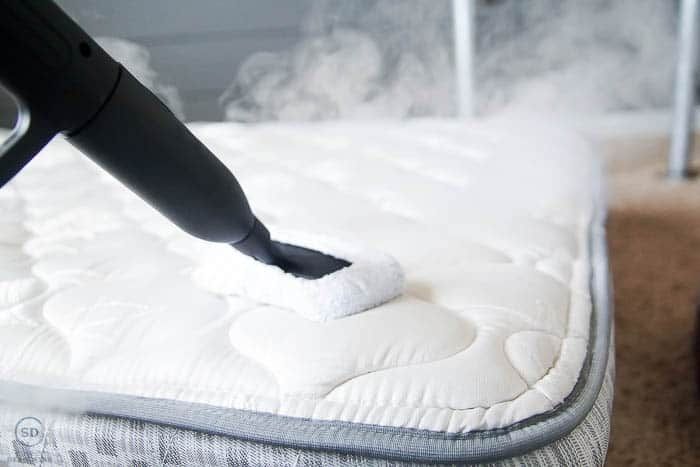
Steam cleaners and carpet extractors add exactly what you are trying to avoid. Tempur-Pedic says its foam should never become wet, and Avocado warns that a steam cleaner's heat can damage latex 47. Our guide on whether it is safe to steam clean a mattress covers the exceptions.
Drying is the step people skip
Drying is not the cleanup after the job. It is the part that decides whether you end up with a fresh mattress or a musty one.
The EPA advises drying water-damaged areas and items within 24 to 48 hours to prevent mold growth, and keeping indoor relative humidity below 60 percent, ideally between 30 and 50 percent 12. Aim for the same window here.
Practical steps that fit that guidance:
- Leave the mattress bare in a ventilated room and point a fan across the surface rather than straight down at one spot.
- Run a dehumidifier or air conditioning if the room is humid.
- Stand the mattress on edge only if the manufacturer allows it, since some constructions should not be bent or stored on their side.
- Skip heat guns, hair dryers on hot settings, space heaters, and open flame. Avocado allows a cool blow dryer on its latex, which is about as much heat as this job should involve 7.
- Check the underside, the seams, and the foundation, not just the treated patch.
- Press a clean dry towel hard against the area and look for transferred moisture before you call it dry.
If the mattress still feels cool or damp, if the underside is wet, or if the smell gets stronger as it dries, keep it out of service and ask the manufacturer or a restoration professional how to assess the interior. Covering a damp mattress with a waterproof protector traps the moisture where you cannot see it.
Match the method to the mattress
Construction matters mostly because it changes how much liquid the bed can tolerate and how much of it you can reach.
| Construction | What usually limits you |
|---|---|
| Memory foam and polyfoam | The core is not washable and holds liquid. Spot treat only, and expect the maker to say the foam must never get wet. |
| Latex | Often tolerates water better than memory foam, but not solvents or steam heat. Do not open the ticking to reach the core. |
| Innerspring and hybrid | Coils do not make a mattress washable. The quilting, foam, fiber padding, and insulators still soak up liquid and dry slowly. |
| Removable washable cover | Wash only the panel the instructions identify as removable, at the stated temperature, and reinstall it only when both cover and mattress are dry. |
| Non-removable or encased cover | Treat it as a spot-clean-only surface, and do not unzip it because the zipper exists. |
| Air, smart, and powered beds | Keep water to a minimum, unplug as the manual directs, and keep liquid away from pumps, hoses, sensors, and controls. |
Two extra cautions for powered beds and adjustable bases. Urine that runs off the side of the mattress can reach a control box, motor, or cable underneath, so check the base and the floor as well as the mattress. Do not restore power to a component that got wet until the manufacturer says it is safe.
Children, adults, and pets need different follow-up
Cleaning the mattress solves tonight. The reason it happened decides whether you are doing this again next week.
Children
Most children are dry during the day by about age 4 and dry at night by about age 5 or 6, so wetting before then is ordinary development 13. Patience works better than pressure, and our guide to bedwetting in children covers what actually helps.
Contact a health care professional if a child has pain or burning with urination, cloudy, dark, bloody, or foul-smelling urine, a weak stream or dribbling, has started wetting again after six months or more of dry nights, or is wetting two to three times a week for three months or more. Diabetes, constipation, bladder or kidney infection, structural problems in the urinary tract, nervous system conditions, and obstructive sleep apnea with snoring and mouth breathing can all be involved 13.
For the practical side, layer the bed. A waterproof protector, a fitted sheet, a second protector, and a second fitted sheet lets you strip one wet layer at 2 a.m. and get everyone back to sleep without a cleaning project.
Adults
New or worsening nighttime wetting in an adult is worth a medical conversation rather than a laundry routine. Talk to a health care professional about trouble urinating, loss of bladder control, waking to use the bathroom, pelvic pain, or leaking urine, and seek care promptly for blood in the urine, painful urination, or an inability to empty the bladder 14. Incontinence has many treatable causes, including diabetes, constipation, prostate conditions, pelvic floor changes after pregnancy or menopause, and nerve conditions 14.
If accidents are ongoing for any reason, a washable waterproof protector is a better answer than repeatedly wetting the mattress with cleaner.
Pets
For cats, start with the veterinarian rather than the mattress. House soiling is the most commonly reported feline behavior problem, and any condition that interferes with normal urination can cause it, including urinary tract inflammation, kidney disease, thyroid disease, and diabetes. A physical examination and lab work, including a urinalysis, come before behavior detective work 10.
Cornell also makes two points that change how you clean. Odors have to be neutralized rather than deodorized to escape a cat's sense of smell, and ammonia-based or vinegar-based products should be avoided because they smell like urine to a cat 10. Until the cause is sorted out, keeping the bedroom door closed is more effective than any cleaner.
When the mattress is not worth saving
Cleaning has real limits, and a mattress is a thick porous assembly you cannot open or inspect.
Replacement or a professional assessment is the sensible call when:
- the smell comes back after correct treatment and complete drying, which usually means residue is in a layer you cannot reach
- visible mold appears or a musty odor seems to come from inside. The EPA notes that absorbent or porous materials may have to be thrown away if they become moldy, because mold can grow into the spaces in the material and be difficult or impossible to remove completely 12
- the core was saturated and you cannot confirm it is dry
- liquid reached electrical components, and the maker cannot confirm the bed is safe to power on
- the ticking or an internal barrier is torn
- the manufacturer will not authorize any method that would actually work
A faded yellow mark with no smell is not on that list. Do not retire a sound mattress over cosmetics. When you do replace one, our guides on when to replace a mattress and how to throw away a mattress cover the timing and disposal.
Preventing the next one
A waterproof fitted protector is the single change that turns an accident from a cleaning project into a laundry load. Water-resistant is not the same as waterproof, so read the product description rather than the marketing headline, wash the protector according to its own label after any accident, and put it back on only when both it and the mattress are dry. Our guides on whether you need a mattress protector and cleaning a mattress protector cover the choices.
Beyond that, keep the bed stripped and ventilated for a while after any accident, keep cleaning products and soiled towels away from children and animals, and treat repeated accidents as a signal to talk to a clinician or veterinarian rather than a reason to buy stronger chemicals.
Bottom line
Blot first, check your mattress's own instructions second, and use the least liquid and the mildest permitted product that will lift the residue. Enzyme cleaners are the reasonable starting point, light repeated passes beat one soaking, and complete drying within a day or two is what prevents a mold problem from replacing an odor problem.
Keep bleach out of it entirely, skip ozone machines and fragrance sprays, and stop escalating when a mattress stops responding. If the odor survives correct cleaning and full drying, if mold appears, or if the accidents keep happening, the useful next step is a conversation with the manufacturer, a clinician, or a veterinarian rather than another round of chemicals.