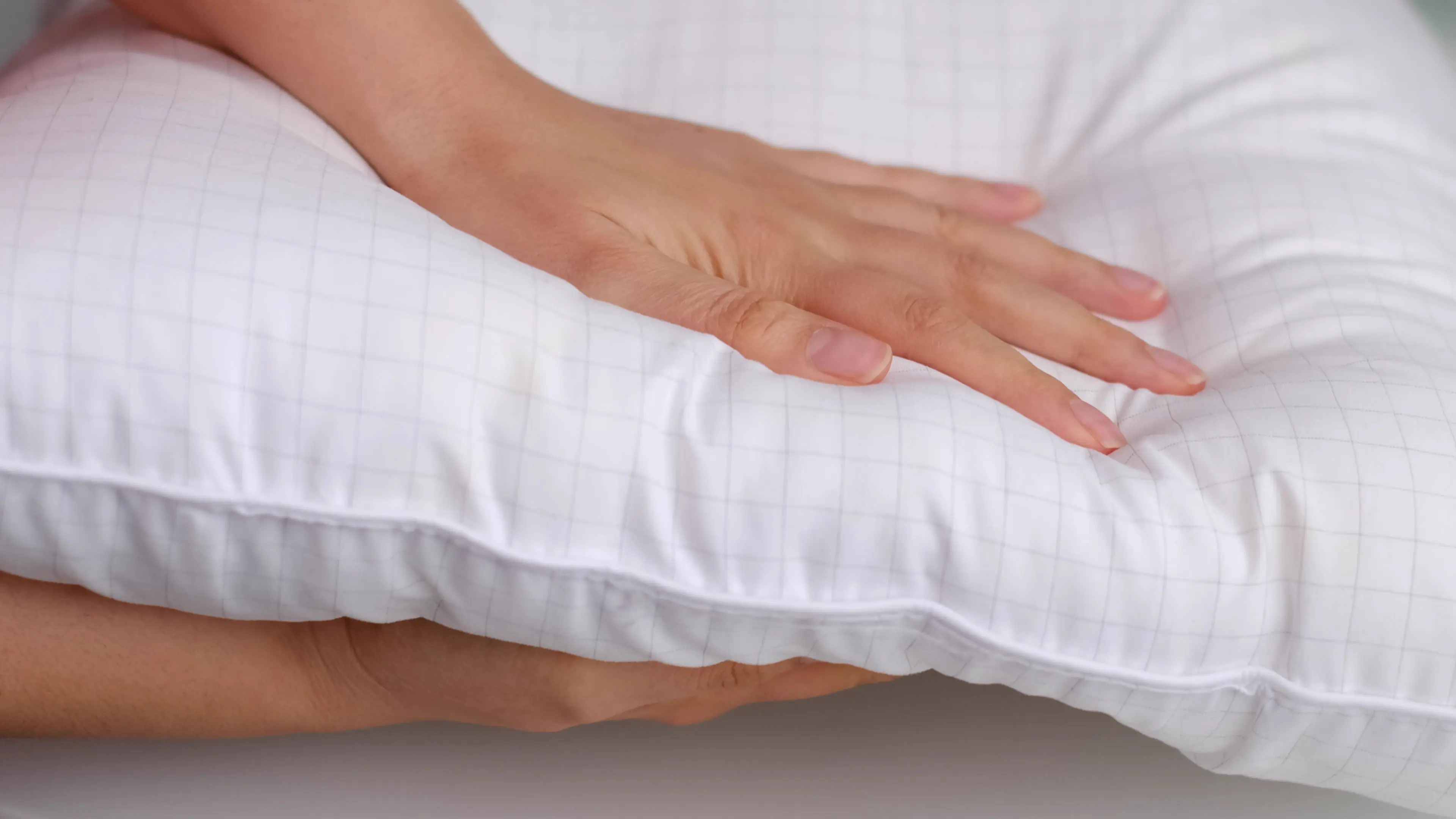


Pillow types are useful starting points, not ready-made answers. Fill determines how a pillow tends to compress, spring back, shift, hold air, and respond to cleaning. The final feel also depends on how much fill is used, whether it is a solid core or loose pieces, the shell and inner chambers, and how the pillow behaves under your head on your mattress.
No material is automatically best for a sleep position, pain condition, or body type. A useful comparison begins with the behavior you need, then checks whether the exact product delivers it.
The properties that change how a pillow feels
Product pages often collapse several different features into words such as “supportive,” “plush,” or “cooling.” Compare the underlying properties instead:
- Loft: The pillow's height before use. More useful is its working loft, or the height that remains after your head compresses the fill.
- Compressibility: How readily the pillow yields under weight. A tall, highly compressible pillow may work lower than a shorter, less compressible core.
- Resilience: How quickly the material returns after pressure is removed. Low-resilience material responds slowly; high-resilience material pushes back and recovers faster.
- Moldability: Whether you can bunch, fold, or redistribute the fill and have it stay where placed.
- Airflow and heat: Open space, holes, loose pieces, cover fabric, room conditions, and contact area can affect heat and moisture. “Breathable,” “gel,” or “cooling” does not by itself establish a lower overnight temperature.
- Noise and movement: Loose hulls or feathers can rustle, while shredded fills can shift. A solid core is usually quieter and more stable.
- Weight: Dense solid foam and hull fills can be harder to move than down or polyester fiber.
- Care: Some whole pillows are washable, some have only a washable cover, and some fills should not be soaked. The instructions for the exact model control.
Foam terminology can also be misleading. Density and firmness are different measurements, and a denser foam is not automatically firmer. Viscoelastic foam, commonly called memory foam, is deliberately low in resilience, which helps explain its slower recovery. 1
Common pillow fills compared
| Fill and construction | Compression and rebound | Moldability or adjustment | Main practical tradeoffs |
|---|---|---|---|
| Down clusters | Compresses readily; fluffs back with handling | Highly moldable | Light and quiet, but working loft depends heavily on fill amount and chambers |
| Feathers or down-feather blend | Usually resists compression more than down alone | Moldable | Quills add structure but may rustle or work toward the shell |
| Polyester or down alternative | Varies from loose clusters to batting | Often moldable; some models are adjustable | Light and widely available, but loose fibers can migrate or clump |
| Solid memory foam | Slow rebound with a stable core shape | Not moldable; sometimes contoured | Consistent geometry, but limited height adjustment and model-specific heat behavior |
| Shredded memory foam | Slow-rebound pieces can settle and shift | Often adjustable by removing fill | Easier to reshape than a solid core, but fill distribution may change overnight |
| Solid latex foam | Faster rebound and more pushback than memory foam | Not moldable; sometimes contoured | Stable and relatively heavy; composition and perforation vary |
| Shredded latex | Springy pieces move independently | Often adjustable and moldable | More movement and texture than a solid latex core |
| Cotton, wool, kapok, or other fiber | Depends on fiber, preparation, and blend | Usually moldable when loose | “Natural” does not predict allergens, temperature, care, or lifespan |
| Buckwheat hulls | Hulls move rather than compress like foam | Highly adjustable and shapeable | Heavy and audible; shell integrity and fill-specific care matter |
These are tendencies, not grades. Two pillows in the same row can feel different because their fill weights, particle sizes, chamber designs, shells, and dimensions differ.
Down and feather are not the same fill
Down consists mainly of soft clusters beneath a bird's outer feathers. It compresses easily and can be shaped by hand. Feathers have shafts and quills, so they usually add more structure, weight, and sound. Many pillows combine the two or use a feather-rich inner chamber with a softer down-rich outer chamber.
Read the actual percentages rather than relying on a name or a photograph of a goose. The Federal Trade Commission says that “pure down,” “all down,” and similar claims must be true, and a stated down or feather percentage must reflect the product's real composition within only limited manufacturing variation. A named species, such as goose, is also a composition claim, not proof that the pillow is cooler, softer, or better than a duck-fill product. 2
Fill power is another down-specific term. It is a laboratory measurement of the volume occupied by a prescribed weight of down and feathers under defined conditions. It is not the assembled pillow's firmness, working height, or fill weight. A high fill-power number cannot tell you how much down is inside the pillow or how the chambers will hold your head. 3
If animal-welfare sourcing matters to you, check the exact certification and product rather than accepting a general brand statement. The Responsible Down Standard addresses bird welfare and chain of custody for certified material, including prohibitions on live plucking and force-feeding. It does not certify comfort, cleanliness for a particular allergy, sleep quality, or pillow durability. 4
Polyester, down alternative, and other fiber fills
“Down alternative” describes an intended feel, not one material. The fill is often polyester formed into fine fibers, clusters, or sheets, but products can use blends or branded fibers. Loose clusters are usually more moldable; a continuous batting layer tends to hold a more uniform shape. Either can flatten or clump depending on construction and use.
Cotton, wool, kapok, and other plant or animal fibers also vary by processing and blend. Wool may be loose, felted, or mixed with polyester. Cotton can be loose or layered. Kapok is a light plant fiber, but a label may identify a blend rather than a pure fill. “Natural” alone does not establish lower emissions, cooler sleep, easier care, allergy safety, sustainability, or longer life.
In the United States, FTC guidance covers pillows among household textile products. Most covered textiles must identify generic fiber content, country of origin, and the manufacturer or responsible marketer. Different sections may need separate disclosure when that distinction prevents deception. Non-fibrous components such as foam are outside the fiber-percentage disclosure, so a textile tag may describe the cover without fully describing a foam core. Check both the label and the model specifications. 5
Solid and shredded memory foam
A solid memory-foam pillow is a molded or cut viscoelastic polyurethane core. It keeps a consistent outline and responds slowly after compression. The core may be flat, sculpted, perforated, or built from layers. Those differences can matter as much as the words “memory foam.”
Shredded memory foam breaks the material into pieces. The spaces between pieces and the ability to move or remove fill make the pillow more moldable than a solid block. Adjustment is not independent of feel: removing pieces lowers the working loft and also changes density, firmness, and how readily the remaining fill shifts.
Gel particles, perforations, mesh panels, and phase-change covers are separate design features. They may change initial touch, airflow, or heat movement in a particular construction, but “gel memory foam” does not guarantee a cool pillow throughout the night.
A CertiPUR-US claim has a defined but limited scope. The program tests participating flexible polyurethane foams for specified content, emissions, and durability criteria. It does not certify the entire pillow, latex foam, the cover, comfort, cooling, or a health outcome. Confirm that the seller and relevant foam are covered rather than extending the logo to every component. 6
Solid and shredded latex
Latex pillows can contain natural-rubber latex, synthetic latex, or a blend. They may use a solid molded core, a contoured core, or loose shredded pieces. Solid latex usually rebounds faster and pushes back more immediately than low-resilience memory foam. Shredded latex adds moldability but also allows the pieces to move.
“Latex,” “natural,” “Dunlop,” and “Talalay” do not provide a complete specification. Ask whether the material is natural, synthetic, or blended; whether the fill is solid or shredded; what the finished dimensions and working feel are; and how the core and cover should be cleaned.
Natural rubber can cause allergic reactions in people with latex allergy. A person with a known or suspected allergy should not rely on a “hypoallergenic” claim and should ask the manufacturer to identify natural-rubber components. An allergist can help assess uncertain reactions. Trouble breathing, widespread hives, swelling, dizziness, or a combination of symptoms after exposure needs immediate medical attention. 7
Buckwheat hulls and other niche fills
Buckwheat-hull pillows hold many dry hulls inside a tightly woven shell. The hulls slide around one another, so the sleeper can make a hollow or move fill to another area. This also makes the pillow heavier and noisier than most fiber or down pillows. Removing hulls can lower the working height, but the result still feels different from soft fiber or slow-response foam.
Water chambers, air bladders, microbeads, and mixed fills are other niche constructions. Compare them by the same properties rather than assuming the unusual material produces a health benefit. Check chamber leakage terms, replacement-fill availability, weight when filled, washing limits, and what happens if one component fails.
Pillow formats change how the fill is used
A format is not a material. The same fill can behave differently in these designs:
Adjustable pillows
“Adjustable” usually means the user can add or remove loose fill, change an air or water chamber, or rearrange removable layers. Check what can actually be changed. A zippered cover alone does not necessarily mean the core is washable or intended to be opened.
Contoured and cervical pillows
A contoured pillow has a shaped surface, often with raised edges, a central depression, or a neck roll. “Cervical” and “orthopedic” may describe the intended geometry, but the terms do not prove that the shape fits one person's neck or treats pain.
Clinical research does not establish one universally best pillow design. A 2021 review found only nine high-quality studies among 35 included articles. Some designs changed pain-related outcomes in selected adults, but the pooled evidence did not show improved sleep quality in people with chronic neck pain, and shape and height could matter separately from material. 8
Wedge pillows
A wedge is a sloped format intended to elevate part of the body or support sitting. Compare its length, width, slope, firmness, and whether it supports only the head or the upper torso. It is not interchangeable with an adjustable bed or a clinician-prescribed positioning plan. A wedge should not be sold or selected as a stand-alone treatment for pain, snoring, reflux, or sleep apnea.
Body pillows
A body pillow is long enough to support or separate more than one body region. Straight, curved, U-shaped, and C-shaped versions use different amounts of bed space and can restrict movement differently. They may provide a comfortable place for the arms or legs, but the format does not by itself treat back pain, pelvic pain, or a pregnancy complication.
Fit depends on your position, body, and mattress
The useful target is not a prescribed number of inches. It is a working height and feel that let your head and neck rest comfortably without a sustained sense of being pushed upward, dropped downward, or forced to rotate.
Sleep position changes the space the pillow must occupy. Side lying places the shoulder between the torso and mattress. Back lying changes the head-to-mattress distance and how a contour contacts the neck. Stomach lying turns the head and can make added height feel intrusive. Many people change positions, so a pillow that can tolerate more than one posture may be more useful than a rigid “best for” label.
Body proportions and mattress sink change the same calculation. Shoulder shape, head and neck dimensions, and habitual posture affect the gap. A shoulder that sinks farther into a softer comfort layer changes the needed working loft compared with the same body on a firmer surface. Reviews of pillow-height research identify posture and head-neck-shoulder dimensions among the relevant determinants, while also finding that existing measurement methods do not produce one universal selection rule. 9
Biomechanical research confirms that changing pillow height can change pressure and cervical angles, but that does not create a household prescription. One study evaluated a specific supine setup and warned that its model and loading assumptions limited generalization. It is evidence that height matters, not evidence that everyone needs the same height. 10
Allergens and “hypoallergenic” claims
Start with the person's known trigger, not a broad material category. Natural rubber proteins are relevant to latex allergy. A fragrance, dye, finish, adhesive, shell fabric, or detergent residue may be a different issue. Down allergy should not be assumed when dust mites or another environmental allergen has not been assessed.
Dust and biological particles can collect in bedding regardless of the fill. The Environmental Protection Agency recommends keeping bedding dry, washing compatible bedding, and using dust-proof pillow and mattress covers for people managing dust exposure. A washable encasement can therefore matter more than replacing one fill with another, provided it fits the person's allergy plan and the pillow's care instructions. 11
No fill is free from every possible allergen, irritant, moisture problem, or care failure. Check the complete product, including the shell, inner liner, adhesives, finishes, and any added fragrance.
A practical way to choose
- Name the current problem. Is the pillow losing height, pushing the head up, shifting, trapping moisture, making noise, feeling too heavy, or requiring care you cannot provide?
- Choose the behavior you want. Decide whether you prefer slow contouring, quick rebound, hand-moldability, stable geometry, or removable fill.
- Read the construction, not just the title. Check fill percentages, solid versus shredded construction, fill weight when disclosed, dimensions, chambers, cover material, removable components, and whether replacement fill is available.
- Verify what a certification covers. A fiber label, down-sourcing standard, foam certification, and organic-content standard answer different questions. None proves that the pillow fits you.
- Check care before buying. Confirm whether the whole pillow, cover, or neither is machine washable; how it must be dried; and whether opening the inner liner is permitted.
- Read the trial and return terms. Look for the actual return window, condition requirements, return shipping, fees, and whether opened bedding can be returned.
- Test it on your own bed. Use your usual mattress and positions. Allow loose fill to settle, then note whether the working loft and pressure remain comfortable rather than judging only the uncompressed showroom height.
Replace or stop using a pillow when the fill leaks, the core tears, moisture or odor persists after permitted cleaning and complete drying, or the pillow no longer returns to a usable shape. Use the pillow's condition and relevant manufacturer guidance rather than assuming one replacement calendar applies to every fill and construction.
A pillow is not a medical treatment
A different pillow may change comfort, but material properties do not identify the cause of persistent neck pain, headaches, arm numbness, or nighttime breathing symptoms. If symptoms persist or concern you, seek clinical evaluation rather than assuming the pillow is the cause or treatment.
Loud snoring, witnessed breathing pauses, gasping, and excessive daytime sleepiness can be signs of obstructive sleep apnea. A contour or wedge may change position or sound without showing that breathing events are controlled. These symptoms warrant medical assessment rather than a pillow marketed as an apnea treatment. 12
This guide is for adult bed pillows. Keep pillows and other soft bedding out of an infant's sleep area, and use a firm, flat, safety-approved infant sleep surface. 13
The most useful pillow category is the one that describes what is actually inside and how it behaves. Compare working loft and construction first, verify labels and care, and use a real return policy to test the result on the bed where it will be used.