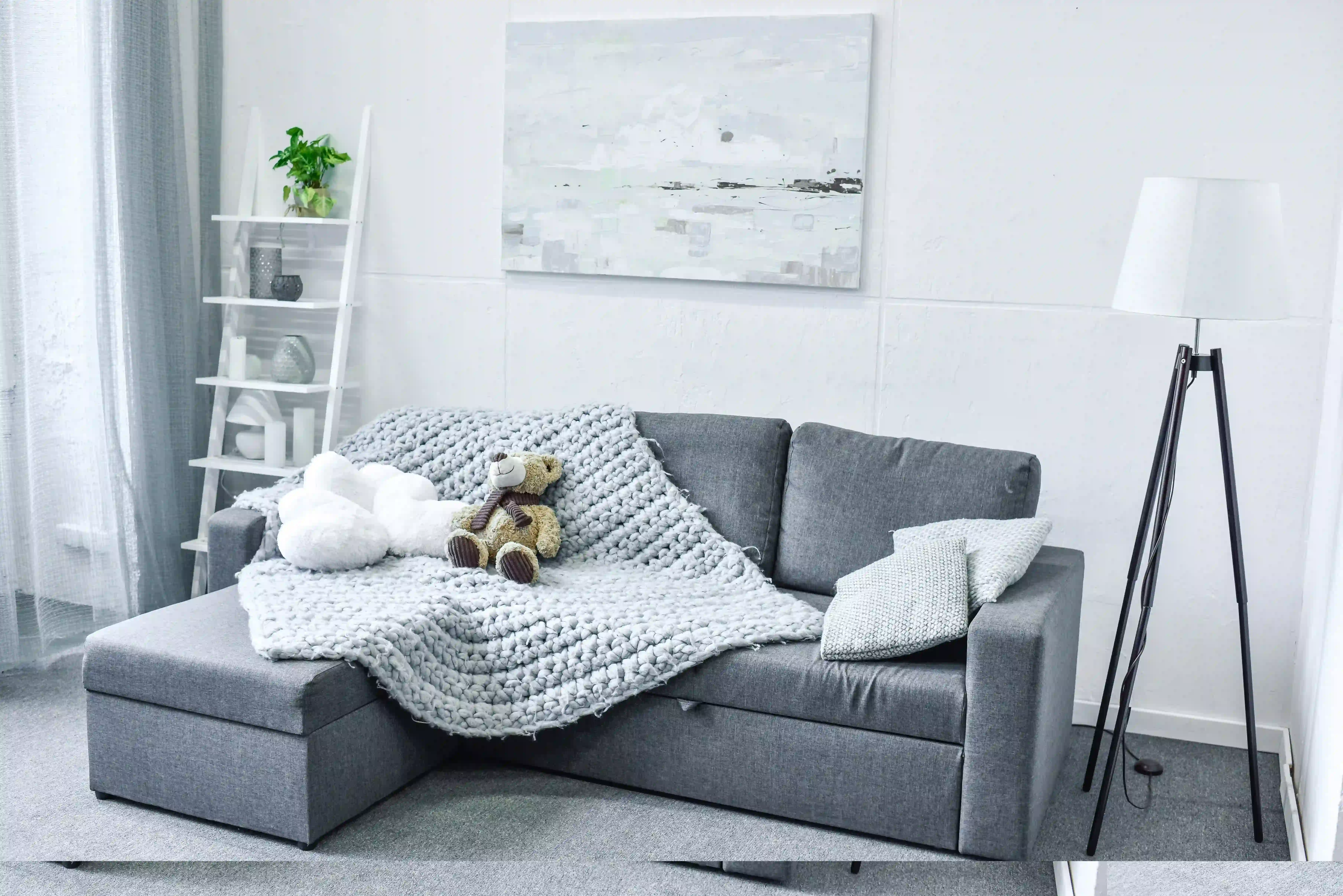
A sofa bed is worth considering when one room must provide both seating and a place to sleep. It is not automatically cheaper, smaller, less comfortable, or less durable than separate furniture. Those outcomes depend on the exact model, how often each mode will be used, and whether the product fits the room and its users.
Start with three sets of facts: the mechanism, the measurements in every position, and the manufacturer's instructions. Labels such as twin, full, queen, sleeper, futon, and daybed do not provide enough information on their own.
What counts as a sofa bed?
“Sofa bed” is a broad retail term for seating that creates a sleep surface. Products within that category can work in substantially different ways.
| Type | How it creates a sleep surface | Checks that matter most |
|---|---|---|
| Pull-out sleeper sofa | A folded deck and usually a separate mattress unfold from inside the sofa | Open depth, mattress dimensions and thickness, leg or deck support, conversion clearance, and replacement-mattress rules |
| Slide-out or lift-up sleeper | A lower platform slides out and rises, or joins the seat to form the bed | Floor clearance, casters, seams between sections, alignment, and whether the seat cushions remain in the sleep surface |
| Fold-flat or click-clack sofa | The back lowers and the seat and back become the sleep surface | Rear clearance, hinge positions, wall distance, and the comfort of the upholstery in both modes |
| Futon | A flexible mattress folds with a hinged frame from seating to sleeping | Approved mattress dimensions and flexibility, frame geometry, retainers, and safe hinge operation |
| Daybed with trundle or extension | A fixed daybed gains another platform or mattress beside or below it | Pulled-out width, mattress pairing, caster path, height difference, and whether the unit makes one larger bed or two separate beds |
| Chair sleeper | A single-width pull-out or fold-out bed is housed in a chair or compact loveseat | Open depth, narrow sleep width, arm width, sitting capacity, and the same mechanism-clearance checks as a larger sleeper |
A chair sleeper is not necessarily shorter when open just because it is narrow when closed. A daybed is not a sofa with a hidden folding mattress. A futon has a flexible mattress and frame relationship that a conventional pull-out sleeper may not share. Identify the mechanism before comparing dimensions, bedding, or maintenance.
Measure the room in both modes
A sofa can fit its wall and still fail as a bed. Record the exact model's:
- Closed footprint: overall width, depth, height, arm width, back height, feet, chaise, and storage access.
- Open footprint: full width and depth after conversion, including projecting legs, handles, casters, cushions, and the space needed to move the mechanism.
- Sleep surface: usable width, length, height, seams, gaps, and edge shape. Do not substitute the closed sofa width.
- Operating clearance: space behind, in front of, and beside the unit for the back, deck, drawer, trundle, or storage lid to move.
- Circulation: room to get into bed, reach an exit, open the room door, and use nearby furniture without stepping over the mechanism.
Mark the closed and open outlines on the floor with removable tape. Include the path of any coffee table or chair that must be moved at bedtime. Check windows, curtains, radiators, outlets, vents, lamps, and doors in both layouts.
Do not infer the bed size from a familiar label. As checked on July 25, 2026, Pottery Barn listed the “Twin” Pacifica sleeper with a 36 by 72-inch mattress and the “Full” version with a 52 by 72-inch mattress. The sofas opened to 88 inches deep 1. The exact product drawings and measurements control, even when standard bedding uses the same size word.
On that same date, current model listings also showed how the mechanism changes the footprint:
- The IKEA FRIHETEN sleeper sectional was listed at 90 1/2 inches wide and 59 1/2 inches deep, with a 55 1/8 by 80 3/8-inch sleep surface. Its underframe pulls out to meet the seat 2.
- The IKEA NYHAMN click-mechanism sofa was listed at 78 3/4 inches wide and 38 1/4 inches deep, with a 55 1/8 by 78 3/4-inch bed 3.
- The IKEA HEMNES daybed was listed at 41 3/8 inches wide when closed and 76 3/4 inches across the extended bed. It requires two specified twin mattresses, stacked in single-bed mode and placed side by side in double-bed mode 4.
These are dated examples of variation, not size standards or recommendations.
Measure the delivery route
Measure more than the final room. Record the clear width and height of the entry door, interior doors, hallways, stairways, landings, elevators, and tight turns. Include door hardware, railings, trim, low ceilings, and hanging fixtures. Compare those openings with the shipping package dimensions and the product's diagonal depth, not only its assembled width.
Pottery Barn's furniture-delivery guide similarly tells buyers to measure every doorway, staircase, elevator, and hallway and to compare entry openings with the furniture's width and diagonal depth 5. Ask the seller:
- how many packages arrive and the size and weight of each
- whether legs, arms, backs, or modules can be removed for delivery
- which parts may be removed without affecting the warranty
- whether delivery includes the room of choice, assembly, packaging removal, and stair carries
- what happens if the delivery team cannot reach the room
Package weight can change the plan. The current FRIHETEN listing separates the sectional into three packages, with the heaviest listed at just over 98 pounds 2. Do not assume a large sofa arrives as one piece or that one person can control each package.
Separate sitting capacity from sleeping capacity
Seat count, sofa width, mattress label, and load rating answer different questions. Verify:
- how many people the manufacturer says may sit on the product
- the sleep surface's measured width and length
- the stated sleeping and total load limits, if published
- whether the rating changes in sofa, bed, trundle, or storage mode
- whether a limit applies to each seat, each platform, or the whole unit
A seating test is not a sleeping-capacity statement. For example, the current NYHAMN page says its seating-furniture tests simulate use by people weighing up to 242 pounds, but the page does not present that number as a bed's total sleeping limit 3. Do not convert it into one.
If a seller does not publish a needed capacity, ask for written model-specific information. Avoid estimates based on frame material, number of legs, customer photos, or a similar-looking product.
Judge comfort in both positions
Sitting comfort does not predict sleeping comfort. A supportive sofa can have a sleep surface with noticeable hinges or seams, while a bed that feels acceptable overnight may have a seat depth or firmness that does not suit everyday sitting.
When possible, test the exact model:
- sit upright and reclined for the length of a normal visit
- lie in the positions the intended sleeper uses
- turn over and sit at the edge
- notice seams, bars, slopes, gaps, heat, noise, and usable length
- open and close the mechanism without a salesperson taking over
- check whether the intended user can reach, lift, pull, and control it
Comfort is individual. There is no sofa-bed material or mattress thickness that is best for everyone, and the category does not support a blanket rule against daily sleep. For regular use, place more weight on the exact model's intended use, sleep-surface comfort, support design, parts availability, warranty terms, and a return or in-home trial that allows a meaningful test.
Do not buy a sofa bed to treat back pain, correct posture, align the spine, or improve sleep quality. Those outcomes cannot be promised from the product category. A person with pain, limited strength, reduced balance, or mobility needs should assess both the sleep surface and the physical steps required to convert and access it.
Check the mattress, deck, and bedding as one system
Some sofa beds have a separate folding mattress. Others use the upholstered seat and back, or combine several cushions into one surface. Before adding or replacing anything, check:
- exact mattress or pad length, width, thickness, weight, and construction
- required folding direction and number of folds
- deck, slat, grid, bar, or platform design
- mattress-retention straps, covers, fasteners, and fire labels
- topper, protector, and bedding limits when the unit is closed
- replacement part numbers and whether substitutions affect coverage
A conventional mattress may be too thick or unable to fold through the required geometry. A thinner mattress is not automatically safe or compatible either. Do not cut foam, remove fire or identity labels, add a board, alter slats, bypass retainers, or force the mechanism around an unapproved mattress.
Choose sheets from the measured sleep surface and mattress depth. A familiar fitted sheet may be loose, tight, or too long when the product uses nonstandard dimensions. Unless the instructions explicitly allow bedding to remain, remove pillows, blankets, and toppers before closing. Fabric caught in a hinge or latch can obstruct the mechanism and damage the bedding or product.
Plan assembly, moving, and floor protection
Read the assembly instructions before ordering. Confirm the number of people required, tools, workspace, orientation, hardware, and whether professional assembly is mandatory or included. Assemble the product in the intended room when the completed unit will not fit back through the doorway.
Before moving an assembled sofa bed:
- remove bedding and any detachable parts the instructions permit
- close and secure the mechanism as directed
- empty storage compartments
- use enough capable helpers or professional movers for the listed weight
- lift from approved structural points rather than pulling on arms, upholstery, a storage lid, or a moving deck
- protect walls, door frames, and floors without placing loose material under a moving caster or leg
Do not drag the unit or raise it on improvised blocks. Use floor pads, cups, or caster protection only when they remain stable and do not interfere with a pull-out, trundle, support leg, or exact product instructions. Recheck level, hardware, movement, and alignment after relocation.
Operate the mechanism safely
Folding hardware creates pinch and crush zones. A 2006 CPSC recall covered about 100,000 specific IKEA LYCKSELE chair beds and sofa beds because fingers could enter the folding mechanism. One fingertip amputation had been reported 6. The recall does not apply to every sofa bed, but it demonstrates why the exact model and safe operating method matter.
Before each conversion:
- clear people, children, pets, toys, cords, bedding, and loose objects from the moving area
- use the designated handle or grip and the body position shown in the instructions
- keep hands, feet, hair, and clothing away from hinges, latches, legs, springs, rails, casters, and storage lids
- control the unit through the entire movement
- make sure supports, legs, locks, and latches are fully engaged before use
Do not let children operate or play in, under, behind, or inside the unit or its storage compartment. Do not let a pet hide beneath a pull-out deck. Do not sit, stand, jump, or sleep on a partly opened mechanism, unsupported foot section, backrest, arm, or storage lid unless the instructions identify that surface and position for use.
Follow any model-specific anti-tip or attachment requirement. Keep drawers closed when they are not being accessed, and do not improvise anchoring or restraint hardware. If the unit shifts, tips, lifts, or becomes unstable during normal operation, stop using it and contact the manufacturer.
Record the brand, model or article number, serial number, and date code from the product label. Check the CPSC recall database before buying used and periodically during ownership 7. If a recall applies, follow its stop-use and remedy instructions. Do not donate or sell an unrepaired recalled product.
Maintain the upholstery and mechanism
Use the cleaning code and care instructions for the exact upholstery. Removable-looking covers are not always washable. Vacuum crevices and accessible surfaces as instructed, blot spills promptly when permitted, and let every layer dry before folding the bed.
Periodically inspect accessible parts without dismantling the mechanism. Look for:
- loose or missing fasteners
- bent, cracked, detached, or uneven supports
- damaged slats, decking, webbing, casters, legs, hinges, or latches
- torn fabric or bedding entering a moving joint
- a mattress that no longer fits or folds correctly
- new scraping, grinding, squealing, binding, or uneven movement
Noise does not have one universal cause. Tighten or lubricate only the parts and at the intervals the manufacturer specifies. Household oil, spray lubricant, or an overtightened fastener can damage upholstery, attract debris, or change how a mechanism moves.
Stop using the bed mode if the frame, deck, support, lock, or mattress is damaged or if operation changes. Ask the manufacturer or an authorized service provider for the correct part and repair procedure. There is no defensible category-wide lifespan. Use, construction, moving, maintenance, parts, and repairability all differ.
Read return and warranty terms before delivery
A brief showroom test may not reveal whether the sofa works for long sitting, overnight sleep, or the effort of daily conversion. Read the actual return policy before ordering, especially for custom upholstery, made-to-order configurations, clearance items, and large-item pickup.
Confirm in writing:
- when the return period starts and whether opened, assembled, or slept-on furniture qualifies
- whether custom fabric, special orders, delivery, assembly, or pickup fees are refundable
- who must disassemble, repackage, and transport a return
- how delivery damage or missing parts must be documented and reported
- whether comfort is a valid return reason
Policies differ and can change. As checked July 25, 2026, IKEA's U.S. policy stated 365 days for unopened products and 180 days for open products with proof of purchase, while excluding merchandise that was dirty, stained, damaged, incomplete, or altered 8. That example is not a promise about another seller or a future purchase.
Read the warranty separately. The FTC advises buyers to check the coverage period, excluded parts or repairs, remedy, maintenance conditions, claims process, labor, and return-shipping responsibility, and to save the warranty and receipt 9. For a sofa bed, ask whether the frame, upholstery, cushions, sleeper mechanism, mattress, motor, and labor have different terms. A long “frame warranty” may not cover the moving part that concerns you.
A practical buying checklist
Before committing to one model:
- Identify the mechanism and obtain its current product page, dimensions, assembly and operating instructions, care guide, warranty, and return policy.
- Measure the closed footprint, open footprint, sleep surface, operating clearance, room circulation, and complete delivery route.
- Verify separate sitting, sleeping, and total load limits without filling gaps with estimates.
- Test sitting, sleeping, edge access, and conversion effort with the intended users in mind.
- Confirm mattress, deck, protector, topper, sheets, and bedding compatibility.
- Price delivery, assembly, floor protection, bedding, future parts, service, and return transport.
- Record the model identity, check recalls, and keep the instructions, warranty, receipt, and product labels.
A sofa bed is a good fit when the exact model works as both pieces of furniture, fits the room and delivery path, can be operated safely, and has acceptable service and return terms. The product name alone cannot answer those questions.