
A standard U.S. queen mattress is generally 60 inches wide by about 80 inches long. A common use of Olympic queen is a 66-by-80-inch mattress, which adds 6 inches of width without adding length. The name is not reliable enough to order from, however. An RV manufacturer may use “Olympic queen” for a different length.
The Better Sleep Council lists a queen as 60 by approximately 80 inches 1. A current Brooklyn Bedding product guide lists its Olympic queen options as 66 by 80 inches 2. In contrast, Holiday Rambler's 2026 Incline specification labels a 66-by-75-inch bed as an Olympic queen 3.
These are not minor labeling details. A 75-inch mattress and an 80-inch mattress do not fit the same enclosed platform or fitted sheet. Treat the product's written width, length, height, shape, and tolerance as the specification. Treat “Olympic queen” as a search term.
Queen and Olympic queen dimensions compared
| Label as shown by the source | Width | Length | What it establishes |
|---|---|---|---|
| Standard U.S. queen | 60 in | About 80 in | The conventional queen starting point |
| Olympic queen in a current mattress catalog | 66 in | 80 in | A common current use of the specialty name |
| Olympic queen in a current RV specification | 66 in | 75 in | The same name can describe a shorter bed |
If the Olympic queen you are considering is truly 66 by 80 inches, it is 6 inches wider than a nominal queen and the same length. Dividing the width equally gives two people 33 inches each instead of 30 inches each. That arithmetic describes surface width, not sleep quality. It does not guarantee that two people will find the mattress comfortable or disturb one another less.
A 66-by-80 version also does not add legroom. A person who wants more length gains nothing over an 80-inch queen. A product labeled Olympic queen may even be shorter, as the RV example shows.
Measure the bed, not the label
Start with the physical space the mattress must occupy. If you are replacing a mattress, remove the bedding and measure the existing mattress across the widest and longest points. Then measure the support platform separately.
Record:
- the clear inside width and length if the mattress sits within rails or a raised lip;
- the usable platform width and length if it sits on top;
- mattress height, including any sewn pillow top;
- rounded corners, radius corners, cutouts, hinges, or notches;
- walls, cabinets, headboards, footboards, and hardware that reduce usable space; and
- whether an RV slide, Murphy mechanism, storage lid, or nearby door must move past the mattress.
Do not derive mattress size from the outside of a frame. Upholstery, rails, trim, and posts can make the outer footprint much larger than the opening that holds the mattress.
A handmade or custom mattress may also have a stated dimensional tolerance. For example, Mattress Insider's current policy says its handmade mattresses may vary by up to 1.5 inches in width or length from the ordered size and that this allowed variation is not a defect 4. That is one seller's rule, not an industry-wide allowance. Ask the seller for the tolerance that applies to the exact product, especially when the mattress must fit between rigid walls or rails.
Plan the room around the complete bed
There is no universal minimum room size for either mattress. A room with a wide doorway and little furniture presents a different fit problem from a room with a narrow aisle, wardrobe doors, or an inward-swinging bedroom door.
Mark the finished bed footprint, not just the mattress, on the floor with painter's tape. Include any frame, headboard, footboard, side rails, adjustable-base legs, or upholstery that extends beyond the mattress.
Check whether you can:
- open the bedroom and closet doors fully;
- pull out drawers without hitting the bed;
- reach outlets, vents, controls, and under-bed storage;
- use both sides of the bed as intended;
- move through the room with the clearance your household needs; and
- operate an RV slide, lift platform, or Murphy mechanism through its full range.
A 66-inch mattress takes 6 more inches of floor width than a 60-inch queen. If the bed remains centered, that usually consumes about 3 inches of clearance on each side. You can position it differently, so measure the actual layout instead of relying on that centered example.
Check the delivery and return route
Ask whether the mattress arrives compressed in a box, folded, rolled, or at full size. Get the packaged dimensions when the route is tight.
Measure the narrowest doors, hallways, stair turns, elevator opening, ceiling pinch points, and RV entry. Include the base or foundation, which may be harder to bend than the mattress. Also plan how the item would leave if it needs to be returned. A bed that reaches the room in compressed form may not follow the same route once expanded.
A queen frame does not automatically fit an Olympic queen
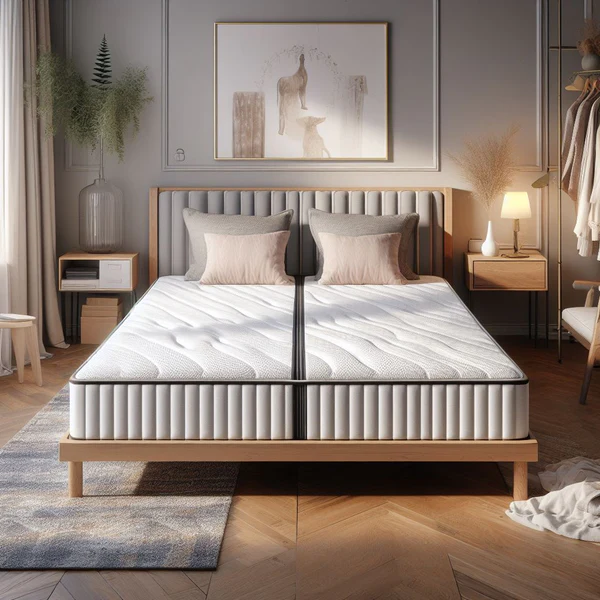
A support system must match the mattress footprint and the mattress maker's structural rules. A frame designed around a 60-inch queen will not necessarily support a 66-inch mattress. Centering a wider mattress on a narrower base can leave roughly 3 inches unsupported on each side.
Before ordering, confirm:
- the support surface's finished width and length;
- whether the mattress sits on top or within an opening;
- required center rails and center legs;
- maximum permitted spacing between slats;
- the base's total weight rating;
- whether a foundation or bunkie board is required; and
- whether the mattress is approved for the chosen adjustable base.
These rules are product-specific. Brooklyn Bedding, for example, currently requires its mattresses to sit on a solid, supportive base and permits a platform with slats no more than 5 inches apart 5. Another mattress warranty may specify a different arrangement. Follow the warranty for the mattress you actually buy.
An adjustable base needs the correct dimensions as well as a compatible mattress construction. “Queen” on the base and “Olympic queen” on the mattress do not establish compatibility. Obtain written confirmation for the exact combination, including whether retainer bars, brackets, synchronized controls, or a separate foundation are needed.
Fitted sheets and protectors need an exact match
A standard queen fitted sheet is designed around a mattress about 60 inches wide, so it should not be assumed to fit correctly over a 66-inch mattress. A king fitted sheet is designed for a wider mattress and may leave loose fabric. Deep pockets solve a height problem, not a width or length mismatch.
For a fitted sheet, protector, encasement, pad, or topper, match all three measurements:
- mattress width;
- mattress length; and
- mattress depth.
A product labeled 66-by-80 Olympic queen may still have a depth limit that is too shallow for a tall pillow-top mattress. A 66-by-75 RV bed needs a different fitted length from a 66-by-80 bed even if both use the same Olympic queen name.
Flat sheets, blankets, quilts, and comforters are more forgiving because they do not wrap tightly around all four corners. Compare their finished dimensions with the mattress and choose the side and foot drop you prefer. A king flat sheet or comforter may provide acceptable coverage, but the size label alone cannot predict the overhang on your particular bed.
Check fitted bedding before buying the mattress. If only custom bedding fits, include its price, lead time, return terms, and replacement availability in the decision.
Availability is model-specific
A brand that makes one Olympic queen does not necessarily offer the size across its range. Brooklyn Bedding's current guide, for example, lists 66-by-80 Olympic queen availability for some models while other models stop at standard sizes or offer different RV dimensions 2.
Search by exact dimensions as well as the name. Useful searches may include “66 x 80 mattress,” “66 x 75 mattress,” “expanded queen,” or the RV model and floorplan. Confirm that the search result leads to the exact size selector on the product page before comparing construction or firmness.
Compare the cost of the complete system:
- mattress;
- compatible frame, foundation, or adjustable base;
- fitted sheets and spare sets;
- protector or encasement;
- topper, if one is planned;
- delivery, setup, and old-mattress removal; and
- any custom-size, return, or restocking charges.
Prices and stock are seller- and model-specific, so a fixed queen-versus-Olympic price range would be misleading. Compare the current total for the exact products you can actually buy.
Split beds and later replacements need extra checking
Do not assume a “split Olympic queen” consists of two standard twin, twin XL, or split-queen pieces. Ask for the exact width and length of each half and whether the listed price includes both pieces.
Confirm whether the system uses:
- one mattress or two;
- one base, two independent bases, or a synchronized pair;
- one fitted sheet, two fitted sheets, or a specialty split-top sheet;
- a connector, retainer, or gap cover; and
- replaceable controls, legs, brackets, and other proprietary parts.
Also ask whether one half can be replaced separately later. A replacement with a different height, edge profile, or bending behavior may not align with the surviving half.
Specialty-size ownership continues after the first purchase. Consider how you would replace the mattress, protector, sheets, foundation, or adjustable-base parts if the original model is discontinued.
Read the trial and return terms before checkout
A prominent sleep-trial headline may not apply to a custom dimension, special order, clearance item, accessory, foundation, or adjustable base. Read the terms for each item in the planned system.
Mattress Insider's current policy illustrates why this step matters: return eligibility varies by product, custom orders have exclusions, an order with incorrect customer-supplied specifications is not eligible for return or exchange, and fees or return shipping can apply 4. Other sellers set their own terms.
Verify in writing:
- whether the exact size is treated as stocked, specialty, or custom;
- when production begins and when cancellation becomes restricted;
- the trial start date and any required minimum use period;
- whether exchanges and refunds follow different rules;
- who pays return transport, pickup, donation, or disposal costs;
- any restocking or processing fee;
- whether opened sheets, protectors, bases, and accessories are returnable; and
- whether a measurement error is covered.
Save the product page, order confirmation, dimensions, shape drawing, and written compatibility answers. Product names and policies can change after the order.
Which one should you choose?
A queen is the simpler choice when 60 by about 80 inches provides enough usable surface and the standard-size mattresses, frames, and fitted bedding you have compared meet your needs.
A 66-by-80 Olympic queen can make sense when the extra 6 inches of width is valuable, the 80-inch length is sufficient, and you have already found a compatible mattress, support system, and bedding. It is not a substitute for a longer mattress.
A mattress with a different Olympic queen measurement, such as 66 by 75 inches, should be treated as its own specialty size. It may be the right replacement for a matching RV platform, but it should not be ordered for a 66-by-80 bed based on the shared name.
If you are still comparing the full range of common sizes, the mattress size and dimensions guide covers twin through California king. This page's narrower purpose is deciding whether the extra width and compatibility work of an Olympic queen are worthwhile for your exact setup.
Final ordering checklist
Before paying, confirm:
- exact finished mattress width, length, height, shape, and permitted tolerance;
- the same measurements for every split piece;
- support dimensions, center support, slat spacing, weight rating, and warranty rules;
- fitted-sheet, protector, and topper dimensions and pocket depth;
- finished frame footprint and operating clearances in the room or RV;
- packaged dimensions and the complete delivery and return route;
- delivery form, setup needs, production lead time, and old-bed removal;
- trial, cancellation, exchange, refund, and return-shipping terms; and
- availability of replacement bedding, foundations, and proprietary parts.
If any answer is given only as “queen” or “Olympic queen,” ask for the measurements. The numbers on the order are what must fit.