


A sore throat that is tolerable during the day often peaks at bedtime. The plan for tonight is short: take a suitable pain reliever early enough for it to work, keep the throat moist and swallowing comfortable, clear your nose so you are not breathing through your mouth for eight hours, prop your head and upper body up, and know the small list of symptoms that mean you should be assessed tonight rather than in the morning.
Most sore throats are caused by viruses. Acute sore throat, including pharyngitis and tonsillitis, is self-limiting, and most people get better within about a week whether the cause is a virus or bacteria 1. In a Cochrane review of antibiotic trials, 82% of people who received placebo or no treatment were free of throat symptoms by one week 2. That does not make tonight more comfortable, but it does mean the realistic goal is relief and sensible monitoring rather than a cure.
Why a sore throat feels worse at night

Several ordinary things line up against you after lights out.
Saliva production drops. Salivary output reaches its lowest circadian level during sleep, and mouth breathing makes oral dryness worse 3. A dry throat hurts more each time you swallow, and you swallow all night whether you notice it or not.
A blocked nose forces mouth breathing. Congestion from a cold, sinus inflammation, or allergies pushes air through an open mouth for hours, and mucus draining down the back of the throat keeps the tissue irritated.
Pain relief taken at dinner has often worn off by 2 a.m., and there is nothing left to distract you from the discomfort.
Some of this is mechanism rather than trial evidence. Still, it points at the four things you can actually change tonight: dryness, nasal blockage, the timing of pain relief, and position.
Pain relief, done safely
Getting the pain down is the single most useful thing you can do before bed, and it is where most of the avoidable mistakes happen.
NICE guidance on acute sore throat suggests paracetamol (sold as acetaminophen in the United States) for pain or fever, or ibuprofen if that is preferred and suitable for you 1. Follow the label rather than any dose you read online, and ask a pharmacist or your clinician which option fits you if you are pregnant or breastfeeding, or have asthma, stomach ulcers, or kidney, liver, or heart disease, or take other medicines.
Taking it 30 to 45 minutes before you plan to be asleep is a reasonable practical habit rather than a tested interval, and it gives the medicine time to work before you are lying in the dark.
Do not stack products that share an ingredient. Acetaminophen is in hundreds of prescription and over-the-counter medicines, including nighttime cold and flu combinations. The FDA advises not using more than one acetaminophen-containing product at a time, because accidental double dosing is easy, and the total for adults and children aged 12 and over should not exceed 4,000 mg in 24 hours 4. Taking too much can cause liver failure 4.
Do not give aspirin to children or teenagers. NHS advice is not to give aspirin to anyone aged 15 or under, because it can rarely cause Reye's syndrome 5. Reye syndrome is a rare condition affecting the liver and brain that develops after a viral infection, aspirin raises the risk, and clinicians now recommend other pain relievers for young patients 6.
For young children, keep it simple. Over-the-counter cough and cold medicines are not recommended below age 6 and can cause serious side effects, but acetaminophen or ibuprofen can be used for fever with the correct dose confirmed by a clinician 7.
One thing to avoid: using a sedating nighttime cold product or a drink to knock yourself out. Products such as NyQuil often combine a sedating antihistamine with acetaminophen, which makes accidental double dosing more likely, and alcohol fragments sleep later in the night. Treat the pain and the dryness instead.
What to do in the hour before bed
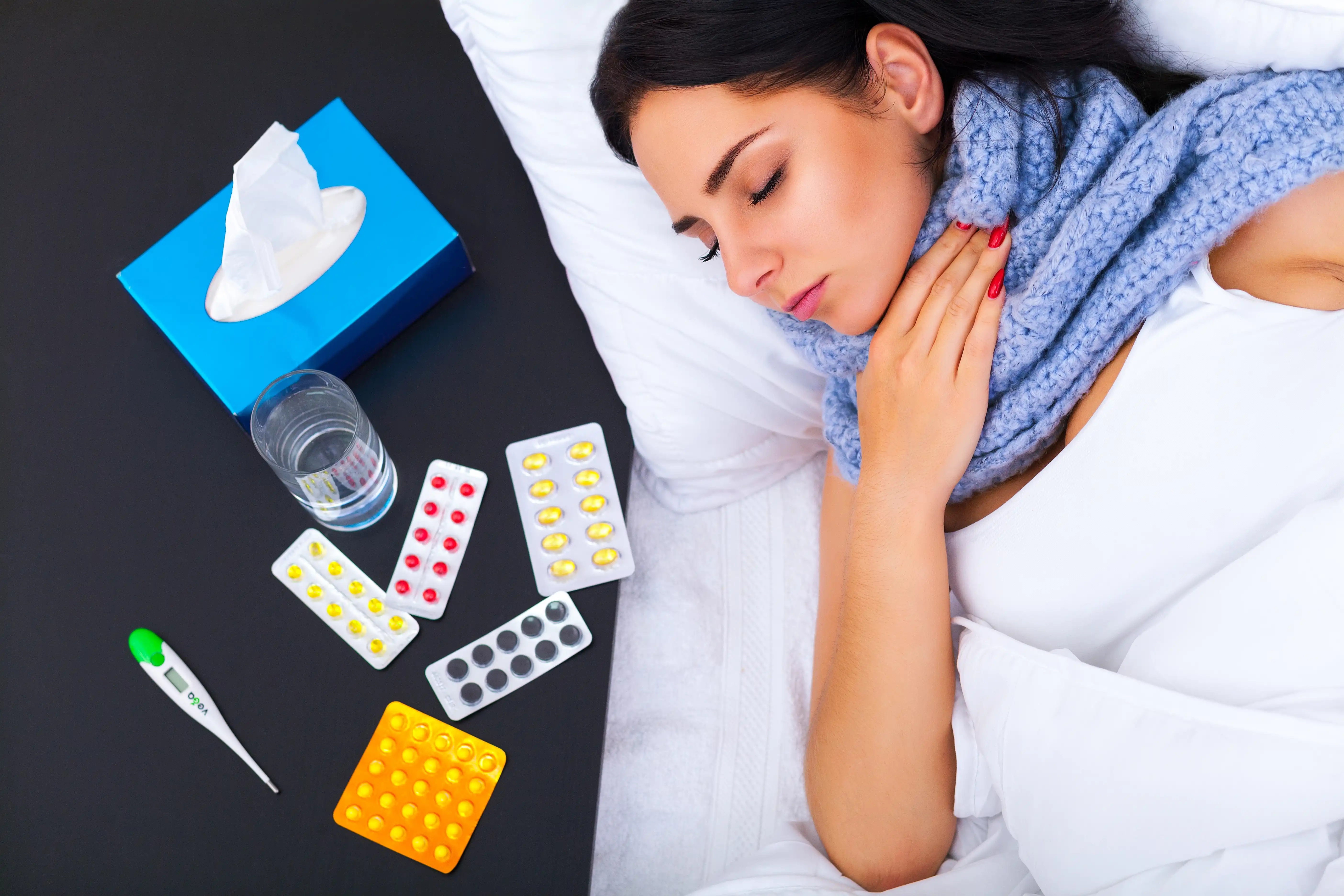
Drink enough, and eat what goes down easily
Guidelines advise an adequate intake of fluids during an acute sore throat 1. Temperature is your preference, not a medical decision. MedlinePlus lists warm liquids such as lemon tea with honey and cold ones such as ice water, along with fruit-flavored ice pops 8. The NHS suggests cool or soft foods 9. Keep a glass of water within reach so a dry mouth at 3 a.m. does not turn into a trip to the kitchen. If you or your child cannot keep fluids down, that moves into medical territory rather than home care 7.
Honey, with one absolute limit
The CDC advises using honey to relieve cough for adults and children at least 1 year old, and states that babies younger than 1 year should not be given honey 7. That age limit is not a preference. Honey can contain bacteria that infants cannot yet handle, which can cause paralysis 10. Never give honey to a baby under 12 months, in a drink, on a spoon, or in any home remedy.
Be clear about what the evidence covers. A 2018 Cochrane review of six trials in 899 children aged 12 months to 18 years found that honey probably reduces cough frequency more than no treatment or placebo, with moderate-certainty evidence, and had effects similar to dextromethorphan 10. Most children were treated for only one night, and the review was about cough rather than throat pain 10. A spoonful of honey, or honey in warm water, is a cheap and reasonable comfort measure. It is not a treatment for the infection.
Lozenges, with an age boundary
NICE notes that some adults may wish to try medicated lozenges containing a local anesthetic, a non-steroidal anti-inflammatory, or an antiseptic, while being clear that these may reduce pain only by a small amount 1. The same guidance found no evidence for non-medicated lozenges, mouthwashes, or local anesthetic mouth spray used on its own 1. So a lozenge is worth trying if it makes the evening easier, and it is not worth expecting much from.
Two safety points. Do not give lozenges to children younger than 4 years old 7. Hard candies and lozenges are a choking risk for young children 8, and the NHS advises against giving young children anything small and hard to suck for the same reason 9. Do not fall asleep with one in your mouth.
Gargling salt water
For adults, dissolve half a teaspoon of salt in a glass of warm water, gargle, then spit it out without swallowing 9. MedlinePlus gives the same recipe as roughly 3 grams of salt in 1 cup, or 240 milliliters, of water, several times a day 8. The NHS specifically says children should not try this 9.
NICE found no trial evidence for mouthwashes in acute sore throat 1, so treat a salt water gargle as a low-cost comfort measure that many people like rather than something shown to shorten the illness.
Steam and a warm shower
This one is weaker than its reputation. A 2017 Cochrane review of heated, humidified air for the common cold found the evidence insufficient to show benefit or harm, rated it low certainty because of bias and inconsistency, and noted that European trials tended to show a positive effect while North American trials showed none 11. The CDC still lists breathing in steam from a shower or a bowl of hot water among ways to feel better 7.
A warm shower before bed is fine if it makes you more comfortable. Leaning over a bowl of boiling water is a genuine scald risk, particularly with children in the house, and the evidence does not justify taking that risk.
Set the room up before you get in
A humidifier is the one piece of equipment worth bothering with. The CDC advises using a clean humidifier or cool mist vaporizer 7, and MedlinePlus notes that a cool-mist vaporizer or humidifier can moisten the air and soothe a dry, painful throat 8.
The word doing the work there is "clean." EPA guidance for portable humidifiers is to empty the tank, wipe all surfaces dry, and refill daily, clean the unit every third day to remove scale, use low-mineral water such as distilled water, and keep indoor relative humidity below 50%, because higher levels encourage mold and dust mites 12. Standing water in a neglected humidifier can grow bacteria and mold, and breathing that mist has been implicated in lung inflammation 12. A dirty humidifier is worse than none.
Beyond that, the usual bedroom basics still apply. Keep the room cool enough to be comfortable, keep tissues and water at the bedside, and if fever is making you sweat, moisture-wicking bedding will save you a change of sheets at 4 a.m.
Position and elevation
No trial tells you the best sleeping position for a sore throat, so treat this section as comfort guidance rather than proven treatment.
Raising the upper body is the adjustment with the clearest rationale, because it is standard advice for the reflux and congestion that often travel with a sore throat. For nighttime reflux, NIDDK suggests elevating your head during sleep by placing a foam wedge or extra pillows under your head and upper back to raise your head 6 to 8 inches off the bed 13.
The detail that matters: raise the torso, not just the head. Stacking pillows under the head alone bends the neck forward, which is uncomfortable and can narrow the airway. A wedge, or pillows arranged under the shoulders and upper back, works better.
Beyond elevation, side and back sleeping are both reasonable if your upper body is propped up. Choose whichever lets you breathe through your nose and swallow without effort. If you wake with your mouth open and your throat drier than when you went to bed, the nose is the thing to fix, not the position.
If the real problem is a blocked nose
Mouth breathing all night undoes most of the other measures. The CDC lists saline nasal spray or drops among the things that help during a cold, and a rubber suction bulb for clearing mucus in young children 7. Saline is low risk and can be used before bed.
Medicated decongestant sprays are labeled for short-term use only, so follow the packaging. Our guides to a blocked nose at night and reducing mouth breathing during sleep go into more detail than belongs here.
Is it strep? What that changes for tonight
Almost nothing about tonight, and quite a lot about tomorrow.
Only around 1 in 10 adults and 3 in 10 children with a sore throat have strep throat 14. IDSA puts group A streptococcus at up to 15% of adults and 30% of children with pharyngitis 15. Strep throat is most common in children aged 5 through 15 and rare in children younger than 3 14.
Features that point toward a virus rather than strep include cough, runny nose, hoarseness, and conjunctivitis 14. People with strep pharyngitis typically do not have cough, runny nose, hoarseness, mouth ulcers, or pink eye 16.
Features that raise the possibility of strep include a sore throat that started very suddenly, fever, pain on swallowing, red and swollen tonsils, white patches or streaks of pus on the tonsils, tiny red spots on the roof of the mouth, and swollen lymph nodes at the front of the neck 14.
What you cannot do is settle it with a flashlight and a mirror. When clear viral features are absent, clinical examination cannot separate viral from strep pharyngitis, so a rapid antigen test or a throat culture is needed 16. In 2025, IDSA suggested that clinicians use a clinical scoring system to decide who should be tested, mainly to identify people with a low probability of strep in whom testing is unlikely to help. That is a conditional recommendation based on very low certainty evidence, and it does not apply to children under 3 years old 15. Testing is still worth considering despite a low score for people who have had household exposure to strep, a previous diagnosis of rheumatic fever, or signs of a complicated infection 15.
Be realistic about what antibiotics deliver. The NHS notes that you do not normally need them for a sore throat, because they usually will not relieve symptoms or speed up recovery 9, and NICE puts the average benefit at roughly 16 hours less illness 1. The Cochrane review found antibiotics reduce throat soreness at day three, with fewer than six people needing treatment for one extra person to be better at that point, while by one week most people had recovered either way. Antibiotics also reduced quinsy and acute rheumatic fever, though both were uncommon 2. When a test confirms strep, antibiotics are recommended at any age, and penicillin or amoxicillin is first choice 16. Antibiotics do nothing for viral pharyngitis 16.
Two practical follow-ons. Taking an appropriate antibiotic for 12 hours or more limits how easily you pass strep on, and people can return to work, school, or daycare once they have no fever and have taken at least 12 to 24 hours of treatment 16. And do not start leftover antibiotics from a previous illness. That skips the test that decides whether they are needed at all.
When the pain is too severe to sleep at all
If the pain stops you swallowing fluids or you cannot sleep despite appropriate pain relief, the answer is an assessment rather than more medicine.
Clinicians sometimes add a single dose of a corticosteroid for severe sore throat. A 2020 Cochrane review of nine trials in 1,319 people, 369 of them children, found that corticosteroids made complete resolution of pain at 24 hours about 2.4 times more likely and at 48 hours about 1.5 times more likely, both high-certainty findings, with roughly five people needing treatment for one extra person to be pain-free at 24 hours. Pain relief also began around six hours sooner, though that estimate carried more uncertainty 17. In eight of the nine trials, everyone was also receiving antibiotics, so this is an add-on effect rather than a standalone treatment 17.
The reviewers described the overall benefit as limited, noted that harm reporting was poor and that evidence in children was sparse, and excluded people with glandular fever, peritonsillar abscess, and those admitted to hospital 17. It is a conversation to have with a clinician, not something to arrange yourself.
Get help now, or in the morning
Emergency care now. Call emergency services or go to an emergency department if you or your child has any of the following 9:
- difficulty breathing, or an inability to swallow
- drooling, which can be a sign of not being able to swallow
- a high-pitched sound while breathing, called stridor
- severe symptoms that are getting worse quickly
One more pattern belongs on that list. Severe throat pain concentrated on one side, with a muffled voice, difficulty or pain on opening the mouth, neck stiffness, or ear pain on the same side, can indicate a peritonsillar abscess, also called quinsy, which can obstruct the airway and needs immediate assessment 18. NICE advises hospital referral for an acute sore throat associated with a severe systemic infection or a suppurative complication such as quinsy 1.
Same-day advice. Contact a clinician or urgent care service today for 97:
- a very high temperature, or feeling hot, cold, or shivery
- signs of dehydration such as urinating less than usual, or dark, strong-smelling urine
- a weakened immune system, for example from diabetes or chemotherapy
- trouble breathing or fast breathing
- a chronic condition that is getting worse
- symptoms that improve and then return or get worse
Within a few days. Book an appointment if 97:
- the sore throat has not improved after a week
- a fever has lasted more than four days, or symptoms more than 10 days without improving
- your child is under 5 years old and needs help for a sore throat
- you get sore throats often
- there is a lump in the mouth or neck, or a mouth or throat ulcer lasting more than three weeks
NICE adds one more trigger that is easy to talk yourself out of: seek help if symptoms worsen rapidly or significantly, or you become systemically very unwell 1.
Two specific patterns are worth naming. A sore throat with a rash can be scarlet fever, which is caused by the same bacteria as strep throat 14. And a severe sore throat lasting well beyond a week in a teenager or young adult, with fever, swollen neck glands, and marked tiredness, can be infectious mononucleosis, where treatment is supportive, antivirals are of little benefit, and fatigue can linger for two to three months 19.
If your throat is only sore when you wake up
A throat that hurts on waking and eases through the morning is usually a different problem from an infection, and the fixes are different too.
Dry air and mouth breathing. Salivary flow is at its lowest during sleep, and mouth breathing makes the dryness worse 3. Our guides to waking up with a dry throat and dry mouth at night cover this in full.
Reflux. NIDDK lists difficulty or pain on swallowing and chronic cough or hoarseness among the symptoms of gastroesophageal reflux disease 20, and recommends elevating the head and upper back 6 to 8 inches for symptom relief 13. See GERD and sleep for the fuller picture.
Allergies and nasal blockage. Persistent congestion keeps the mouth open all night. Start with allergens that affect sleep and a blocked nose at night.
Snoring and possible sleep apnea. Dry mouth is listed among the symptoms of sleep apnea, and the more specific pointers are frequent loud snoring, breathing that starts and stops, gasping for air, and daytime sleepiness 21. If those apply to you, mention them when you next see a clinician rather than treating the throat alone.
Frequently asked questions
What is the best sleeping position for a sore throat?
There is no trial that answers this, so pick comfort over rules. Raising your head and upper body helps if congestion or reflux is part of the problem, and NIDDK suggests 6 to 8 inches of elevation using a wedge or pillows under the head and upper back for reflux 13. Raise the whole torso rather than stacking pillows under your head, and then use whichever of side or back sleeping lets you breathe through your nose.
Can I give my child honey for a sore throat at night?
Honey can be used to relieve cough in children aged at least 1 year, but babies younger than 1 year should never be given it 7, because honey can contain bacteria that infants cannot handle and that can cause paralysis 10. For children over 1, the evidence supports a modest effect on cough rather than a treatment for throat pain 10.
Does gargling with salt water really help?
It may feel better, but do not expect it to shorten the illness. NICE found no trial evidence for mouthwashes in acute sore throat 1, while the NHS still lists a warm salt water gargle as a self-care option for adults and says children should not try it 9.
How long should I wait before seeing someone?
A week is the usual benchmark. Most acute sore throats settle within about that time, and NICE advises seeking help if symptoms have not started to improve after one week, worsen rapidly or significantly, or you become very unwell 1. Sooner is right for dehydration, a fever lasting more than four days, symptoms that improve and then get worse, or any breathing difficulty 79.
Can I take something to sleep through it?
Treat the pain and the dryness instead of reaching for sedation. Nighttime cold and flu combinations often pair a sedating antihistamine with acetaminophen, which raises the risk of accidentally exceeding the acetaminophen limit if you are also taking a separate pain reliever 4, and these products are not recommended for children under 6 7. Alcohol is not a sleep aid during an illness. If the pain is severe enough that nothing lets you sleep, speak to a clinician instead of adding more medicine. A single dose of a corticosteroid is one option they can weigh alongside other treatment 17.